
When it comes to fastening solutions in mechanical, automotive, construction, and industrial applications, flange nuts play a crucial role. They are widely used because they combine the functions of a nut and a washer into a single component, improving load distribution and resistance to loosening. However, selecting the correct flange nut requires a clear understanding of flange nut size charts, standards, materials, and applications.
This comprehensive guide explains everything you need to know about flange nut size charts, including dimensions, standards, how to read charts, and tips for choosing the right flange nut for your project.
What Is a Flange Nut?
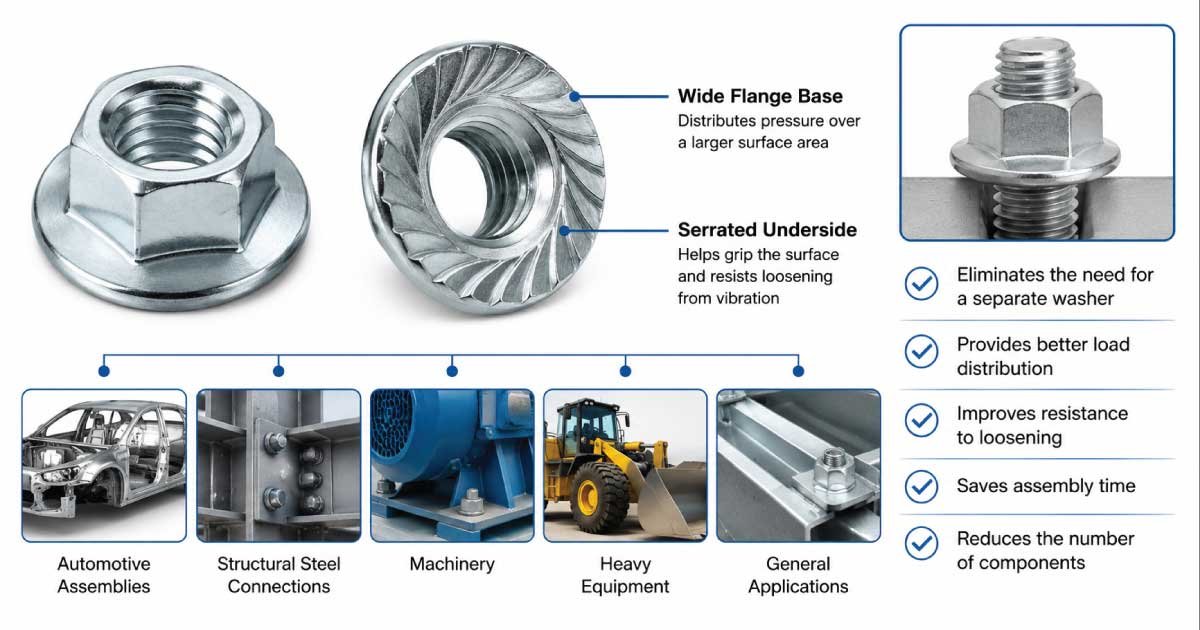
A flange nut is a type of nut that has a wide circular base (the flange) at one end. This flange acts like a built-in washer, distributing pressure evenly over a larger surface area. Some flange nuts are serrated on the underside of the flange, which helps resist loosening caused by vibration.
Key Advantages of Flange Nuts
- Eliminates the need for a separate washer
- Provides better load distribution
- Improves resistance to loosening
- Saves assembly time
- Reduces the number of components
Because of these advantages, flange nuts are commonly used in automotive assemblies, structural steel connections, machinery, and heavy equipment.
Why Flange Nut Size Charts Matter
Flange nut size charts are essential engineering references that help ensure correct selection, compatibility, and safety in fastening systems. They provide precise dimensional data that reduces errors during assembly and supports reliable performance in both industrial applications and everyday mechanical work operations.
- Incorrect sizing can cause thread damage
- Poor fit may lead to loosening or failure
- Improper load distribution can weaken joints
- Safety and performance may be compromised
Size charts help engineers, technicians, and DIY users select the correct flange nut based on thread size, pitch, flange diameter, nut thickness, and wrench size.
Common Flange Nut Standards
Metric Flange Nut Size Chart (DIN 6923)
Below is a commonly used metric flange nut size chart based on DIN 6923. It provides standardized dimensions for different thread sizes used in engineering and manufacturing applications. These values help ensure correct fitment, compatibility, and reliable fastening performance in metric mechanical assemblies.
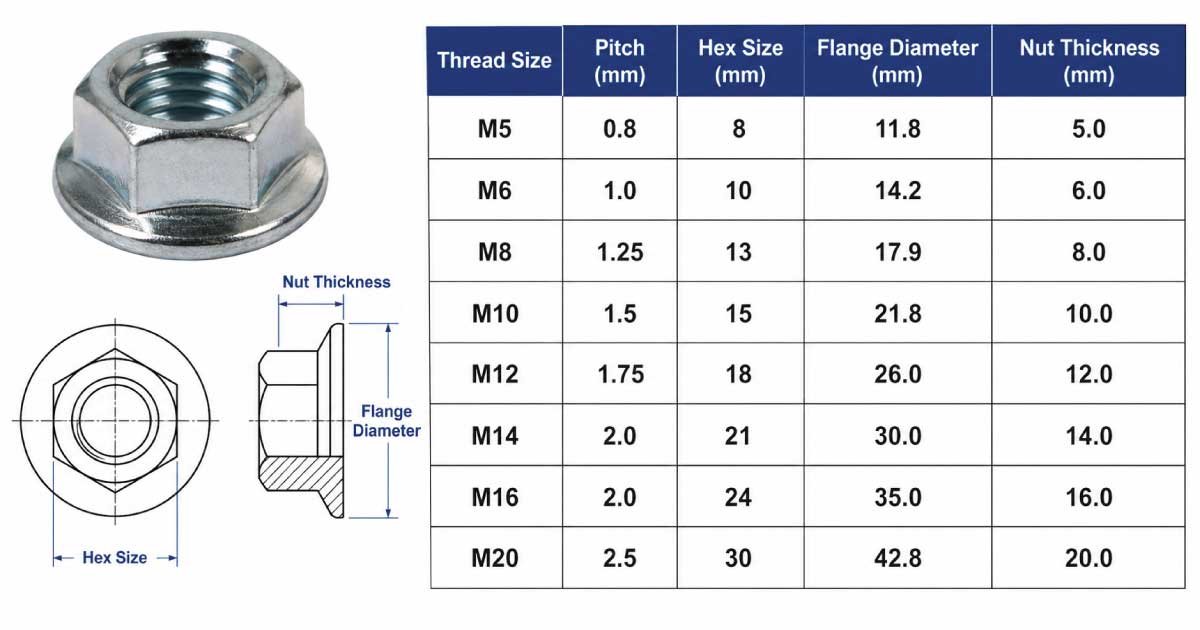
| Thread Size | Pitch (mm) | Hex Size (mm) | Flange Diameter (mm) | Nut Thickness (mm) |
|---|---|---|---|---|
| M5 | 0.8 | 8 | 11.8 | 5.0 |
| M6 | 1.0 | 10 | 14.2 | 6.0 |
| M8 | 1.25 | 13 | 17.9 | 8.0 |
| M10 | 1.5 | 15 | 21.8 | 10.0 |
| M12 | 1.75 | 18 | 26.0 | 12.0 |
| M14 | 2.0 | 21 | 30.0 | 14.0 |
| M16 | 2.0 | 24 | 35.0 | 16.0 |
| M20 | 2.5 | 30 | 42.8 | 20.0 |
How to Read This Chart
- Thread Size (M): Nominal diameter of the bolt
- Pitch: Distance between threads
- Hex Size: Wrench or spanner size
- Flange Diameter: Width of the flange
- Nut Thickness: Height of the nut
Inch (Imperial) Flange Nut Size Chart
This inch (imperial) flange nut size chart provides a quick reference for engineers and technicians working with US customary fasteners. It lists common thread sizes along with key dimensional parameters such as TPI, hex size, flange diameter, and nut thickness for accurate selection and compatibility.
| Thread Size | Threads per Inch (TPI) | Hex Size (in) | Flange Diameter (in) | Nut Thickness (in) |
|---|---|---|---|---|
| 1/4″-20 | 20 | 7/16 | 0.68 | 0.23 |
| 5/16″-18 | 18 | 1/2 | 0.80 | 0.28 |
| 3/8″-16 | 16 | 9/16 | 0.95 | 0.34 |
| 7/16″-14 | 14 | 5/8 | 1.10 | 0.39 |
| 1/2″-13 | 13 | 3/4 | 1.30 | 0.45 |
| 5/8″-11 | 11 | 15/16 | 1.65 | 0.56 |
Imperial flange nuts are commonly used in U.S.-based automotive and construction applications.
Serrated vs. Non-Serrated Flange Nuts
Flange nuts are manufactured in two main surface designs at the flange base, and each type serves different mechanical and material requirements. The choice between serrated and non-serrated versions depends on vibration levels, surface sensitivity, and whether maximum grip or surface protection is needed in the application.
Serrated Flange Nuts
Serrated flange nuts feature small ridges on the underside of the flange that enhance friction and prevent loosening under dynamic loads. They are especially effective in high-vibration environments where maintaining clamp force is critical over time.
- Have ridges on the underside of the flange
- Bite into the mating surface
- Excellent for vibration resistance
- Common in automotive and machinery applications
Non-Serrated Flange Nuts
Non-serrated flange nuts have a smooth bearing surface that avoids marking or damaging softer materials. They are preferred where surface finish protection is important or where additional washers are used to manage load distribution.
- Smooth flange surface
- Suitable for softer materials or coated surfaces
- Often used with hardened washers if needed
When selecting a size, ensure the flange diameter does not damage the mating surface.
Materials Used in Flange Nuts
Material selection is a critical factor in flange nut performance, often as important as size selection. Different materials provide varying levels of strength, corrosion resistance, and suitability for specific environments, making them essential for long-term reliability and safety.
Common Materials
- Carbon Steel – General-purpose use
- Alloy Steel – High strength and load capacity
- Stainless Steel (A2 / A4) – Corrosion resistance
- Brass – Electrical and decorative applications
Strength Grades
- Metric: Class 8, 10, 10.9, 12
- Imperial: Grade 5, Grade 8
Always match the flange nut strength with the bolt grade to avoid joint failure.
How to Choose the Right Flange Nut Size
Selecting the correct flange nut size is essential for ensuring secure fastening, proper load distribution, and long-term reliability in mechanical assemblies. A wrong choice can lead to loosening, thread damage, or structural failure, so each factor must be carefully evaluated before installation in practical applications.
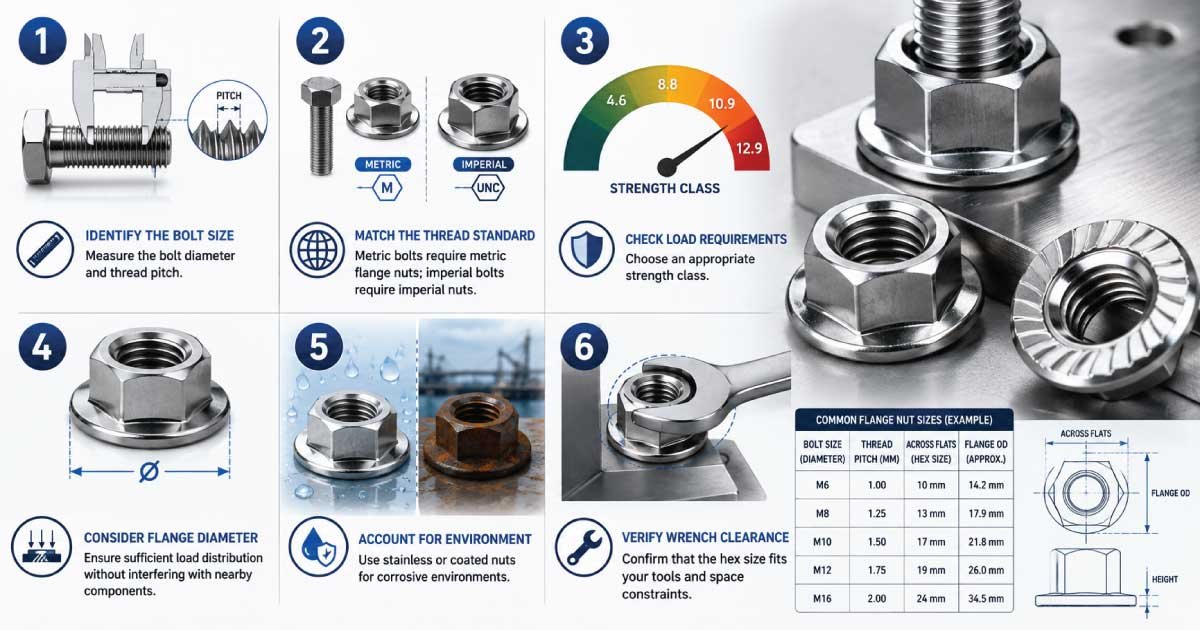
Identify the Bolt Size
Correct bolt identification is the first and most important step in selecting a flange nut. Measuring the bolt diameter and thread pitch ensures compatibility between components, preventing mismatched threads, poor engagement, or potential failure during tightening and long-term operational use in mechanical assemblies.
Measure the bolt diameter and thread pitch.
Match the Thread Standard
Thread standards must always align between the bolt and flange nut to ensure proper fit and structural integrity. Using incompatible systems can cause cross-threading or weak fastening, so it is essential to follow either metric or imperial specifications consistently throughout the assembly process.
Metric bolts require metric flange nuts; imperial bolts require imperial nuts.
Check Load Requirements
Understanding load conditions helps in selecting a flange nut with adequate strength for the application. Different strength classes are designed to withstand varying stress levels, and choosing the correct rating ensures safety, durability, and reliable performance under operational forces and vibration.
Choose an appropriate strength class.
Consider Flange Diameter
The flange diameter plays a key role in distributing load evenly across the surface. A properly sized flange prevents material damage and improves joint stability, especially in high-stress applications where uneven pressure could lead to loosening or deformation of connected components.
Ensure sufficient load distribution without interfering with nearby components.
Account for Environment
Environmental conditions significantly affect the performance and lifespan of flange nuts. Exposure to moisture, chemicals, or salt can cause corrosion, so selecting suitable materials or protective coatings is essential for maintaining strength, reliability, and long-term service performance in harsh environments.
Use stainless or coated nuts for corrosive environments.
Verify Wrench Clearance
Ensuring proper tool access is essential for efficient installation and maintenance. Adequate wrench clearance prevents slipping, over-tightening, or damage to surrounding parts, allowing safe and accurate torque application even in confined or complex assembly spaces.
Confirm that the hex size fits your tools and space constraints.
Flange Nut vs. Regular Nut with Washer
Flange nuts and regular hex nuts with washers serve similar fastening purposes, but they differ in design efficiency and performance characteristics. Flange nuts integrate a built-in washer-like surface that simplifies assembly and improves load distribution, making them more suitable for high-speed production and vibration-heavy applications.
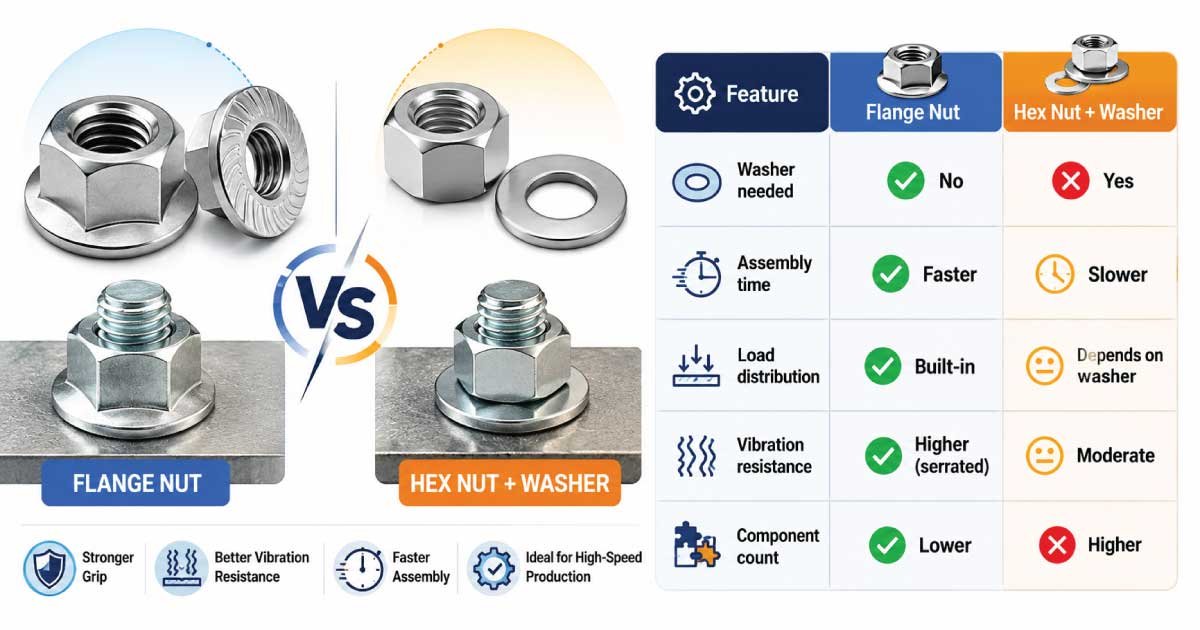
| Feature | Flange Nut | Hex Nut + Washer |
|---|---|---|
| Washer needed | No | Yes |
| Assembly time | Faster | Slower |
| Load distribution | Built-in | Depends on washer |
| Vibration resistance | Higher (serrated) | Moderate |
| Component count | Lower | Higher |
Flange nuts are often preferred in mass production and high-vibration environments.
Final Thoughts
A flange nut size chart is an essential reference for anyone working with fasteners. Understanding thread sizes, flange diameters, nut thickness, and standards ensures safe, reliable, and efficient fastening. Whether you are designing machinery, assembling automotive components, or performing maintenance work, selecting the correct flange nut size can significantly improve joint performance and longevity.
By using the charts and guidelines in this complete guide, you can confidently choose the right flange nut for your application, reduce assembly errors, and enhance overall system reliability.
👉 Looking for the right eye bolt size? This Eye Bolt Size Chart covers standard dimensions, types, load capacities, materials, applications, and selection tips to help you choose the correct eye bolt for safe lifting and secure fastening. Read the full guide to explore detailed charts, practical examples, and expert recommendations.

Engineer Hassan is a Mechanical Engineer with 16+ years of hands-on experience in mechanical hardware, fasteners, and workshop tools. He focuses on size selection, thread identification, and measurement, helping users choose the correct components with accuracy and safety.