
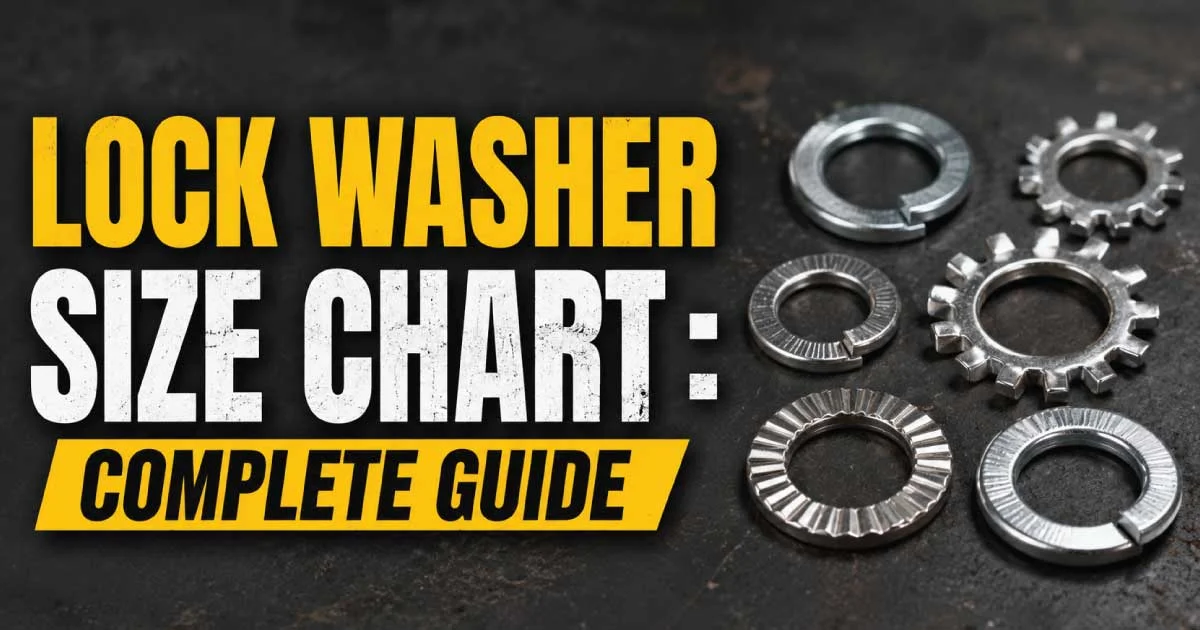
Lock washers may be small components, but they play a critical role in the reliability and safety of mechanical assemblies. Whether you are working in automotive repair, industrial manufacturing, construction, or DIY projects, selecting the correct lock washer size is essential to ensure fasteners remain secure under vibration, load, and thermal expansion. This complete guide explains what lock washers are, how they work, the different types available, and most importantly how to read and use a lock washer size chart correctly.
What Is a Lock Washer?
A lock washer is a specially designed type of washer used to prevent nuts and bolts from loosening gradually over time due to vibration or movement. Unlike flat washers, which mainly spread load, lock washers add resistance through spring tension, serrations, or deformation that grips fasteners securely.
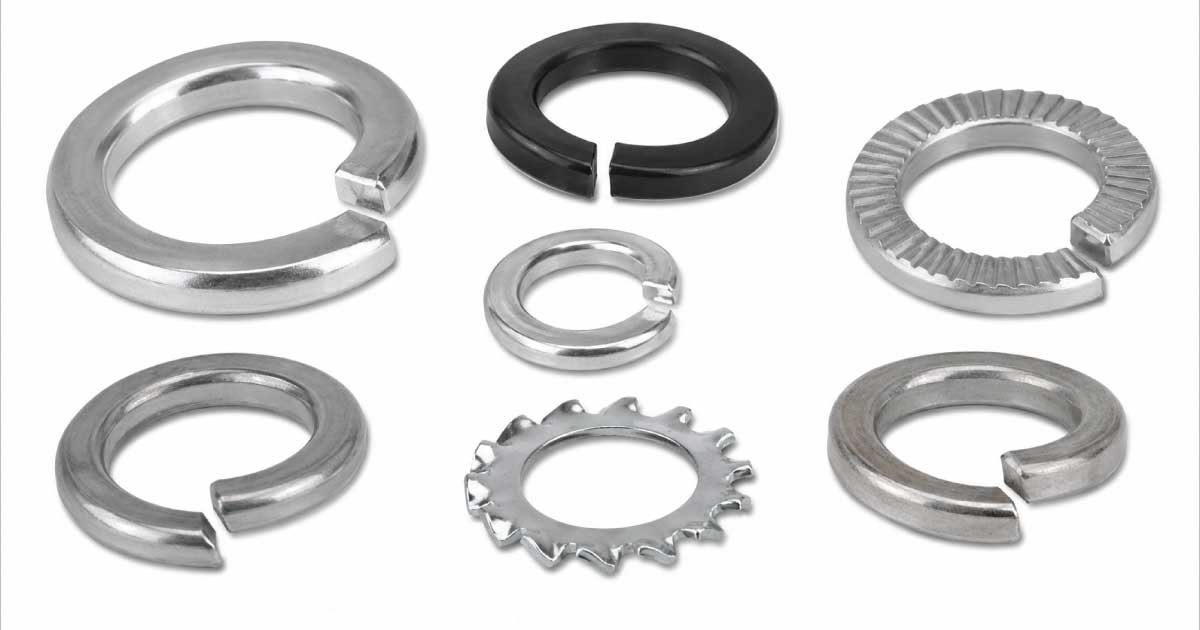
Lock washers are commonly used in environments exposed to vibration, dynamic loads, or frequent temperature changes conditions where standard fasteners are more likely to loosen.
Why Lock Washer Size Matters
Choosing the correct lock washer size is essential for ensuring fastener reliability and long-term performance. The right size helps maintain proper tension, prevents loosening under stress, and protects surfaces from damage. Incorrect sizing can reduce effectiveness and lead to premature failure, especially in vibration-prone or high-load applications.
Choosing the correct lock washer size is just as important as choosing the right bolt or nut. An incorrectly sized washer can lead to:
- Reduced locking effectiveness
- Uneven load distribution
- Damage to the mating surface
- Premature fastener failure
A washer that is too large may not provide sufficient tension, while one that is too small may deform improperly or fail to seat correctly. Lock washer size charts exist to eliminate guesswork and help match washers precisely to fastener sizes.
Metric Lock Washer Size Chart (Typical Values)
Below is a general reference chart for metric split lock washers, showing typical inner diameter, outer diameter, and thickness values for common bolt sizes. These measurements may vary slightly depending on manufacturing standards and application requirements. Always verify exact dimensions with manufacturer specifications before using in critical engineering or safety applications.
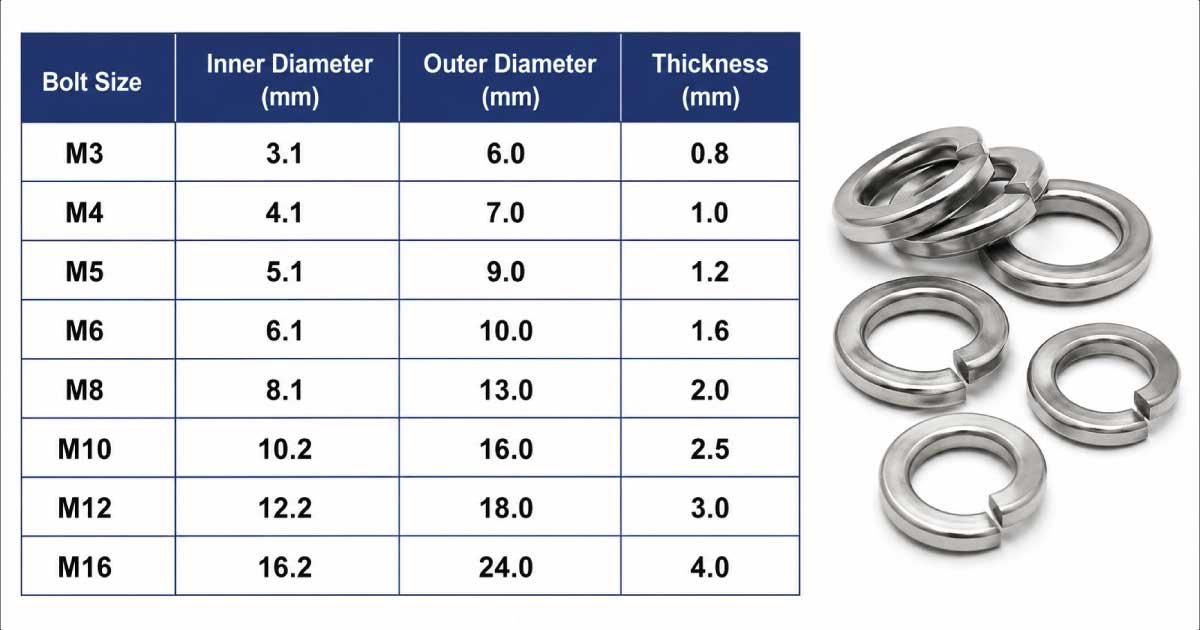
Below is a general reference for metric split lock washers. Always verify with manufacturer specifications for critical applications.
| Bolt Size | Inner Diameter (mm) | Outer Diameter (mm) | Thickness (mm) |
|---|---|---|---|
| M3 | 3.1 | 6.0 | 0.8 |
| M4 | 4.1 | 7.0 | 1.0 |
| M5 | 5.1 | 9.0 | 1.2 |
| M6 | 6.1 | 10.0 | 1.6 |
| M8 | 8.1 | 13.0 | 2.0 |
| M10 | 10.2 | 16.0 | 2.5 |
| M12 | 12.2 | 18.0 | 3.0 |
| M16 | 16.2 | 24.0 | 4.0 |
These sizes are commonly used across ISO and DIN standards, though tolerances may differ slightly.
Common Types of Lock Washers
Before diving into size charts, it’s important to understand the main types of lock washers, as sizing conventions apply slightly differently depending on the type.
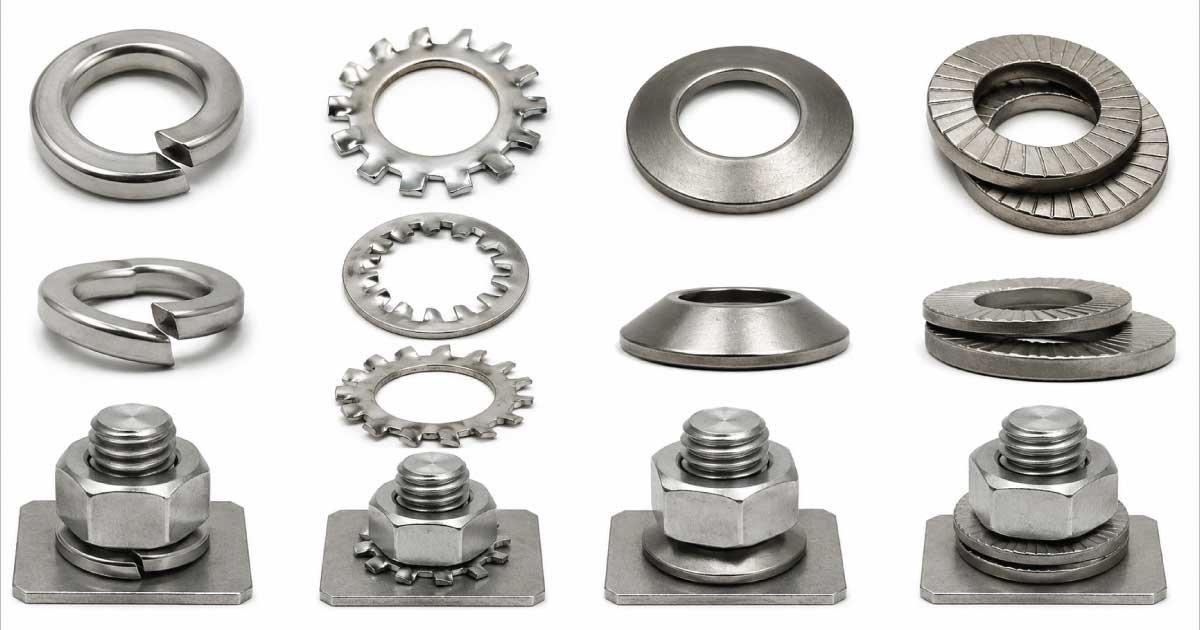
1. Split (Helical Spring) Lock Washers
Split (helical spring) lock washers are among the most widely used fastening components in mechanical assemblies. They are designed with a split and twisted helical shape that creates tension when compressed under a bolt or nut. This tension helps resist loosening caused by vibration, thermal expansion, or dynamic loads.
Best for: General-purpose applications, light to medium vibration.
2. Tooth Lock Washers
Tooth lock washers are specialized fasteners designed with serrated edges that dig into mating surfaces to prevent loosening. They are available in external, internal, or combination tooth configurations. These washers improve grip, enhance electrical conductivity in grounding applications, and perform well in assemblies requiring low-profile locking solutions.
- External tooth: Teeth on the outer edge
- Internal tooth: Teeth on the inner edge
- Combination tooth: Teeth on both edges
Best for: Electrical grounding, thin materials, low-profile assemblies.
3. Belleville (Conical Spring) Washers
Belleville washers, also known as conical spring washers, are engineered to provide high load capacity and controlled spring deflection. Their cone-shaped design allows them to absorb shock, maintain preload, and compensate for thermal expansion. They are commonly used in heavy-duty assemblies requiring consistent clamping force under varying conditions.
Best for: Heavy loads, thermal expansion compensation, high-vibration environments.
4. Wedge-Locking Washers
Wedge-locking washers are advanced anti-loosening fastener systems that use paired washers with cam faces to generate tension. When a bolt loosens, the wedge effect increases resistance rather than decreasing it. This makes them highly reliable in extreme vibration environments and critical safety applications where failure is not acceptable.
Best for: Critical safety applications, extreme vibration.
Understanding Lock Washer Size Charts
- Metric (ISO / DIN standards)
- Imperial (SAE / ANSI standards)
While charts may vary slightly by manufacturer, the key dimensions are consistent.
Key Dimensions in a Lock Washer Size Chart
When reading a lock washer size chart, it’s important to understand the core measurements used to define fit, strength, and compatibility. These dimensions ensure the washer performs correctly under load and provides reliable locking action in different mechanical environments.
When reading a lock washer size chart, you’ll usually see the following measurements:
1. Nominal Size
This refers to the standard bolt or screw size the washer is designed to match, such as M6, M8, 1/4″, or 3/8″. It acts as the primary reference point for selecting compatible washers and ensures proper alignment between fastener and washer.
2. Inner Diameter (ID)
The inner diameter is the size of the washer’s central hole. It must fit over the bolt or screw shaft smoothly without excessive clearance. A proper ID ensures stability while allowing easy installation without binding or misalignment.
3. Outer Diameter (OD)
The outer diameter represents the total width of the washer. This dimension affects how force is distributed across the surface. A larger OD provides better load distribution and helps protect softer materials from damage under tightening pressure.
4. Thickness
Thickness refers to the material depth of the washer. It plays a key role in determining stiffness, spring force, and overall durability. Thicker washers generally provide stronger resistance to deformation and better performance in high-load applications.
5. Free Height (for split washers)
Free height is the original height of a split lock washer before it is compressed during tightening. This measurement is important because it indicates the amount of spring tension the washer can generate when installed and fully loaded.
Imperial (SAE) Lock Washer Size Chart (Typical Values)
For inch-based fasteners, lock washers are sized according to SAE or ANSI standards. These standards ensure compatibility between washers and commonly used imperial bolts in mechanical assemblies across automotive, construction, and industrial equipment. While dimensions can vary slightly by manufacturer, the values below represent typical industry reference sizes.
For inch-based fasteners, lock washers are sized according to SAE or ANSI standards.
| Bolt Size | Inner Diameter (in) | Outer Diameter (in) | Thickness (in) |
|---|---|---|---|
| #6 | 0.149 | 0.312 | 0.040 |
| #8 | 0.174 | 0.344 | 0.047 |
| #10 | 0.196 | 0.375 | 0.050 |
| 1/4″ | 0.260 | 0.500 | 0.065 |
| 5/16″ | 0.323 | 0.594 | 0.078 |
| 3/8″ | 0.385 | 0.688 | 0.094 |
| 1/2″ | 0.510 | 0.875 | 0.125 |
Imperial lock washers are widely used in automotive, construction, and older machinery.
How to Choose the Right Lock Washer Size
Selecting the correct lock washer involves more than simply matching it to a bolt diameter; it requires understanding load conditions, material behavior, and environmental factors. A properly chosen washer ensures secure fastening, reduces the risk of loosening, and improves the long-term reliability of mechanical assemblies in both light and heavy-duty applications.
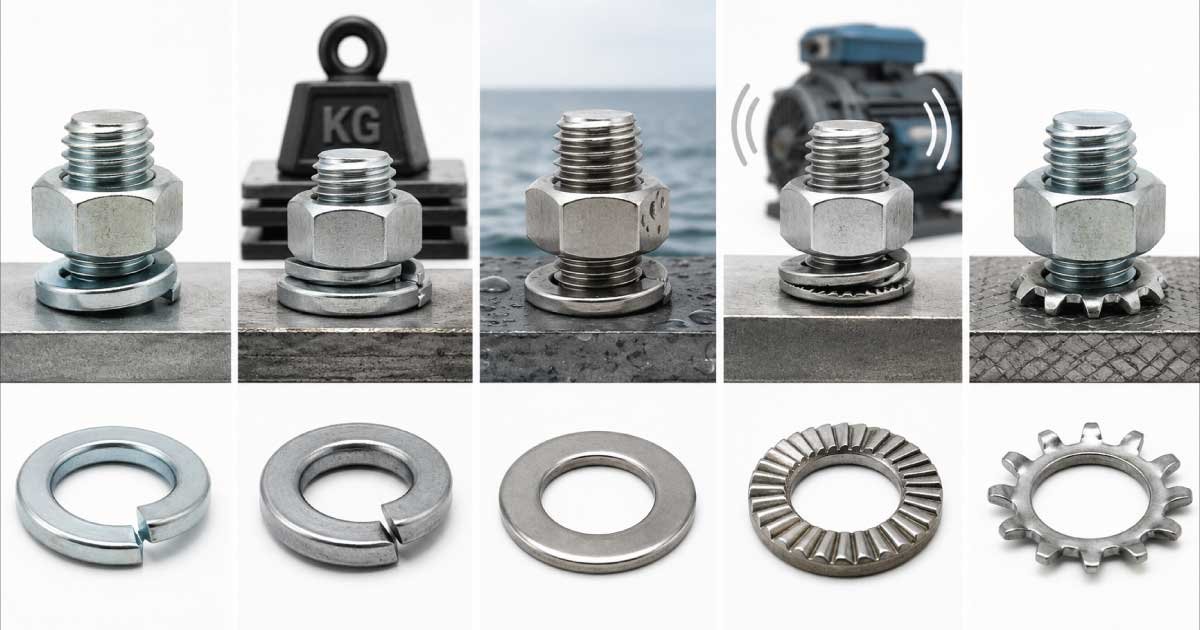
Selecting the correct lock washer involves more than matching bolt size. Consider the following factors:
1. Match the Fastener Diameter
Always select a washer that matches the nominal diameter of the bolt or screw being used. This ensures proper fit, correct load transfer, and effective locking performance. For example, an M8 bolt must be paired with an M8 washer to maintain proper alignment and stability during tightening.
Always choose a washer sized for the nominal diameter of the bolt or screw. An M8 bolt requires an M8 washer—never substitute.
2. Consider the Application Load
The amount of force acting on a joint significantly affects washer selection. Light-duty applications may work well with standard split washers, while heavy-load environments often require stronger alternatives like thicker washers or Belleville (conical spring) washers for improved stress distribution and durability.
Heavier loads may require thicker washers or conical (Belleville) washers instead of split lock washers.
3. Check Material Compatibility
Lock washers are manufactured from materials such as carbon steel, stainless steel, and brass, each offering different strength and corrosion resistance properties. It is important to match washer material with both the fastener and operating environment to prevent galvanic corrosion and ensure long-term performance.
Washers are available in steel, stainless steel, brass, and other alloys. Match washer material to the fastener and environment to avoid galvanic corrosion.
4. Account for Vibration Levels
In environments with constant or high vibration, standard split lock washers may not provide sufficient resistance. In such cases, more advanced locking solutions like wedge-locking washers or serrated washers are preferred to maintain clamping force and prevent loosening under dynamic conditions.
For high-vibration environments, standard split lock washers may not be sufficient. Consider wedge-locking or serrated washers.
5. Verify Surface Hardness
Tooth lock washers rely on their serrated edges biting into the mating surface to create resistance. If the surface is too hard, these teeth may fail to grip properly, reducing effectiveness. Ensuring compatible surface hardness is essential for achieving reliable locking performance.
Tooth lock washers require surfaces soft enough for teeth to bite effectively. Hardened surfaces may reduce their effectiveness.
Common Mistakes When Using Lock Washer Size Charts
Even when using a size chart, incorrect selection or installation can lead to reduced performance or failure of the fastened joint. Understanding these common mistakes helps prevent issues in both industrial and everyday mechanical applications.
Even with a size chart, errors can happen. Avoid these common mistakes:
- Mixing metric and imperial sizes: An M6 washer is not interchangeable with a 1/4″ washer.
- Using oversized washers: Excessive inner diameter reduces locking action.
- Ignoring thickness: Thinner washers may flatten too easily under load.
- Assuming all standards are identical: DIN, ISO, SAE, and ANSI charts may vary slightly.
Always double-check specifications when working on safety-critical assemblies.
Do Lock Washers Always Prevent Loosening?
Lock washers improve resistance to loosening, but they do not guarantee complete prevention of fastener failure in all conditions. Their effectiveness depends on vibration level, load type, surface condition, and installation quality. In high-dynamic or critical applications, traditional split lock washers alone may not provide sufficient reliability over time.
While lock washers improve resistance to loosening, they are not a universal solution. Studies have shown that traditional split lock washers can lose effectiveness under extreme vibration. In such cases, alternative methods may be more reliable:
- Thread-locking adhesives
- Prevailing torque nuts
- Wedge-lock washer systems
Understanding the limitations of each fastening method is just as important as choosing the right size.
Lock Washer Size Chart vs Flat Washer Size Chart
Lock washer and flat washer size charts are often confused because both are matched to similar bolt diameters, but their functions are fundamentally different. Lock washers focus on preventing rotation and loosening, while flat washers primarily distribute load and protect mating surfaces from damage during tightening.
It’s important not to confuse lock washer charts with flat washer charts. Although they may share similar inner diameters, lock washers are designed with spring or biting features, while flat washers focus on load distribution. Substituting one for the other can compromise joint performance.
Final Thoughts
A lock washer size chart is an essential reference for engineers, technicians, and DIY enthusiasts alike. By understanding washer types, dimensions, and standards, you can confidently select the right washer for any fastening application. Correct sizing ensures optimal locking performance, reduces maintenance issues, and enhances overall safety.
Whether you’re assembling machinery, repairing vehicles, or working on structural projects, taking the time to consult a proper lock washer size chart is a small step that delivers long-term reliability. Always pair accurate sizing with the right washer type and material for the best results.
If you’d like, I can also help you create a downloadable lock washer size chart, application-specific recommendations, or SEO optimization for this blog post.
👉 Choosing the right pipe size is essential for efficient flow and reliable performance. This Pipe Size Chart covers standard dimensions, nominal pipe sizes, schedules, wall thicknesses, metric and inch measurements, and selection tips. Read the full guide to compare pipe sizes and choose the right pipe for any application.

Engineer Hassan is a Mechanical Engineer with 16+ years of hands-on experience in mechanical hardware, fasteners, and workshop tools. He focuses on size selection, thread identification, and measurement, helping users choose the correct components with accuracy and safety.