
Hex nuts are among the most widely used fasteners in the world. Found in construction, automotive assemblies, industrial machinery, furniture, and everyday household projects, these small components play a critical role in holding structures together. Despite their simplicity, choosing the correct hex nut size is essential for safety, strength, and performance.
This complete guide to hex nut size charts will help you understand hex nut dimensions, measurement standards, thread sizes, materials, and how to select the right nut for your application. Whether you are a professional engineer, mechanic, or DIY enthusiast, this guide will give you the clarity you need.
What Is a Hex Nut?
A hex nut is a six-sided internally threaded fastener designed to be used with a bolt, screw, or threaded rod. The hexagonal shape allows easy tightening and loosening using common tools such as wrenches or spanners.
Hex nuts are typically used in conjunction with washers to distribute load and prevent surface damage. They are manufactured in a wide range of sizes, thread types, materials, and grades to suit different applications.
Why Hex Nut Size Matters
Using the correct hex nut size is not optional it is critical for safety, performance, and durability in any assembly. A mismatched or incorrect nut size can compromise load distribution, reduce clamping effectiveness, and increase the risk of failure, especially in high-stress or vibration-prone environments.
An improperly sized nut can lead to:
- Thread stripping
- Insufficient clamping force
- Loosening due to vibration
- Structural failure
- Safety hazards
A hex nut size chart helps ensure compatibility between the nut and bolt while also guiding tool selection and torque requirements.
Understanding Hex Nut Size Terminology
Before reading a hex nut size chart, it is essential to understand the standard terminology and dimensions used to describe nut and bolt compatibility. These measurements define how a nut fits, how much load it can handle, and which tools are required for proper installation.
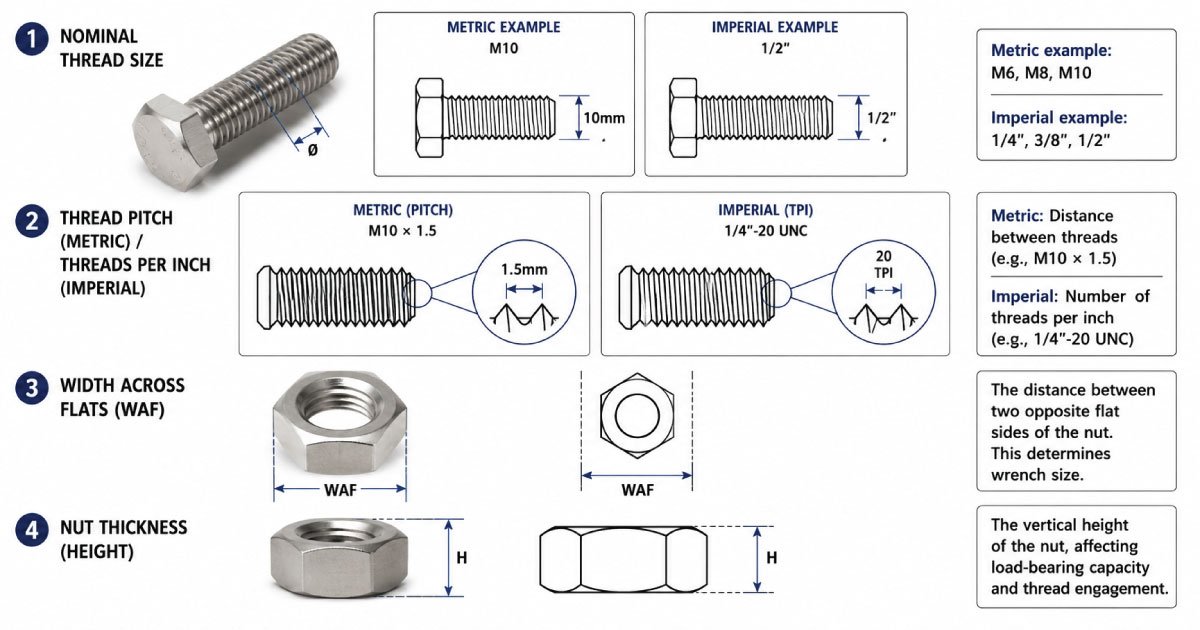
Nominal Thread Size
The nominal thread size defines the basic diameter of the bolt or screw that a hex nut is engineered to match. It is the primary reference for compatibility, ensuring proper thread engagement, load transfer, and secure fastening without excessive looseness or binding during assembly.
Metric example: M6, M8, M10
Imperial example: 1/4″, 3/8″, 1/2″
Thread Pitch (Metric) / Threads Per Inch (Imperial)
Thread pitch or threads per inch describes how closely the threads are spaced along the fastener. This dimension is critical for ensuring the nut and bolt mesh correctly, preventing cross-threading, uneven load distribution, and premature wear under mechanical stress.
Metric: Distance between threads (e.g., M10 × 1.5)
mperial: Number of threads per inch (e.g., 1/4″-20 UNC)
Width Across Flats (WAF)
Width across flats measures the distance between two opposite flat faces of a hex nut. This dimension determines the correct wrench or spanner size, ensuring efficient torque application while minimizing the risk of tool slippage, rounding, or damage during tightening and loosening.
The distance between two opposite flat sides of the nut. This determines wrench size.
Nut Thickness (Height)
Nut thickness, also known as height, indicates the vertical dimension of the nut from top to bottom. It directly influences the number of threads engaged with the bolt, affecting load capacity, strength, and resistance to loosening under vibration or dynamic forces.
The vertical height of the nut, affecting load-bearing capacity and thread engagement.
Metric Hex Nut Size Chart (ISO Standard)
Metric hex nuts are manufactured according to internationally recognized ISO standards to ensure consistency, interchangeability, and reliable performance across applications. Common standards such as ISO 4032 for standard hex nuts and ISO 4033 for thin hex nuts define dimensions, tolerances, and mechanical compatibility for metric fasteners used worldwide.
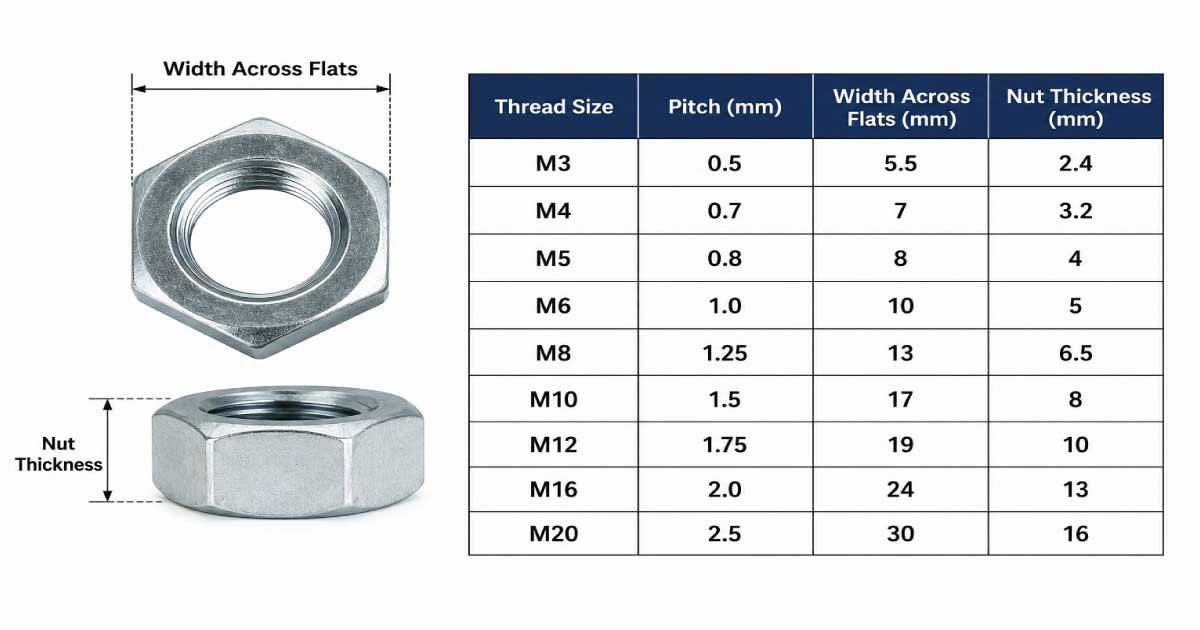
Metric hex nuts follow ISO standards such as ISO 4032 (standard hex nuts) and ISO 4033 (thin hex nuts).
| Thread Size | Pitch (mm) | Width Across Flats (mm) | Nut Thickness (mm) |
|---|---|---|---|
| M3 | 0.5 | 5.5 | 2.4 |
| M4 | 0.7 | 7 | 3.2 |
| M5 | 0.8 | 8 | 4 |
| M6 | 1.0 | 10 | 5 |
| M8 | 1.25 | 13 | 6.5 |
| M10 | 1.5 | 17 | 8 |
| M12 | 1.75 | 19 | 10 |
| M16 | 2.0 | 24 | 13 |
| M20 | 2.5 | 30 | 16 |
Note:
Fine-thread versions exist and have different pitch values.
Imperial (SAE) Hex Nut Size Chart
Imperial hex nuts are standardized fasteners widely used in the United States, particularly in automotive, construction, and machinery applications. Their dimensions and thread forms are defined by ANSI and ASME standards to ensure proper fit, strength, and interchangeability across compatible bolts and tools.
Imperial hex nuts are governed by ANSI and ASME standards and commonly used in the United States.
| Thread Size | Threads Per Inch (TPI) | Width Across Flats (in) | Nut Thickness (in) |
|---|---|---|---|
| 1/4″ | 20 (UNC) | 7/16 | 7/32 |
| 5/16″ | 18 | 1/2 | 17/64 |
| 3/8″ | 16 | 9/16 | 21/64 |
| 7/16″ | 14 | 11/16 | 11/32 |
| 1/2″ | 13 | 3/4 | 27/64 |
| 5/8″ | 11 | 15/16 | 41/64 |
| 3/4″ | 10 | 1-1/8 | 47/64 |
UNC (Unified National Coarse) and UNF (Unified National Fine) threads differ in pitch but share the same nominal diameter.
Hex Nut Grades and Strength Ratings
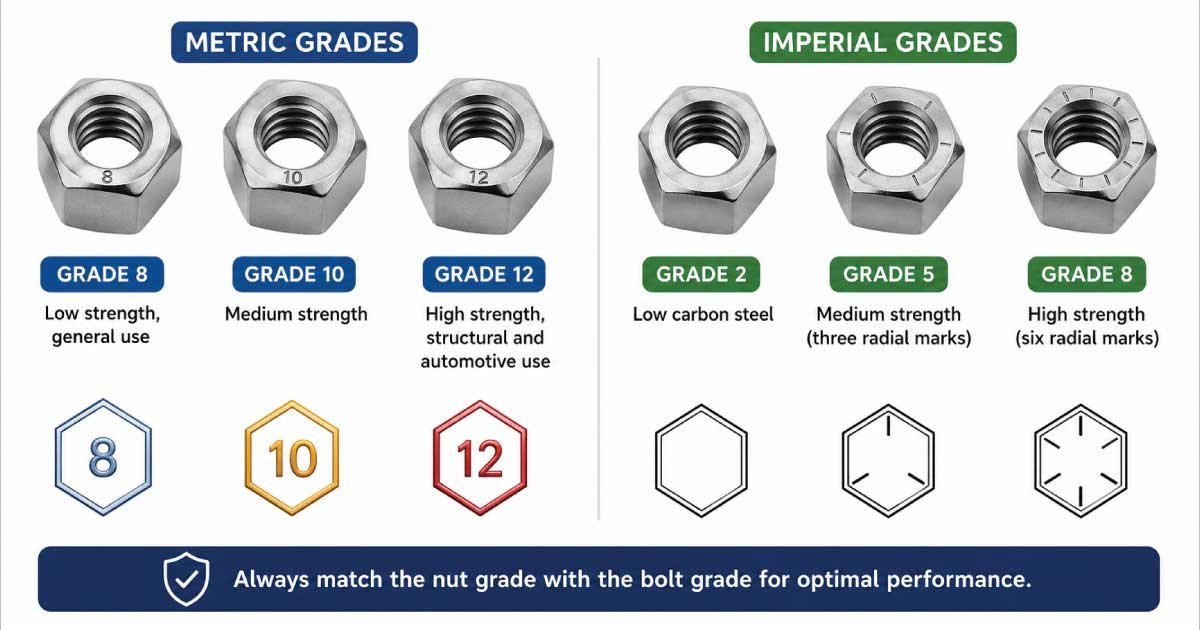
While a hex nut size chart defines physical dimensions, the grade specifies the nut’s mechanical strength and performance limits. Nut grades indicate material composition, tensile strength, and load capacity, helping ensure the fastener can safely handle applied forces without deforming or failing in service.
Metric Grades
- Grade 8 – Low strength, general use
- Grade 10 – Medium strength
- Grade 12 – High strength, structural and automotive use
Imperial Grades
- Grade 2 – Low carbon steel
- Grade 5 – Medium strength (three radial marks)
- Grade 8 – High strength (six radial marks)
Always match the nut grade with the bolt grade for optimal performance.
Materials Used in Hex Nuts
The material used to manufacture a hex nut plays a major role in its strength, corrosion resistance, weight, and suitability for specific environments. While material selection does not alter dimensional sizing, it directly affects durability, torque limits, and long-term performance in mechanical, electrical, or outdoor applications.
Common Materials
- Carbon steel – Strong, economical
- Stainless steel (304, 316) – Corrosion resistant
- Brass – Electrical conductivity, corrosion resistance
- Aluminum – Lightweight, low strength
- Alloy steel – High tensile strength
Material choice does not change the size chart, but it does influence performance and torque limits.
Fine Thread vs Coarse Thread Hex Nuts
Fine and coarse thread hex nuts differ in thread spacing, performance characteristics, and ideal use cases. Selecting the correct thread type improves assembly reliability, load handling, and resistance to loosening, especially in environments involving vibration, contamination, or frequent adjustment.
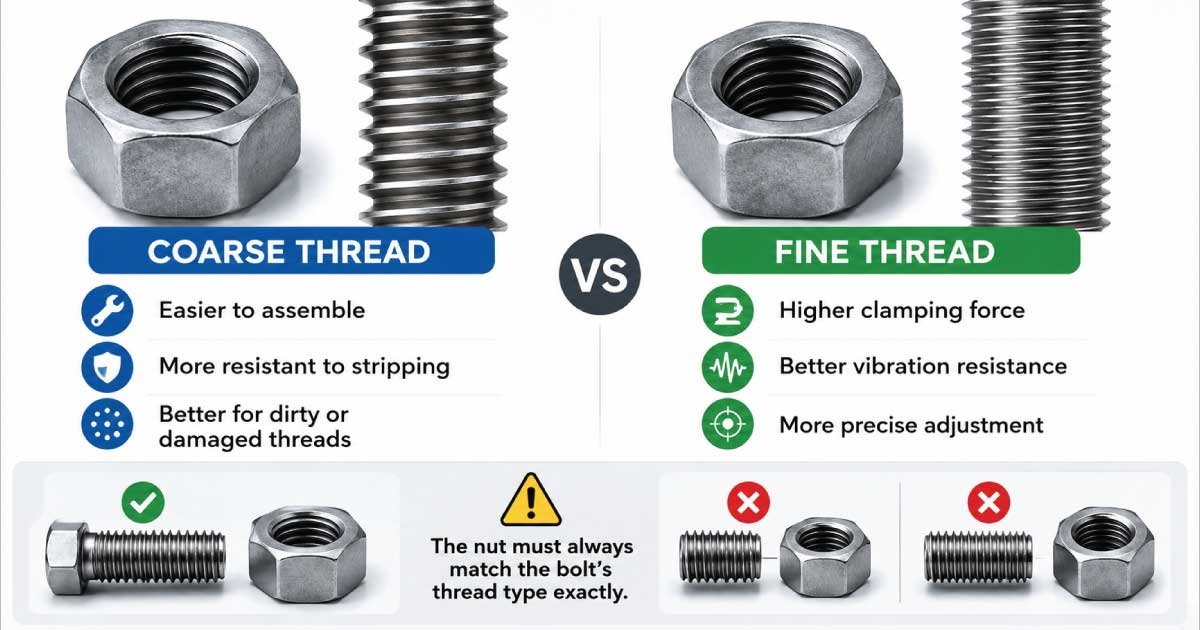
Coarse Thread
- Easier to assemble
- More resistant to stripping
- Better for dirty or damaged threads
Fine Thread
- Higher clamping force
- Better vibration resistance
- More precise adjustment
The nut must always match the bolt’s thread type exactly.
How to Measure a Hex Nut Correctly
When a hex nut size chart is not available, accurate manual measurement ensures correct identification and safe reuse. Using basic measuring tools allows you to determine thread compatibility, wrench size, and load capacity, helping prevent mismatched fasteners and reducing the risk of loosening, stripping, or mechanical failure.
- Measure internal thread diameter using calipers
- Count thread pitch or use a thread gauge
- Measure width across flats
- Measure nut thickness
Comparing these values to a standard chart will identify the nut size accurately.
Common Hex Nut Applications by Size
Hex nut sizes are commonly associated with specific application ranges based on load requirements and component scale. Selecting the appropriate size helps maintain structural integrity, ensures proper clamping force, and avoids failures caused by undersized fasteners in demanding service conditions.
- M3–M5: Electronics, small appliances
- M6–M8: Furniture, bicycles, light machinery
- M10–M12: Automotive, industrial equipment
- M16 and above: Structural steel, heavy equipment
Using undersized nuts in high-load applications is a common and dangerous mistake.
Torque Considerations and Size Charts
Size charts define physical dimensions, but torque charts determine how a hex nut performs under tightening forces. Proper torque application ensures adequate clamping without damaging threads, with requirements varying based on fastener properties and installation conditions.
Larger nuts generally require higher torque, but torque also depends on:
- Material
- Grade
- Lubrication
- Washer usage
Never exceed recommended torque values, as over-tightening can cause thread failure even with correct sizing.
Metric vs Imperial: Choosing the Right System
Metric and imperial fastener systems are designed around different measurement standards and are not interchangeable. Choosing the correct system ensures proper thread engagement, accurate torque application, and long-term reliability, especially when maintaining or repairing machinery from different regions or manufacturing eras.
- Metric: Global standard, used in most modern equipment
- Imperial: Common in older machinery and U.S.-made equipment
Never mix metric nuts with imperial bolts—even if they seem to fit initially.
Common Mistakes When Using Hex Nut Size Charts
Hex nut size charts are valuable tools, but errors still occur when key details are overlooked. Misinterpretation or assumptions can lead to improper fastening, reduced strength, and potential safety risks, particularly in load-bearing or vibration-prone applications.
- Assuming wrench size equals thread size
- Mixing thread pitches
- Ignoring nut grade
- Using standard nuts where heavy hex nuts are required
- Over-tightening without torque specifications
A size chart should always be used alongside application knowledge.
Conclusion
Hex nut size charts are essential tools for anyone working with fasteners. Understanding thread sizes, width across flats, thickness, grades, and materials ensures safe, strong, and reliable assemblies. While hex nuts may seem simple, selecting the wrong size or type can lead to serious mechanical failures.
By using the correct hex nut size chart and matching it carefully with the appropriate bolt, washer, and torque specification, you ensure long-lasting performance and structural integrity in any project.
Whether you’re assembling furniture, repairing machinery, or designing industrial systems, mastering hex nut sizing is a fundamental skill worth learning well.
👉 Need the right bolt size for your project? This Bolt Size Chart provides standard bolt dimensions, metric and inch sizes, thread pitches, head sizes, strength grades, and selection tips. Read the full guide to compare bolt sizes, understand specifications, and choose the correct fastener for every application.

Engineer Hassan is a Mechanical Engineer with 16+ years of hands-on experience in mechanical hardware, fasteners, and workshop tools. He focuses on size selection, thread identification, and measurement, helping users choose the correct components with accuracy and safety.