
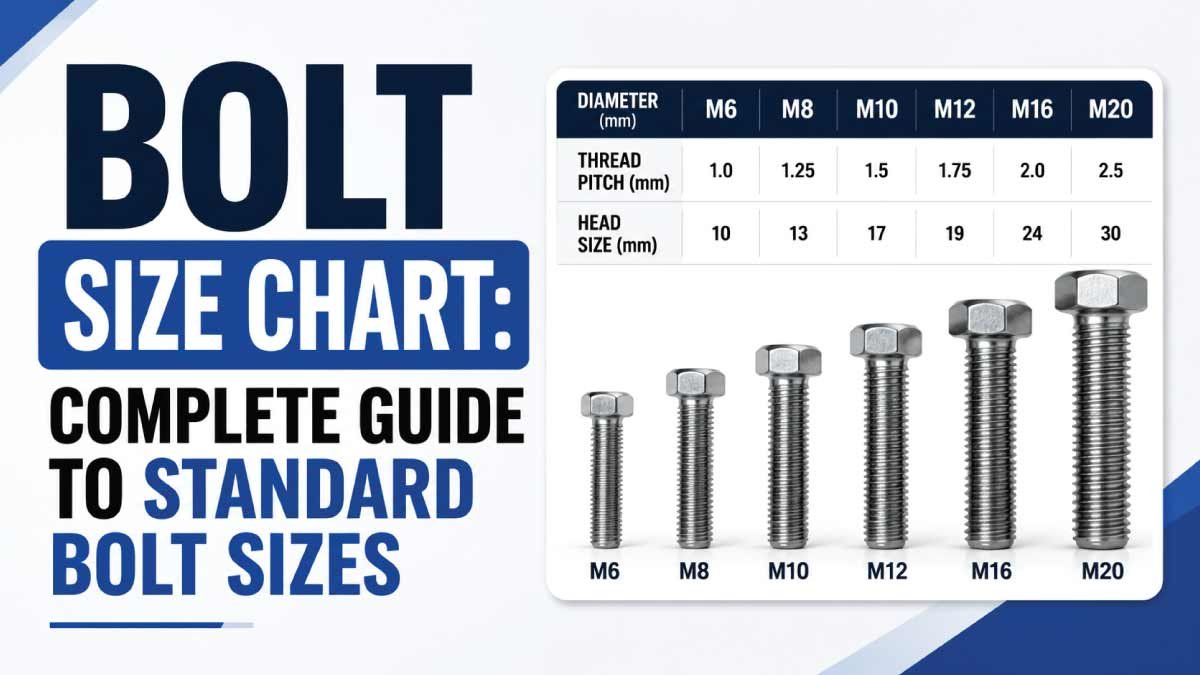
A bolt size chart is an essential reference tool used in mechanical engineering, construction, automotive repair, and DIY projects. It helps identify the correct bolt diameter, length, thread pitch, and standard measurement system so you can choose the right fastener for any application.
Using the wrong bolt size can lead to weak joints, equipment failure, or safety risks, so understanding this chart is extremely important.
In this detailed guide, you will learn what a bolt size chart is, how to read it, different bolt measurement systems, and how to select the correct bolt for your project.
What Is a Bolt Size Chart?
A bolt size chart is a standardized reference table used in engineering and mechanical work to define the exact dimensions of different bolts. It helps users quickly identify the correct fastener size for specific applications, ensuring accuracy, compatibility, and efficiency in assembly, repair, and manufacturing processes.
A bolt size chart is a standardized reference table that shows the dimensions of bolts, including:
- Bolt diameter (thickness of the bolt shaft)
- Bolt length (from head to tip)
- Thread pitch (distance between threads)
- Metric or imperial size system
- Common applications
These charts are widely used in workshops, factories, and engineering design because they remove guesswork when selecting fasteners.
Instead of measuring every bolt manually, technicians simply refer to the chart and choose the correct specification.
Why Bolt Sizes Are Important
Bolt size charts are essential reference tools used in engineering, construction, and mechanical work to ensure the correct selection of bolts for different applications. They provide standardized measurements for diameter, length, thread pitch, and compatibility with nuts and tapped holes. Using these charts helps improve accuracy, safety, and efficiency in assembly and maintenance tasks.
1. Ensures Proper Fit
Bolt size charts help ensure that the bolt matches the hole and nut perfectly. A correct fit is crucial for strong fastening and stable assembly. Even a small mismatch in diameter or thread pitch can lead to loose connections, misalignment, or mechanical failure, especially under load or vibration conditions.
2. Improves Safety
Safety is one of the most important reasons for using bolt size charts. Incorrect bolt selection can lead to weak joints and structural failures in machines, vehicles, bridges, or buildings. Proper sizing ensures that bolts can handle the required stress and load, reducing the risk of accidents and equipment damage.
3. Saves Time
Bolt size charts eliminate the need for guesswork or trial-and-error when selecting fasteners. Instead of testing multiple bolts, users can quickly refer to standardized values and choose the correct size instantly. This improves workflow efficiency in workshops, manufacturing plants, and repair jobs, saving both time and effort.
4. Standardization
Bolt size charts promote global standardization by following widely accepted systems such as metric (millimeters) and imperial (inches). This ensures that bolts and fasteners are compatible across different countries, industries, and manufacturers. Standardization simplifies inventory management, design planning, and international engineering collaboration.
Bolt Measurement Systems
Bolt measurement systems define how bolt sizes are standardized and labeled across different regions and industries. These systems ensure compatibility between bolts, nuts, and threaded holes, making it easier for engineers and technicians to select the correct fasteners for various mechanical, structural, and industrial applications.
1. Metric System (mm)
The metric system is the most widely used bolt sizing standard across Europe, Asia, and most parts of the world. It measures bolt dimensions in millimeters and follows a simple, decimal-based structure that makes sizing easier and more consistent in engineering design and manufacturing.
Common metric bolt sizes include:
- M4
- M5
- M6
- M8
- M10
- M12
- M16
- M20
The “M” stands for metric, and the number represents the nominal diameter of the bolt in millimeters, making it easy to identify size at a glance.
Example:
M8 bolt = 8 mm diameter
2. Imperial System (Inches)
The imperial system is commonly used in the United States and in older mechanical equipment. Instead of millimeters, it uses inches to define bolt sizes, and often includes thread information in terms of threads per inch (TPI), which adds precision for matching components.
Common imperial bolt sizes include:
- 1/4 inch bolt
- 5/16 inch bolt
- 3/8 inch bolt
- 1/2 inch bolt
Imperial bolts are usually defined by:
- Diameter in inches
- Threads per inch (TPI)
Standard Bolt Size Chart (Metric)
The metric bolt size chart is a widely used reference in engineering and manufacturing that helps identify bolt dimensions based on millimeters. It provides quick guidance for selecting the correct bolt size according to load requirements, application type, and structural strength needed in mechanical and industrial assemblies.
| Bolt Size (M) | Diameter (mm) | Typical Applications |
|---|---|---|
| M4 | 4 mm | Electronics, light fixtures |
| M5 | 5 mm | Small machinery, appliances |
| M6 | 6 mm | Automotive parts, furniture |
| M8 | 8 mm | Structural fittings, engines |
| M10 | 10 mm | Heavy machinery, frames |
| M12 | 12 mm | Construction, industrial equipment |
| M16 | 16 mm | Bridges, heavy structures |
| M20 | 20 mm | Large industrial applications |
Standard Bolt Size Chart (Imperial)
The imperial bolt size chart is commonly used in the United States and some older mechanical systems. It defines bolt sizes in inches and is often paired with thread specifications like TPI. This system is essential for compatibility in legacy equipment and American-standard engineering designs.
| Bolt Size (inch) | Diameter (approx mm) | Common Uses |
|---|---|---|
| 1/4 inch | 6.35 mm | Light mechanical work |
| 5/16 inch | 7.94 mm | Automotive parts |
| 3/8 inch | 9.52 mm | Construction, machinery |
| 7/16 inch | 11.11 mm | Heavy equipment |
| 1/2 inch | 12.7 mm | Structural applications |
| 5/8 inch | 15.87 mm | Industrial machinery |
| 3/4 inch | 19.05 mm | High-load structures |
👉 Explore the complete Thread Pitch Guide for both Metric and Imperial Screws in this easy-to-understand article. Learn how thread pitch affects screw compatibility, strength, and performance in mechanical and DIY projects. Understand thread measurements, identification methods, and common standards. Read the full guide to choose the correct screw threads with confidence and accuracy.
How to Read a Bolt Size Chart
Understanding a bolt size chart is straightforward once you learn the basic format used to describe bolt dimensions. Each part of the size code provides important information about the bolt’s diameter, length, and threading, helping you select the correct fastener for safe and accurate assembly work.
Step 1: Identify Diameter
The first value in a bolt size specification indicates the diameter of the bolt. This can appear as “M8” in metric or “3/8 inch” in imperial sizing. It represents the thickness of the bolt shaft and is a key factor in determining strength and load capacity.
Step 2: Check Length
Bolt length refers to the measurement from the underside of the bolt head to the tip of the threaded end. This ensures proper engagement with materials being joined and avoids issues like loose fitting or excessive protrusion during installation.
Example:
M8 × 40 means 8 mm diameter and 40 mm length
Step 3: Understand Thread Pitch
Thread pitch describes how closely spaced the threads are on a bolt. It affects how the bolt engages with a nut or threaded hole and influences strength, holding power, and resistance to vibration in different mechanical applications.
- Coarse threads: stronger grip, easier installation
- Fine threads: more precise, better vibration resistance
Common Bolt Types Used With Size Charts
Bolt size charts are used for many different bolt designs, even though the basic measurements like diameter and length remain the same. Each bolt type is designed for a specific purpose, material, and load condition, making it important to understand their differences when selecting the right fastener.
1. Hex Bolts
Hex bolts are the most commonly used bolt type in mechanical and structural applications. They have a hexagonal head that allows easy tightening with a wrench or socket, making them suitable for general assembly work where strength and reliability are required.
2. Carriage Bolts
Carriage bolts feature a rounded head with a square neck beneath it, which prevents the bolt from rotating once installed. They are mainly used in wood structures and applications where a smooth, finished appearance is needed along with secure fastening.
3. Flange Bolts
Flange bolts have an integrated washer-like flange under the head that helps distribute load evenly. This design reduces the need for separate washers and improves stability, making them ideal for automotive and heavy-duty mechanical applications.
4. Socket Head Bolts
Socket head bolts are designed for high-torque applications and are tightened using an Allen key or hex wrench. They are commonly used in machinery, precision equipment, and tight spaces where strong fastening force is required.
5. U-Bolts
U-bolts are shaped like the letter “U” and are used to secure pipes, tubes, or cylindrical objects. They provide strong clamping force and are widely used in plumbing, automotive suspension systems, and structural support applications.
👉 Learn how to use a Micrometer Screw Gauge with this easy beginner-friendly guide. Understand accurate measurement techniques, reading scales, least count calculation, and common mistakes to avoid. This detailed Micrometer Screw Gauge Reading Guide helps students, mechanics, and DIY users improve precision measurement skills. Read the full post for step-by-step explanations and practical tips.
How to Choose the Right Bolt Size
Selecting the correct bolt size is essential for ensuring safety, strength, and long-term reliability in any mechanical or structural assembly. The right choice depends on several engineering and environmental factors that influence how well the bolt performs under load and working conditions.
1. Material Type
The type of material being fastened plays a major role in bolt selection. Softer materials like wood or plastic require different bolt designs compared to harder materials such as steel or concrete, which need stronger and more rigid fastening solutions to prevent damage or failure.
2. Load Requirements
The amount of load or force the joint must handle determines the bolt size. Heavier loads require larger diameter bolts, such as M12 or M16, to ensure sufficient strength and prevent shearing or deformation under stress in mechanical or structural applications.
3. Environmental Conditions
Environmental exposure affects bolt performance over time. Outdoor or humid conditions often require corrosion-resistant materials like stainless steel bolts to prevent rust, maintain durability, and ensure long-term structural integrity in exposed installations.
4. Hole Size Compatibility
Proper matching between bolt diameter and drilled hole size is critical for secure fastening. A correctly sized hole ensures proper fit, reduces movement, and allows the bolt to achieve maximum grip strength without loosening or damaging surrounding material.
5. Thread Type
Thread type influences both installation ease and holding strength. Coarse threads are better for quick assembly and softer materials, while fine threads provide higher precision, better vibration resistance, and stronger clamping force in demanding mechanical applications.
Common Mistakes When Using Bolt Size Charts
While bolt size charts are simple and very useful, beginners often make errors when interpreting them. These mistakes can lead to weak joints, damaged threads, or improper assembly. Understanding these common issues helps improve accuracy and ensures safer, more reliable fastening in mechanical and structural work.
1. Ignoring Thread Pitch
Many users focus only on bolt diameter and overlook thread pitch, which is equally important. Incorrect thread matching can cause poor engagement, weak fastening, or complete failure of the joint even if the bolt size appears correct on the chart.
2. Wrong Length Selection
Choosing the wrong bolt length is a frequent mistake. A bolt that is too short will not provide enough grip, while an overly long bolt may protrude unnecessarily, waste material, or interfere with nearby components during assembly.
3. Mixing Metric and Imperial
Mixing metric and imperial bolt systems often leads to serious fitting problems. Even small differences in measurement can cause stripped threads, loose connections, or improper alignment, making it essential to always use a consistent sizing system throughout a project.
4. Over-tightening
Even when the correct bolt size is selected, excessive tightening can cause damage. Over-tightening may strip threads, deform materials, or weaken the bolt itself, reducing the overall strength and reliability of the assembled joint.
Conclusion
A bolt size chart is an essential tool for anyone working with mechanical systems, construction, or DIY projects. It helps ensure that you select the correct bolt diameter, length, and thread type for safe and reliable assembly.
Understanding both metric and imperial systems allows you to work confidently with any standard used around the world. Whether you are building machinery, repairing vehicles, or working on home projects, using the correct bolt size is key to strength, safety, and durability.
By referring to a bolt size chart, you eliminate guesswork and ensure professional-quality results every time.
👉 Discover different Chisel Sizes and learn their practical uses with this beginner-friendly guide. From wood chisels to metalworking tools, understand how each size improves accuracy, cutting, carving, and shaping tasks. Read the full post to choose the right Chisel Applications and make your DIY or professional projects easier and more efficient
FAQs:
What is a bolt size?
Bolt size refers to the diameter, thread type, and length of a bolt. It is usually expressed in metric (M6, M8, M10) or imperial units. The size helps determine compatibility with nuts and tapped holes. Correct bolt size ensures proper strength, fit, and safe mechanical fastening in different applications.
What does M8, M10, M12 mean?
M8, M10, and M12 are metric bolt designations where “M” stands for metric thread and the number represents the nominal diameter in millimeters. For example, M8 is 8 mm diameter, M10 is 10 mm, and M12 is 12 mm. These sizes are widely used in engineering and construction industries.
What does m8x1.25 bolt mean?
An M8×1.25 bolt means the bolt has a 8 mm nominal diameter with a thread pitch of 1.25 mm. The pitch indicates the distance between threads. This specification helps ensure correct fitting with matching nuts or tapped holes, providing secure fastening and proper mechanical strength in assemblies.
What is the meaning of M10 1.0 * 20?
M10 1.0 × 20 means a metric bolt with a 10 mm diameter, 1.0 mm thread pitch, and 20 mm length. It is a fine-thread bolt where 1.0 mm is the distance between threads. The length refers to the usable shaft of the bolt excluding the head.
Is M8 a 13mm bolt?
No, M8 does not mean 13 mm bolt size. M8 refers to an 8 mm nominal thread diameter. However, the head size of an M8 bolt can be 13 mm across flats, depending on the standard (like hex head bolts). So, 13 mm is the wrench size, not the thread size.
What is a M8 * 40 bolt?
An M8 × 40 bolt means a metric bolt with an 8 mm diameter and 40 mm length. The thread pitch is usually standard unless specified otherwise. This bolt is commonly used in machinery, furniture, and structural applications where moderate length fastening is required for secure assembly.
What is M12 bolt size?
M12 bolt size refers to a metric bolt with a 12 mm nominal diameter. It is commonly used in heavy-duty applications such as construction, automotive, and industrial machinery. The thread pitch and length can vary depending on the requirement, but M12 generally provides strong load-bearing capability.
Is a 12 bolt stronger than a 10 bolt?
Yes, generally an M12 bolt is stronger than an M10 bolt because it has a larger diameter, which provides higher tensile strength and load capacity. A thicker bolt can handle more stress and torque. However, actual strength also depends on material grade and thread type, not just size.
What is M6 bolt size?
M6 bolt size refers to a metric bolt with a 6 mm nominal diameter. It is commonly used in light mechanical assemblies, electronics, and small machinery. M6 bolts come in different lengths and thread pitches, but they are generally suitable for low to medium load applications.

Engineer Hassan is a Mechanical Engineer with 16+ years of hands-on experience in mechanical hardware, fasteners, and workshop tools. He focuses on size selection, thread identification, and measurement, helping users choose the correct components with accuracy and safety.