
Oil seals play a vital role in keeping lubricants inside machinery while preventing dust, dirt, moisture, and other contaminants from entering critical components. Whether used in automotive engines, industrial gearboxes, hydraulic systems, pumps, electric motors, or heavy equipment, selecting the correct oil seal size is essential for reliable performance, reduced maintenance, and longer equipment life.
Even a small mismatch in dimensions or material can lead to lubricant leakage, premature bearing failure, increased friction, and costly downtime.
This complete Oil Seal Size Chart guide explains everything you need to know about choosing the right oil seal for your application. You’ll learn how to read oil seal sizes, understand standard dimensions, measure seals accurately, compare different materials, identify common seal types, follow industry standards, avoid installation mistakes, and maintain seals for maximum service life.
Whether you are a beginner, mechanic, maintenance technician, engineering student, or industrial professional, this guide provides practical, easy-to-understand information to help you confidently select and replace oil seals while improving the reliability and efficiency of your equipment.
What Is an Oil Seal?
An oil seal is a critical mechanical component designed to prevent lubricant leakage while keeping contaminants such as dust, water, and dirt away from rotating shafts and bearings. Choosing the correct oil seal size is essential for reliable equipment performance, reduced maintenance costs, and longer service life. Understanding oil seal dimensions, materials, and applications helps engineers, mechanics, and maintenance professionals select the right seal for different operating conditions.
Oil seals, also known as shaft seals, rotary seals, or radial shaft seals, are widely used in automotive systems, industrial machinery, pumps, gearboxes, hydraulic equipment, electric motors, and agricultural machines. They create a tight sealing interface between a rotating shaft and a stationary housing while allowing smooth shaft rotation.
Unlike simple rubber rings, modern oil seals are carefully engineered with precision dimensions, reinforced metal cases, and specialized sealing lips that withstand pressure, friction, temperature changes, and chemical exposure.
Some major functions of an oil seal include:
- Preventing lubricating oil and grease leakage
- Blocking dust, dirt, mud, and moisture
- Protecting bearings from contamination
- Extending machinery service life
- Reducing maintenance frequency
- Improving operational efficiency
Without properly selected oil seals, even expensive machinery can experience premature bearing failure, lubricant loss, overheating, and costly downtime.
Why Oil Seal Size Matters
Selecting the correct oil seal size is far more important than simply matching the shaft diameter. A properly sized seal ensures effective sealing pressure, minimizes wear, and supports long-term equipment reliability. Even small dimensional errors can result in leakage, excessive friction, shaft damage, or early seal failure.
Professional maintenance teams always verify three primary dimensions before ordering a replacement oil seal:
- Shaft diameter (Inner Diameter)
- Housing bore diameter (Outer Diameter)
- Seal width (Thickness)
When these dimensions are incorrect, several problems may occur:
| Incorrect Dimension | Possible Result |
|---|---|
| Small inner diameter | Excessive friction and overheating |
| Large inner diameter | Oil leakage |
| Small outer diameter | Loose housing fit |
| Large outer diameter | Installation damage |
| Incorrect width | Poor sealing performance |
Even if two seals appear visually identical, slight dimensional differences can significantly affect performance. Therefore, measuring accurately and following manufacturer recommendations are considered standard industry practices.
Oil Seal Size Chart
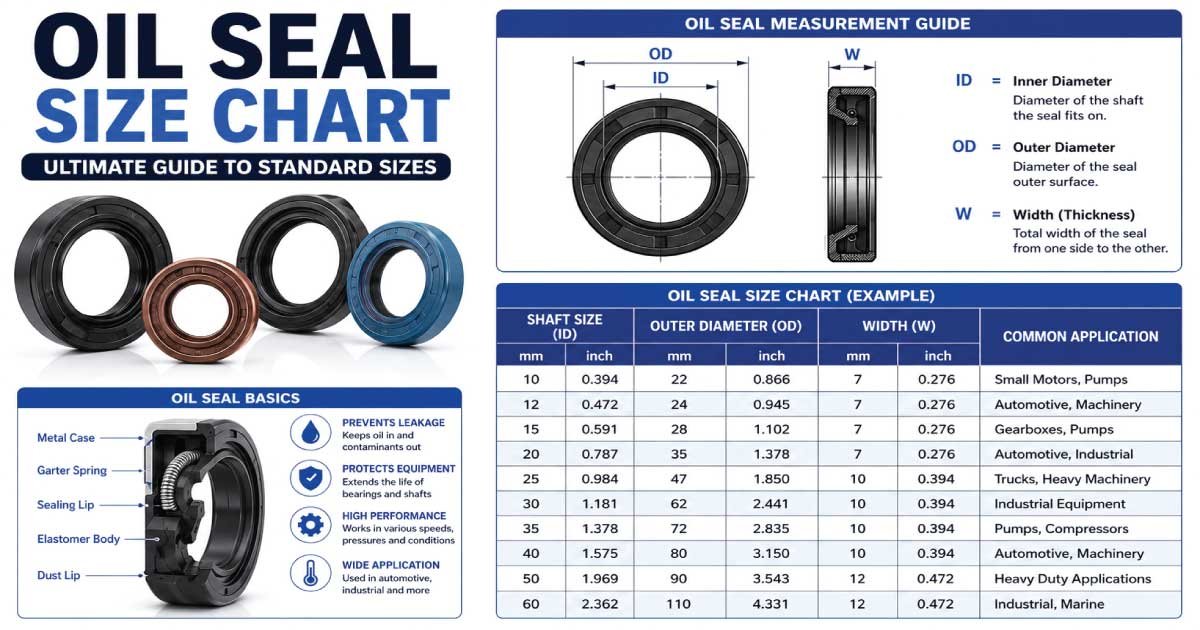
An oil seal size chart provides standardized dimensions that simplify seal identification and replacement. Manufacturers generally specify oil seal sizes using the format Inner Diameter × Outer Diameter × Width (ID × OD × W), typically measured in millimeters.
Below is a commonly used reference chart for metric oil seals.
| Shaft Diameter (ID) | Outer Diameter (OD) | Width (mm) | Common Size Format |
|---|---|---|---|
| 10 mm | 22 mm | 7 | 10 × 22 × 7 |
| 12 mm | 24 mm | 7 | 12 × 24 × 7 |
| 15 mm | 28 mm | 7 | 15 × 28 × 7 |
| 17 mm | 30 mm | 7 | 17 × 30 × 7 |
| 20 mm | 35 mm | 7 | 20 × 35 × 7 |
| 22 mm | 40 mm | 7 | 22 × 40 × 7 |
| 25 mm | 42 mm | 7 | 25 × 42 × 7 |
| 30 mm | 47 mm | 7 | 30 × 47 × 7 |
| 35 mm | 52 mm | 8 | 35 × 52 × 8 |
| 40 mm | 62 mm | 10 | 40 × 62 × 10 |
| 45 mm | 65 mm | 10 | 45 × 65 × 10 |
| 50 mm | 72 mm | 10 | 50 × 72 × 10 |
| 55 mm | 80 mm | 10 | 55 × 80 × 10 |
| 60 mm | 85 mm | 10 | 60 × 85 × 10 |
| 70 mm | 95 mm | 10 | 70 × 95 × 10 |
This chart represents common metric sizes frequently used in industrial equipment. However, manufacturers may also produce custom dimensions for specialized machinery, high-speed applications, or heavy-duty equipment.
Understanding Oil Seal Dimensions
Every oil seal is manufactured using three primary dimensions that determine whether it will fit and perform correctly. Understanding these measurements helps avoid ordering mistakes and ensures the replacement seal matches the equipment’s design specifications.
Inner Diameter (ID)
The inner diameter corresponds to the shaft diameter. It determines how tightly the sealing lip contacts the rotating shaft.
A correctly sized ID provides enough sealing pressure without generating excessive friction. If the shaft diameter is worn or damaged, replacing only the seal may not solve leakage problems because the sealing surface itself affects performance.
Outer Diameter (OD)
The outer diameter matches the housing bore where the oil seal is installed.
Proper OD sizing ensures a secure press fit that prevents lubricant leakage around the seal’s outer edge. Excessively loose or overly tight housing fits may reduce sealing efficiency or damage the seal during installation.
Seal Width
Seal width represents the thickness of the oil seal.
Although width may seem less important than diameter, it affects:
- Installation depth
- Lip positioning
- Structural stability
- Load distribution
- Overall sealing performance
Manufacturers often provide multiple width options for identical shaft diameters depending on operating requirements.
How To Read Oil Seal Sizes
Oil seal markings may appear confusing at first, but they follow a simple dimensional format recognized throughout the mechanical industry. Learning how to read these markings makes replacement faster and reduces the chance of selecting the wrong component.
Consider the following example:
35 × 52 × 8
This indicates:
- Inner Diameter = 35 mm
- Outer Diameter = 52 mm
- Width = 8 mm
Some manufacturers also include:
- Material code
- Temperature rating
- Manufacturer logo
- Rotation direction
- Dust lip designation
For example:
35 × 52 × 8 NBR TC
This means:
| Marking | Meaning |
|---|---|
| 35 | Shaft diameter |
| 52 | Housing diameter |
| 8 | Seal width |
| NBR | Nitrile rubber |
| TC | Double lip oil seal |
Learning these markings helps technicians quickly identify replacement seals without relying solely on equipment manuals.
Common Oil Seal Types
Different oil seal designs are intended for different operating environments. Selecting the proper type improves sealing efficiency, reduces wear, and increases service life under varying speeds, temperatures, and contamination levels.
Single Lip Oil Seal
Single lip oil seals are the most commonly used design in equipment operating within relatively clean environments.
Their primary purpose is retaining lubricating oil while providing minimal friction against the rotating shaft.
Typical applications include:
- Electric motors
- Gearboxes
- Pumps
- Industrial fans
- Compressors
They are generally economical and suitable for standard-duty applications where external contamination is limited.
Double Lip Oil Seal
Double lip oil seals include an additional dust lip that helps prevent contaminants from entering the housing.
This extra protection significantly improves reliability in dusty or dirty operating conditions.
Common industries include:
- Agriculture
- Mining
- Construction
- Heavy equipment
- Automotive wheel hubs
Although double lip seals create slightly more friction, the additional contamination protection often outweighs this disadvantage.
Metal Case Oil Seal
Metal case oil seals incorporate a steel outer shell that increases structural rigidity and improves installation stability.
These seals are frequently selected for:
- High-load machinery
- Industrial gear reducers
- Large pumps
- Manufacturing equipment
The reinforced structure minimizes deformation during installation and operation.
Rubber Covered Oil Seal
Rubber-covered oil seals feature an elastomer-coated outer surface that enhances sealing against minor housing imperfections.
These designs are especially useful when housing bores have slight surface irregularities or corrosion.
They also reduce the risk of leakage around the outside diameter.
👉 Don’t guess the correct size. Follow our complete Blind Rivet Size Chart, Complete Guide, and Professional Guide to ensure the perfect fit for your project.
Oil Seal Materials Comparison
Oil seal performance depends heavily on the sealing material. Different elastomers offer varying resistance to heat, oil, chemicals, pressure, and environmental conditions.
The table below compares common oil seal materials.
| Material | Temperature Range | Oil Resistance | Typical Applications |
|---|---|---|---|
| NBR | -40°C to 120°C | Excellent | General machinery |
| FKM (Viton) | -20°C to 200°C | Excellent | Automotive engines |
| Silicone | -60°C to 200°C | Moderate | Food equipment |
| EPDM | -50°C to 150°C | Poor for petroleum oils | Water systems |
| PTFE | -70°C to 260°C | Outstanding | High-speed machinery |
Selecting material based solely on temperature is not recommended. Engineers also evaluate shaft speed, lubricant compatibility, pressure, environmental contaminants, and expected service life before making a final choice.
How To Measure an Oil Seal
Accurate measurement is one of the most important steps when replacing an oil seal. Professionals typically use precision measuring tools to ensure the replacement matches the original specifications. Measuring a worn seal alone can lead to incorrect sizing, so it is best to measure the shaft and housing directly whenever possible.
Before starting, clean the shaft and housing thoroughly to remove oil, rust, or debris that could affect measurements. Then use calibrated measuring instruments for the highest level of accuracy.
Tools Required
The right measuring tools improve accuracy and reduce replacement errors. Most maintenance workshops keep these instruments readily available because they are used for many mechanical inspection tasks.
Common tools include:
- Digital vernier caliper
- Outside micrometer
- Inside bore gauge
- Steel ruler for quick reference
- Cleaning cloth and solvent
- Equipment service manual (if available)
Digital calipers are suitable for many maintenance tasks, while micrometers provide greater precision for critical applications where tight tolerances are required.
Measurement Steps
Follow these steps to identify the correct oil seal dimensions:
- Measure the shaft diameter where the sealing lip contacts the shaft. This is the seal’s inner diameter (ID).
- Measure the housing bore where the seal is pressed into place. This determines the outer diameter (OD).
- Measure the width or depth of the seal seating area to determine the required seal thickness.
- Compare the measured values with the manufacturer’s specifications or a standard oil seal size chart.
- Verify the seal material and lip design before purchasing a replacement, especially if the equipment operates in high temperatures, dusty environments, or with aggressive lubricants.
Completing these measurements carefully helps ensure proper fitment and minimizes the risk of leakage or premature seal wear.
👉 Whether you are replacing or installing a component, our Solid Rivet Size Chart offers an Expert Guide and Professional Guide to make the right selection with confidence.
How To Choose The Right Oil Seal
Selecting the correct oil seal involves more than matching three dimensions. Engineers and maintenance professionals also consider operating speed, pressure, lubricant type, shaft finish, environmental contamination, and temperature. Evaluating these factors together helps maximize seal life, reduce maintenance costs, and improve equipment reliability under real operating conditions.
A properly selected oil seal maintains lubrication while minimizing friction and wear. Choosing an unsuitable material or lip design may lead to leakage, overheating, or rapid seal deterioration even if the dimensions are correct.
Consider the following factors before purchasing an oil seal:
- Confirm the shaft diameter, housing bore, and seal width.
- Select a material compatible with the lubricant.
- Check the operating temperature range.
- Consider shaft rotational speed.
- Evaluate exposure to dirt, water, or chemicals.
- Choose a single or double lip design based on contamination levels.
- Verify pressure requirements if the system is pressurized.
- Follow the equipment manufacturer’s recommendations whenever available.
Professional maintenance teams often replace worn shafts or install repair sleeves if the sealing surface is damaged. Installing a new seal on a grooved shaft rarely provides a lasting solution.
Oil Seal Industry Standards
Oil seals are manufactured according to internationally recognized standards that ensure dimensional consistency, material quality, and interchangeability. Following these standards simplifies replacement and helps maintenance professionals source compatible seals from different manufacturers without extensive modifications.
Below are several common standards used throughout the sealing industry.
| Standard | Purpose |
|---|---|
| ISO 6194 | Rotary shaft lip seal dimensions and requirements |
| DIN 3760 | Metric radial shaft seals |
| DIN 3761 | Elastomer radial shaft seals |
| JIS B2402 | Japanese oil seal specifications |
| ASTM D2000 | Rubber material classification |
| SAE Standards | Automotive sealing applications |
Although many manufacturers comply with these standards, certain heavy-duty machines may use proprietary seal designs. Always compare part numbers and equipment documentation before ordering replacement components.
Oil Seal Installation Best Practices
Correct installation is just as important as selecting the proper oil seal. Even a high-quality seal can fail prematurely if installed incorrectly. Industry best practices focus on preventing lip damage, maintaining proper alignment, and ensuring the seal seats evenly within the housing.
Before installation, inspect the shaft for scratches, corrosion, or excessive wear. Clean both the shaft and housing thoroughly, and remove old adhesive, dirt, or metal particles that could compromise the sealing surface.
The following installation practices are widely recommended:
- Lightly lubricate the sealing lip before installation.
- Use the correct installation driver or press tool.
- Apply force evenly around the seal.
- Never strike the sealing lip directly with a hammer.
- Avoid twisting the seal during installation.
- Protect the lip from sharp shaft edges using a sleeve if necessary.
- Ensure the seal sits squarely in the housing.
Following these recommendations helps reduce installation damage and improves long-term sealing performance.
👉 Explore our detailed Lock Nut Size Chart for accurate specifications, an Expert Guide, and a Professional Guide that helps you avoid common sizing mistakes.
Common Oil Seal Applications
Oil seals are used across nearly every industry where rotating shafts require lubrication and contamination protection. Their versatility makes them essential components in both light-duty equipment and heavy industrial machinery.
Different applications may require unique seal materials, lip designs, or pressure ratings depending on operating conditions.
Some of the most common applications include:
| Industry | Typical Equipment |
|---|---|
| Automotive | Engines, transmissions, wheel hubs |
| Manufacturing | Conveyor systems, gearboxes |
| Agriculture | Tractors, harvesters, pumps |
| Construction | Excavators, loaders, cranes |
| Marine | Propeller shafts, pumps |
| Mining | Crushers, conveyors |
| Power Generation | Turbines, generators |
| Food Processing | Mixers, packaging equipment |
In each application, selecting the correct oil seal helps prevent lubricant loss, reduce downtime, and extend equipment service life.
Oil Seal Advantages And Limitations
Oil seals provide an economical and effective sealing solution for many rotating applications. However, like any mechanical component, they have limitations that should be considered during equipment design and maintenance planning.
Advantages
Oil seals offer several important benefits that contribute to machinery reliability and lower operating costs.
- Prevent lubricant leakage
- Protect bearings from contamination
- Reduce maintenance frequency
- Improve equipment efficiency
- Support long service life
- Available in many sizes and materials
- Easy to replace during scheduled maintenance
These advantages make oil seals one of the most widely used sealing solutions in mechanical systems.
Limitations
Despite their benefits, oil seals are not suitable for every operating condition. Understanding their limitations helps prevent improper application.
- Sensitive to shaft surface damage
- Limited pressure capability for standard designs
- Improper installation can shorten service life
- High shaft speeds require specialized materials
- Extreme temperatures may require premium elastomers such as PTFE or FKM
Selecting the appropriate seal type and material helps minimize these limitations.
Common Oil Seal Problems
Oil seal failures often result from installation errors, incorrect material selection, shaft wear, or unfavorable operating conditions. Identifying the root cause rather than simply replacing the seal helps prevent repeated failures and reduces maintenance expenses.
Routine inspections can detect early warning signs before severe leakage or equipment damage occurs.
| Problem | Likely Cause | Recommended Solution |
|---|---|---|
| Oil leakage | Incorrect size | Install correct dimensions |
| Lip wear | Rough shaft surface | Repair or replace shaft |
| Seal hardening | Excessive heat | Upgrade seal material |
| Outer leakage | Loose housing fit | Replace with proper OD |
| Torn sealing lip | Incorrect installation | Install using proper tools |
| Excessive wear | Dry operation | Lubricate before installation |
| Contamination inside housing | Single lip used in dirty conditions | Install double lip seal |
Analyzing these issues systematically improves equipment reliability and minimizes unnecessary replacement costs.
Oil Seal Maintenance Tips
Preventive maintenance significantly extends oil seal life and reduces unexpected equipment failures. Maintenance personnel should inspect seals during routine servicing rather than waiting for visible leakage.
Regular inspections also help identify shaft wear, lubricant contamination, or housing damage before these issues become major mechanical problems.
Recommended maintenance practices include:
- Inspect seals during scheduled maintenance intervals.
- Replace leaking seals promptly.
- Keep shafts clean and free from corrosion.
- Monitor operating temperatures.
- Use the recommended lubricant.
- Avoid overfilling lubrication systems.
- Replace damaged bearings that may cause shaft misalignment.
- Store spare seals in a cool, dry environment away from sunlight.
Applying these simple practices improves sealing performance and reduces long-term maintenance costs.
Practical Selection Examples
Understanding how oil seals are selected in real situations makes the sizing process much easier. The following examples demonstrate common engineering approaches used in maintenance and equipment repair.
Example 1: Gearbox Replacement
A gearbox shaft measures 40 mm, the housing bore measures 62 mm, and the original seal width is 10 mm.
The correct replacement size is:
40 × 62 × 10 mm
If the gearbox operates continuously at elevated temperatures, an FKM (Viton) seal may provide better heat resistance than standard NBR.
Example 2: Agricultural Pump
A pump operates in muddy outdoor conditions with frequent exposure to water and dust.
Although the shaft dimensions match a standard single lip seal, selecting a double lip oil seal offers improved contamination protection and typically extends maintenance intervals.
Example 3: High-Speed Electric Motor
An electric motor operates at high rotational speed with minimal contamination.
A high-quality NBR or PTFE seal, depending on operating temperature and shaft speed, can reduce friction while maintaining effective lubrication. Careful shaft surface finishing is also essential for long seal life.
Conclusion
Selecting the correct Oil Seal Size Chart is essential for preventing lubricant leakage, protecting bearings, and ensuring reliable machinery performance. While dimensions such as inner diameter, outer diameter, and width are the starting point, professionals also evaluate material compatibility, operating temperature, shaft speed, contamination levels, and installation methods before making a final selection.
Following recognized industry standards, measuring components accurately, and applying proper installation and maintenance practices can significantly extend seal service life. Whether you are maintaining automotive equipment, industrial machinery, pumps, or gearboxes, understanding oil seal sizing and selection helps reduce downtime, improve efficiency, and lower repair costs.
By using the guidance, charts, examples, and best practices covered in this complete guide, you can confidently choose the right oil seal for your specific application and achieve long-lasting, dependable sealing performance.
Frequently Asked Questions
What does an oil seal size mean?
An oil seal size is expressed as Inner Diameter × Outer Diameter × Width (ID × OD × W). These three dimensions identify the shaft diameter, housing bore diameter, and seal thickness. Matching all three measurements ensures proper installation, effective sealing, and long service life. Always verify the dimensions with equipment documentation before ordering a replacement seal.
Can I use a different oil seal material?
Yes, but the replacement material must be compatible with the operating environment. Factors such as lubricant type, temperature, shaft speed, chemical exposure, and contamination levels should all be considered. For example, FKM performs well in high-temperature applications, while NBR is suitable for most general industrial machinery using petroleum-based lubricants.
How often should an oil seal be replaced?
There is no universal replacement interval because service life depends on operating conditions, installation quality, shaft condition, and maintenance practices. Oil seals should be inspected during scheduled equipment servicing and replaced whenever leakage, excessive wear, hardening, cracking, or lip damage is observed to avoid further mechanical problems.
Why does a new oil seal leak immediately?
Immediate leakage often indicates an installation issue rather than a defective seal. Common causes include incorrect dimensions, damaged sealing lips, worn shafts, improper lubrication during installation, or a damaged housing bore. Inspect the entire sealing system before replacing another seal to identify the actual cause of failure.
Can an oil seal handle pressure?
Most standard rotary oil seals are designed primarily for lubricant retention rather than high-pressure sealing. If the application involves internal pressure beyond the seal’s design limits, specialized pressure-rated seals or alternative sealing systems should be used. Always review the manufacturer’s pressure specifications before installation.
How do I identify the correct replacement oil seal?
Measure the shaft diameter, housing bore diameter, and seal width using precision measuring tools. Then verify the seal material, lip design, operating temperature range, and equipment specifications. If the original seal markings are still visible, matching the complete part number is usually the most reliable method for selecting a replacement.

Engineer Hassan is a Mechanical Engineer with 16+ years of hands-on experience in mechanical hardware, fasteners, and workshop tools. He focuses on size selection, thread identification, and measurement, helping users choose the correct components with accuracy and safety.