
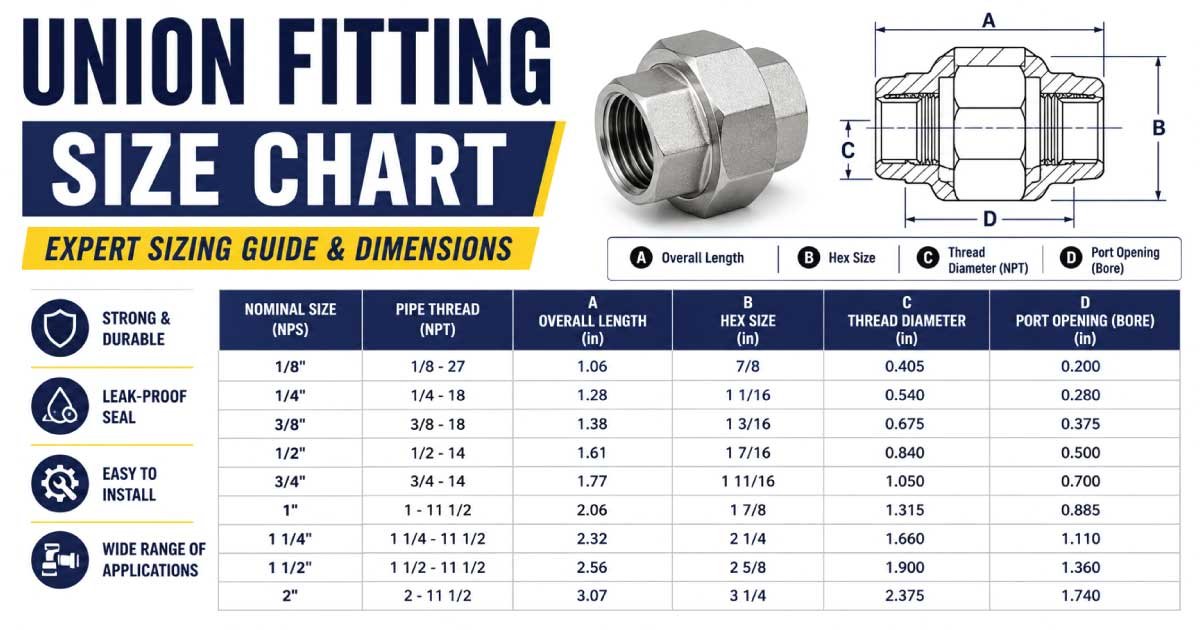
Union fittings are essential components in plumbing, industrial piping, HVAC, hydraulic, and gas systems. Unlike standard couplings, a union fitting allows pipes to be disconnected and reconnected without cutting or rotating the pipeline.
This makes maintenance, repairs, and equipment replacement much easier. Selecting the correct union fitting size ensures secure connections, leak-free performance, and efficient fluid flow.
This guide explains standard union fitting sizes, materials, connection types, and selection methods.
What Is a Union Fitting?
A union fitting is a three-piece pipe connector designed to join two pipes while allowing easy disassembly. It consists of a male end, a female end, and a central union nut that tightens the connection. Unlike permanent fittings, unions simplify maintenance because pipes can be separated without disturbing the surrounding piping system.
Key features include:
- Easy installation and removal
- Leak-resistant sealing
- Available in threaded, welded, and compression designs
- Suitable for high- and low-pressure systems
- Reusable connection
Why Union Fitting Size Matters
Choosing the correct union fitting size improves system performance and reduces maintenance issues. An incorrectly sized fitting may cause leaks, pressure loss, restricted flow, or difficulty during installation. Proper sizing ensures compatibility with connected pipes and long-term system reliability.
Benefits of proper sizing include:
- Secure pipe connections
- Reduced leakage
- Smooth fluid flow
- Easier maintenance
- Longer service life
- Better pressure handling
Union Fitting Size Chart (Nominal Pipe Size)
The following table lists the most commonly used union fitting sizes for residential, commercial, and industrial piping systems.
| Nominal Size (Inch) | DN Size | Outside Diameter (Approx.) | Typical Applications |
|---|---|---|---|
| 1/8″ | DN6 | 10.3 mm | Instrumentation |
| 1/4″ | DN8 | 13.7 mm | Pneumatic systems |
| 3/8″ | DN10 | 17.1 mm | Hydraulic lines |
| 1/2″ | DN15 | 21.3 mm | Residential plumbing |
| 3/4″ | DN20 | 26.7 mm | Water supply |
| 1″ | DN25 | 33.4 mm | Commercial piping |
| 1-1/4″ | DN32 | 42.2 mm | HVAC systems |
| 1-1/2″ | DN40 | 48.3 mm | Steam lines |
| 2″ | DN50 | 60.3 mm | Industrial pipelines |
| 2-1/2″ | DN65 | 73.0 mm | Chemical plants |
| 3″ | DN80 | 88.9 mm | Manufacturing industries |
| 4″ | DN100 | 114.3 mm | Municipal water systems |
| 6″ | DN150 | 168.3 mm | Process industries |
Parts of a Union Fitting
A union fitting consists of three precision-machined components that work together to create a removable and leak-proof joint. Understanding each part helps ensure proper installation and maintenance.
1. Male End
The male end contains external threads or a welded connection that joins one section of the pipe. It forms one side of the union and provides a sealing surface when tightened with the union nut.
2. Female End
The female end connects to the opposite pipe section and contains internal threads or another compatible connection. Together with the male end, it creates a strong, reusable connection suitable for repeated assembly and disassembly.
3. Union Nut
The union nut is the central locking component that pulls both ends together. Tightening the nut compresses the sealing surfaces, creating a leak-free joint while allowing future disassembly without rotating the connected pipes.
Types of Union Fittings
Union fittings are manufactured in several designs to accommodate different piping systems and applications.
1. Threaded Union
Threaded unions are the most common type used in plumbing and low- to medium-pressure piping systems. They can be installed quickly without welding, making them ideal for maintenance-friendly applications.
Applications include:
- Residential plumbing
- Water systems
- Compressed air
- Gas piping
- Irrigation systems
2. Socket Weld Union
Socket weld unions are commonly used for small-diameter, high-pressure piping systems. The pipe inserts into the fitting before welding, producing a strong and reliable joint suitable for steam, hydraulic, and industrial process systems.
3. Butt Weld Union
Butt weld unions provide excellent strength for medium- and large-diameter industrial pipelines. They are frequently used where permanent welded connections with removable equipment sections are required, such as refineries and power plants.
4. Compression Union
Compression unions use ferrules and compression nuts to create leak-resistant joints without welding or threading. These fittings are widely used for copper, stainless steel, and plastic tubing in plumbing, refrigeration, and instrumentation systems.
Common Union Fitting Materials
Material selection depends on pressure, temperature, corrosion resistance, and the fluid being transported. Choosing the right material improves durability and minimizes maintenance.
1. Stainless Steel Union
Stainless steel unions offer outstanding corrosion resistance and high strength, making them suitable for food processing, pharmaceutical manufacturing, marine environments, and chemical plants. They perform exceptionally well under high temperatures and demanding operating conditions.
2. Carbon Steel Union
Carbon steel unions are widely used in oil, gas, steam, and industrial processing systems. They provide excellent mechanical strength, high-pressure capability, and cost-effective performance for heavy-duty applications.
3. Brass Union
Brass unions are popular in residential plumbing, compressed air, and gas systems because they resist corrosion and are easy to install. They also provide reliable sealing for potable water applications.
4. PVC Union
PVC unions are lightweight, inexpensive, and resistant to rust and chemical corrosion. They are commonly installed in irrigation systems, swimming pools, drainage networks, and low-pressure water distribution systems.
Common Applications of Union Fittings
Union fittings are widely used wherever piping systems require periodic maintenance or equipment replacement. Their removable design eliminates the need to cut or rotate pipes during servicing, reducing downtime and labor costs.
Major applications include:
- Residential plumbing
- Commercial buildings
- HVAC systems
- Water treatment plants
- Chemical processing
- Oil and gas facilities
- Fire protection systems
- Hydraulic equipment
- Pneumatic systems
- Food and beverage processing
How to Choose the Correct Union Fitting Size
Selecting the correct union fitting size is essential for maintaining leak-free connections and efficient fluid flow. The fitting should match the pipe dimensions, pressure requirements, temperature range, and connection type. Proper sizing reduces maintenance issues and ensures long-lasting performance in residential, commercial, and industrial piping systems.
1. Match the Pipe Size
Always select a union fitting that matches the nominal pipe size (NPS) or outside diameter of the connected pipes. Using the correct size prevents leaks, minimizes flow restrictions, and ensures a secure connection.
Check the following:
- Pipe outside diameter
- Nominal pipe size (NPS)
- DN size
- Thread compatibility
- Connection standard
2. Verify the Pipe Schedule
The pipe schedule determines wall thickness and affects fitting compatibility. A union fitting must match the schedule of the connected pipe to ensure proper strength, alignment, and pressure-handling capability.
Common schedules include:
- Schedule 10
- Schedule 20
- Schedule 40
- Schedule 80
- Schedule 160
- XXS (Double Extra Strong)
3. Consider Operating Pressure
Pressure rating is an important factor when selecting a union fitting. High-pressure systems require fittings manufactured from stronger materials with thicker walls to ensure safe operation and prevent connection failures.
Consider:
- Maximum operating pressure
- Pressure surges
- Working pressure
- Safety margin
4. Select the Right Material
Different materials perform better in specific environments. Consider corrosion resistance, temperature, pressure, and the type of fluid before selecting a union fitting.
Common fluids include:
- Water
- Steam
- Oil
- Natural gas
- Chemicals
- Compressed air
- Food-grade liquids
📘 Explore Complete Size Guide 👉 Tube Size Chart: Standard Tube Dimensions Guide 2026
Pipe Schedule Size Chart
Matching the fitting to the correct pipe schedule ensures structural integrity and leak-free installation.
| Nominal Pipe Size | Schedule 40 Wall Thickness | Schedule 80 Wall Thickness |
|---|---|---|
| 1/2″ | 2.77 mm | 3.73 mm |
| 3/4″ | 2.87 mm | 3.91 mm |
| 1″ | 3.38 mm | 4.55 mm |
| 1-1/4″ | 3.56 mm | 4.85 mm |
| 1-1/2″ | 3.68 mm | 5.08 mm |
| 2″ | 3.91 mm | 5.54 mm |
| 3″ | 5.49 mm | 7.62 mm |
| 4″ | 6.02 mm | 8.56 mm |
Union Fitting Pressure Ratings
Pressure ratings vary according to material, manufacturing standard, and connection type. Always choose a fitting capable of handling the maximum system pressure for safe and reliable operation.
| Pressure Class | Typical Applications |
|---|---|
| Class 150 | Water systems |
| Class 300 | Commercial piping |
| Class 600 | Steam systems |
| Class 900 | Industrial processing |
| Class 1500 | Refineries |
| Class 2500 | High-pressure plants |
Common Union Fitting Standards
Union fittings are manufactured according to international standards to ensure compatibility, dimensional accuracy, and reliable performance across different piping systems.
Common standards include:
- ASME B16.11
- ASME B1.20.1
- ASTM A105
- ASTM A182
- ASTM B62
- MSS SP-83
- ISO Standards
- DIN Standards
Advantages of Union Fittings
Union fittings offer several advantages over permanent pipe connections, especially in systems requiring regular maintenance or equipment replacement. Their reusable design simplifies servicing while maintaining dependable sealing performance.
Key advantages include:
- Easy pipe disconnection
- Reusable connection
- Leak-resistant sealing
- Quick installation
- Reduced maintenance time
- Excellent durability
- Wide material selection
- Suitable for high-pressure systems
📘 Explore Complete Size Guide 👉 Screw Size Chart: Complete Guide to Screw Sizes
Limitations of Union Fittings
Although highly practical, union fittings also have some limitations. Proper installation and correct sizing help reduce these issues while maintaining reliable system performance.
Common limitations include:
- Higher cost than couplings
- More installation space required
- Thread wear after repeated use
- Additional sealing surfaces
- Limited use in extremely confined spaces
How to Install a Union Fitting
Proper installation ensures a secure, leak-free connection and extends the service life of both the fitting and the piping system.
Basic Installation Steps
- Measure and prepare the pipe.
- Clean the pipe ends thoroughly.
- Install the male and female sections.
- Position the sealing surfaces correctly.
- Tighten the union nut evenly.
- Avoid over-tightening.
- Perform a pressure test.
- Inspect for leaks before operation.
Maintenance Tips for Union Fittings
Regular inspection helps maintain reliable performance and prevents unexpected leaks. Proper maintenance also extends the service life of the fitting and connected piping.
Maintenance recommendations:
- Inspect sealing surfaces regularly.
- Check for corrosion.
- Tighten loose union nuts.
- Replace damaged seals.
- Clean threaded connections.
- Monitor vibration.
- Perform routine pressure testing.
Union Fitting vs Coupling
Although unions and couplings both connect pipes, they serve different purposes and offer different maintenance advantages.
| Feature | Union Fitting | Coupling |
|---|---|---|
| Removable | Yes | No |
| Easy Maintenance | Excellent | Limited |
| Reusable | Yes | Usually No |
| Installation | Simple | Simple |
| Cost | Higher | Lower |
| Best Use | Equipment servicing | Permanent connections |
Common Installation Mistakes
Incorrect installation can reduce sealing performance and increase maintenance costs. Following manufacturer recommendations helps prevent premature fitting failure.
Avoid these mistakes:
- Selecting the wrong fitting size
- Mixing incompatible thread types
- Over-tightening the union nut
- Damaging sealing surfaces
- Using incorrect pipe schedule
- Installing misaligned pipes
- Ignoring pressure ratings
- Skipping leak testing
📘 Explore Complete Size Guide 👉 Machine Screw Size Chart: Complete Guide 2026
Industries That Use Union Fittings
Union fittings are widely used in industries where equipment requires frequent inspection, maintenance, or replacement. Their removable design minimizes downtime and simplifies servicing.
Major industries include:
- Oil and gas
- Water treatment
- Chemical processing
- Food manufacturing
- Pharmaceutical production
- HVAC systems
- Fire protection
- Marine engineering
- Hydraulic systems
- Industrial manufacturing
Key Takeaways
Union fittings provide a practical, reliable, and maintenance-friendly solution for connecting pipes in residential, commercial, and industrial systems.
By selecting the correct size, material, pressure rating, and connection type, you can ensure leak-free operation, simplify future maintenance, and improve overall system performance.
Whether used in plumbing, HVAC, oil and gas, chemical processing, or water treatment, properly sized union fittings contribute to safer operation, reduced downtime, and longer service life.
FAQs:
What is a union fitting used for?
A union fitting is used to connect two sections of pipe while allowing quick disconnection for maintenance, repairs, inspections, or equipment replacement. Unlike permanent pipe connections, unions can be separated without cutting or rotating the pipeline, making installation, servicing, and future modifications much easier and more cost-effective.
What sizes do union fittings come in?
Union fittings are commonly available in sizes from 1/8 inch to 6 inches, with larger sizes manufactured for heavy industrial applications. The correct size depends on the pipe diameter, pressure rating, flow requirements, and system specifications used in plumbing, oil and gas, chemical processing, and industrial piping systems.
Can union fittings be reused?
Yes, union fittings are designed for repeated use. If the threads, sealing surfaces, and gasket or O-ring remain undamaged, the fitting can be disconnected and reassembled multiple times without compromising performance. Regular inspection and proper installation help ensure leak-free operation and extend the fitting’s service life significantly.
Which material is best for union fittings?
The best material depends on the intended application. Stainless steel provides excellent corrosion resistance, carbon steel is suitable for high-pressure systems, brass is widely used in plumbing and gas lines, while PVC is ideal for low-pressure water systems because of its lightweight construction and corrosion-resistant properties.
What is the difference between a union and a coupling?
A union fitting allows pipes to be disconnected and reconnected easily without cutting or rotating the pipeline, making maintenance convenient. A coupling creates a more permanent connection between pipes and usually requires cutting, pipe removal, or system disassembly when repairs, replacements, or modifications become necessary.

Engineer Hassan is a Mechanical Engineer with 16+ years of hands-on experience in mechanical hardware, fasteners, and workshop tools. He focuses on size selection, thread identification, and measurement, helping users choose the correct components with accuracy and safety.