
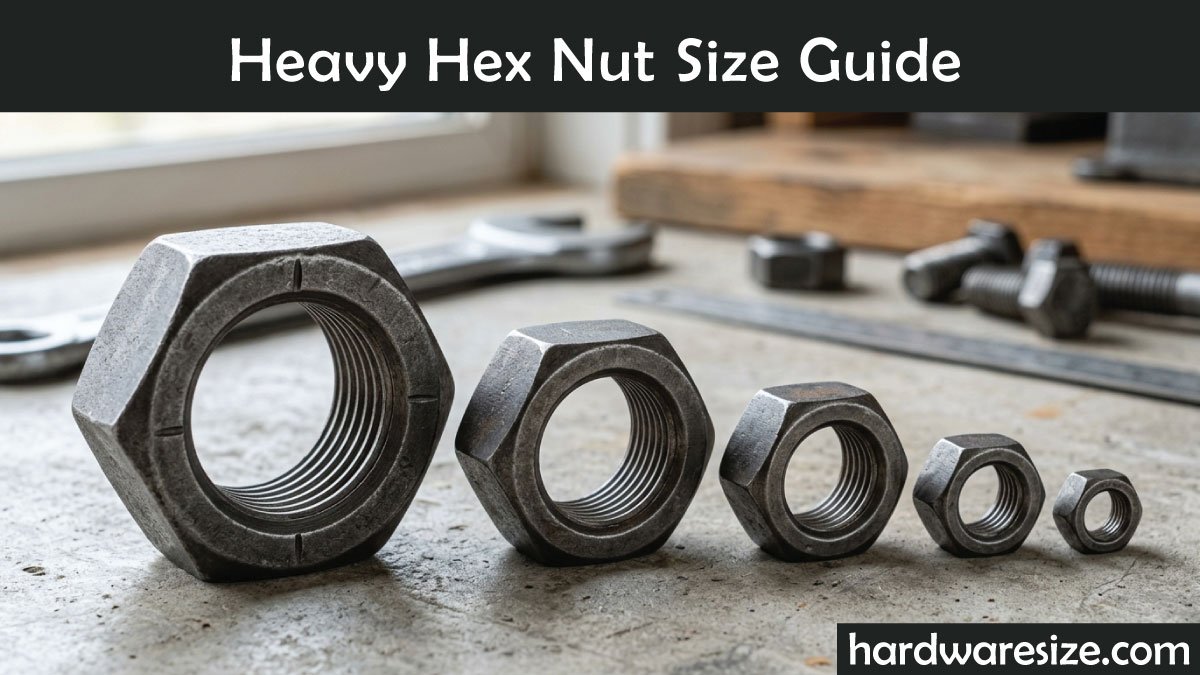
Heavy hex nuts are widely used in construction, structural steelwork, bridges, heavy machinery, and industrial fastening applications. Compared to standard hex nuts, they offer greater strength, improved load distribution, and better resistance to vibration and loosening.
Their definition, dimensions, sizes, and materials can be understood by engineers, contractors, and buyers to choose the right fastener in the challenging settings.
This guide explains everything you need to know about heavy hex nuts in simple and practical terms.
What Is a Heavy Hex Nut?
A heavy hex nut is a six-side internally threaded fastener which is wider and fatter across flats than an average hex nut. It is set to work with high-strength bolts in which greater clamping force and durability are needed.
The heavy hex nuts are typically coupled with structural bolts and are made to high level of requirements in terms of dimension and mechanical requirements e.g. ASTM, ASME and ISO.
Key Characteristics
- Thicker profile than standard hex nuts
- Larger bearing surface
- Designed for high-load and structural applications
- Improved resistance to stripping and deformation
Heavy Hex Nut – Definition
A heavy hex nut is a six-sided internally threaded nut, which is not only thicker and wider than a normal hex nut. It is used in high strength and structural where a higher load bearing capacity is needed, better thread engagement and resistance to loosening.
The construction, bridges, steel structures, heavy machinery, and heavy hex nuts are commonly used with structural and high-strength bolts.
They have a higher bearing surface that spreads the pressure evenly and thus the chances of thread stripping or failure of the joint under heavy load is reduced.
Heavy Hex Nut vs Standard Hex Nut
Although heavy hex nuts and standard hex nuts may look alike, they are designed for different purposes. Heavy hex nuts provide greater strength, thicker profiles, and wider bearing surfaces, make them ideal for structural and high-load applications, while standard hex nuts are suited for general, light-duty fastening needs.
Table: Heavy Hex Nut vs Standard Hex Nut
| Feature | Heavy Hex Nut | Standard Hex Nut |
|---|---|---|
| Thickness | Thicker | Thinner |
| Width Across Flats | Wider | Narrower |
| Load Capacity | High | Moderate |
| Applications | Structural & heavy-duty | General fastening |
| Cost | Slightly higher | Lower |
What Does a Heavy Hex Nut Look Like?
A heavy hex nut is a six-sided, solid shape, which is more or less a regular hex nut, except that it is much thicker and broader.
Its horizontal top and bottom surface and higher height will have a better tool grip and higher thread engagement which will lead to more strength, stability and durability on high stress and structural application.
A heavy hex nut has:
- A six-sided (hexagonal) shape
- A flat top and bottom surface
- A larger height and wider face compared to standard nuts
Because of its increased thickness, it provides more thread engagement, which significantly improves strength and durability in high-stress applications.
Heavy Hex Nut Dimensions Explained
Heavy hex nut dimensions determine how accurately the nut fits with bolts and tools. These measurements are standardized to ensure proper alignment, secure fasten, and also compatibility across manufacturers. Key dimensions include the nominal diameter, which matches the bolt size, the width across flats for wrench fitting, and the nut’s thickness, which affects strength.
Common Dimensions Include:
- Nominal Diameter – Bolt size the nut fits
- Width Across Flats (WAF) – Distance between two opposite flat sides
- Thickness (Height) – Vertical height of the nut
Heavy Hex Nut Dimensional Overview Table Chart
| Dimension Name | Description | Importance |
|---|---|---|
| Nominal Diameter | Thread size (e.g., 1/2″, 3/4″) | Determines bolt compatibility |
| Width Across Flats | Tool grip size | Affects wrench selection |
| Thickness | Nut height | Influences load strength |
| Thread Pitch | Threads per inch | Ensures secure fit |
Heavy Hex Nut Size Chart
Heavy hex nuts are available in both imperial (inch) and metric sizes to suit the various bolt standards. The sample inch-size chart below indicates popular dimensions, and can assist you in choosing the appropriate nut, depending on the size of bolts, fits of a wrench and the necessary thickness in achieving secure and reliable attachment.
Heavy Hex Nut Size Chart (Inch Series) With Table
| Bolt Size | Width Across Flats | Thickness |
|---|---|---|
| 1/2″ | 7/8″ | 7/16″ |
| 5/8″ | 1-1/16″ | 9/16″ |
| 3/4″ | 1-1/4″ | 21/32″ |
| 7/8″ | 1-7/16″ | 3/4″ |
| 1″ | 1-5/8″ | 7/8″ |
Note: Dimensions may vary slightly depending on standards such as ASTM A563 or ASME B18.2.2.
Heavy Hex Nut Materials
The choice of material is a significant factor in the strength, durability, resistance to corrosion, and suitability of a period heavy hex nut. The choice of the appropriate material guarantees the nut to be reliable in terms of load, exposure to the environment, and its durability in terms of structural or industrial projects.
1- Carbon Steel
The carbon steel heavy hex nuts are characterized by high strength, low costs, and broad supply. They are typically utilized in structural steel, construction, and other industrial applications that require a high load capacity but are not very costly. They provide good performance under controlled conditions.
2- Alloy Steel
The heavy hex nuts made of alloy steel are of extraordinary tensile strength, toughness and extreme load resistance. They are applicable in heavy machineries, high pressure as well as critical mechanical uses where maximum durability and performance are needed in cases of stress and vibrations.
3- Stainless Steel
The stainless steel heavy hex nuts are prized due to high level of corrosion resistance, clean and long life. They are widely applied in outdoors, maritime, food grade and chemical settings where rust, moisture and severe conditions resistance are necessary.
4- Galvanized Steel
Galvanized steel heavy hex nuts, which have been coated with zinc to give them the additional protection against rust and corrosion. This predisposes them to construction, outdoor construction, fencing, and exposed structures where moisture and weather conditions otherwise tend to shorten the life span of the fasteners.
5- Brass
Brass heavy hex nuts are free of rust and non-magnetic, plus, electrically conductive; hence, they are applicable to electrical systems, decorative purposes, and areas that need to be resistant to rust. They are not as hard as steel but give good service under low-load and specialty application.
6- Heavy Hex Nut Materials Explained With Table
| Material | Properties | Typical Applications |
|---|---|---|
| Carbon Steel | High strength, economical | Structural steel |
| Alloy Steel | Very high tensile strength | Heavy machinery |
| Stainless Steel | Corrosion resistant | Outdoor & marine |
| Galvanized Steel | Rust protection | Construction projects |
| Brass | Non-magnetic, corrosion resistant | Electrical uses |
Grades of Heavy Hex Nuts
There are various grades of heavy hex nuts that are produced to suit the strength and specifications of the bolts they are intended to be used as. When choosing a grade, three critical issues of structural integrity, load-bearing or performance, and safety need to be considered in construction, machinery, and industrial applications. The different grades have purposes and application in the environment.
Common Grades:
-
ASTM A563 Grade A – General structural use
-
ASTM A563 Grade DH – High-strength applications
-
ASTM A194 Grade 2H – Used with ASTM A193 bolts
-
ASTM F594 – Stainless steel grade
Choosing the correct grade ensures proper load-bearing performance and safety.
How to Measure a Heavy Hex Nut
Accuracy is necessary when measuring a heavy hex nut so that it can fit the bolt correctly, washer firmly screwed, and the load can be safely carried. By applying the right equipment and a few steps sequentially, you know what size nut, thread, and dimensions overall you need in the structural or heavy-duty mode of use.
1. Measure the Nominal Diameter
First measure the inside diameter of the nut with a caliper. This is used to determine the bolt size that the heavy hex nut is supposed to fit. The correct measure of the diameter is necessary to prevent loose fits or mismatch in the threads during installation.
2. Check the Thread Pitch
Measure the number of threads per inch or the thread spacing in the metric. The correct thread pitch should be matched to protect against cross threading, premature wear or loss of fastening, the correct thread pitch should be matched.
3. Measure Width Across Flats (WAF)
Find the distance between two parallel adjacent flat sides of the nut. This is the width across flats that is used to check the required size of the necessary wrench or socket to install and tighten the tool and to make sure the tool is being firmly gripped and the possibility of rounding is avoided.
4. Measure the Nut Thickness
Measure the height of the nut at its top and bottom. The heavy hex nuts have a greater thread engagement, higher load distribution, and greater resistance to stripping in high tightening forces as the nuts are heavier than the normal nuts.
5. Identify the Material and Grade
Check marks, finish or documentation to determine the material of the nut and grade. Having this information will verify the strength ratings, corrosion and compatibility to the corresponding bolt when used in structural or high strength applications.
6. Verify the Applicable Standard
Establish the manufacturing standard, e.g. ASTM A563 or ASME B18.2.2. It is used to assure standards and it can be applied in construction and industrial applications to verify that the dimensions are correct, the load capacity is adequate, and the project or safety standards have been met.
Applications of Heavy Hex Nuts
Heavy hex nuts have found application in industries that place great importance on strength, safety and reliability. Their construction is such that they can withstand high tension loads thus being suited in those areas that require secure and durable fastening in extreme conditions. The selection of the correct nut makes certain of long run efficiency and strength.
Typical Applications:
-
Structural steel connections
-
Bridges and highway projects
-
Power plants and refineries
-
Heavy equipment assembly
-
Wind and solar installations
Their ability to handle high tension loads makes them essential for critical joints.
Advantages of Heavy Hex Nuts
Heavy hex nuts have a few important benefits that render them suitable to strenuous usage. Their design of being thicker and their broader bearing surfaces offers them better load capacity, better tool engagement and structural safety.
They also minimize the chances of thread stripping and add to their service life thus making them a good selection when it comes to heavy-duty projects.
Key Advantages:
| Advantage | Benefit |
|---|---|
| Higher Load Capacity | Can handle stronger bolts and heavier forces |
| Better Tool Engagement | Easier and safer to tighten with wrenches or sockets |
| Reduced Risk of Thread Stripping | Less likely to deform under high torque |
| Longer Service Life | Durable for long-term structural applications |
| Improved Structural Safety | Provides reliable fastening for critical joints |
Standards and Specifications
Heavy hex nuts are manufactured in line with set standards, consistency, safety, and bolts compatibility. These standards dictate dimensions, mechanical properties and material requirements and it is easier to choose the appropriate nut in structural, industrial or heavy-duty application. The standard must be checked prior to purchase.
- ASTM A563
- ASTM A194
- ASME B18.2.2
- ISO 4032 (metric equivalents)
Always confirm the standard required for your project before purchasing.
Final Thoughts
Hex nuts, which are heavy, are critical in the field of structural and industrial fastening. They are thicker, broader in size, and are made of high-strength material making them used in the application where safety, durability and load capacity are important.
Understand definitions, dimensions, sizes, materials, and standards could make you decide with a lot of confidence on what type of heavy hex nut to use in any heavy-duty application.
👉 Learn all about Wrench Sizes Explained: Tips, Charts & Selection Guide in this detailed post. Understand how to choose the right wrench for every nut and bolt, use charts for accurate sizing, and follow expert tips for safe and efficient work. Read the full guide for precise and hassle-free fastening!

Engineer Hassan is a Mechanical Engineer with 16+ years of hands-on experience in mechanical hardware, fasteners, and workshop tools. He focuses on size selection, thread identification, and measurement, helping users choose the correct components with accuracy and safety.