
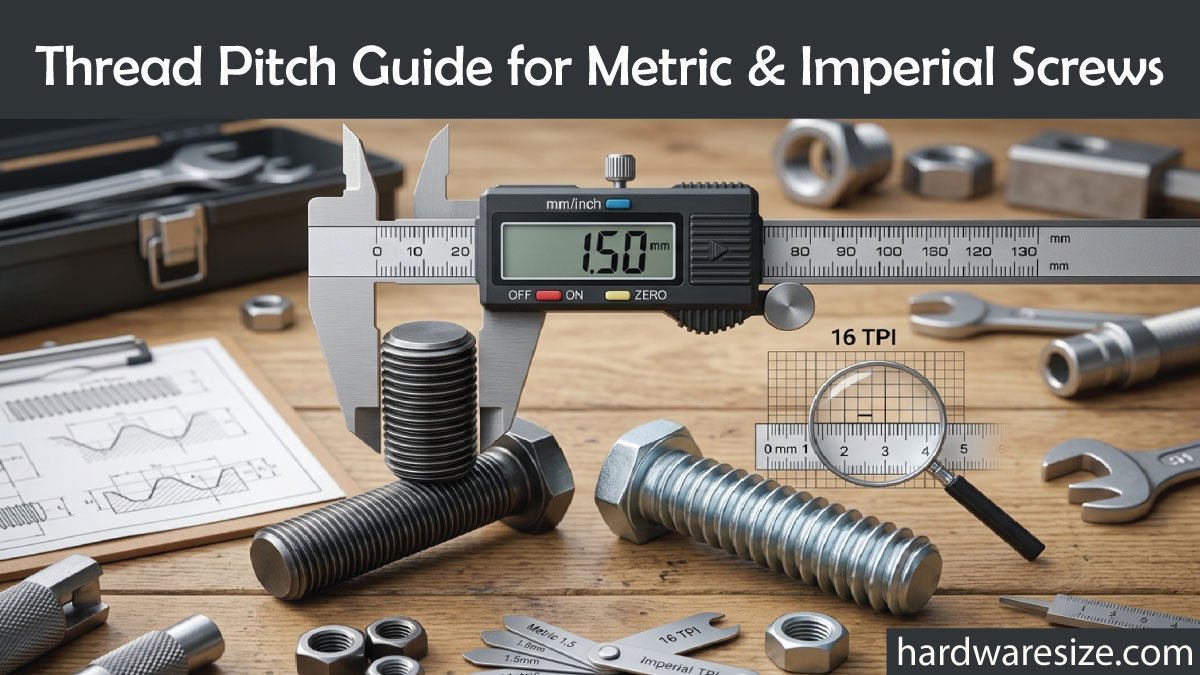
When working with screws, bolts, and fasteners, one of the most important concepts to understand is thread pitch. Whether you are doing woodworking, mechanical repair, metal fabrication, or DIY home projects, choosing the correct thread pitch ensures a strong, secure, and reliable connection.
But here’s where many beginners get confused: metric and imperial screws measure thread pitch in completely different ways. If you do not understand the difference, you can easily end up with mismatched fasteners that don’t fit properly.
In this detailed guide, you will learn what thread pitch means, how it works in both metric and imperial systems, and how to choose the right one for your project.
What Is Thread Pitch?
Thread pitch refers to the exact distance between one thread crest and the next on a screw or bolt. It basically shows how tightly the threads are wrapped around the fastener. This spacing plays a key role in how the screw engages with a nut or threaded hole during fastening.
In simple words:
👉 It tells you how tightly or loosely the threads are spaced.
A smaller pitch means threads are closer together, which creates finer control and smoother adjustments. A larger pitch means threads are spaced farther apart, allowing quicker fastening but usually less precision in movement.
Thread pitch affects:
- Strength of fastening
- Ease of tightening
- Resistance to vibration
- Compatibility with nuts and tapped holes
Why Thread Pitch Matters
Thread pitch is often ignored by beginners who only focus on diameter and length, but it is equally important in ensuring a proper mechanical fit. Even a correctly sized screw can fail if the thread pitch does not match the mating part.
If the pitch is wrong:
- The screw will not fit properly
- Threads may get damaged
- The joint will become weak
- Fastener may loosen under pressure
This is why engineers, mechanics, and manufacturers always verify thread pitch before assembly. A correct pitch ensures safety, durability, and long-term performance in any mechanical connection.
Metric Thread Pitch System
The metric thread pitch system is the most commonly used standard worldwide, especially in engineering, manufacturing, and construction. It is part of the ISO metric system, designed for simplicity and consistency. In this system, thread pitch is measured in millimeters, making it easy to understand, calculate, and apply in real-world mechanical work.
The metric system is widely used around the world. In this system, thread pitch is measured in millimeters (mm), which allows engineers and technicians to quickly identify spacing between threads without complex conversions. This makes it highly practical for international industries and standardization.
How Metric Thread Pitch Works
In metric screws, the concept is straightforward and easy to interpret. The thread pitch directly indicates the distance between two adjacent threads, measured in millimeters. This clear measurement system reduces confusion and helps ensure accurate matching of screws, bolts, and tapped holes in mechanical applications.
👉 Thread pitch = distance between threads (in mm)
For example:
M8 × 1.25 means:
- M8 = 8 mm diameter screw
- 1.25 = 1.25 mm distance between threads
This means each thread is spaced 1.25 mm apart along the length of the screw, ensuring a precise and standardized fit with compatible nuts or threaded holes.
Metric Thread Types
Metric threads are standardized screw thread systems used worldwide for fastening parts in mechanical, automotive, and industrial applications. They mainly differ based on pitch, strength, and usage requirements. The two most common types are coarse threads and fine threads, each designed for specific performance needs and working conditions.
1. Coarse Thread
Coarse threads have a larger pitch, meaning the distance between threads is wider. This design allows faster installation and easier assembly, especially in general-purpose applications. They are more resistant to damage and stripping, making them ideal for rough or soft materials like aluminum and plastic. A common example is M8 × 1.25.
2. Fine Thread
Fine threads feature a smaller pitch with closer spacing between threads. This provides better precision and a tighter fit, which improves holding strength under vibration. They are commonly used in automotive, machinery, and high-stress engineering applications where accuracy matters. A typical example is M8 × 1.0, offering improved tensile strength and control.
Advantages of Metric Thread System
The metric thread system is widely preferred in modern engineering and manufacturing because of its simplicity, accuracy, and global standardization. It follows a logical decimal-based structure, making it easy for technicians and engineers to understand, measure, and apply in real-world mechanical designs without confusion or complex conversions.
Easy to calculate: Metric threads use simple millimeter measurements, which makes calculations straightforward. Engineers can quickly determine spacing, compatibility, and sizing without needing complex formulas or conversions.
Based on decimal system: The entire system is built on powers of 10, meaning conversions between units are very simple. You only need to move a decimal point to switch between millimeters, centimeters, and meters.
Universally standardized (ISO system): The metric thread system follows ISO international standards, ensuring that parts made in different countries remain compatible. This reduces errors in global manufacturing and trade.
Widely used in engineering and manufacturing: Most industries such as automotive, aerospace, construction, and machinery rely on metric threads due to their reliability, precision, and global acceptance.
Imperial Thread Pitch System
The imperial system, commonly used in the United States, measures thread pitch differently compared to the metric system. Instead of measuring the distance between two threads in millimeters, it focuses on how many threads fit within a one-inch length. This method is known as TPI (Threads Per Inch), and it is still widely used in older machines and American engineering standards.
👉 Threads per inch (TPI)
This means how many threads are present in one inch of screw length. A higher TPI indicates finer threads, while a lower TPI means coarser threads with wider spacing.
How Imperial Thread Pitch Works
In the imperial thread system, the concept of pitch is based on counting threads rather than measuring spacing. Instead of calculating the distance between two threads, engineers simply count how many threads appear within one inch of screw length. This method is known as Threads Per Inch (TPI) and is commonly used in American engineering standards.
For example:
1/4”-20 UNC means:
- 1/4 inch diameter screw
- 20 threads per inch
So instead of measuring spacing, you count how many threads fit in one inch. A higher number means finer threads, while a lower number means coarser threads with stronger gripping ability.
Common Imperial Thread Sizes
Imperial thread sizes are widely standardized and used in many industries, especially in the United States. Each size is designed for specific applications, ranging from delicate electronics to heavy-duty mechanical structures. Understanding these common sizes helps in selecting the right fastener for strength, precision, and durability.
Here are some widely used imperial thread specifications:
#4-40 → Small electronics
Used in computers, circuit boards, and small precision devices where compact and fine fastening is required.
#6-32 → Electrical equipment
Commonly found in electrical panels, appliances, and general hardware assemblies due to its balanced strength and size.
#8-32 → General-purpose screws
Used in household products, machinery covers, and light mechanical fittings for everyday applications.
1/4”-20 UNC → Very common bolt size
One of the most widely used fasteners in construction, automotive, and general engineering work.
5/16”-18 UNC → Medium strength
Used in automotive parts, machinery assemblies, and structural connections requiring moderate load support.
3/8”-16 UNC → Heavy-duty fastening
Designed for strong mechanical joints, industrial equipment, and structural frameworks where high strength is essential.
UNC vs UNF Threads
Imperial thread systems are widely used in the United States and follow the Unified Thread Standard (UTS). The two main types are UNC and UNF threads. They differ mainly in thread spacing, strength, and application. Each type is designed to perform better in specific mechanical and engineering conditions.
1. UNC (Unified National Coarse)
UNC threads have fewer threads per inch, meaning the threads are spaced further apart. This design provides a stronger grip and faster assembly, making them suitable for general-purpose applications. They are more resistant to damage and are commonly used in construction and machinery. A typical example is 1/4”-20 UNC.
2. UNF (Unified National Fine)
UNF threads have more threads per inch, resulting in closer spacing between threads. This allows better precision, improved holding power, and stronger resistance to vibration loosening. They are widely used in automotive, aerospace, and precision engineering applications where accuracy is critical. A common example is 1/4”-28 UNF.
Metric vs Imperial Thread Pitch Differences
How to Measure Thread Pitch
Measuring thread pitch is essential for identifying screws, bolts, and fasteners correctly. It helps ensure compatibility in mechanical assembly and prevents fitting errors. There are different methods for measuring thread pitch depending on whether you are using tools or simple measuring techniques.
Method 1: Thread Pitch Gauge
A thread pitch gauge is the most accurate and professional tool for measuring thread pitch. It contains multiple metal blades with marked thread patterns that match different pitches. By aligning the gauge with the screw threads, you can quickly identify the correct pitch.
Steps:
- Match the gauge teeth with the screw threads carefully
- Adjust until you find a perfect fit with no gaps
- Read the pitch value printed on the matched blade
Method 2: Ruler (Metric System)
A ruler can be used when a pitch gauge is not available. This method is commonly used for metric screws and gives a good approximate result.
Steps:
- Measure a 10 mm section of the screw threads
- Count how many full threads are within that distance
- Divide 10 by the number of threads to get the pitch
Example:
If there are 8 threads in 10 mm:
Pitch = 10 ÷ 8 = 1.25 mm
Method 3: Ruler (Imperial System)
For imperial screws, thread pitch is measured in threads per inch (TPI). This method is simple and widely used in hardware systems.
Steps:
- Measure exactly 1 inch along the screw threads
- Count the total number of thread peaks within that inch
- That number is the TPI value
Example:
If there are 20 threads in 1 inch:
TPI = 20
Why Thread Pitch Compatibility Is Critical
Thread pitch compatibility is extremely important in any mechanical, construction, or engineering work. Even if two screws look similar in size, a mismatch in thread pitch can completely prevent proper fastening. This is because threads must align perfectly to create a secure and stable connection.
Mixing thread systems or incorrect pitch can cause serious problems:
Cross-threading damage: When incompatible threads are forced together, they can cut or destroy each other. This permanently damages both the screw and the threaded hole, making future fastening difficult or impossible.
Weak mechanical joints: If threads do not fully match, the contact area between surfaces is reduced. This leads to weak joints that cannot handle proper load or pressure during operation.
Loose fittings under vibration: Mismatched thread pitch can cause screws to gradually loosen when exposed to vibration or movement, which is especially dangerous in machines and vehicles.
Equipment failure: In critical systems, incorrect thread engagement can lead to part failure, breakdowns, or even safety hazards in mechanical assemblies.
Even if the diameter matches, incorrect pitch will not fit. The screw may appear correct at first glance, but it will not properly engage, proving that thread pitch is just as important as size when selecting fasteners.
Also Read: 👉 Metric vs Imperial Units in Engineering (Simple Guide) explains the difference between two major measurement systems used in engineering. Learn how metric and imperial units work, how to convert them, and avoid common mistakes in calculations. Read the full post for complete understanding.
Applications of Thread Pitch
Thread pitch plays a very important role in different industries because it affects strength, precision, and reliability of fastening. Choosing the correct pitch ensures safety, durability, and proper performance in mechanical and structural systems.
1. Automotive Industry
In the automotive industry, different thread pitches are used depending on the function of the part. Fine threads are commonly used in engine components because they provide high precision and better resistance to vibration. On the other hand, coarse threads are used in suspension and heavy parts where strength and quick assembly are more important than precision.
2. Construction
In construction work, thread pitch is mainly selected for strength and durability. Coarse threads are widely used in structural bolts because they provide strong engagement with materials like steel and concrete. They are also more resistant to wear and damage, making them suitable for heavy-duty frameworks and building structures.
3. Electronics
In electronics, small screws with fine thread pitch are commonly used. These screws allow precise fastening without damaging sensitive and delicate components. Fine threads also help in controlled tightening, which is important in compact devices like laptops, smartphones, and circuit boards where accuracy is critical.
4. Plumbing
In plumbing systems, standardized thread pitches are used in pipe fittings to ensure proper sealing. These threads help create tight connections that prevent water or gas leaks under pressure. Correct thread selection is essential for maintaining safety and efficiency in residential and industrial plumbing systems.
Tips for Choosing the Right Thread Pitch
Selecting the correct thread pitch is essential for achieving strong and reliable fastening in any mechanical or construction project. Proper selection ensures safety, durability, and smooth assembly without damaging components or threads during installation.
Here are some practical tips:
✔ Always check compatibility before tightening
✔ Use coarse threads for strength-heavy applications
✔ Use fine threads for precision work
✔ Keep a thread gauge in your toolkit
✔ Don’t force mismatched screws
Common Mistakes Beginners Make
Many beginners face issues while working with screws and bolts because they overlook thread pitch or use incorrect methods during selection and installation. These small mistakes can lead to serious mechanical problems or damaged components.
- Confusing metric and imperial systems
- Ignoring thread pitch and focusing only on diameter
- Over-tightening mismatched screws
- Using wrong tools for measurement
Avoiding these mistakes saves time and prevents damage.
Simple Conversion Insight (Metric vs Imperial)
Understanding basic conversions between metric and imperial units can help in quick estimation when working with mixed systems. However, these values are only approximate and should not replace proper measurement tools for accurate thread matching.
- 1 inch = 25.4 mm
- 1 mm ≈ 0.039 inches
But thread pitch should not be guessed—you should always verify using proper tools.
Final Thoughts
Understanding the thread pitch guide for metric and imperial screws is essential for anyone working with tools, machinery, or DIY projects.
Metric systems are easier to understand because they use direct millimeter spacing, while imperial systems rely on counting threads per inch. Both systems are widely used in different parts of the world, and knowing how to identify them helps you avoid costly mistakes.
If you work with fasteners regularly, investing in a thread pitch gauge and learning both systems will make your work more accurate, professional, and reliable.
In the end, choosing the right thread pitch is not just about fitting parts together—it’s about ensuring strength, safety, and long-term performance.
Also Read: 👉 How to Read Vernier Caliper Measurements (Easy Guide) shows a simple way to understand and read precise measurements using a vernier caliper. Learn step-by-step methods to measure small dimensions accurately in workshop and engineering tasks. Read the full post for complete practical guidance.
FAQs:
What is the pitch of a metric screw thread?
The pitch of a metric screw thread is the distance between two adjacent thread peaks, measured in millimeters. It indicates how fine or coarse the thread is. For example, a pitch of 1.25 mm means each thread is spaced 1.25 mm apart.
What does M8, M10, M12 mean?
M8, M10, and M12 refer to metric thread sizes where “M” stands for metric and the number represents the nominal diameter in millimeters. For example, M8 means an 8 mm diameter bolt. The pitch may vary unless specifically mentioned alongside the size.
What is the difference between metric and imperial thread pitch?
Metric thread pitch is measured as the distance between threads in millimeters, while imperial thread pitch is measured in threads per inch (TPI). Metric uses spacing, whereas imperial counts how many threads fit within one inch length.
What is the definition of thread pitch?
Thread pitch is defined as the distance between corresponding points on adjacent threads, typically measured from peak to peak. In metric systems, it is expressed in millimeters and determines how tightly or loosely the threads are spaced along the fastener.
Is M12 the thread pitch?
No, M12 is not the thread pitch. It represents the nominal diameter of the thread, which is 12 mm. The pitch is a separate value, such as 1.75 mm for a standard M12 thread, and must be specified separately.
What does 1.25 thread pitch mean?
A 1.25 thread pitch means the distance between two adjacent threads is 1.25 millimeters. This indicates a relatively fine thread, often used where precision and better holding strength are required compared to coarse threads with larger spacing.
How to define thread pitch?
Thread pitch is defined by measuring the distance between two consecutive thread peaks in a straight line parallel to the axis. It can also be determined using a thread pitch gauge, which helps match the spacing accurately for identification.
What are the two types of thread pitch?
The two main types of thread pitch are coarse and fine. Coarse threads have larger spacing and are stronger and easier to assemble, while fine threads have smaller spacing, offering better precision, tighter fit, and improved resistance to loosening in vibrations.

Engineer Hassan is a Mechanical Engineer with 16+ years of hands-on experience in mechanical hardware, fasteners, and workshop tools. He focuses on size selection, thread identification, and measurement, helping users choose the correct components with accuracy and safety.