
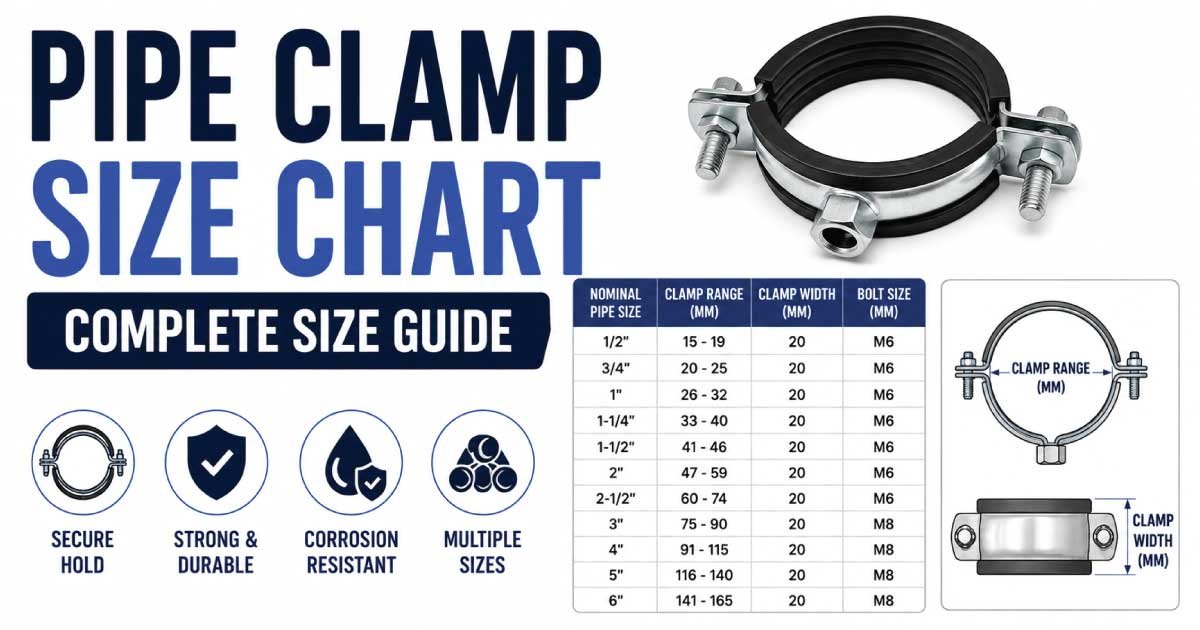
A pipe clamp is a mechanical fastening and support component used to secure pipes, tubes, conduit, hoses, and other cylindrical components to walls, ceilings, floors, frames, and structural supports. Pipe clamps are available in many styles, materials, and sizes, making them useful in plumbing, HVAC, industrial piping, hydraulic systems, electrical installations, and construction.
Choosing the correct pipe clamp size requires more than matching the nominal pipe size. The actual outside diameter, clamp inside diameter, pipe material, load, temperature, vibration, mounting method, and support spacing can all affect the correct selection.
This complete pipe clamp size chart and guide covers common pipe clamp sizes, metric and imperial dimensions, types, materials, installation methods, measurements, applications, and important selection considerations.
What Is a Pipe Clamp?
A pipe clamp is a fastening device designed to support, secure, or guide a pipe while preventing unwanted movement.
Depending on its design, a pipe clamp may attach a pipe to:
- Walls
- Floors
- Ceilings
- Structural steel
- Machinery
- Equipment frames
- Concrete surfaces
- Mounting rails
Pipe clamps can also reduce pipe movement caused by:
- Vibration
- Thermal expansion
- Fluid movement
- Mechanical loads
- External forces
Common pipe clamp designs include split clamps, two-piece clamps, U-bolt clamps, cushioned clamps, hanger clamps, and saddle-style clamps.
How Does a Pipe Clamp Work?
A typical pipe clamp surrounds part or all of a pipe and connects it to a supporting structure.
The clamp creates a controlled connection between the pipe and its support.
Depending on the type, the clamp may:
- Hold the pipe firmly
- Allow controlled axial movement
- Reduce vibration
- Prevent lateral movement
- Guide the pipe
- Support the weight of the pipe and contents
The correct clamp must be selected according to the intended function.
A clamp designed for light electrical conduit should not automatically be used for a heavy industrial pipeline.
Pipe Clamp Size Chart
The following chart provides a general reference for common pipe clamp sizes.
| Nominal Clamp Size | Approx. Diameter | Common Application |
|---|---|---|
| 1/4 in | 6.35 mm | Small tubing |
| 3/8 in | 9.53 mm | Tubing and small lines |
| 1/2 in | 12.70 mm | Small pipe and conduit |
| 3/4 in | 19.05 mm | Plumbing and conduit |
| 1 in | 25.40 mm | Small pipe |
| 1-1/4 in | 31.75 mm | Plumbing |
| 1-1/2 in | 38.10 mm | Pipe and tubing |
| 2 in | 50.80 mm | Plumbing and HVAC |
| 2-1/2 in | 63.50 mm | Larger pipe |
| 3 in | 76.20 mm | Industrial piping |
| 4 in | 101.60 mm | Large pipe |
| 5 in | 127.00 mm | Industrial applications |
| 6 in | 152.40 mm | Large piping |
| 8 in | 203.20 mm | Heavy-duty piping |
| 10 in | 254.00 mm | Large industrial systems |
| 12 in | 304.80 mm | Large pipe systems |
Important: Pipe clamp size and nominal pipe size are not always identical. Actual outside diameter and the manufacturer’s clamp dimensions should be checked before selection.
Metric Pipe Clamp Size Chart
Metric pipe clamps are often specified by the outside diameter of the pipe or tube.
| Clamp Size | Approx. Pipe Diameter | Typical Application |
|---|---|---|
| 6 mm | 6 mm | Small tubing |
| 8 mm | 8 mm | Instrument tubing |
| 10 mm | 10 mm | Hydraulic tubing |
| 12 mm | 12 mm | Tubing |
| 15 mm | 15 mm | Plumbing and tubing |
| 16 mm | 16 mm | Conduit and tubing |
| 20 mm | 20 mm | Pipe and conduit |
| 22 mm | 22 mm | Tubing |
| 25 mm | 25 mm | Plumbing |
| 28 mm | 28 mm | Pipe |
| 32 mm | 32 mm | Plumbing |
| 40 mm | 40 mm | Pipe and tubing |
| 50 mm | 50 mm | Industrial pipe |
| 63 mm | 63 mm | Larger pipe |
| 75 mm | 75 mm | Piping systems |
| 90 mm | 90 mm | Large pipe |
| 100 mm | 100 mm | Industrial installations |
Actual metric clamp sizes vary according to the pipe standard and clamp manufacturer.
Why Pipe Clamp Size Matters
Choosing the correct pipe clamp size is important because an improperly sized clamp can create several problems.
A clamp that is too small may:
- Compress the pipe
- Damage insulation
- Distort thin-wall tubing
- Prevent proper installation
A clamp that is too large may:
- Allow excessive movement
- Create vibration
- Provide poor support
- Allow the pipe to shift
The ideal clamp provides secure support while accommodating the movement and operating conditions expected in the piping system.
Nominal Pipe Size vs Actual Outside Diameter
One of the most important concepts when choosing a pipe clamp is the difference between nominal pipe size and actual outside diameter.
For many standard pipe systems, the nominal size is not the same as the physical outside diameter.
For example, a pipe identified by a particular nominal size may have an outside diameter determined by its applicable pipe standard.
Therefore, don’t select a clamp solely from the nominal pipe label.
Instead:
Measure or verify the actual outside diameter of the pipe.
This is particularly important when working with:
- PVC
- CPVC
- Copper
- Stainless steel tubing
- Hydraulic tubing
- Electrical conduit
- Metric tubing
Pipe Clamp Dimensions
Pipe clamps have several important dimensions.
Inside Diameter
The inside diameter is the opening through which the pipe passes.
It should provide the appropriate clearance for the pipe and its operating conditions.
Clamp Width
Clamp width affects the contact area and overall support provided to the pipe.
Clamp Height
The height determines the position of the pipe relative to the mounting surface.
Mounting Hole Diameter
This determines the compatible screw, bolt, stud, or mounting hardware.
Mounting Hole Spacing
Two-piece clamps may have one or more mounting points.
Clamp Thickness
The thickness of the clamp body influences its stiffness and mechanical strength.
Types of Pipe Clamps
Pipe clamps are available in many designs.
Two-Piece Pipe Clamp
A two-piece clamp consists of two halves that surround the pipe.
The halves are connected using screws or bolts.
These clamps are common in:
- Hydraulic systems
- Industrial piping
- Machinery
- Heavy equipment
They provide good support and are available with different mounting configurations.
U-Bolt Pipe Clamp
A U-bolt pipe clamp uses a U-shaped threaded bolt that wraps around the pipe.
The threaded ends pass through a support plate and are secured using nuts.
U-bolts are commonly used for:
- Plumbing
- Industrial piping
- Automotive systems
- Structural applications
- Pipe supports
They are particularly useful when the pipe needs to be secured to a beam, bracket, or support plate.
Saddle Pipe Clamp
A saddle clamp has a curved body that fits around the pipe.
It is commonly attached to a wall or flat mounting surface using screws or bolts.
Saddle clamps are useful for:
- Small piping
- Electrical conduit
- Tubing
- Cables
- Hoses
Cushioned Pipe Clamp
Cushioned pipe clamps include a rubber or elastomer insert.
The cushion can help:
- Reduce vibration
- Reduce noise
- Protect the pipe surface
- Prevent metal-to-metal contact
- Absorb minor movement
They are commonly used in automotive, hydraulic, HVAC, and industrial applications.
Hanger Pipe Clamp
Pipe hanger clamps are designed to suspend pipes from:
- Ceilings
- Structural beams
- Threaded rods
- Support frames
They are common in plumbing, HVAC, fire-protection, and mechanical installations.
Pipe Clamp Size for Plumbing
Plumbing pipe clamps are available in many sizes.
Common sizes include:
- 1/2 inch
- 3/4 inch
- 1 inch
- 1-1/4 inch
- 1-1/2 inch
- 2 inch
- 2-1/2 inch
- 3 inch
- 4 inch
However, the appropriate clamp depends on the actual outside diameter of the pipe.
Plastic pipe, copper tubing, steel pipe, and other materials can have different physical dimensions even when their nominal sizes appear similar.
Pipe Clamp Size for PVC Pipe
PVC pipe clamps must match the actual outside diameter of the PVC pipe.
PVC piping can be available in different schedules and standards, so the same nominal pipe size may have different wall thicknesses while maintaining the applicable outside diameter.
When selecting a clamp:
- Identify the pipe standard.
- Identify the nominal size.
- Verify the actual outside diameter.
- Select a clamp with suitable clearance.
- Consider thermal expansion and movement.
Avoid tightening the clamp excessively against plastic pipe.
Discover More: Woodruff Key Size Chart: Accurate Dimensions Guide
Pipe Clamp Size for Copper Pipe
Copper tubing is often measured by its actual outside diameter.
Common copper tube sizes include:
- 1/4 inch
- 3/8 inch
- 1/2 inch
- 5/8 inch
- 3/4 inch
- 7/8 inch
- 1 inch
- 1-1/4 inch
- 1-1/2 inch
- 2 inch
When selecting a copper pipe clamp, use the actual tubing outside diameter rather than assuming that the nominal designation corresponds directly to the clamp opening.
Pipe Clamp Size for Steel Pipe
Steel pipe commonly uses nominal pipe sizing systems.
The actual outside diameter can differ from the nominal size.
For larger steel pipe, the weight of the pipe and its contents becomes increasingly important.
Heavy steel piping may require:
- Heavy-duty clamps
- U-bolts
- Pipe shoes
- Structural supports
- Engineered pipe hangers
The clamp must be capable of supporting the combined system weight.
Pipe Clamp for Hydraulic Tubing
Hydraulic tubing requires secure support because pressure changes and machinery vibration can cause movement.
Hydraulic pipe clamps are often manufactured with:
- Metal clamp bodies
- Elastomer inserts
- Bolted mounting systems
- Heavy-duty designs
Cushioned hydraulic clamps can reduce vibration and protect tubing surfaces.
The correct clamp size should match the actual tubing outside diameter.
Pipe Clamp for HVAC Systems
HVAC systems commonly use pipe clamps and hangers to support:
- Refrigerant lines
- Condensate lines
- Water pipes
- Chilled-water piping
- Heating pipes
- Duct-related piping
Temperature changes can cause pipes to expand and contract.
Therefore, the clamp system should accommodate the expected movement rather than unnecessarily restricting the pipe.
Pipe Clamp for Electrical Conduit
Pipe-style clamps are also commonly used for electrical conduit.
When selecting a conduit clamp, consider:
- Actual conduit outside diameter
- Conduit material
- Mounting surface
- Environmental exposure
- Required support spacing
For electrical installations, follow the applicable electrical code and manufacturer’s installation requirements.
How to Measure Pipe for a Clamp
Correct measurement helps prevent sizing errors.
Step 1: Identify the Pipe
Determine whether the pipe is:
- Steel
- Stainless steel
- Copper
- PVC
- CPVC
- Aluminum
- Hydraulic tubing
- Other material
Step 2: Measure Outside Diameter
Use a caliper for accurate measurement.
For larger pipe, measure the circumference and calculate the diameter if necessary.
The relationship is:
Outside Diameter ≈ Circumference ÷ 3.14159
Step 3: Measure Existing Clamp
If replacing a clamp, measure its inside diameter.
Step 4: Check Mounting Dimensions
Measure:
- Hole diameter
- Hole spacing
- Clamp width
- Overall height
Step 5: Consider Clearance
Determine whether the pipe needs to move due to thermal expansion, vibration, or operating conditions.
Discover More: Snap Ring Size Chart: Full Technical Size Guide
How to Choose the Correct Pipe Clamp Size
Follow these steps when selecting a clamp.
1. Determine the Actual Pipe Diameter
Do not rely solely on the nominal pipe size.
2. Identify the Pipe Material
Different materials have different surface characteristics and operating conditions.
3. Determine the Load
Consider:
- Pipe weight
- Fluid weight
- Insulation
- Fittings
- Valves
- External loads
4. Consider Temperature
Thermal expansion can create movement.
5. Consider Vibration
Machinery and pumps may require cushioned clamps.
6. Select the Correct Clamp Type
Choose between:
- U-bolt
- Saddle
- Two-piece
- Cushioned
- Hanger
- Heavy-duty clamp
7. Verify Mounting Hardware
Make sure the bolts, screws, anchors, or threaded rods are suitable for the support surface.
Pipe Clamp Load Capacity
Pipe clamp load capacity varies considerably.
It depends on:
- Clamp material
- Clamp design
- Pipe diameter
- Fastener size
- Mounting surface
- Installation method
- Pipe weight
- Fluid weight
- Vibration
- Temperature
A small plastic clamp may only be appropriate for lightweight tubing, while a heavy-duty steel clamp can support much larger loads.
Never determine load capacity from pipe diameter alone.
Discover More: Split Pin Size Chart: Standard Split Pin Sizes Explained
Pipe Clamp Spacing
Pipe support spacing depends on the piping material, diameter, temperature, fluid, orientation, and applicable standards.
For example, a lightweight plastic pipe may require different support spacing than a heavy steel pipe.
Factors affecting support spacing include:
- Pipe size
- Pipe material
- Pipe schedule
- Fluid density
- Operating temperature
- Horizontal or vertical orientation
- Vibration
- Insulation
- Local codes
For engineered piping systems, use the applicable piping standard or manufacturer’s support recommendations.
Pipe Clamp Materials
Steel Pipe Clamps
Steel clamps provide good mechanical strength and are widely used in industrial applications.
Stainless Steel Pipe Clamps
Stainless steel is useful where corrosion resistance is important.
Typical environments include:
- Outdoor installations
- Marine environments
- Chemical facilities
- Food-processing areas
- Wet locations
Galvanized Steel Clamps
Galvanized steel provides a protective zinc coating and is commonly used for construction and outdoor applications.
Plastic Pipe Clamps
Plastic clamps are lightweight and corrosion-resistant.
They are often used for:
- PVC systems
- Cable management
- Small tubing
- Electrical conduit
- Lightweight plumbing
Rubber-Lined Pipe Clamps
Rubber-lined pipe clamps are useful where the pipe needs protection from the clamp body.
The lining can provide:
- Vibration isolation
- Noise reduction
- Surface protection
- Improved grip
- Reduced abrasion
They are particularly useful for metal pipes mounted to metal structures.
Pipe Clamp Installation Guide
Step 1: Position the Pipe
Place the pipe in its required location.
Step 2: Position the Clamp
Place the clamp around or underneath the pipe according to its design.
Step 3: Mark the Mounting Location
Mark the required hole positions.
Step 4: Prepare the Mounting Surface
Drill or prepare the mounting points using suitable equipment.
Step 5: Install the Fasteners
Install the appropriate screws, bolts, anchors, or threaded rods.
Step 6: Tighten the Clamp
Tighten the clamp sufficiently to secure the pipe.
Avoid excessive compression, especially with plastic pipe and thin-wall tubing.
Step 7: Inspect the Installation
Verify that the pipe is properly supported and that the clamp has not damaged the pipe.
Common Pipe Clamp Installation Mistakes
Choosing by Nominal Size Alone
Nominal pipe size does not always equal outside diameter.
Over-Tightening
Excessive force can damage pipe surfaces and deform plastic or thin-wall tubing.
Using a Clamp That Is Too Large
An oversized clamp may allow movement and vibration.
Ignoring Thermal Expansion
Rigidly fixing a pipe at every point can create unwanted stresses.
Using the Wrong Anchor
A strong clamp is ineffective if it is attached to an unsuitable wall anchor or structural surface.
Insufficient Support
Long pipe runs may sag if support spacing is excessive.
Pipe Clamp vs Pipe Hanger
A pipe clamp secures or grips a pipe, while a pipe hanger is generally used to suspend a pipe from above.
Pipe clamps can be mounted to:
- Walls
- Floors
- Frames
- Structural supports
Pipe hangers are commonly attached to:
- Ceilings
- Beams
- Threaded rods
- Overhead structures
Both can be part of a complete pipe-support system.
Pipe Clamp vs U-Bolt
A U-bolt is a specific type of pipe clamp consisting of a U-shaped threaded fastener.
A conventional pipe clamp may have a split body, cushion, or mounting bracket.
U-bolts are commonly used where the pipe is mounted to a support plate or structural member.
Two-piece clamps can be more convenient when the pipe needs to be installed or removed without completely disassembling the support.
Pipe Clamp Applications
Pipe clamps are used in many industries, including:
- Plumbing
- HVAC
- Construction
- Oil and gas
- Manufacturing
- Automotive
- Agriculture
- Hydraulic systems
- Pneumatic systems
- Electrical installations
- Water treatment
- Industrial processing
- Fire protection
They provide an economical way to control and support piping systems.
Advantages of Pipe Clamps
Pipe clamps provide several advantages.
- Simple installation
- Wide range of sizes
- Multiple material options
- Easy maintenance
- Compact design
- Good pipe support
- Vibration-control options
- Suitable for many pipe materials
- Available for wall and overhead mounting
The exact benefits depend on the clamp type.
Pipe Clamp Size Chart Quick Reference
| Nominal Size | Approx. Diameter | Typical Use |
|---|---|---|
| 1/4 in | 6.35 mm | Small tubing |
| 3/8 in | 9.53 mm | Tubing |
| 1/2 in | 12.70 mm | Small pipe |
| 3/4 in | 19.05 mm | Plumbing |
| 1 in | 25.40 mm | Pipe and conduit |
| 1-1/4 in | 31.75 mm | Plumbing |
| 1-1/2 in | 38.10 mm | Pipe |
| 2 in | 50.80 mm | HVAC/plumbing |
| 2-1/2 in | 63.50 mm | Larger pipe |
| 3 in | 76.20 mm | Industrial piping |
| 4 in | 101.60 mm | Large pipe |
| 5 in | 127.00 mm | Industrial systems |
| 6 in | 152.40 mm | Large piping |
| 8 in | 203.20 mm | Heavy-duty piping |
| 10 in | 254.00 mm | Industrial piping |
| 12 in | 304.80 mm | Large pipe systems |
Note: These are general nominal sizes. Actual pipe clamp dimensions vary according to the clamp style, pipe standard, manufacturer, material, and intended application.
Frequently Asked Questions About Pipe Clamp Sizes
What size pipe clamp do I need?
Choose a pipe clamp based primarily on the actual outside diameter of the pipe. Then consider pipe weight, fluid weight, temperature, vibration, mounting surface, and clamp type. The clamp should provide secure support without excessively compressing or damaging the pipe.
What are the common pipe clamp sizes?
Common pipe clamp sizes include 1/2, 3/4, 1, 1-1/4, 1-1/2, 2, 3, 4, 6, 8, and 12 inches. Smaller and larger sizes are also available. Metric clamps are commonly available for tubing and metric piping systems.
How do I measure a pipe for a clamp?
Measure the outside diameter of the pipe using a caliper. For large pipes, you can measure the circumference and divide it by π to estimate the diameter. Always verify the measurement against the clamp manufacturer’s dimensions.
Is pipe clamp size the same as pipe size?
Not necessarily. Nominal pipe size and actual outside diameter can be different. This is particularly important for standardized steel pipe. Always verify the actual outside diameter before purchasing a clamp.
Can pipe clamps be used on PVC pipe?
Yes. Pipe clamps are commonly used with PVC and other plastic piping, but they should not be overtightened. The clamp should support the pipe without crushing or deforming it. Thermal expansion and required support spacing should also be considered.
What is the difference between a pipe clamp and a U-bolt?
A U-bolt is a specific type of pipe-support clamp that uses a U-shaped threaded bolt and nuts. A pipe clamp is a broader term covering many designs, including two-piece, cushioned, saddle, and hanger clamps.
What is a cushioned pipe clamp?
A cushioned pipe clamp has a rubber or elastomer insert between the clamp and pipe. The cushion can reduce vibration, noise, abrasion, and metal-to-metal contact while helping protect the pipe surface.
How far apart should pipe clamps be installed?
Pipe clamp spacing depends on pipe material, diameter, weight, temperature, fluid, orientation, and applicable codes or manufacturer recommendations. Heavy or flexible piping generally requires closer support than lightweight rigid piping.
Can pipe clamps support heavy pipes?
Yes, heavy-duty pipe clamps can support large and heavy pipes, but the complete support system must be designed for the load. This includes the clamp, fasteners, anchors, structural support, pipe, fluid, and installation conditions.
What material is best for pipe clamps?
The best material depends on the environment. Stainless steel provides strong corrosion resistance, galvanized steel is useful for many outdoor applications, carbon steel provides mechanical strength, and plastic clamps are suitable for many lightweight and corrosion-resistant installations.
Final Thoughts
A pipe clamp size chart makes it easier to identify common clamp sizes, but choosing the correct pipe clamp requires more than matching a nominal diameter.
The most important starting point is the actual outside diameter of the pipe. From there, consider the pipe material, total load, operating temperature, vibration, thermal expansion, mounting surface, support spacing, and environmental conditions.
Common pipe clamp sizes range from small 1/4-inch clamps for tubing to large 12-inch clamps for industrial piping, with many metric and intermediate sizes available.
For ordinary plumbing, conduit, tubing, and cable applications, a correctly sized clamp can provide simple and reliable support. For heavy industrial piping, high-pressure systems, HVAC equipment, or safety-critical installations, use a properly rated pipe-support system and follow applicable engineering standards and manufacturer specifications.

Engineer Hassan is a Mechanical Engineer with 16+ years of hands-on experience in mechanical hardware, fasteners, and workshop tools. He focuses on size selection, thread identification, and measurement, helping users choose the correct components with accuracy and safety.