
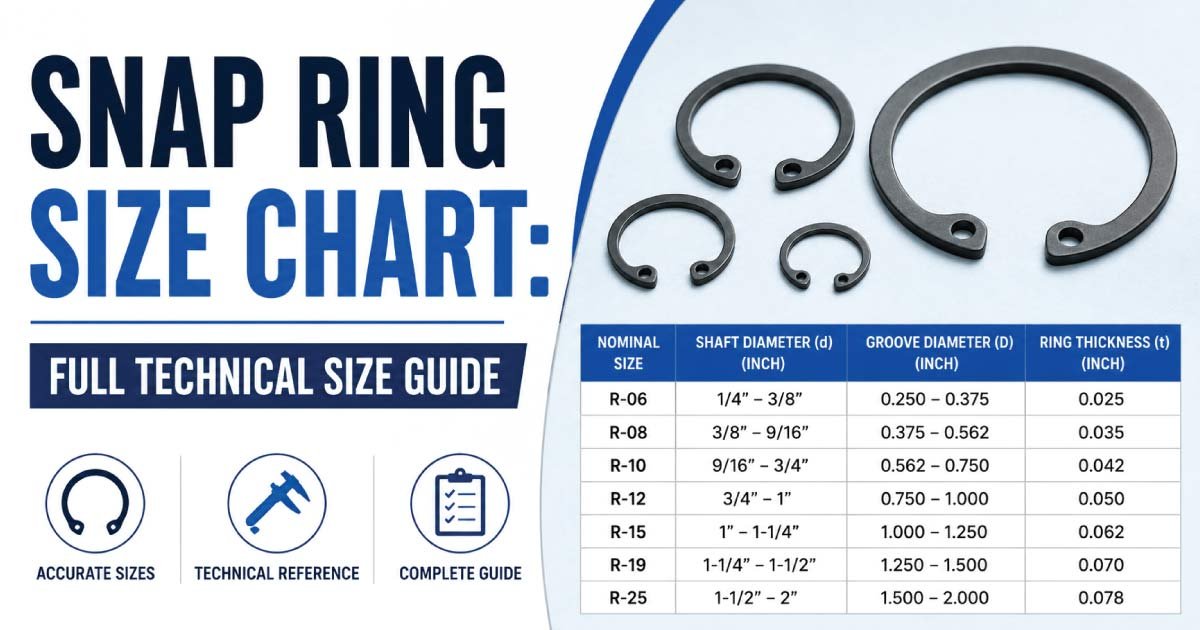
Snap rings, also known as circlips or retaining rings, are small but extremely important mechanical fasteners used in a wide range of machines and assemblies. Despite their simple appearance, they play a critical role in holding components in position and preventing unwanted axial movement in rotating or sliding systems.
Understanding a Snap Ring Size Chart is essential for selecting the correct ring diameter, groove dimensions, and thickness to ensure safe, reliable, and long-lasting performance. Whether used in automotive transmissions, electric motors, hydraulic systems, or industrial machinery, snap rings are designed to provide compact and effective retention.
This complete guide explains snap ring sizes, types, materials, working principles, applications, and how to choose the correct size for your project.
What Is a Snap Ring?
A snap ring is a circular metal fastener with open ends that fits into a machined groove on a shaft (external snap ring) or inside a bore (internal snap ring). Once installed, it locks components in place and prevents them from sliding out of position.
Unlike bolts or screws, snap rings do not carry primary structural loads. Instead, they act as retaining devices that keep components such as bearings, gears, spacers, and pulleys securely positioned.
Snap rings are widely used in:
- Automotive transmissions and gearboxes
- Electric motors and rotating equipment
- Hydraulic cylinders and pumps
- Industrial machines and assemblies
- Household appliances and power tools
- Agricultural machinery and equipment
Their compact design makes them ideal for tight spaces where traditional fasteners cannot be used.
How Does a Snap Ring Work?
A snap ring works by elastic deformation. It slightly expands or compresses to fit into a groove, then returns to its original shape to lock into position.
The working process is simple but highly effective:
- A precise groove is machined into a shaft or housing
- The snap ring is either expanded (internal type) or compressed (external type) using special pliers
- The ring is inserted into the groove
- Once released, it snaps into place
- The ring acts as a barrier, preventing axial movement
This mechanism creates a secure mechanical stop that resists vibration, shock loads, and movement during operation.
Because of this design, snap rings are especially useful in systems that experience continuous rotation or oscillation.
Snap Ring Size Chart (Internal Snap Rings)
Internal snap rings are selected based on the bore or groove diameter where they are installed. Proper sizing is essential to ensure secure retention, correct seating, and safe load handling in internal assemblies.
| Groove Diameter | Ring Size (mm) | Shaft/Bore Range |
|---|---|---|
| 10 mm | 10 mm | 8–10 mm |
| 12 mm | 12 mm | 10–12 mm |
| 15 mm | 15 mm | 12–15 mm |
| 17 mm | 17 mm | 15–17 mm |
| 20 mm | 20 mm | 17–20 mm |
| 25 mm | 25 mm | 20–25 mm |
| 30 mm | 30 mm | 25–30 mm |
| 35 mm | 35 mm | 30–35 mm |
| 40 mm | 40 mm | 35–40 mm |
| 50 mm | 50 mm | 40–50 mm |
The groove diameter must match precisely to ensure proper retention and reliable performance under load.
Snap Ring Size Chart (External Snap Rings)
External snap rings are chosen based on shaft diameter and groove compatibility. Correct selection ensures secure axial locking and prevents components from slipping off rotating shafts.
| Shaft Diameter | Ring Size (mm) | Groove Range |
|---|---|---|
| 8 mm | 8 mm | 6–8 mm |
| 10 mm | 10 mm | 8–10 mm |
| 12 mm | 12 mm | 10–12 mm |
| 15 mm | 15 mm | 12–15 mm |
| 20 mm | 20 mm | 15–20 mm |
| 25 mm | 25 mm | 20–25 mm |
| 30 mm | 30 mm | 25–30 mm |
| 35 mm | 35 mm | 30–35 mm |
| 40 mm | 40 mm | 35–40 mm |
| 50 mm | 50 mm | 40–50 mm |
External snap rings are widely used in rotating machinery where secure axial positioning is required under continuous movement.
Common Snap Ring Thickness
Snap ring thickness directly affects strength, durability, and resistance to axial loads. Heavier-duty applications require thicker rings for improved performance.
| Shaft Size | Thickness |
|---|---|
| Small (6–10 mm) | 0.8–1.0 mm |
| Medium (10–25 mm) | 1.0–1.5 mm |
| Large (25–50 mm) | 1.5–2.5 mm |
| Heavy Duty | 2.5–4.0 mm |
Thicker snap rings provide greater resistance to vibration and higher axial forces, making them suitable for demanding mechanical systems.
Materials Used in Snap Rings
Snap rings are produced from different materials based on strength requirements, corrosion resistance, flexibility, and working environment. Proper material selection ensures reliable performance and long service life in mechanical assemblies.
1. Carbon Steel
Carbon steel is the most commonly used material for snap rings due to its high strength and durability. It is often coated with zinc or black oxide to improve resistance against corrosion in standard operating conditions.
Features:
- Most common material
- High strength and durability
- Often zinc or black oxide coated
2. Stainless Steel
Stainless steel snap rings provide excellent corrosion resistance, making them suitable for harsh and moisture-rich environments. They are widely used in industries where hygiene and long-term durability are important.
Features:
- Excellent corrosion resistance
- Ideal for marine and outdoor environments
- Used in food processing and chemical industries
3. Spring Steel
Spring steel snap rings are known for their high elasticity and flexibility. They offer excellent fatigue resistance, allowing repeated installation and removal without significant deformation.
Features:
- High elasticity and flexibility
- Excellent fatigue resistance
- Suitable for repeated installation and removal
How to Read a Snap Ring Size
Snap ring sizes are usually written in a simple format that directly indicates the shaft or bore diameter they are designed to fit. Understanding this notation is important for correct selection and safe installation.
1. External Snap Ring Example
A typical external snap ring size may appear as:
20 mm External Snap Ring
Meaning:
- Fits a 20 mm shaft
- Installed in an external groove
This type is used on shafts to prevent components from sliding off during rotation or axial movement.
2. Internal Snap Ring Example
An internal snap ring size may appear as:
25 mm Internal Circlip
Meaning:
- Fits a 25 mm bore
- Installed inside a housing
This type is used inside cylindrical housings to retain components such as bearings, bushings, or seals.
3. Importance of Proper Sizing
In all cases, accurate groove machining and correct size selection are essential for safe installation and reliable performance. Improper sizing can lead to loosening, deformation, or failure of the snap ring under load or vibration.
How to Choose the Correct Snap Ring Size
Selecting the correct snap ring size is essential for secure axial retention, mechanical stability, and long service life of assemblies. Proper selection depends on shaft or bore dimensions, load conditions, groove accuracy, and operating environment. Choosing the right size prevents failure, disengagement, and costly mechanical damage.
1. Shaft or Bore Diameter
The shaft or bore diameter is the primary reference for snap ring selection. The ring must match the exact groove location and diameter to ensure proper seating. Incorrect sizing can cause looseness or over-stressing, leading to slipping, poor retention, or sudden disengagement under operational load conditions.
2. Load Conditions
Load conditions directly affect snap ring strength requirements. Systems with high axial loads need thicker and stronger snap rings to prevent deformation or failure. Under heavy stress, weak rings may expand or break. Proper load matching ensures stability, safety, and long-term performance in industrial and mechanical applications.
3. Groove Dimensions
Accurate groove dimensions are critical for snap ring performance. Incorrect groove depth or width can prevent proper seating and lead to ring displacement during operation. A poorly machined groove may reduce holding strength or cause failure. Properly designed grooves ensure secure fit, correct positioning, and reliable mechanical retention.
4. Operating Environment
The operating environment plays a key role in snap ring material selection. In corrosive or humid conditions, stainless steel snap rings are preferred to prevent rust and degradation. Harsh environments can weaken standard materials over time. Choosing corrosion-resistant options ensures durability, consistent performance, and reduced maintenance requirements.
5. Speed and Vibration
High-speed and vibration-heavy applications require precision-fit snap rings with excellent fatigue resistance. Continuous motion can loosen poorly fitted rings, leading to failure or disengagement. Proper selection ensures secure retention, minimal movement, and long-term reliability in dynamic systems such as engines, rotating machinery, and industrial equipment.
Applications of Snap Rings
Snap rings are widely used in almost every mechanical industry because they provide a simple and reliable method of retaining components on shafts or inside housings. Their compact design and strong locking ability make them essential in many rotating and load-bearing systems.
1. Automotive Industry
In automotive systems, snap rings are used to secure moving and rotating parts, ensuring proper alignment and preventing axial movement under vibration and load.
Used in:
- Transmission systems
- Axle assemblies
- Engine components
2. Industrial Machinery
Snap rings play an important role in industrial equipment by holding components in precise positions, especially in high-speed and high-load applications.
Used in:
- Pumps
- Compressors
- Gear systems
3. Electrical Motors
In electric motor assemblies, snap rings help maintain accurate positioning of internal components to ensure smooth and efficient operation.
Used in:
- Rotor positioning
- Bearing retention
4. Agricultural Equipment
Agricultural machinery relies on snap rings for durable and vibration-resistant fastening in demanding field conditions.
Used in:
- Tractor drive shafts
- Harvesting machinery
- Power transmission systems
Advantages of Snap Rings
Snap rings provide a simple, efficient, and reliable method for retaining components in mechanical assemblies. Their compact design and ease of use make them suitable for a wide range of industrial applications.
Advantages include:
- Compact and space-saving design
- Quick installation and removal
- Cost-effective fastening solution
- High resistance to axial movement
- Reusable in many applications
- Available in wide size ranges
- Reliable performance under vibration
These advantages make snap rings an essential component in modern mechanical and industrial design.
Snap Ring vs Retaining Ring
Snap rings and retaining rings are both used for securing components, but they differ in design, precision, and application requirements. Understanding these differences helps in selecting the correct fastener for specific engineering needs.
| Feature | Snap Ring | Retaining Ring |
|---|---|---|
| Design | Wire-based circular ring | Precision stamped ring |
| Strength | Moderate | High |
| Precision | Medium | High |
| Usage | General applications | Precision engineering |
| Cost | Lower | Higher |
Snap rings are typically preferred for general mechanical applications due to their simplicity and cost-effectiveness, while retaining rings are used in high-precision assemblies where tighter tolerances and higher performance are required.
Maintenance and Inspection
Regular maintenance and inspection of snap rings are essential to ensure safe, stable, and reliable mechanical operation. Over time, exposure to load, vibration, and environmental conditions can reduce their effectiveness, so routine checks help prevent unexpected failures.
1. Inspection Checklist
Snap rings should be carefully inspected for any signs of wear, damage, or improper installation that may affect their performance in retaining components.
Check for:
- Wear or deformation
- Corrosion or rust
- Loss of elasticity
- Improper seating in groove
- Cracks or fatigue damage
2. Replacement Guidelines
Damaged or weakened snap rings should always be replaced immediately. Using compromised rings can lead to component dislodgement, misalignment, or complete mechanical failure. Prompt replacement ensures continued safety, reliability, and proper functioning of the assembly.
Conclusion
A Snap Ring Size Chart is a vital reference for selecting the correct retaining ring for shafts and bores in mechanical systems. Proper sizing ensures secure component positioning, smooth machine operation, and long service life.
By understanding snap ring types, dimensions, materials, and applications, you can confidently choose the right snap ring for any industrial or automotive application and ensure safe, efficient mechanical performance.

Engineer Hassan is a Mechanical Engineer with 16+ years of hands-on experience in mechanical hardware, fasteners, and workshop tools. He focuses on size selection, thread identification, and measurement, helping users choose the correct components with accuracy and safety.