
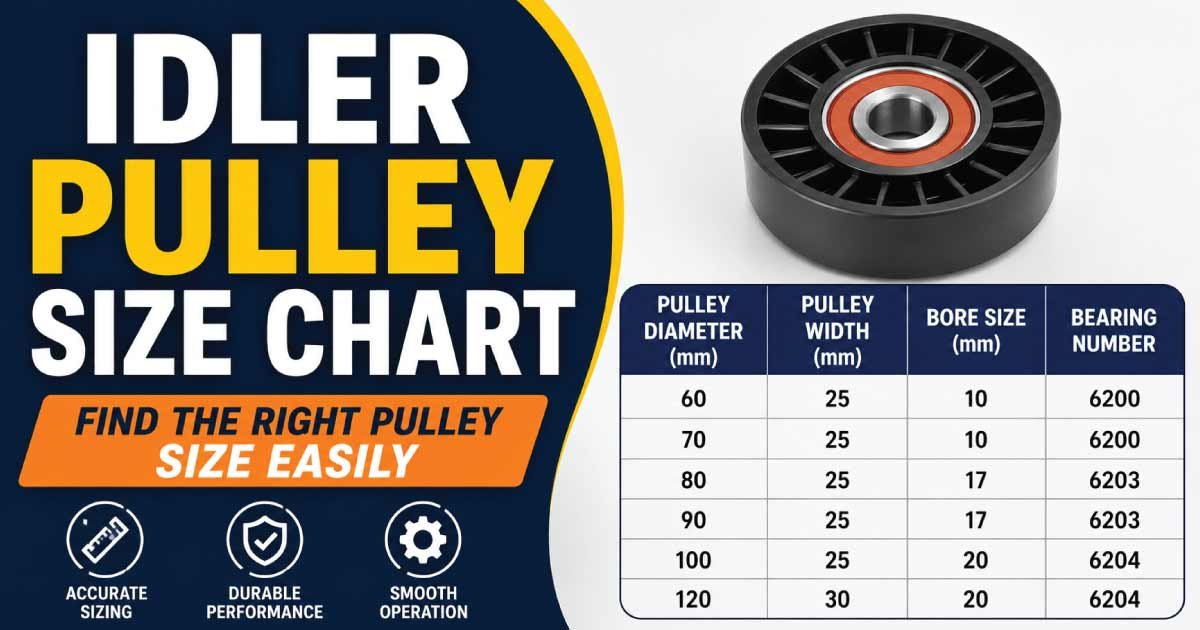
An idler pulley is a rotating component used to guide, support, tension, or redirect a belt in a mechanical drive system. Unlike a drive pulley, an idler pulley normally does not provide power to the belt. Instead, it helps maintain proper belt alignment and contact with other pulleys.
Choosing the correct idler pulley size depends on several factors, including pulley diameter, belt width, bore size, bearing type, belt profile, and operating speed. Using an incorrectly sized pulley can cause belt slipping, excessive wear, noise, vibration, or premature bearing failure.
This idler pulley size chart explains common pulley diameters, belt widths, bore dimensions, bearing options, applications, and selection considerations. Whether you are working on an automotive belt system, conveyor, industrial machine, lawn equipment, or power transmission system, this guide will help you understand the important dimensions.
What Is an Idler Pulley?
An idler pulley is a freely rotating pulley that supports or guides a belt or chain. It is usually mounted on a fixed shaft, stud, bracket, or bearing assembly.
Depending on the system, an idler pulley can perform several functions:
- Maintain belt tension
- Guide the belt along a specific path
- Increase belt wrap around a drive pulley
- Prevent belt vibration
- Maintain belt alignment
- Redirect the belt
- Reduce belt flutter
- Support long belt spans
Idler pulleys are found in many systems, including:
- Automotive engines
- Serpentine belt systems
- Timing belt systems
- Conveyor equipment
- Industrial machinery
- Agricultural equipment
- HVAC equipment
- Lawn and garden machinery
- Manufacturing equipment
The correct pulley must match the belt and operating conditions of the system.
How Idler Pulley Sizes Are Measured
An idler pulley is described by several dimensions rather than its outside diameter alone.
Important measurements include:
- Outside diameter
- Belt width
- Bore diameter
- Bearing dimensions
- Pulley thickness
- Groove width
- Groove depth
- Flange diameter
- Overall height
- Bearing centerline
For a flat-belt idler, the outside diameter and belt-contact width are particularly important.
For a V-belt or ribbed-belt idler, the groove profile must match the belt.
For an automotive serpentine system, the pulley must also match the belt rib configuration and the manufacturer’s specified application.
Common Idler Pulley Size Chart
The following chart provides representative idler pulley sizes used across various mechanical applications. Actual dimensions vary significantly by belt type, manufacturer, and equipment.
| Pulley Diameter | Approx. Diameter in mm | Common Belt Width | Typical Application |
|---|---|---|---|
| 2 in | 51 mm | 1/4–1/2 in | Small machinery |
| 2.5 in | 64 mm | 1/4–1/2 in | Light-duty systems |
| 3 in | 76 mm | 1/4–3/4 in | General machinery |
| 4 in | 102 mm | 1/2–1 in | Industrial drives |
| 5 in | 127 mm | 1/2–1-1/2 in | Medium-duty systems |
| 6 in | 152 mm | 1–2 in | Conveyors and machinery |
| 8 in | 203 mm | 1–3 in | Heavy-duty equipment |
| 10 in | 254 mm | 2–4 in | Large belt systems |
| 12 in | 305 mm | 2–4+ in | Industrial applications |
These dimensions are general reference ranges rather than universal standards. The belt manufacturer’s minimum pulley diameter and the equipment manufacturer’s specifications should be checked before selecting an idler pulley.
Idler Pulley Diameter Chart
Pulley diameter has a major influence on belt bending, belt life, system speed, and belt contact.
| Nominal Diameter | Approx. Metric Diameter | General Category |
|---|---|---|
| 2 inch | 51 mm | Compact |
| 2.5 inch | 64 mm | Small |
| 3 inch | 76 mm | Small/medium |
| 4 inch | 102 mm | Medium |
| 5 inch | 127 mm | Medium |
| 6 inch | 152 mm | Large |
| 8 inch | 203 mm | Large |
| 10 inch | 254 mm | Heavy-duty |
| 12 inch | 305 mm | Industrial |
The appropriate diameter should be selected based on the belt type and the minimum recommended pulley diameter.
A larger pulley can reduce bending stress in many belt systems, while a smaller pulley can help create a more compact design. However, the belt manufacturer’s minimum diameter must not be exceeded in the wrong direction.
Idler Pulley Belt Width
The pulley width should be compatible with the belt width and belt tracking requirements.
Common belt widths vary widely depending on the application.
For example:
- Small machinery may use narrow belts.
- Automotive systems use application-specific serpentine belts.
- Industrial conveyors may use much wider belts.
- Agricultural machinery can use specialized drive belts.
The pulley should provide sufficient belt support without creating unnecessary interference.
A pulley that is too narrow can allow the belt to move off its intended path, while an excessively wide pulley may not fit correctly within the machine.
Idler Pulley Bore Size
The bore is the central hole through which the pulley is mounted.
Common bore sizes include:
- 1/4 inch
- 3/8 inch
- 1/2 inch
- 5/8 inch
- 3/4 inch
- 1 inch
- 1-1/4 inch
- Metric sizes such as 6 mm, 8 mm, 10 mm, 12 mm, 15 mm, and 20 mm
The bore must match the mounting shaft, stud, bearing, or bushing.
When replacing an idler pulley, do not assume that the bore is standard simply because the outside diameter matches.
Idler Pulley Bearing Sizes
Many idler pulleys use an integrated bearing to allow smooth rotation around a fixed shaft or mounting bolt.
Common bearing dimensions can be described by:
- Bore diameter
- Outside diameter
- Bearing width
For example, a bearing designation such as 6203 identifies a particular bearing series and dimensional arrangement, but the correct bearing must still be verified for the application.
Bearing selection depends on:
- Radial load
- Speed
- Temperature
- Lubrication
- Environmental conditions
- Expected service life
An idler pulley bearing should be selected based on the actual operating conditions rather than size alone.
Types of Idler Pulleys
Different idler pulley designs are used depending on the belt system.
Flat Idler Pulley
A flat idler pulley has a relatively smooth belt-contact surface.
It is commonly used with flat belts and some specialized belt-drive systems.
Applications include:
- Conveyors
- Industrial machinery
- Material handling
- Manufacturing equipment
V-Belt Idler Pulley
A V-belt idler pulley may have a groove designed to accommodate the V-shaped belt.
The groove must match the belt profile.
Common V-belt profiles include:
- A section
- B section
- C section
- Specialized metric profiles
Serpentine Idler Pulley
Serpentine belt systems commonly use smooth or ribbed idler pulleys depending on where the pulley contacts the belt.
These are widely used in automotive accessory drive systems.
Timing Belt Idler Pulley
Timing belt idlers are designed to work with toothed timing belts.
The pulley tooth profile must match the belt tooth profile to ensure proper engagement.
Flanged Idler Pulley
A flanged pulley has raised edges that help keep the belt in position.
It may be useful where belt tracking is important.
Smooth vs. Ribbed Idler Pulleys
The belt-contact surface is an important feature of many idler pulleys.
A smooth pulley provides a continuous flat contact surface and is commonly used where the belt’s smooth back contacts the pulley.
A ribbed pulley has grooves designed to engage the belt’s ribbed side.
| Feature | Smooth Pulley | Ribbed Pulley |
|---|---|---|
| Contact surface | Smooth | Grooved/ribbed |
| Typical belt contact | Belt back | Belt ribbed side |
| Common use | Serpentine systems | Serpentine systems |
| Tracking | Depends on system design | Positive rib engagement |
| Compatibility | Must match belt contact side | Must match belt ribs |
Using the wrong pulley surface can cause belt noise, slipping, wear, or improper tracking.
How Idler Pulley Size Affects Belt Performance
Pulley diameter directly affects the amount of bending imposed on a belt.
When a belt travels around a small pulley, it bends more sharply. Repeated bending can increase fatigue and shorten belt life.
A larger pulley generally provides a larger bending radius.
Pulley size can affect:
- Belt fatigue
- Belt temperature
- Belt life
- System speed
- Noise
- Contact area
- Packaging
- Bearing speed
However, the correct size is determined by the complete belt-drive design.
Always follow the belt manufacturer’s minimum pulley diameter recommendations.
Discover More:
How to Choose the Correct Idler Pulley Size
Selecting the correct pulley requires matching it to the belt and machine.
Identify the Belt
Determine whether the system uses:
- Flat belt
- V-belt
- Serpentine belt
- Timing belt
- Ribbed belt
- Specialized belt
The pulley profile must match the belt.
Measure the Existing Pulley
Record the:
- Outside diameter
- Belt width
- Bore
- Overall width
- Bearing dimensions
- Groove profile
Check the Belt Path
Determine whether the pulley contacts the belt’s smooth or ribbed side.
Check the Mounting Arrangement
Confirm the pulley fits the existing shaft, bolt, stud, bearing, or bracket.
Check the Operating Speed
High-speed applications require a pulley and bearing designed for the required rotational speed.
Check the Load
The bearing and pulley construction must be suitable for the belt tension and operating load.
Discover More:
How to Measure an Idler Pulley
Accurate measurements make replacement easier.
Measure Outside Diameter
Use a caliper or measuring tool to determine the largest diameter across the pulley.
Measure across the pulley surface rather than the mounting hardware.
Measure Belt Width
Measure the width of the belt-contacting area.
For grooved pulleys, also record the groove count and profile.
Measure the Bore
Measure the inside diameter of the mounting hole or bearing.
Measure Overall Width
Measure the total pulley width from one side to the other.
Check the Bearing
If the pulley uses a bearing, record its:
- Bore
- Outside diameter
- Width
The bearing number may also be stamped on the bearing itself.
Idler Pulley for Automotive Applications
Automotive engines commonly use idler pulleys as part of accessory belt systems.
An automotive idler pulley may guide a serpentine belt around:
- Alternator
- Water pump
- Air-conditioning compressor
- Power steering pump
- Crankshaft pulley
- Tensioner
- Other accessories
Automotive idler pulleys are usually application-specific.
Even when two pulleys look similar, they may differ in:
- Diameter
- Width
- Bearing
- Groove design
- Offset
- Mounting depth
- Rotation requirements
For vehicle repairs, the vehicle manufacturer’s part number or a verified application-specific replacement is preferable to choosing based only on physical dimensions.
Discover More:
Idler Pulley vs. Tensioner Pulley
Idler pulleys and tensioner pulleys can look similar but perform different functions.
An idler pulley normally guides or supports the belt while remaining mounted in a fixed position.
A tensioner pulley is attached to a tensioning mechanism that applies controlled force to the belt.
| Feature | Idler Pulley | Tensioner Pulley |
|---|---|---|
| Main function | Guide/support belt | Maintain belt tension |
| Mounting | Usually fixed | Attached to tensioner |
| Movement | Normally fixed position | Moves through tensioning mechanism |
| Belt routing | Yes | Yes |
| Spring mechanism | Usually absent | Often present |
Some systems can use several idler pulleys but only one or more tensioners.
Idler Pulley vs. Drive Pulley
The main difference is their role in power transmission.
A drive pulley receives power from a motor or engine and transfers it to the belt.
An idler pulley generally rotates because the belt moves around it.
| Feature | Idler Pulley | Drive Pulley |
|---|---|---|
| Drives belt | No | Yes |
| Power input | No | Yes |
| Main function | Guide/support | Transmit power |
| Belt contact | Yes | Yes |
| Bearing requirement | Common | Depends on design |
The two pulleys can have similar physical appearances but very different functions.
Common Idler Pulley Problems
An idler pulley can develop problems over time because of continuous rotation and belt loading.
Common symptoms include:
- Grinding noise
- Whining
- Squealing
- Excessive vibration
- Pulley wobble
- Belt misalignment
- Belt wear
- Bearing play
- Excessive pulley temperature
A noisy idler pulley often indicates bearing wear, but belt misalignment or contamination can also cause unusual sounds.
If the pulley has noticeable lateral movement or rough rotation, it should be inspected and replaced when necessary.
Idler Pulley Maintenance
Regular inspection can help prevent unexpected belt-drive failures.
Check the pulley for:
- Cracks
- Excessive wear
- Corrosion
- Bearing noise
- Bearing looseness
- Groove damage
- Belt tracking problems
- Surface contamination
When the pulley is removed, rotate the bearing by hand.
A healthy bearing should rotate smoothly without grinding, binding, or excessive play.
Also inspect the belt because a damaged belt can sometimes be the source of noise or abnormal wear.
Common Idler Pulley Sizing Mistakes
Avoid these mistakes when selecting or replacing an idler pulley:
- Measuring only the outside diameter
- Ignoring belt width
- Using the wrong groove profile
- Choosing an incorrect bore
- Ignoring bearing dimensions
- Using a pulley below the belt’s minimum diameter
- Confusing a tensioner pulley with an idler pulley
- Installing a smooth pulley where a ribbed pulley is required
- Ignoring pulley offset
- Selecting a pulley without considering operating speed
Matching all important dimensions is more reliable than selecting a pulley based on appearance.
Idler Pulley Selection Checklist
Before purchasing a replacement, record the following information:
- Pulley outside diameter
- Pulley width
- Belt width
- Belt type
- Groove count
- Groove profile
- Bore diameter
- Bearing number
- Bearing width
- Mounting arrangement
- Pulley offset
- Operating speed
- Operating temperature
- Manufacturer part number
For automotive and industrial applications, matching the original part number can provide a more reliable replacement than measuring only the pulley.
Frequently Asked Questions About Idler Pulley Sizes
What size idler pulley do I need?
The correct idler pulley size depends on the belt type, outside diameter, belt width, groove profile, bore, bearing, speed, and machine design. Start by measuring the existing pulley and identifying the belt. For application-specific systems, verify the manufacturer’s part number or specifications.
Does idler pulley size matter?
Yes. Idler pulley diameter affects belt bending, belt life, belt routing, speed, and system packaging. A pulley that is too small can cause excessive belt bending and fatigue. Always follow the minimum pulley diameter recommended for the specific belt.
What is the difference between an idler pulley and a tensioner pulley?
An idler pulley normally guides or supports the belt from a fixed mounting position. A tensioner pulley is connected to a tensioning mechanism that maintains the correct belt tension. Although they may look similar, their mounting and functions are different.
How do I measure an idler pulley?
Measure the outside diameter, belt-contact width, bore diameter, overall width, and groove dimensions. If the pulley contains a bearing, record the bearing number or measure its bore, outside diameter, and width. Also identify the belt type and pulley surface.
Can I use a larger idler pulley?
A larger idler pulley may be acceptable in some designs, but it can change belt routing, clearance, speed, and system geometry. The replacement must fit the available space and remain compatible with the belt system. Use the manufacturer’s specified pulley diameter whenever possible.
Conclusion
An idler pulley size chart provides a useful starting point for comparing common pulley diameters, widths, and applications. However, selecting the correct idler pulley requires more than matching the outside diameter.
The belt type, pulley diameter, belt width, groove profile, bore, bearing, offset, operating speed, and mounting arrangement should all be checked before installation.
For general mechanical systems, accurate measurements can help identify a replacement pulley. For automotive, industrial, or other application-specific equipment, the manufacturer’s part number and technical specifications are usually the most reliable way to ensure compatibility.
Choosing the correct idler pulley size helps maintain proper belt tracking, reduce unnecessary wear, support reliable operation, and extend the service life of the belt-drive system.

Engineer Hassan is a Mechanical Engineer with 16+ years of hands-on experience in mechanical hardware, fasteners, and workshop tools. He focuses on size selection, thread identification, and measurement, helping users choose the correct components with accuracy and safety.