
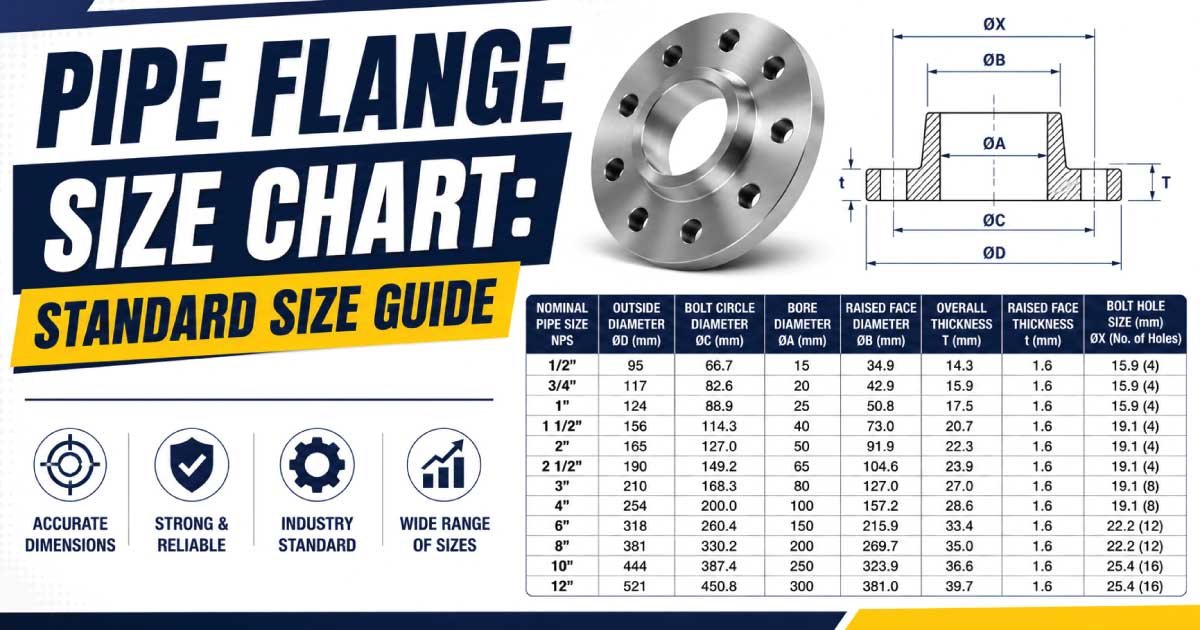
Pipe flanges are essential components in piping systems, providing a secure and detachable connection between pipes, valves, pumps, fittings, and other equipment.
They ensure leak-proof joints while allowing easy maintenance, inspection, and system modifications. Choosing the correct pipe flange size is critical for maintaining system integrity, handling operating pressure safely, and ensuring compatibility with piping standards.
This guide explains pipe flange dimensions, size charts, measurement methods, flange types, materials, and practical selection tips.
What Is a Pipe Flange?
A pipe flange is a circular disc with bolt holes designed to join pipes and piping equipment. It is bolted together with another matching flange and sealed using a gasket to prevent leaks. Pipe flanges are widely used in oil and gas, chemical processing, water treatment, HVAC, marine, food processing, and power generation industries because they provide strong, reliable, and serviceable pipe connections.
Primary Functions
- Connects piping sections securely
- Creates leak-proof joints
- Supports high-pressure systems
- Simplifies maintenance
- Allows equipment replacement
- Improves piping flexibility
Common Types of Pipe Flanges
Different piping systems require different flange designs depending on pressure, temperature, fluid type, and installation requirements. Understanding these flange types helps ensure the correct selection for safe and efficient operation.
1. Weld Neck Pipe Flange
A weld neck flange features a long tapered hub that is butt-welded directly to the pipe. This design distributes stress evenly and offers excellent strength, making it suitable for high-pressure and high-temperature applications where reliability is critical.
Advantages
- Superior mechanical strength
- Excellent pressure resistance
- Reduced stress concentration
- Long service life
- Ideal for critical piping systems
2. Slip-On Pipe Flange
Slip-on flanges slide over the outside of the pipe before being welded on both sides. They are easy to align, simple to install, and commonly used in low- and medium-pressure piping systems.
Benefits
- Easy installation
- Lower fabrication cost
- Good alignment
- Suitable for moderate pressure
- Readily available
3. Blind Pipe Flange
Blind flanges have no center opening and are used to close the end of a pipe, pressure vessel, or equipment nozzle. They allow future expansion while providing a secure pressure seal.
Applications
- Pipeline termination
- Pressure testing
- Equipment isolation
- Maintenance shutdown
- Future system expansion
4. Socket Weld Pipe Flange
Socket weld flanges are designed for small-diameter, high-pressure pipelines. The pipe fits into a recessed socket before welding, providing smooth flow and strong mechanical support.
ANSI Pipe Flange Size Chart (Class 150)
The following table lists common ANSI Class 150 pipe flange dimensions.
| Nominal Pipe Size (NPS) | Outside Diameter (in) | Bolt Circle (in) | Bolt Holes | Bolt Size |
|---|---|---|---|---|
| 1/2″ | 3.50 | 2.38 | 4 | 1/2″ |
| 3/4″ | 3.88 | 2.75 | 4 | 1/2″ |
| 1″ | 4.25 | 3.12 | 4 | 1/2″ |
| 1-1/4″ | 4.62 | 3.50 | 4 | 5/8″ |
| 1-1/2″ | 5.00 | 3.88 | 4 | 5/8″ |
| 2″ | 6.00 | 4.75 | 4 | 5/8″ |
| 3″ | 7.50 | 6.00 | 4 | 5/8″ |
| 4″ | 9.00 | 7.50 | 8 | 5/8″ |
| 6″ | 11.00 | 9.50 | 8 | 3/4″ |
| 8″ | 13.50 | 11.75 | 8 | 3/4″ |
| 10″ | 16.00 | 14.25 | 12 | 7/8″ |
| 12″ | 19.00 | 17.00 | 12 | 7/8″ |
Metric Pipe Flange Size Chart
Metric pipe flanges are commonly used in ISO, DIN, and EN piping systems throughout Europe and many international industrial projects.
| Nominal Diameter (DN) | Outside Diameter (mm) | Bolt Circle (mm) | Bolt Holes |
|---|---|---|---|
| DN15 | 95 | 65 | 4 |
| DN20 | 105 | 75 | 4 |
| DN25 | 115 | 85 | 4 |
| DN32 | 140 | 100 | 4 |
| DN40 | 150 | 110 | 4 |
| DN50 | 165 | 125 | 4 |
| DN65 | 185 | 145 | 4 |
| DN80 | 200 | 160 | 8 |
| DN100 | 220 | 180 | 8 |
| DN150 | 285 | 240 | 8 |
| DN200 | 340 | 295 | 12 |
| DN250 | 405 | 355 | 12 |
Understanding Pipe Flange Dimensions
Selecting the correct pipe flange requires understanding several critical dimensions. These measurements determine whether two flanges will align correctly, seal effectively, and safely withstand the operating pressure. Accurate dimensions also reduce installation errors and prevent costly leaks or system failures.
1. Nominal Pipe Size (NPS or DN)
The nominal pipe size identifies the pipe that the flange is designed to fit. Although called “nominal,” this value is a standardized designation rather than the pipe’s exact outside diameter. Always verify compatibility using standard flange size charts.
2. Outside Diameter (OD)
The outside diameter measures the overall width of the flange. It provides space for bolt holes and determines the flange’s overall footprint within the piping assembly.
3. Bolt Circle Diameter (BCD)
The bolt circle diameter is the diameter of the imaginary circle passing through the centers of all bolt holes. Correct BCD measurements ensure accurate bolt alignment between mating flanges.
4. Bolt Hole Diameter
Bolt hole diameter determines which bolt size can be used. Proper clearance allows easy installation while maintaining sufficient clamping force for secure gasket compression.
How to Measure a Pipe Flange
Accurate measurements are essential when replacing existing flanges or designing new piping systems. Measuring several dimensions ensures compatibility with standard flange specifications.
Step 1: Measure the Outside Diameter
Use a tape measure or digital caliper to measure the flange’s outside diameter.
Measurement Tips
- Measure across the widest point
- Keep the measuring tool level
- Record measurements carefully
- Compare with flange charts
Step 2: Measure the Bolt Circle
Determine the bolt circle diameter by measuring between bolt hole centers according to the bolt pattern. This dimension is one of the easiest ways to identify flange standards.
Step 3: Count and Measure Bolt Holes
Count the total number of bolt holes and measure their diameter accurately. These measurements help identify the flange class and ensure compatibility with bolts and mating flanges.
📘 Explore Complete Size Guide 👉 Chisel Sizes and Their Applications for Beginners
Common Pipe Flange Materials
Material selection plays a major role in flange performance, especially in systems exposed to high temperatures, corrosive chemicals, or extreme pressure. Choosing the correct material increases reliability and extends service life.
Carbon Steel Pipe Flanges
Carbon steel is the most widely used flange material because it combines strength, durability, and affordability for general industrial service.
Advantages
- High mechanical strength
- Economical
- Easy to machine
- Good weldability
- Suitable for most industrial applications
Stainless Steel Pipe Flanges
Stainless steel flanges provide outstanding corrosion resistance, making them ideal for sanitary and aggressive chemical environments.
Benefits
- Excellent corrosion resistance
- Long service life
- Hygienic surface
- High-temperature performance
- Low maintenance requirements
Alloy Steel Pipe Flanges
Alloy steel flanges are designed for demanding applications involving elevated temperatures, heavy mechanical loads, and high-pressure systems.
Applications of Pipe Flanges
Pipe flanges are used across numerous industries because they provide durable, removable, and leak-resistant connections that simplify maintenance while maintaining reliable system performance.
Oil and Gas Industry
Pipe flanges connect pipelines, valves, separators, pumps, compressors, and pressure vessels operating under demanding pressure and temperature conditions.
Common Applications
- Refineries
- Offshore drilling platforms
- Natural gas pipelines
- Petrochemical facilities
- Storage terminals
Water and Wastewater Systems
Municipal water treatment plants rely on pipe flanges to connect pumps, valves, filters, and pipelines while allowing quick maintenance and system expansion.
Typical Uses
- Water treatment plants
- Pump stations
- Filtration systems
- Wastewater facilities
- Distribution networks
📘 Explore Complete Size Guide 👉 What Is Cotter Pin? Sizes, Parts, Types and How to Choose
How to Choose the Correct Pipe Flange Size
Selecting the correct pipe flange size is essential for ensuring a secure, leak-free, and long-lasting piping connection. The flange must match the pipe size, pressure rating, flange face, bolt pattern, and gasket specifications. Using the wrong flange size can lead to leaks, misalignment, equipment damage, and costly downtime. Always verify dimensions using the appropriate ANSI, ASME, DIN, EN, or JIS standard before installation.
Selection Checklist
- Measure the pipe size (NPS or DN)
- Verify the pressure class
- Match the flange face type
- Check the bolt circle diameter
- Count the bolt holes
- Measure bolt hole diameter
- Choose the correct flange material
- Verify gasket compatibility
- Consider operating temperature
- Follow applicable piping standards
Pipe Flange Pressure Classes
Pipe flanges are manufactured in different pressure classes to safely withstand varying operating pressures and temperatures. As the pressure class increases, the flange generally becomes thicker and stronger to handle greater mechanical loads without leakage or deformation.
Common ANSI Pressure Classes
The most widely used pressure ratings include:
- Class 150
- Class 300
- Class 400
- Class 600
- Class 900
- Class 1500
- Class 2500
Higher pressure classes are commonly found in power plants, refineries, chemical processing facilities, steam pipelines, and high-pressure industrial systems.
Pipe Flange Face Types
The flange face is the sealing surface where the gasket is compressed between two mating flanges. Choosing the correct face type improves sealing performance and reduces the risk of leakage under different operating conditions.
1. Raised Face (RF)
Raised Face flanges have a slightly elevated gasket seating surface. They are the most commonly used flange type because they provide excellent sealing performance for medium- and high-pressure applications.
Advantages
- Reliable sealing
- Easy gasket replacement
- Widely available
- Suitable for most industries
- Cost-effective
2. Flat Face (FF)
Flat Face flanges have a completely flat sealing surface and are commonly used with cast iron equipment or low-pressure piping systems where even gasket compression is required.
3. Ring Type Joint (RTJ)
RTJ flanges contain precision-machined grooves that hold metallic ring gaskets. They are designed for extremely high-pressure and high-temperature services requiring maximum sealing reliability.
Pipe Flange Standards
International flange standards ensure that flanges manufactured by different companies remain interchangeable. Understanding these standards helps prevent compatibility issues during installation or replacement.
ANSI / ASME Standards
ANSI and ASME standards are widely used in North America and many industrial projects worldwide.
Common specifications include:
- ASME B16.5
- ASME B16.47
- ASME B16.36
- ASME B16.48
DIN Standards
DIN flanges are commonly used in Europe and are recognized for their metric dimensions and standardized pressure ratings.
EN Standards
European Norm (EN) standards provide modern metric specifications for industrial piping systems throughout Europe.
JIS Standards
Japanese Industrial Standards (JIS) are widely used across Asia in manufacturing, shipbuilding, and industrial piping projects.
📘 Explore Complete Size Guide 👉 Roller Bearing Size Chart: Full Guide with PDF and Images
Pipe Flange Material Comparison
Selecting the proper material depends on pressure, corrosion resistance, operating temperature, and the type of fluid transported.
| Material | Best Applications | Main Advantages |
|---|---|---|
| Carbon Steel | Industrial piping | Strong and economical |
| Stainless Steel | Food and chemical plants | Excellent corrosion resistance |
| Alloy Steel | High-temperature systems | Superior strength |
| Cast Iron | Water distribution | Cost-effective |
| Duplex Stainless Steel | Offshore platforms | Excellent corrosion resistance |
| PVC | Water supply systems | Lightweight and rust resistant |
Common Pipe Flange Installation Mistakes
Improper installation often causes flange leakage, gasket failure, and reduced service life. Following recommended installation procedures helps maintain reliable sealing and system safety.
Avoid these common mistakes:
- Using incorrect flange size
- Installing the wrong gasket
- Uneven bolt tightening
- Excessive bolt torque
- Dirty sealing surfaces
- Misaligned pipes
- Mixing incompatible standards
- Reusing damaged gaskets
- Ignoring torque specifications
- Failing to inspect flange faces
Pipe Flange Maintenance Tips
Routine inspections help identify wear before it causes leaks or expensive equipment failures. Proper maintenance also extends the service life of piping systems.
Maintenance recommendations include:
- Inspect for corrosion
- Check gasket condition
- Tighten loose bolts
- Clean flange faces
- Replace damaged fasteners
- Monitor system pressure
- Inspect for cracks
- Verify alignment
- Replace worn gaskets
- Schedule preventive maintenance
Consistent maintenance minimizes downtime and improves operational reliability.
Advantages of Using Standard Pipe Flanges
Standard pipe flanges provide consistent dimensions, making installation easier and ensuring compatibility between components from different manufacturers. They also improve maintenance efficiency by allowing quick disassembly and reassembly.
Major advantages include:
- Leak-resistant connections
- Easy installation
- Simplified maintenance
- High pressure capability
- Excellent sealing performance
- Wide material availability
- Standardized dimensions
- Long service life
- Improved system safety
- Reduced maintenance costs
Signs a Pipe Flange Needs Replacement
Pipe flanges are exposed to pressure, temperature changes, vibration, and corrosion throughout their service life. Regular inspections help identify damage before leaks or mechanical failures occur.
Common warning signs include:
- Visible corrosion
- Cracked flange body
- Warped sealing surface
- Persistent leakage
- Damaged bolt holes
- Loose bolts
- Excessive vibration
- Surface pitting
- Gasket failure
- Difficulty maintaining proper bolt torque
Replacing damaged flanges promptly helps maintain safe and reliable system operation.
Applications of Pipe Flanges Across Industries
Pipe flanges are used in virtually every industry that relies on fluid or gas transportation because they provide durable, serviceable, and leak-proof pipe connections.
Chemical Processing Plants
Chemical facilities use corrosion-resistant pipe flanges to transport acids, solvents, and hazardous chemicals safely while allowing easy maintenance.
Power Generation
Power plants depend on pipe flanges for boilers, turbines, steam pipelines, cooling systems, and high-pressure process equipment.
Marine Industry
Ships and offshore platforms use stainless steel and duplex pipe flanges for seawater systems, fuel lines, hydraulic systems, and ballast piping.
Food and Beverage Industry
Sanitary stainless steel pipe flanges are used in food processing and beverage manufacturing because they provide hygienic, easy-to-clean piping connections.
In Summary
Choosing the correct pipe flange size is critical for ensuring safe, leak-free, and efficient piping systems. Understanding flange dimensions, pressure classes, face types, materials, and international standards allows engineers, contractors, and maintenance professionals to select the right flange for every application.
Using accurate pipe flange size charts, following proper installation procedures, and performing regular inspections significantly improves system reliability, minimizes maintenance costs,
and extends the service life of industrial piping systems in oil and gas, water treatment, chemical processing, power generation, marine, manufacturing, and HVAC industries.
Frequently Asked Questions
How do I determine the correct pipe flange size?
To determine the correct pipe flange size, measure the nominal pipe size, outside diameter, bolt circle diameter, bolt hole diameter, and the number of bolt holes. Compare these dimensions with ANSI, ASME, DIN, EN, or JIS flange size charts to identify the correct flange specification for your piping system.
What is the difference between NPS and DN?
NPS (Nominal Pipe Size) is the inch-based sizing system mainly used in North America, while DN (Diameter Nominal) is the metric designation used internationally. Although the numbering differs, both systems identify compatible pipe and flange sizes rather than the exact physical dimensions of the pipe or flange.
Which pipe flange type is used most frequently?
The Raised Face (RF) pipe flange is the most commonly used type because it provides an excellent sealing surface for gaskets and supports a wide range of pressure classes. It is widely used in industrial, commercial, oil and gas, water treatment, and general process piping applications.
Can I connect flanges from different standards?
In most cases, flanges from different standards should not be connected because ANSI, DIN, EN, and JIS flanges have different bolt patterns, dimensions, and pressure ratings. Mixing standards can cause misalignment, sealing problems, and leaks unless specially engineered adapter flanges are used for compatibility.
How long do pipe flanges typically last?
High-quality pipe flanges can last for several decades when properly selected, installed, and maintained. Their service life depends on factors such as material quality, operating pressure, temperature, corrosion exposure, fluid type, and regular inspection to ensure reliable performance and prevent premature wear or failure.

Engineer Hassan is a Mechanical Engineer with 16+ years of hands-on experience in mechanical hardware, fasteners, and workshop tools. He focuses on size selection, thread identification, and measurement, helping users choose the correct components with accuracy and safety.