
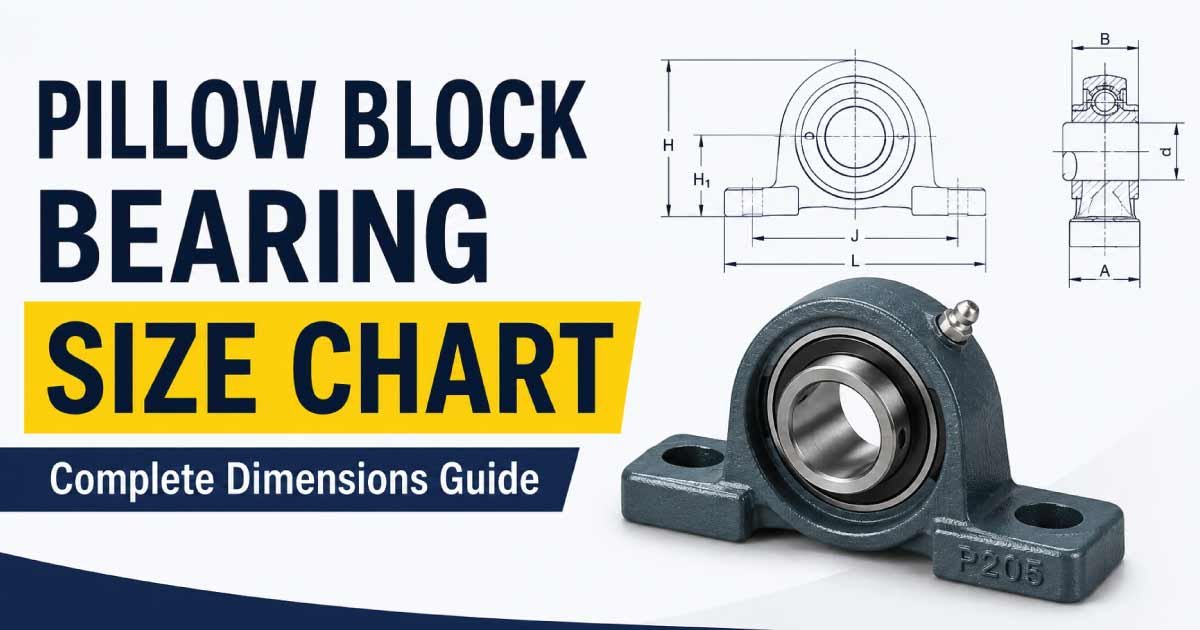
Choosing the correct pillow block bearing is important for keeping rotating shafts properly supported, aligned, and protected during operation. A pillow block bearing combines a bearing insert with a housing, making it easier to mount and maintain on conveyors, agricultural equipment, fans, industrial machinery, and many other applications.
The main challenge is selecting the correct bearing size. Pillow block bearings are commonly identified by bearing numbers, shaft diameter, housing dimensions, and insert type. Even when two bearings look similar, their bore size, mounting-hole spacing, overall height, or load capacity can differ.
This pillow block bearing size chart explains common bearing sizes and dimensions while showing you how to identify, measure, and select the right unit for your application.
What Is a Pillow Block Bearing?
A pillow block bearing is a mounted bearing assembly designed to support a rotating shaft. It normally consists of a bearing insert fitted inside a housing. The housing provides a stable mounting surface, while the bearing insert supports the shaft and allows it to rotate with reduced friction.
Pillow block bearings are especially useful when a shaft needs to be supported above or away from a machine frame.
Common applications include:
- Conveyor systems
- Agricultural machinery
- Industrial fans and blowers
- Material-handling equipment
- Packaging machinery
- Textile machinery
- Woodworking equipment
- Food-processing machinery
- Pumps and rotating equipment
- General mechanical assemblies
The housing is usually mounted to a flat surface with bolts. Depending on the bearing design, the shaft may be secured with set screws, an eccentric locking collar, or another locking arrangement.
How Pillow Block Bearing Sizes Are Determined
The most important dimension is usually the shaft bore diameter. The bore must match the shaft on which the bearing is installed.
However, bore diameter is only one part of pillow block bearing sizing. Other dimensions can affect whether the bearing will fit correctly into the machine.
Important measurements include:
- Shaft or bore diameter
- Bearing insert outside diameter
- Housing length
- Housing width
- Overall bearing height
- Mounting-hole diameter
- Mounting-hole center distance
- Bearing width
- Overall housing dimensions
- Shaft-to-mounting-surface height
The bearing number can also provide valuable information. For example, UCP205 belongs to a common pillow block bearing series, while its bore size identifies the shaft size for which the unit is intended.
Common Pillow Block Bearing Size Chart
The following chart shows common UCP-series pillow block bearing sizes. Exact housing dimensions can vary between manufacturers and product series, so the manufacturer’s dimensional drawing should always be checked before ordering.
| Bearing Size | Typical Bore Diameter | Common Shaft Size | Typical Application |
|---|---|---|---|
| UCP201 | 12 mm | 12 mm | Light machinery |
| UCP202 | 15 mm | 15 mm | Conveyors and equipment |
| UCP203 | 17 mm | 17 mm | General machinery |
| UCP204 | 20 mm | 20 mm | Industrial equipment |
| UCP205 | 25 mm | 25 mm | Conveyors and rotating machinery |
| UCP206 | 30 mm | 30 mm | Medium-duty equipment |
| UCP207 | 35 mm | 35 mm | Industrial machinery |
| UCP208 | 40 mm | 40 mm | Conveyors and fans |
| UCP209 | 45 mm | 45 mm | Heavy machinery |
| UCP210 | 50 mm | 50 mm | Industrial applications |
| UCP211 | 55 mm | 55 mm | Medium/heavy equipment |
| UCP212 | 60 mm | 60 mm | Industrial machinery |
| UCP213 | 65 mm | 65 mm | Heavy-duty machinery |
| UCP214 | 70 mm | 70 mm | Large rotating equipment |
| UCP215 | 75 mm | 75 mm | Heavy industrial equipment |
| UCP216 | 80 mm | 80 mm | Large machinery |
| UCP217 | 85 mm | 85 mm | Heavy-duty applications |
| UCP218 | 90 mm | 90 mm | Large industrial systems |
These are representative UCP pillow block bearing sizes. Other mounted-bearing series may use different designations and dimensions.
Understanding Pillow Block Bearing Numbers
Bearing numbers can appear confusing because different manufacturers and bearing series use different identification systems. Understanding the basic structure makes replacement easier.
For example, UCP205 is a common pillow block bearing designation.
- UC generally identifies the bearing insert series.
- P identifies the pillow block housing style.
- 205 identifies the bearing size within the series.
The exact meaning of bearing codes can vary between manufacturers, so the complete manufacturer’s catalog should be checked when identifying a specific product.
A bearing number should not be the only method of identification. Always compare the bore diameter and mounting dimensions with the existing unit.
Metric Pillow Block Bearing Sizes
Metric pillow block bearings are widely used in machinery manufactured with metric shafting. Their bore sizes are specified in millimeters.
Common metric bore sizes include:
- 12 mm
- 15 mm
- 17 mm
- 20 mm
- 25 mm
- 30 mm
- 35 mm
- 40 mm
- 45 mm
- 50 mm
- 55 mm
- 60 mm
- 65 mm
- 70 mm
- 75 mm
- 80 mm
- 85 mm
- 90 mm
Metric pillow block bearings are convenient when the shaft diameter and machine dimensions are designed around metric standards.
When replacing a metric unit, measure the shaft with a suitable precision measuring tool rather than assuming the nominal size from appearance.
Inch Pillow Block Bearing Sizes
Inch-bore pillow block bearings are common in machinery designed around imperial dimensions. Instead of millimeters, the bore is specified in fractions or decimal inches.
Common shaft sizes may include:
- 1/2 inch
- 5/8 inch
- 3/4 inch
- 7/8 inch
- 1 inch
- 1-1/8 inch
- 1-1/4 inch
- 1-3/8 inch
- 1-1/2 inch
- 1-5/8 inch
- 1-3/4 inch
- 2 inches
- 2-1/4 inches
- 2-1/2 inches
- 2-3/4 inches
- 3 inches
Some manufacturers provide inch-bore versions of otherwise similar bearing housings. Therefore, two units may have similar external dimensions while using different shaft diameters.
Pillow Block Bearing Housing Dimensions
Housing dimensions are important when replacing an existing pillow block bearing. A bearing can have the correct bore but still fail to fit because its mounting dimensions are different.
The main housing dimensions to check are:
Mounting Hole Center Distance
This is the distance between the centers of the mounting holes. It determines whether the new housing will line up with the existing bolt holes.
If the center distance is different, you may need to modify the mounting arrangement or select another bearing housing.
Overall Housing Length
Overall length becomes important when there is limited space around the bearing. A longer housing may interfere with nearby components.
Overall Width
Housing width determines the amount of horizontal space required for installation and helps ensure adequate clearance.
Overall Height
The height from the mounting surface to the center of the shaft is particularly important. Changing this dimension can alter shaft alignment.
Mounting Hole Diameter
The bolt or fastener must fit correctly through the housing mounting holes. The mounting-hole size should be compared with the existing bolts.
Pillow Block Bearing Dimension Reference
| Dimension | What It Measures | Why It Matters |
|---|---|---|
| Bore | Inside diameter of bearing | Must match shaft |
| Housing length | Overall housing length | Determines available space |
| Housing width | Overall housing width | Ensures clearance |
| Bearing height | Mounting surface to shaft center | Maintains shaft alignment |
| Mounting-hole spacing | Distance between mounting holes | Ensures bolt-hole alignment |
| Mounting-hole diameter | Diameter of housing holes | Determines suitable fastener |
| Bearing width | Width of bearing insert | Helps confirm replacement |
| Shaft diameter | Diameter of supported shaft | Primary sizing measurement |
Exact dimensions should always be taken from the manufacturer’s technical drawing because dimensions may differ between brands and product series.
Discover More:
How to Measure a Pillow Block Bearing
If the bearing identification number is missing or unreadable, physical measurement is the best way to identify a replacement.
1. Measure the Shaft Diameter
Use a caliper or micrometer to measure the shaft where it passes through the bearing.
Take measurements at several points if possible. This can help identify wear, damage, or an undersized shaft.
For example, if the shaft measures approximately 25 mm, a 25 mm bore pillow block bearing may be the appropriate starting point.
2. Measure the Mounting Hole Spacing
Measure from the center of one mounting hole to the center of the other. Center-to-center measurement is preferable because measuring from outer edges can introduce errors.
3. Measure the Housing
Record the:
- Overall length
- Overall width
- Overall height
- Mounting-hole diameter
- Shaft center height
These measurements help distinguish between similar bearing units.
4. Check the Bearing Markings
Look for markings stamped or engraved on the bearing insert or housing. Common markings may identify the series, bore size, manufacturer, or product number.
Cleaning dirt and grease from the housing may reveal markings that were previously difficult to read.
Types of Pillow Block Bearings
Pillow block bearings are available in several designs. Selecting the right type depends on the shaft, loading conditions, alignment requirements, and operating environment.
Standard Pillow Block Bearings
Standard pillow block units are widely used for general-purpose applications. They provide a simple way to mount a bearing onto a supporting surface.
They are frequently found in conveyors, fans, agricultural equipment, and general machinery.
Heavy-Duty Pillow Block Bearings
Heavy-duty units generally have stronger housings and bearing arrangements designed for demanding loads or operating conditions.
They may be appropriate where machinery experiences higher radial loads, vibration, or continuous operation.
Two-Bolt Pillow Block Bearings
Two-bolt pillow block housings are among the most common designs. Two mounting bolts secure the housing to the machine frame.
They are simple to install and are available in many shaft sizes.
Four-Bolt Mounted Bearings
Four-bolt bearing housings use four mounting points and can provide a larger mounting footprint. They are often used when additional mounting stability is required.
They should not automatically be considered interchangeable with a two-bolt pillow block simply because the bore diameter is identical.
Pillow Block Bearing Materials
The housing material can affect durability, weight, corrosion resistance, and suitability for different applications.
Common materials include:
- Cast iron
- Pressed steel
- Stainless steel
- Thermoplastic
- Specialized housing materials
Cast iron housings are common in industrial applications because of their strength and rigidity.
Stainless steel housings can be useful in environments where corrosion resistance is important.
Thermoplastic housings are lightweight and may be suitable where reduced weight or corrosion resistance is desired.
The bearing insert itself may use different steel grades, seals, lubrication arrangements, and surface treatments depending on its intended application.
How to Choose the Correct Pillow Block Bearing
Selecting a bearing based only on shaft diameter can result in an incorrect replacement. Consider the complete operating environment.
Check the Shaft Size
The bore must properly correspond to the shaft diameter. An incorrect bore can prevent proper installation or create excessive movement.
Check the Load
Determine the radial and, where applicable, axial loads acting on the bearing.
A bearing designed for light loads may not be suitable for heavy industrial machinery.
Check the Speed
Rotational speed affects bearing temperature, lubrication requirements, and service life.
High-speed applications may require a bearing specifically rated for the operating speed.
Consider Alignment
Some pillow block bearings can accommodate limited shaft misalignment through their bearing design. However, they should not be used to compensate for major structural misalignment.
Proper shaft and housing alignment remains important.
Consider the Environment
Temperature, dust, moisture, chemicals, and contaminants can influence bearing selection.
For example:
- Dusty environments require effective sealing.
- Wet environments may benefit from corrosion-resistant components.
- High-temperature applications require suitable bearing materials and lubricants.
- Food-processing applications may require specialized hygienic designs.
Pillow Block Bearing vs. Flange Bearing
Both pillow block and flange bearings are mounted bearing units, but their mounting arrangements are different.
A pillow block bearing is normally mounted on a flat surface with the shaft running parallel to the mounting surface.
A flange bearing attaches to the side of a machine, wall, or plate, allowing the shaft to pass through the mounting structure.
The choice depends primarily on the machine layout.
| Feature | Pillow Block Bearing | Flange Bearing |
|---|---|---|
| Mounting style | Base-mounted | Flange-mounted |
| Typical shaft direction | Parallel to mounting surface | Through mounting surface |
| Common use | Conveyors and rotating shafts | Wall and panel mounting |
| Mounting footprint | Base housing | Flange |
| Alignment requirements | Important | Important |
Neither type is universally better. The correct option depends on the physical arrangement and loads in the machine.
Discover More:
Common Pillow Block Bearing Applications
Pillow block bearings are used in a wide range of mechanical systems because they are relatively simple to install and replace.
Typical applications include:
- Conveyor rollers
- Belt conveyors
- Agricultural machinery
- Industrial fans
- Blowers
- Textile machinery
- Packaging equipment
- Food-processing machinery
- Material-handling equipment
- Small manufacturing machines
- Shaft-driven equipment
- General-purpose rotating machinery
They are particularly useful where a rotating shaft needs external support without installing a bearing directly inside a machine housing.
Signs That a Pillow Block Bearing Needs Replacement
A pillow block bearing may need inspection or replacement when unusual operating symptoms appear.
Common warning signs include:
- Excessive vibration
- Unusual noise
- Grinding sounds
- Increased operating temperature
- Visible shaft movement
- Damaged seals
- Grease leakage
- Corrosion
- Loose mounting bolts
- Excessive bearing play
Noise or vibration does not always mean the bearing itself has failed. Misalignment, shaft damage, loose mounting hardware, poor lubrication, or contamination can produce similar symptoms.
Therefore, inspect the complete bearing assembly before replacing it.
Common Pillow Block Bearing Sizing Mistakes
Incorrect bearing selection can lead to premature failure or installation problems.
Avoid these common mistakes:
- Selecting a bearing only by its outside appearance
- Matching the bore but ignoring housing dimensions
- Confusing metric and inch bore sizes
- Ignoring mounting-hole spacing
- Failing to check shaft condition
- Choosing a bearing without considering load
- Ignoring rotational speed
- Using an unsuitable seal for the environment
- Assuming all manufacturers use identical dimensions
- Installing a replacement without checking alignment
A bearing that physically fits may still be unsuitable for the machine’s load, speed, temperature, or environmental conditions.
Tips for Installing a Pillow Block Bearing
Correct installation can significantly affect bearing performance and service life.
Before installation:
- Clean the shaft and mounting surface.
- Check the shaft for burrs, corrosion, and wear.
- Confirm the bearing bore.
- Verify mounting-hole alignment.
- Check the housing for damage.
- Confirm that the bearing is correctly lubricated.
- Make sure the shaft is properly aligned.
Tighten mounting hardware according to the manufacturer’s specifications. If the unit uses set screws or another shaft-locking mechanism, follow the manufacturer’s recommended tightening procedure.
Avoid striking the bearing directly with a hammer during installation because improper impact can damage the bearing components.
Pillow Block Bearing Maintenance
Regular inspection can help identify problems before they cause equipment downtime.
A basic maintenance program may include:
- Checking bearing temperature
- Inspecting for unusual noise
- Checking vibration
- Inspecting seals
- Checking mounting bolts
- Verifying lubrication
- Looking for corrosion
- Checking shaft alignment
- Inspecting for excessive play
Lubrication requirements vary by bearing design. Do not assume that adding more grease is always better. Excessive lubrication can increase operating temperature and may reduce bearing performance.
Follow the manufacturer’s recommended grease type, quantity, and relubrication interval.
Discover More:
How Long Do Pillow Block Bearings Last?
There is no single service life for every pillow block bearing. Bearing life depends on several factors, including load, speed, lubrication, alignment, contamination, temperature, and installation quality.
A correctly selected bearing operating under suitable conditions can provide long service. Conversely, excessive loading, contamination, poor lubrication, or misalignment can significantly shorten service life.
For critical machinery, bearing life calculations should be based on the manufacturer’s published load ratings and operating conditions rather than a generic replacement interval.
Frequently Asked Questions About Pillow Block Bearings
What is the most common pillow block bearing size?
There is no single universal size because pillow block bearings are manufactured for many shaft diameters. Common metric sizes include 20, 25, 30, 35, 40, and 50 mm. UCP-series bearings such as UCP204, UCP205, and UCP206 are frequently encountered in general machinery.
How do I know what size pillow block bearing I need?
Start by measuring the shaft diameter where the bearing is installed. Then check the existing bearing number, housing dimensions, mounting-hole spacing, shaft center height, load, speed, and operating environment. Comparing these measurements with the manufacturer’s dimensional catalog provides a more reliable selection.
What does UCP205 mean on a pillow block bearing?
UCP205 is a common designation for a pillow block bearing unit. The code identifies the housing and bearing series and the size within that series. The exact dimensions and specifications should still be confirmed against the manufacturer’s catalog before purchasing a replacement.
Are pillow block bearings interchangeable between brands?
Some pillow block bearings from different manufacturers may have compatible dimensions, but they should not automatically be considered interchangeable. Bore size, mounting-hole spacing, housing height, bearing width, load rating, seals, and locking method can differ. Always compare the manufacturer’s dimensional and performance specifications.
Can a pillow block bearing support axial loads?
Many pillow block bearing units can accommodate some axial load, but their capacity depends on the specific bearing design and operating conditions. They are commonly selected primarily for radial shaft support. If significant axial loads are present, consult the bearing manufacturer’s load ratings before selecting a unit.
Conclusion
A pillow block bearing size chart is useful for narrowing down the correct bearing, but bore diameter should not be the only measurement considered. Shaft size, bearing series, housing dimensions, mounting-hole spacing, center height, load, speed, alignment, and operating environment all influence the correct selection.
For a replacement, begin by identifying the bearing number if possible. If the marking is unavailable, measure the shaft diameter and housing carefully, then compare the results with the manufacturer’s specifications.
Choosing the correct pillow block bearing helps maintain shaft alignment, reduce friction, improve equipment reliability, and prevent unnecessary downtime. Always verify the exact dimensions and performance ratings before purchasing or installing a replacement bearing.

Engineer Hassan is a Mechanical Engineer with 16+ years of hands-on experience in mechanical hardware, fasteners, and workshop tools. He focuses on size selection, thread identification, and measurement, helping users choose the correct components with accuracy and safety.