
An adjustable wrench is one of the most versatile hand tools for tightening and loosening nuts and bolts of different sizes. Unlike a fixed-size wrench, its movable jaw allows one wrench to work with a range of fastener sizes. This makes it useful for plumbing, automotive repairs, mechanical work, construction, maintenance, and DIY projects.
Choosing the right adjustable wrench size depends on more than the length of the tool. The wrench’s overall length, maximum jaw opening, jaw depth, handle design, and working capacity all affect how effectively it can be used.
This adjustable wrench size chart explains common wrench sizes, jaw capacities, measurements, types, applications, and selection tips. Whether you need a compact wrench for tight spaces or a large adjustable wrench for heavy-duty work, understanding the different sizes will help you choose the right tool.
What Is an Adjustable Wrench?
An adjustable wrench is a hand tool with one fixed jaw and one movable jaw. The movable jaw is controlled by a worm gear or adjustment mechanism, allowing the opening between the jaws to be changed.
Unlike a standard combination wrench, which is manufactured for one specific fastener size, an adjustable wrench can accommodate multiple nut and bolt sizes.
The main components include:
- Fixed jaw
- Movable jaw
- Adjustment worm
- Handle
- Jaw opening
- Jaw faces
- Head
The tool is often called a crescent wrench, although Crescent is also a well-known brand associated with this style of wrench.
Adjustable wrenches are especially useful when working with different fastener sizes or when carrying multiple fixed-size wrenches is inconvenient.
How Adjustable Wrench Sizes Are Measured
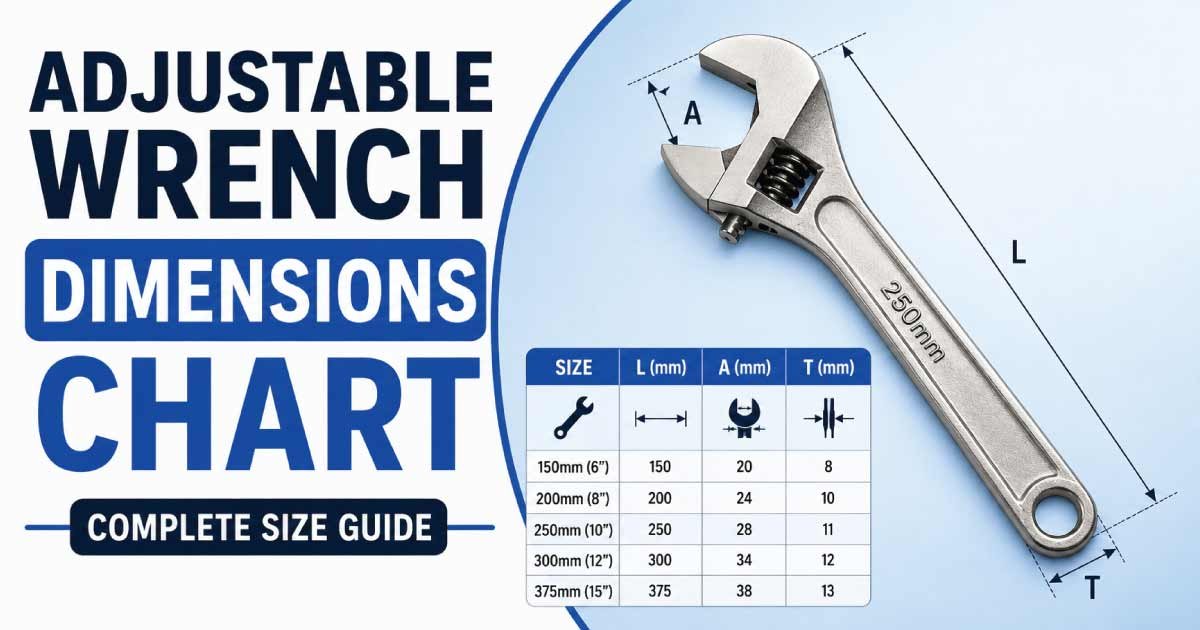
Adjustable wrench sizes are generally described by the overall length of the tool, while its actual working capacity is determined by the maximum jaw opening.
For example, an adjustable wrench may be described as a 6-inch, 8-inch, 10-inch, or 12-inch wrench. These numbers generally refer to the approximate overall length of the wrench.
However, two 8-inch adjustable wrenches from different manufacturers may have slightly different maximum jaw capacities.
Important dimensions include:
- Overall wrench length
- Maximum jaw opening
- Minimum jaw opening
- Jaw depth
- Head thickness
- Handle thickness
- Weight
For selecting a wrench, the maximum jaw opening is often more useful than the overall length alone.
Common Adjustable Wrench Size Chart
The following chart provides common adjustable wrench sizes and typical jaw capacities. Actual specifications vary by manufacturer, so use the manufacturer’s product dimensions when exact capacity is required.
| Wrench Size | Approx. Length | Typical Maximum Jaw Opening | Common Uses |
|---|---|---|---|
| 4 inch | 100 mm | 12–15 mm | Small repairs, electronics |
| 6 inch | 150 mm | 18–20 mm | DIY and light maintenance |
| 8 inch | 200 mm | 24–25 mm | General mechanical work |
| 10 inch | 250 mm | 28–30 mm | Plumbing and automotive work |
| 12 inch | 300 mm | 33–35 mm | Heavy maintenance |
| 15 inch | 375 mm | 40–45 mm | Larger fasteners |
| 18 inch | 450 mm | 50–55 mm | Heavy-duty applications |
| 24 inch | 600 mm | 60–70 mm | Large industrial work |
These values are typical ranges rather than universal standards. Always check the manufacturer’s specifications before selecting a wrench for a particular fastener.
Adjustable Wrench Size in Inches and Millimeters
The wrench’s nominal size is commonly given in inches, but the physical dimensions can also be expressed in millimeters.
| Nominal Wrench Size | Approx. Length in mm | General Category |
|---|---|---|
| 4 inch | 100 mm | Compact |
| 6 inch | 150 mm | Small |
| 8 inch | 200 mm | Medium |
| 10 inch | 250 mm | Medium-large |
| 12 inch | 300 mm | Large |
| 15 inch | 375 mm | Extra-large |
| 18 inch | 450 mm | Heavy-duty |
| 24 inch | 600 mm | Industrial |
The conversion between inches and millimeters is based on 1 inch = 25.4 mm. Actual tool length may differ slightly from the nominal size because manufacturers may round their product dimensions.
4-Inch Adjustable Wrench
A 4-inch adjustable wrench is a compact option designed for small fasteners and situations where working space is limited.
Its short handle makes it easier to carry in a small toolbox, tool pouch, or maintenance kit.
Common applications include:
- Small mechanical repairs
- Light-duty maintenance
- Bicycle adjustments
- Small plumbing fittings
- Tight spaces
- General DIY work
The main limitation is its relatively small jaw opening and reduced leverage compared with larger adjustable wrenches.
6-Inch Adjustable Wrench
A 6-inch adjustable wrench provides a useful balance between portability and working capacity.
It is small enough for everyday carry while offering more leverage and jaw capacity than a compact 4-inch model.
Typical uses include:
- Household repairs
- Plumbing maintenance
- Automotive adjustments
- Bicycle maintenance
- Appliance repair
- General workshop tasks
For a compact toolbox, a 6-inch adjustable wrench is often a practical size.
8-Inch Adjustable Wrench
The 8-inch adjustable wrench is one of the most useful general-purpose sizes. It provides more leverage than smaller models while remaining relatively easy to handle.
It can be used for:
- General mechanical work
- Plumbing
- Automotive maintenance
- Construction
- Equipment repair
- DIY projects
For users who want one adjustable wrench for general maintenance, an 8-inch model is often a versatile choice.
10-Inch Adjustable Wrench
A 10-inch adjustable wrench provides additional leverage and a larger jaw opening than 6-inch and 8-inch models.
It is commonly used for:
- Plumbing
- Automotive repairs
- Industrial maintenance
- Large fasteners
- Construction equipment
- General mechanical work
The larger handle can produce more turning force, but it also requires more clearance around the fastener.
12-Inch Adjustable Wrench
A 12-inch adjustable wrench is designed for larger fasteners and applications where additional leverage is useful.
It is commonly found in:
- Plumbing work
- Heavy maintenance
- Industrial equipment
- Large machinery
- Construction
- Automotive repair
Because of its larger head and handle, it may be difficult to use in confined areas.
15-Inch and Larger Adjustable Wrenches
Adjustable wrenches larger than 12 inches are generally selected for larger fasteners and demanding mechanical applications.
Common sizes include:
- 15 inches
- 18 inches
- 24 inches
These large tools provide greater leverage and jaw capacity but are heavier and less suitable for confined spaces.
They are commonly used for:
- Large plumbing fittings
- Industrial machinery
- Heavy equipment
- Large pipe fittings
- Maintenance operations
- Construction equipment
For extremely large fasteners, a properly sized pipe wrench, combination wrench, socket, or specialized tool may be more appropriate than an adjustable wrench.
How to Choose the Right Adjustable Wrench Size
Choosing the correct adjustable wrench involves considering the fastener size, available space, required torque, and frequency of use.
Measure the Fastener
First determine the size of the nut or bolt you need to turn.
The wrench must open wide enough to fit completely over the fastener without forcing the jaws.
Check the Jaw Opening
The maximum jaw opening should be greater than the fastener size.
For example, if a fastener requires a 25 mm opening, choose an adjustable wrench with a jaw capacity that comfortably exceeds 25 mm.
Consider Available Space
A large wrench may have enough capacity but still be unsuitable if there is not enough room to rotate the handle.
For confined spaces, a smaller adjustable wrench or a thin-head design may be preferable.
Consider Leverage
Larger wrenches generally provide greater leverage because of their longer handles.
However, more leverage is not always better. Excessive force can damage the fastener, wrench, or surrounding components.
Check the Wrench Quality
Look for:
- Strong jaw construction
- Smooth adjustment mechanism
- Minimal jaw movement
- Clearly marked measurements
- Comfortable handle
- Corrosion-resistant finish
A quality adjustable wrench should maintain a secure grip on the fastener when correctly adjusted.
Discover More:
Adjustable Wrench vs. Fixed Wrench
Adjustable and fixed wrenches both have important advantages.
| Feature | Adjustable Wrench | Fixed Wrench |
|---|---|---|
| Fastener sizes | Multiple sizes | Usually one or two |
| Adjustability | Yes | No |
| Convenience | High | Moderate |
| Speed of use | Moderate | Usually faster |
| Jaw fit | Adjustable | Fixed |
| Portability | One tool covers multiple sizes | Multiple tools may be needed |
| Precision fit | Depends on adjustment | Excellent |
| Common use | General maintenance | Professional mechanical work |
A fixed wrench normally provides a more precise fit, while an adjustable wrench offers greater versatility.
Adjustable Wrench vs. Pipe Wrench
Adjustable wrenches and pipe wrenches are designed for different purposes.
An adjustable wrench has smooth jaws and is primarily intended to grip hexagonal nuts and bolts.
A pipe wrench has serrated jaws designed to grip round objects such as pipes.
| Feature | Adjustable Wrench | Pipe Wrench |
|---|---|---|
| Jaw surface | Generally smooth | Serrated |
| Primary purpose | Nuts and bolts | Pipes and round fittings |
| Fastener protection | Better | Can mark surfaces |
| Adjustment | Worm mechanism | Threaded adjustment |
| Typical use | Mechanical work | Plumbing and pipe work |
Using a pipe wrench on a finished hexagonal fastener can damage the fastener surface. Likewise, an adjustable wrench is generally not the best choice for gripping smooth round pipe.
Types of Adjustable Wrenches
Different adjustable wrench designs are available for specific applications.
Standard Adjustable Wrench
The standard adjustable wrench has a traditional straight jaw arrangement and is suitable for general-purpose work.
It is available in many sizes and is one of the most common designs.
Wide-Jaw Adjustable Wrench
A wide-jaw adjustable wrench provides a larger opening while maintaining a relatively compact overall size.
This can be useful when working with larger fasteners but limited space.
Slim-Jaw Adjustable Wrench
Slim-jaw models have thinner jaws designed to fit into restricted spaces.
They can be useful for plumbing, automotive, and machinery applications where standard jaws cannot reach the fastener effectively.
Ratcheting Adjustable Wrench
Some specialized adjustable wrenches incorporate a ratcheting mechanism, allowing the user to turn a fastener without completely removing the wrench after every movement.
These designs can improve convenience in certain applications but are generally more specialized than traditional adjustable wrenches.
What Size Adjustable Wrench Is Best for Plumbing?
The best adjustable wrench size for plumbing depends on the fitting and available space.
For general household plumbing, common choices include:
- 6-inch wrench for small fittings
- 8-inch wrench for general tasks
- 10-inch wrench for larger fittings
- 12-inch wrench for larger plumbing connections
Plumbing work often involves fittings of different sizes, so having two adjustable wrenches can be more useful than relying on one very large tool.
For example, one wrench can hold a fitting while another turns the connecting component.
What Size Adjustable Wrench Is Best for Automotive Work?
Automotive applications involve many different fastener sizes, so no single adjustable wrench covers every job.
An 8-inch or 10-inch wrench can be useful for general maintenance, while a 6-inch model can help with smaller or confined areas.
However, adjustable wrenches should not automatically replace properly sized sockets and combination wrenches. Fixed tools generally provide a more precise fit and can reduce the chance of rounding a fastener.
How to Use an Adjustable Wrench Correctly
Correct adjustment is essential for preventing damage to the fastener and tool.
Follow these steps:
- Open the jaws wider than the fastener.
- Place the fixed jaw against the fastener.
- Turn the adjustment mechanism until the movable jaw contacts the opposite flat.
- Make sure the jaws sit squarely on the fastener.
- Apply force smoothly through the handle.
- Avoid excessive force when the wrench is not fully seated.
The jaws should grip the flat surfaces of the nut or bolt rather than the corners.
Discover More:
Common Adjustable Wrench Mistakes
Incorrect use can damage both the wrench and fastener.
Avoid these common mistakes:
- Using the wrong wrench size
- Leaving excessive space between the jaws
- Gripping the corners of a fastener
- Using an adjustable wrench on heavily damaged fasteners
- Using a cheater bar to extend the handle
- Hammering on the wrench
- Using the tool beyond its rated capacity
- Using an adjustable wrench as a substitute for a pipe wrench
- Applying excessive force at an angle
- Using a damaged or excessively worn wrench
The adjustment mechanism should also move smoothly. Excessive looseness between the jaws can make it difficult to maintain a secure grip.
How to Maintain an Adjustable Wrench
Proper maintenance keeps the adjustment mechanism working smoothly and helps extend tool life.
Clean the Wrench
Remove dirt, grease, and debris after use. Pay particular attention to the adjustment mechanism.
Inspect the Jaws
Check the jaw faces for excessive wear, cracks, chips, or deformation.
Lubricate the Adjustment Mechanism
A small amount of suitable lubricant can help maintain smooth movement. Avoid excessive lubrication because it can attract dust and debris.
Store It Properly
Keep the wrench in a dry location and avoid exposing it unnecessarily to moisture.
If the tool develops significant jaw movement or visible damage, replace it rather than relying on it for demanding work.
Discover More:
Adjustable Wrench Size Selection Tips
Use these quick guidelines when selecting an adjustable wrench:
- Choose the smallest wrench that comfortably fits the fastener.
- Check the maximum jaw opening before purchasing.
- Use longer handles when appropriate leverage is needed.
- Choose slim-jaw models for confined spaces.
- Prefer fixed wrenches when an exact fit is available.
- Do not exceed the manufacturer’s rated capacity.
- Keep the wrench square with the fastener.
- Use quality tools with minimal jaw play.
- Carry multiple sizes for varied maintenance work.
A small selection such as 6-inch, 8-inch, and 10-inch adjustable wrenches can cover many general-purpose tasks.
Frequently Asked Questions About Adjustable Wrench Sizes
What are the most common adjustable wrench sizes?
Common adjustable wrench sizes include 4, 6, 8, 10, and 12 inches. Larger models such as 15, 18, and 24 inches are available for bigger fasteners and heavy-duty applications. The best size depends on the required jaw opening, available working space, and amount of leverage needed.
What size adjustable wrench should I buy?
For general household and workshop use, an 8-inch adjustable wrench is a versatile starting point. A 6-inch model is useful for compact jobs, while a 10- or 12-inch wrench provides greater jaw capacity and leverage. Check the manufacturer’s maximum jaw opening before purchasing.
Is an adjustable wrench the same as a crescent wrench?
The terms are commonly used to describe the same general type of tool: a wrench with one fixed jaw and one movable jaw. However, Crescent is also a brand name associated with adjustable wrenches. Product designs and features can vary between manufacturers.
How do I measure an adjustable wrench?
Adjustable wrench size is normally based on its approximate overall length, such as 6, 8, or 10 inches. To understand its actual working capacity, also measure the maximum distance between the jaws. Manufacturer specifications provide the most accurate jaw-opening measurement.
Can an adjustable wrench replace a socket set?
An adjustable wrench can handle many different fastener sizes, but it does not completely replace a socket set. Sockets generally provide a more precise fit and are better suited for repeated or high-torque work. An adjustable wrench is best considered a versatile supplementary tool.
Conclusion
An adjustable wrench size chart makes it easier to compare common wrench lengths and understand their typical applications. Small 4- and 6-inch models are useful for compact work, while 8- and 10-inch wrenches are versatile choices for general maintenance. Larger 12-inch and above models provide greater jaw capacity and leverage for demanding applications.
Remember that overall wrench length does not tell the complete story. Always check the maximum jaw opening, fastener size, available clearance, handle length, and tool quality before choosing a wrench.
For general-purpose work, having several adjustable wrench sizes is often more practical than relying on one oversized tool. Select the smallest suitable wrench for the job, adjust the jaws firmly against the fastener, and use the tool within its intended capacity for safer and more effective results.

Engineer Hassan is a Mechanical Engineer with 16+ years of hands-on experience in mechanical hardware, fasteners, and workshop tools. He focuses on size selection, thread identification, and measurement, helping users choose the correct components with accuracy and safety.