
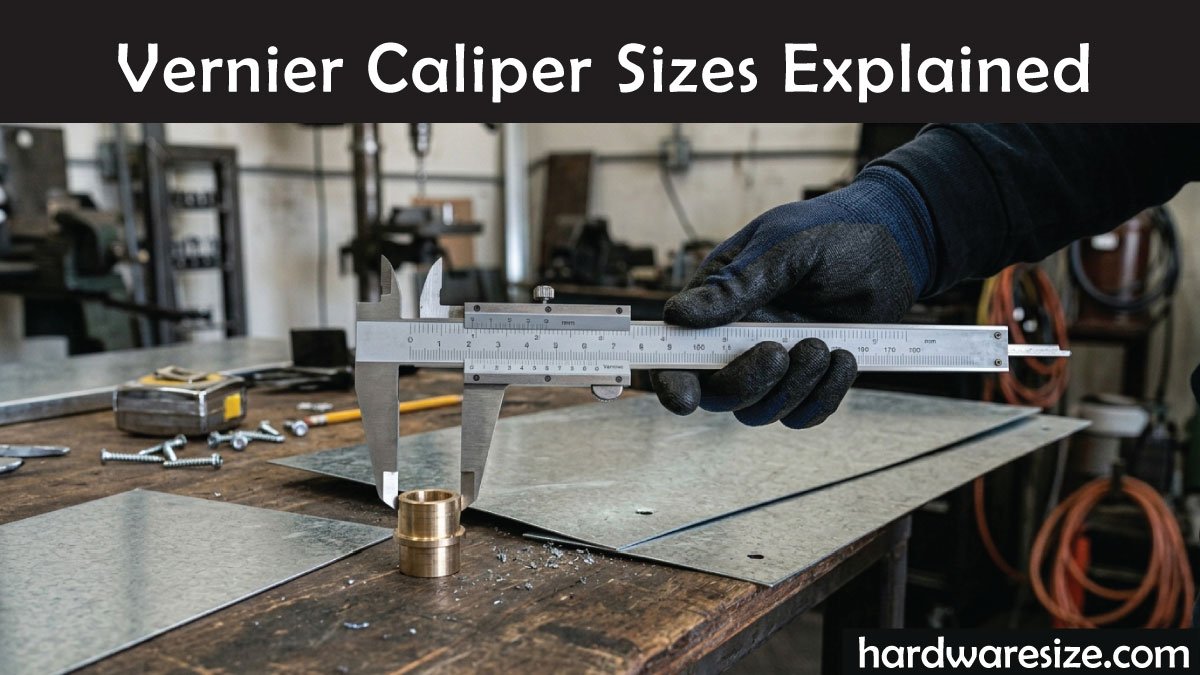
It is precision that counts in machines. You can be measure a bolt, check the diameter of a pipe, or determining the thickness of a metal sheet, but any small error can result in poor fitting, rework or failure. A Vernier caliper is then one of the most reliable items in any workshop.
Here however is a point that many beginners have forgotten, the correct Vernier caliper size is as important as the use.
With all the details you need to know, you will gain an understanding of what Vernier caliper sizes are and how they influence your work and how to choose the correct caliper size based on actual use, not just theory.
Understand Vernier Caliper Size (What It Really Means)
When we discuss the size of a Vernier caliper we mean its greatest measure-ability dimension–the largest dimension which it is capable of measuring exactly.
For example:
- A 150 mm caliper can measure objects up to 150 mm
- A 300 mm caliper can measure up to 300 mm
This measurement range is determined by the length of the main scale and the travel distance of the sliding jaw.
However, size is not just about range. It also impacts:
- Tool balance
- Ease of handling
- Measurement precision in different situations
A small caliper offers better control for fine work, while the large caliper provides reach but may sacrifice comfort for delicate measurements.
Common Vernier Caliper Sizes (Explained in Depth)
Let’s make a division on the most common sizes and their best placement. Know these sizes will assist you in the correct tool to use when measure the both small scale and in industry processes with accuracy, comfort, and efficiency.
1. 150 mm (6-Inch) Vernier Caliper
This is the standard size found in most toolboxes. It is widely preferred by beginners and also professionals because it offers an excellent balance of precision, portability, and ease of use in everyday measurement tasks across multiple applications and industries.
It’s ideal for:
- Nuts, bolts, screws
- Small machine components
- DIY and hobby work
Control and convenience is the greatest benefit of this size. It can be held in one hand and as such, it can be used easily to get good readings without shaking or misalignment.
Practically speaking, since you are measuring objects less than 5-6 inches very often, this size will accommodate pretty much everything. It is also easy to carry, store and can be used in Bench work, instructional purposes and close-up inspection of mechanicals.
2. 200 mm (8-Inch) Vernier Caliper
This one is somewhat bigger and more flexible but not too bulky. It is often chosen by users who need a bit more measuring range while still maintain good handling, make it suitable for both workshop and light industrial applications.
Best suited for:
- Medium-sized parts
- General workshop tasks
- Automotive components
It provides you with some extra range and still has a reasonable precision. This is chosen by many professionals as a compromise between a small and a long range.
This size also mitigates the use of tools that are often different when handling mixed-size components. It is particularly handy in repair, where there are small and moderately large parts that require to be measured quickly and efficiently.
3. 300 mm (12-Inch) Vernier Caliper
Here we pass into greater space. It is sized to suit people who handle larger parts on a regular basis and require longer ranges of measurement, and so is common in fabrication shops, mechanical workshops, and industry.
This size is commonly used for:
- Metal plates
- Pipes and tubes
- Fabrication work
It has a significantly larger measuring range, but it is also more delicate. Due to the length, any slight tilt will interfere with accuracy.
This size has proven to be incredibly handy when dealing with mixed projects in which part sizes vary widely. But it requires the steadiest of hands and good positioning so that there is uniform and dependable results in actual usage.
4. 600 mm and Larger Calipers
They are used in industrial applications where the measurement of large-scale components is a common need. They are built for durability and extended reach, make them essential tools in the heavy engineering, construction, and large manufacturing operations.
Used for:
- Large machinery parts
- Structural components
- Heavy fabrication
These calipers are more weighty and in some cases two hands are needed to work effectively. They remain very accurate, but are not designed to make sensitive or fine measurements.
They are not suited to fine work, but rather rough and coarse work by virtue of their size. These oversized measuring tools can be handled, supported, and experienced well to get an accurate reading.
Also Read 👉 Allen Key Size Chart explains metric and SAE sizes, proper selection, and real-world uses in a clear way. Avoid mistakes and choose the right tool every time—read the full post now for complete guidance and practical tips!
Why Size Selection Matters More Than You Think
It is a common belief among many that the best option is to purchase the largest caliper. Things actually work the other way around, though: in practice, that method can be very counter-productive since size does have a direct relationship with accuracy, comfort, and general efficiency in real-world measurement cases.
Here’s why:
1. Accuracy Depends on Control
A bigger caliper is more difficult to hold still particularly when using little or delicate items. Even a slight hand movement, jaw misalignment, or uneven pressure can lead to incorrect readings, reduce the reliability of your measurements in precision-based mechanical or engineering tasks.
2. Comfort Affects Performance
Small work is soon uncomfortable and inefficiently done with an oversized tool. Your hand grows weary, less steady, and your measurements grow clumsy to repeat, which may slow down your work process and give you a high risk of consistent measurement errors over the years.
3. Precision Work Needs Smaller Tools
When tight tolerances are necessary in your work, a smaller caliper will give a superior grip and control. It enables you to hold the jaws in a more precise position, exert even pressure, or more reliable reading measurements, particularly with small parts or other finer components of a mechanism.
4. Large Work Requires Reach
Conversely, a small caliper will not be able to open up large-enough to be useful with larger objects. This compels you to guess at sizes or change tools often, which makes it less efficient and can create errors when working with larger sizes such as pipes or plates.
Real Example (From Workshop Use)
I used a 150 mm caliper in my early days at the workshop. It did best with bolts, shafts and small fittings. However, as I began to use longer metal brackets and pipe sections, I was always limited.
I needed to count by parts or other tools, thereby compromising precision. The solution to the problem was immediately found in an upgrade to a 300 mm caliper, but another problem was introduced: the necessary care with it when making smaller measurements.
That’s when I realized something important:
👉 No single caliper size fits every job.
👉 Professionals often keep multiple sizes for different tasks.
Types of Measurements and Size Impact
There is no single type of measurement with a Vernier caliper. It has three primary functions, each of which varies with size, particularly in the areas of reach, control, and precision when working in the mechanical, industrial, and DIY setting.
1- External Measurements
They are width, thickness, and outer diameter. It is the simplest measurement method that is applied in nearly all workshop applications when the outer dimensions of an object have to be measured fast and precisely.
- Small calipers are excellent for precision
- Large calipers handle bigger objects but require steady hands
Smaller calipers receive better hold and alignment and are suitable with fine work. Although larger calipers can measure larger parts, their larger jaws are more delicate and need a great deal of care to stay in contact and prevent tiny tilts that can create a difference in the final reading.
2- Internal Measurements
Used for measure the inside of holes or pipes. The operation of this is based on the caliper upper jaws, which protrude to internal dimensions to be captured.
- Larger calipers are better for wider openings
- Smaller calipers may struggle to reach inside deeper areas
On smaller machines, big calipers can be used to easily measure large internal diameters, whereas the small ones are restricted by the size of the jaw and the size of the opening. Deep or wide gaps may be inaccessible to a smaller tool, thus necessitating the use of a larger tool to reach them.
3- Depth Measurements
Using the depth rod at the end. This is particularly applicable to measuring holes, slots, grooves, and recesses of mechanical components, or materials, which are very difficult to measure.
- Longer calipers allow deeper measurements
- Short calipers are limited in reach
Longer caliper gives greater depth of measurements and as such, it is applicable to deeper holes. Shorter calipers are more stable but do not have an ability to measure up to their rod length thus can be used only in some cases.
Also Read: 👉 Drill Bit Types for wood, metal, and concrete are explained in a simple, practical way. Learn which bit to use for each material and avoid costly mistakes—read the full post now for clear guidance and expert tips!
Vernier Caliper Size vs Accuracy
There is a mythical belief that bigger calipers are less precise. That is not fully so, and accuracy relies primarily on the quality of tools and how they are used and not only on their size.
Accuracy depends on:
- Manufacturing quality
- Calibration
- User technique
But size is also capable of influencing practical accuracy (experience in actual use) as manipulation is a significant factor in the measurement process.
For example:
- A 150 mm caliper is easier to align → better real-world precision
- A 300 mm caliper is harder to stabilize → slightly higher chance of error
It can be the same lowest count (e.g. 0.02 mm), but the experience of the use is quite different with both tools. A smaller tool is much more controlled and a larger one needs more control in positioning and stabilization in grip.
Digital vs Manual: Does Size Change the Choice?
Size and type are usually jointly used since varying working needs and measurements may dictate the type of calipers that users like, whether digital, dial, and manual, at different sizes.
1- Small Sizes (150–200 mm)
- Common in digital versions
- Easy to read
- Great for beginners
The sizes are also commonly found in digital format due to their convenience in using and reading. Beginners benefit from instant readings, reduced calculation errors, and faster measurements during repetitive tasks in the workshops or home projects.
2- Medium to Large Sizes (200–300 mm)
- Available in both digital and manual
- Manual versions are often more durable
At this level, the users tend to make a choice based on preference. Digital calipers are more convenient, whereas the manual versions have durability and reliability in harsh conditions when the electronics may be subject to dust, oil, and other mechanical damages.
3- Large Sizes (300 mm+)
- Usually manual or dial
- Built for rugged industrial use
The large calipers usually come in the form of a manual since they are applied where there are heavy work environment. They are robust and stable, not digital convenient and can be used in industries where stability is the consideration, rather than the convenient.
Large size digital calipers are also available though they are not as frequent as the smaller size because of cost and difficulty in handling.
How to Choose the Right Vernier Caliper Size
This is a pragmatic decision-making strategy that will assist you in choosing the most appropriate caliper size, which fits your current work, future requirements as well as comfort. Make the good better best decision guarantees greater precision, productivity, and sustainability of use in professional or DIY use.
Step 1: Identify Your Typical Work Size
Ask yourself:
What is the largest object I measure regularly?
A caliper of 150 mm would have been sufficient in the case of you working on most work less than 100 mm. This will prevent you from having to carry around tool size that you will not use, and it will mean that your caliper is just the right size such that you will not over-complicate its use or compromise its accuracy.
Step 2: Think About Future Needs
Don’t just buy for today. Consider upcoming projects. Increasing the scale of your work is always a possibility down the line and it will be possible to pick a caliber that is slightly bigger and avoid upgrading your work too early and costing more money in the future.
Go one size larger in case you are dealing with bigger materials. This helps you to be flexible and your tool will not be wasted when you expand your projects in size and complexity.
Step 3: Consider Work Environment
Bench work → smaller caliper
Field or fabrication work → larger caliper
The place of work is a significant factor in the selection of a tool. The smaller calipers are easier to operate in a work bench whereas the big ones have the reach and ruggedness required in outside, industrial, or fabrication applications.
Step 4: Balance Comfort and Capability
Choose a size that:
- Feels comfortable in your hand
- Covers your measurement range
A caliper must not just do the job you require but must be comfortable to hold. A proper ratio between size and comfort enhances accuracy, decreases fatigue, and decreases the speed and reliability of accomplishing repeated measurements.
Also Read: 👉 Screwdriver Types Explained helps beginners understand different types, their uses, and when to use each tool. Learn the basics the right way and avoid common mistakes—read the full post now for clear guidance and practical tips!
Common Mistakes to Avoid
Expert users have poor decisions in choosing caliper size. These mistakes can be avoided and it can save you money, enhance accuracy and make sure your tool is efficient in the long run.
1- Choosing Only Based on Price
Low end tools do not offer high precision and durability. Although they might be perceived as a good bargain at first, they might give inaccurate readings and they are easily worn out, and hence costs are incurred at the end of the day of replacement or rework.
2- Ignoring Measurement Range
The instrument that is not capable of occupying your whole scope soon becomes useless. When it comes to getting a caliper you should always make sure that it will be able to accommodate your largest size in terms of measurement so as to prevent any interruptions and the use of extra tools in the process of work.
3- Buying Oversized Tools
Big calipers may slow down small operations. They are more difficult to control, less comfortable and may cause measurement errors in an instance that needs precision and stability such as fine or detailed work.
4- Not Checking Build Quality
Smooth movement, distinct indications and appropriate adjustment is vital. A well-built caliper ensures consistent performance, accurate readings, and also long term reliability, especially in demand in workshop or industrial environments.
Maintenance Tips for Any Size Caliper
It does not matter how much, good care will provide accuracy over a long period. Regular maintain is not only extend the life of your tool but also maintain the measurements to be reliable and unchanged with time.
- Clean the jaws after every use
- Avoid dropping the tool
- Store in a protective case
- Check zero error regularly
- Keep away from moisture and dust
A properly cared-caliper may last many years without decreasing when it comes to accuracy. Handling and storage are equally significant as the correct choice of the size in the first place.
When Should You Upgrade Your Caliper?
You should consider upgrading if:
- You frequently reach the maximum limit of your current caliper
- You struggle to measure larger objects
- Your work scope has expanded
- You need better efficiency in handling different sizes
Timely upgrading enhances the workflow and avoids the tendency of work being slowed by measurement limitations. It also makes sure that you are accurate in a broader scope of work.
Many professionals eventually build a set that includes:
- 150 mm for precision
- 300 mm for versatility
Multiple sizes are important to be able to deal with both the little and large measurements, and thus be able to do your job more quickly, more precisely, and more professionally, in general.
Final Thoughts
Understand Vernier caliper sizes is not just about numbers—it’s about select the tool that truly matches your workflow and daily measurement needs. A 150 mm caliber is best used in make delicate, miniature and daily work with great control and convenience.
In the meantime, 200-300 mm calipers are more flexible, so that they can be used to work with small and large components without repeated change of the tools. To measure large structures and machine parts that require heavy-duty industrial tasks, 600 mm and bigger calipers are developed.
It depends not on the size of the tool you use, but the size that suits you in the work. A 150 mm caliper is a good place to start when new to the business whereas when the project requirements increase, a change to a 300 mm can be made.

Engineer Hassan is a Mechanical Engineer with 16+ years of hands-on experience in mechanical hardware, fasteners, and workshop tools. He focuses on size selection, thread identification, and measurement, helping users choose the correct components with accuracy and safety.