
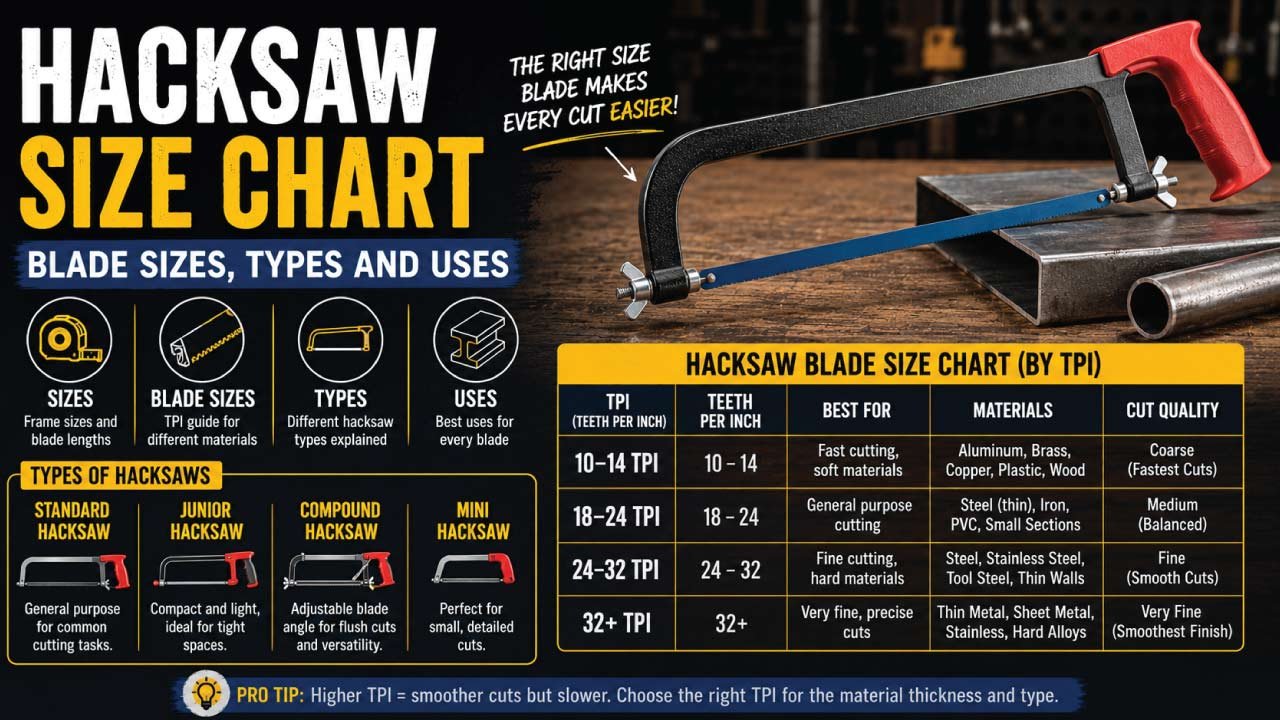
A hacksaw is one of the most useful hand tools for cutting metal, plastic, pipes, rods, bolts, and other materials. Whether you are a mechanic, plumber, electrician, metalworker, or DIY user, choosing the correct hacksaw size is important for smooth cutting, safety, and better accuracy.
Many beginners buy a hacksaw without understanding frame sizes, blade lengths, teeth per inch (TPI), or material compatibility. Using the wrong hacksaw size can make cutting difficult, damage the blade, and waste time.
In this complete hacksaw size guide, you will learn about hacksaw frame sizes, blade dimensions, TPI charts, blade types, applications, and tips for selecting the right hacksaw for your work.
What Is a Hacksaw?
A hacksaw is a hand-operated cutting tool primarily designed for cutting metal and hard materials. It consists of a rigid frame and a thin, replaceable blade with fine teeth. It is widely used in workshops, plumbing, construction, and DIY repair work for precise and controlled cutting tasks.
Modern hacksaws can also cut:
- Plastic
- PVC pipes
- Aluminum
- Copper
- Steel rods
- Bolts
- Brass
- Wood (with special blades)
The cutting performance depends heavily on blade size, tooth count (TPI), and blade material, which determine cutting speed and smoothness.
Main Parts of a Hacksaw
A hacksaw is made of several key components that work together to ensure accurate and efficient cutting. Understanding these parts helps in selecting the right hacksaw and maintaining it properly for long-term use and better performance.
1. Frame
The frame is the main structure of the hacksaw that holds the blade in place. It provides strength and stability during cutting and is usually made of metal or strong alloy for durability and long-lasting use.
2. Blade
The blade is a thin steel strip with sharp teeth used for cutting materials. It is replaceable and comes in different TPI ratings depending on whether the user needs fast cutting or fine, smooth finishing.
3. Handle
The handle is the grip area used to control the hacksaw during cutting. It is designed for comfort and stability, allowing the user to apply steady pressure and maintain better cutting accuracy.
4. Tension Adjuster
The tension adjuster is used to tighten or loosen the blade inside the frame. Proper tension is important for straight, accurate cuts and prevents blade bending or breakage during use.
5. Blade Pins
Blade pins are small locking components that secure the blade firmly into the frame. They ensure the blade stays in position during cutting and prevent slipping or movement for safe operation.
Standard Hacksaw Sizes
Hacksaw sizes are usually identified by blade length.
| Hacksaw Size | Blade Length | Common Use |
|---|---|---|
| Mini Hacksaw | 6 inches | Small precision work |
| Junior Hacksaw | 8 inches | Light-duty cutting |
| Standard Hacksaw | 10 inches | Medium work |
| Full-Size Hacksaw | 12 inches | Heavy-duty cutting |
| Large Industrial Hacksaw | 14 inches | Industrial applications |
The 12-inch hacksaw is the most commonly used size worldwide.
Mini Hacksaw Size Guide
Mini hacksaws are small, compact cutting tools designed for precision work in tight or confined spaces. They are ideal for light-duty cutting tasks where a full-size hacksaw cannot easily reach or operate. Despite their small size, they offer good control and accuracy.
1. Common Features
Mini hacksaws are designed for portability and ease of use. Their short blade length and lightweight frame make them perfect for detailed work and small repair jobs in plumbing, electrical, and DIY applications.
- Blade Length: 6 inches
- Narrow frame
- Lightweight design
- Used in tight spaces
2. Best Uses
Mini hacksaws are best suited for small and precise cutting tasks where accuracy is more important than cutting power. They are commonly used in plumbing, electrical work, and light metal trimming.
- Cutting small pipes
- Electrical conduit work
- PVC cutting
- Small bolts
- Fine metal trimming
3. Advantages
Mini hacksaws are very user-friendly, especially for beginners or for work in confined areas. Their compact size makes them easy to handle and control during precise cutting operations.
- Easy to control
- Works in confined spaces
- Lightweight
4. Limitations
Although mini hacksaws are useful for precision work, they are not designed for heavy-duty cutting. Their small size limits their cutting power and speed when dealing with thick or hard materials.
- Slow cutting
- Not suitable for thick metal
Junior Hacksaw Size Guide
Junior hacksaws are slightly larger than mini hacksaws.
| Feature | Size |
|---|---|
| Blade Length | 8 inches |
| Frame Type | Small |
| Best Material | Plastic and thin metal |
Common Applications
- DIY projects
- Household repairs
- Thin aluminum cutting
- Plastic pipe cutting
Standard Hacksaw Size Guide
Standard hacksaws are the most widely used.
| Feature | Size |
|---|---|
| Blade Length | 10 inches |
| Frame Size | Medium |
| Typical Use | General cutting |
Suitable For
- Steel rods
- Pipes
- Copper tubes
- Aluminum bars
- Bolts
This size offers a balance between portability and cutting power.
Full-Size Hacksaw Guide
The 12-inch hacksaw is the industry standard.
| Feature | Specification |
|---|---|
| Blade Length | 12 inches |
| Cutting Capacity | High |
| Best Use | Heavy-duty cutting |
Advantages
- Faster cutting
- Better stability
- Stronger frame
- Higher tension support
Common Users
- Mechanics
- Plumbers
- Welders
- Fabricators
- Metalworkers
Industrial Hacksaw Sizes
Industrial hacksaws are designed for large and heavy cutting jobs.
| Size | Common Application |
|---|---|
| 14 inches | Thick steel cutting |
| 16 inches | Industrial workshops |
| 18 inches | Heavy fabrication |
These saws are less common in home workshops.
Hacksaw Blade Size Chart
Blade length and tooth size both affect performance.
| Blade Length | Typical TPI | Material Type |
| 6 inch | 24–32 TPI | Thin metals |
| 8 inch | 18–24 TPI | Plastic and soft metals |
| 10 inch | 18–32 TPI | General metal cutting |
| 12 inch | 14–32 TPI | Heavy-duty cutting |
Adjustable vs Fixed Hacksaw Frames
Hacksaw frames come in two main types: fixed and adjustable. Both are designed to hold the blade under tension, but they differ in flexibility, strength, and usability. Choosing the right frame depends on the type of work, frequency of use, and blade size requirements.
1. Fixed Frame Hacksaw
A fixed frame hacksaw is designed to support only one specific blade length. It is simple in structure and highly stable, making it suitable for users who perform consistent cutting tasks with the same blade size.
Advantages
- Stronger frame
- Better stability
Disadvantages
- Limited flexibility
2. Adjustable Frame Hacksaw
An adjustable frame hacksaw allows users to fit different blade lengths, making it more versatile. It is widely used in professional settings where different cutting tasks require different blade types and sizes.
Advantages
- Versatile
- Accepts different blades
Disadvantages
- Slightly heavier
Adjustable frames are preferred by professionals because they offer more flexibility for different cutting applications.
3. Hacksaw Blade Direction
Correct blade installation is very important for safe and efficient cutting. Many beginners install the blade incorrectly, which reduces cutting performance and may damage the tool or material.
4. Correct Blade Direction
The hacksaw blade must be installed in the correct direction to ensure proper cutting action. If installed correctly, the saw cuts efficiently on the forward stroke with better control and less effort.
- The teeth should point forward, away from the handle
This allows the hacksaw to cut during the forward stroke.
👆 Drill Size Chart: Complete Guide To Standard Drill Sizes is a complete expert guide to understanding drill bit sizes, standard measurements, and accurate drilling applications. Read the full post to choose the correct drill size, improve precision, and avoid common drilling mistakes in woodworking, metalworking, and DIY projects like a professional.
How to Choose the Correct Hacksaw Size
Choose Based on Material Thickness
| Material Thickness | Recommended TPI |
|---|---|
| Thin sheet metal | 32 TPI |
| Medium pipe | 24 TPI |
| Thick steel bar | 18 TPI |
Choose Based on Workspace
The working environment plays a major role in selecting the right hacksaw. Tight spaces require compact tools for better control, while open areas allow the use of larger frames for faster and more efficient cutting.
1. Tight Areas
For confined or narrow spaces, smaller hacksaws are easier to control and maneuver. They provide better precision and reduce difficulty when working in restricted positions.
Use:
- Mini hacksaw
- Junior hacksaw
2. Open Workspace
In open areas, larger hacksaws are more effective because they provide better cutting speed and stability. They are suitable for general workshop and construction work.
Use:
- 10-inch hacksaw
- 12-inch hacksaw
Choose Based on Frequency of Use
The frequency of use also determines the best hacksaw type. Occasional users can choose basic models, while professionals need stronger frames and high-quality blades for long-term performance.
1. Occasional DIY Work
For light and occasional tasks, simple hacksaws with standard blades are enough. They are affordable and easy to use for basic household or repair work.
- Standard carbon steel blade
- 10-inch frame
2. Professional Use
Professional users require durable tools that can handle continuous and heavy-duty cutting. Adjustable frames and bi-metal blades are preferred for strength and long service life.
- 12-inch adjustable frame
- Bi-metal blade
👆 What Is a Ratchet? Sizes, Types, Uses and Materials is a complete expert guide to understanding ratchet sizes, drive types, materials, and practical applications in automotive and mechanical work. Read the full post to choose the right ratchet, improve efficiency, and handle fastening tasks accurately like a professional mechanic or DIY expert.
Hacksaw Uses in Different Industries
Hacksaws are widely used across multiple industries due to their ability to cut metal, plastic, and other hard materials with precision and control.
1. Plumbing
Hacksaws are commonly used in plumbing for cutting and shaping pipes during installation and repair work. They provide clean cuts for proper fitting and connection.
Used for:
- Pipe cutting
- PVC trimming
- Copper tube cutting
2. Automotive Repair
In automotive work, hacksaws are used for cutting metal parts and trimming exhaust systems. They help in repair and modification tasks.
Used for:
- Cutting bolts
- Exhaust pipe cutting
- Metal trimming
3. Metal Fabrication
Hacksaws are essential in metal workshops for shaping and cutting various metal components used in construction and manufacturing.
Used for:
- Rod cutting
- Steel bar cutting
- Sheet metal work
4. Electrical Work
Electricians use hacksaws for cutting protective conduits and cable trays during installation and maintenance tasks.
Used for:
- Conduit cutting
- Cable tray trimming
Common Hacksaw Problems
Hacksaws can develop issues if used incorrectly or maintained poorly. Understanding these problems helps improve performance and prevent tool damage during work.
1. Blade Breaking
Blade breakage is usually caused by excessive force or improper blade setup. It reduces efficiency and can be dangerous if not handled carefully.
Causes
- Excessive pressure
- Wrong blade tension
- Incorrect TPI
2. Crooked Cuts
Crooked cuts occur when the blade is not stable or properly controlled. This affects accuracy and results in uneven cutting lines.
Causes
- Loose blade
- Poor grip
- Low-quality blade
3. Slow Cutting
Slow cutting reduces productivity and usually results from dull or incorrect blades. Proper blade selection and maintenance improve speed and efficiency.
Causes
- Dull blade
- Wrong TPI
- Incorrect cutting angle
Hacksaw Safety Tips
Safety is very important when using a hacksaw because it involves sharp blades and metal cutting. Following proper safety practices reduces the risk of injury and improves cutting accuracy.
1. Wear Safety Glasses
Eye protection is essential because metal particles and dust can fly during cutting, which may cause serious eye injuries.
- Metal particles can fly during cutting
2. Use Gloves
Gloves help improve grip and protect hands from sharp edges or accidental contact with the blade during cutting operations.
- Gloves improve grip and reduce injuries
3. Secure the Material
Always clamp the workpiece before cutting to prevent movement, which improves accuracy and reduces the chance of accidents.
- Use a vise or clamp before cutting
4. Avoid Excessive Pressure
Let the blade do the cutting work. Applying too much force can damage the blade and cause uneven or unsafe cutting.
- Let the blade do the work
5. Inspect the Blade
Check the blade before use to ensure it is not cracked or damaged. A faulty blade can break during cutting and cause injury.
- Never use cracked or damaged blades
👆 Pipe Wrench Size Chart: Types, Uses and Complete Guide is a must-read expert guide for understanding pipe wrench sizes, types, and common plumbing applications. Read the full post to choose the correct wrench size, improve gripping power, and complete pipe repair and maintenance tasks safely and efficiently like a professional plumber.
Hacksaw vs Other Cutting Tools
| Tool | Best For |
|---|---|
| Hacksaw | Manual metal cutting |
| Angle Grinder | Fast heavy cutting |
| Reciprocating Saw | Demolition work |
| Pipe Cutter | Clean pipe cuts |
| Jigsaw | Curved cuts |
Best Hacksaw Size for Beginners
For beginners, choosing the right hacksaw setup is important for learning proper control, cutting technique, and safety. A medium-sized hacksaw provides a good balance between ease of use, stability, and cutting performance, making it suitable for most basic workshop and home repair tasks.
Recommended Beginner Setup
For most beginners, the best choice is:
- 12-inch adjustable hacksaw
- 24 TPI bi-metal blade
This setup works well for most home and workshop tasks.
Professional Hacksaw Recommendations
Professional users need stronger, more durable, and more versatile hacksaw setups to handle continuous and heavy-duty cutting work. Professionals usually prefer adjustable frames with high-quality blades that offer better performance and longer service life.
| Feature | Recommendation |
|---|---|
| Frame | Adjustable |
| Blade Material | Bi-metal |
| Blade Length | 12 inches |
| TPI Range | 18–32 |
This combination offers excellent versatility, durability, and cutting efficiency for industrial, automotive, and fabrication work.
Final Thoughts
Choosing the correct hacksaw size improves cutting speed, accuracy, and safety. Small hacksaws are ideal for precision work and tight spaces, while 12-inch hacksaws are best for general workshop and industrial use.
Understanding blade size, TPI, frame type, and blade material helps you select the right hacksaw for every project. For most users, a 12-inch adjustable hacksaw with a bi-metal 24 TPI blade provides the best balance of durability and performance.
Whether you are cutting pipes, bolts, rods, or sheet metal, using the correct hacksaw size makes the job easier and more efficient.
FAQs:
What is the most common hacksaw size?
The most common hacksaw size is 12-inch because it offers a perfect balance of control, cutting power, and versatility. It is widely used by both professionals and DIY users for cutting metal pipes, rods, and plastics, making it the standard choice in most workshops.
Which TPI is best for metal cutting?
For general metal cutting, 24 TPI (teeth per inch) is considered the best option. It provides smooth and controlled cutting on thin to medium metals. Higher TPI blades are used for finer work, while lower TPI blades are better for thicker materials like heavy steel sections.
Can a hacksaw cut wood?
Yes, a hacksaw can cut wood, but it is not the ideal tool. Standard metal blades may cause rough cuts or splintering. For better results, special wood-cutting blades with fewer teeth are recommended, as they allow faster cutting and reduce damage to the wooden surface.
Why does my hacksaw blade keep breaking?
A hacksaw blade usually breaks due to excessive pressure, incorrect blade tension, or using the wrong blade for the material. Over-tightening or loose fitting can also cause stress. Using steady, controlled strokes and selecting the correct TPI and blade type helps prevent frequent breakage.
Which hacksaw blade lasts the longest?
Bi-metal hacksaw blades last the longest because they combine a flexible body with hardened steel teeth. This design reduces snapping while maintaining sharpness for a longer time. They are ideal for heavy-duty and repeated cutting tasks in metalworking and general workshop applications.

Engineer Hassan is a Mechanical Engineer with 16+ years of hands-on experience in mechanical hardware, fasteners, and workshop tools. He focuses on size selection, thread identification, and measurement, helping users choose the correct components with accuracy and safety.