
Threads are one of the most important parts of fasteners like bolts, screws, and nuts. If you don’t understand threads properly, even correctly sized bolts and nuts may not fit together.
Two basic types of threads exist in mechanical systems: external threads and internal threads. Understanding the difference is essential for anyone working with bolts, nuts, or machine parts.
In this beginner guide, you will learn what external and internal threads are, how they differ, how to measure them, and how they work together.
What Are Threads?
Threads are spiral-shaped ridges that are created on the surface of fasteners and mechanical parts. These ridges help connect two or more components securely by turning or tightening them together. Threads are one of the most important parts of bolts, screws, nuts, and pipe fittings because they create strong holding force and prevent parts from coming loose easily.
Threads are found on:
- Bolts
- Screws
- Nuts
- Pipes and fittings
Threads work by converting rotational motion into tight clamping force.
What Is External Thread?
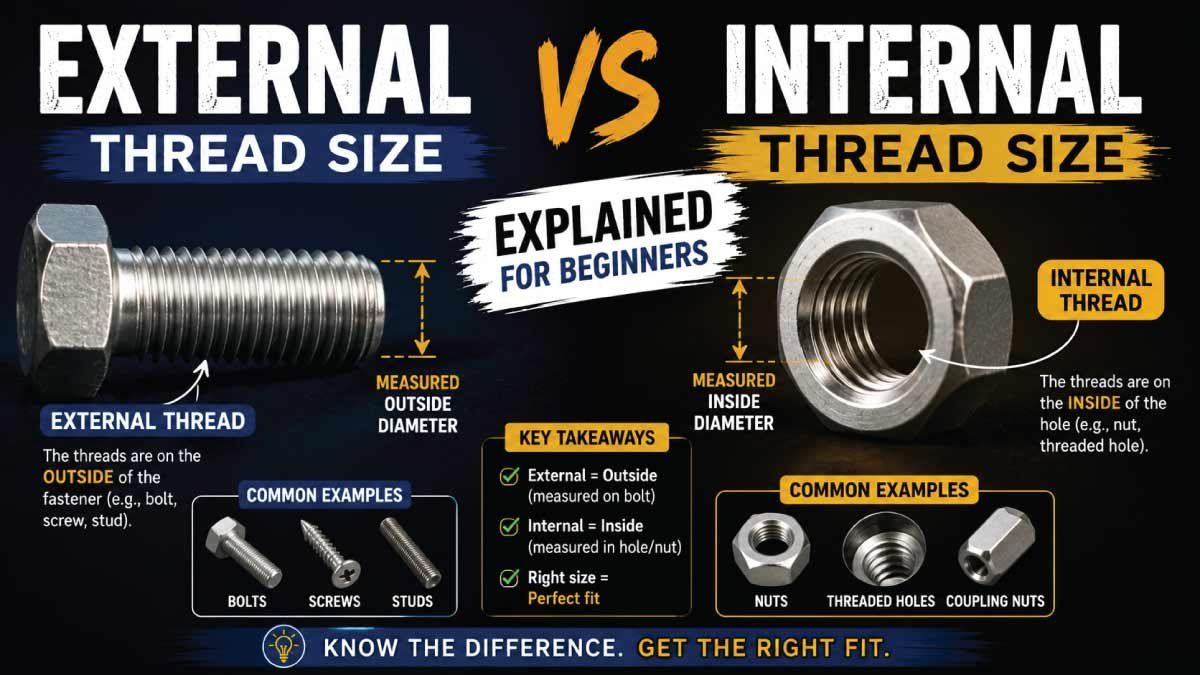
An external thread is a type of thread that is formed on the outside surface of a round or cylindrical part. These threads are designed to fit into matching internal threads, allowing parts to fasten together securely. External threads are commonly used in mechanical, automotive, plumbing, and construction applications.
Examples of External Threads:
- Bolt threads
- Screw threads
- Studs
Simple Definition:
👉 External thread is the male thread that goes outside and screws into a nut or hole.
Key Features of External Threads:
- Found on outer surface
- Visible spiral ridges
- Usually on bolts and screws
- Fits into internal threads
- Called “male threads”
Example:
When you insert a bolt into a nut, the threaded part of the bolt is called the external thread. These outer spiral ridges rotate into the nut and create a tight connection. The nut contains matching internal threads that accept and lock onto the bolt threads securely.
- The bolt has external threads
- The nut accepts those threads
What Is Internal Thread?
An internal thread is a thread that is created inside a hole or opening of a mechanical part. These threads are designed to receive and match with external threads, allowing two components to fasten together securely. Internal threads are commonly used in nuts, machine parts, pipe fittings, and threaded holes.
Examples of Internal Threads:
- Nuts
- Threaded holes in machines
- Pipe fittings
Simple Definition:
👉 Internal thread is the female thread that receives the external thread.
Key Features of Internal Threads:
- Found inside a hole
- Not visible unless inspected closely
- Present in nuts and tapped holes
- Receives external threads
- Called “female threads”
Example:
When you tighten a nut onto a bolt, the inside grooves of the nut are called internal threads. These threads match the bolt’s external threads and create a strong and secure connection when tightened properly.
- The nut has internal threads
- It locks onto the bolt’s external threads
External vs Internal Thread: Main Differences
External and internal threads are two essential types of threads used in fastening systems. They work together to create secure mechanical connections in bolts, nuts, screws, pipes, and machine parts. Understanding their differences in location, shape, function, and manufacturing helps improve proper fastening, safety, and thread compatibility in engineering applications.
1. Location
The biggest difference between external and internal threads is their position on a component. External threads are formed on the outer surface of bolts, screws, or studs. Internal threads are created inside holes, nuts, or fittings so they can receive the external thread properly during fastening.
- External thread → Outside surface (bolt/screw)
- Internal thread → Inside surface (nut/hole)
2. Function
External and internal threads work together to create a secure mechanical connection. The external thread enters and rotates into the internal thread, while the internal thread grips and holds the external thread tightly to prevent loosening during use.
- External thread → Inserts into internal thread
- Internal thread → Holds external thread
3. Shape
The shape of both thread types is also different. External threads have raised spiral ridges that are clearly visible on the outside of a fastener. Internal threads contain matching grooves cut inside a hole or nut to allow proper engagement with external threads.
- External → Raised spiral ridges
- Internal → Grooves cut inside
4. Naming
In engineering and fastening terminology, external and internal threads are often called male and female threads. This naming is based on how the parts fit together during assembly, where the male thread enters the female thread.
- External = Male thread
- Internal = Female thread
5. Tools Used
Different tools are used to manufacture these threads. External threads are commonly produced using thread rolling machines or cutting dies, while internal threads are usually created with taps that cut grooves inside drilled holes.
- External threads → formed by rolling or cutting dies
- Internal threads → made using taps
How to Measure External Thread Size
Measuring external thread size is important for identifying the correct bolt, screw, or threaded fastener. Accurate measurements help ensure proper fitting with nuts and threaded holes. The process usually includes measuring the thread diameter, checking thread pitch, and confirming whether the thread follows metric or imperial standards.
Step 1: Measure Diameter
Use a vernier caliper to measure the outside diameter of the threaded part. Measure across the outermost points of the thread to get the major diameter. This measurement helps identify the thread size and is the first step in thread identification.
Use a vernier caliper to measure outer diameter.
Step 2: Identify Thread Pitch
Thread pitch refers to the distance between one thread and the next. You can measure it using a thread pitch gauge or compare the threads with a standard thread chart. Correct pitch measurement ensures the fastener matches properly with nuts or threaded holes.
Use a thread gauge or compare with standard chart.
Step 3: Confirm Thread Type
After measuring diameter and pitch, determine whether the thread is metric or imperial. Metric threads are measured in millimeters, while imperial threads use inches and threads per inch (TPI). Identifying the correct system prevents fitting and compatibility problems.
Check if it is metric or imperial.
Example
An M8 bolt has an external thread diameter of approximately 8 millimeters. The “M” stands for metric thread, while the number represents the outer diameter of the threaded section.
Example:
M8 bolt = 8 mm external thread diameter
How to Measure Internal Thread Size
Measuring internal thread size helps identify the correct nut, threaded hole, or pipe fitting for a matching bolt or screw. Since internal threads are located inside a hole, careful measurement is required. The process includes measuring the inner diameter, matching the correct bolt size, and checking thread pitch compatibility.
Step 1: Measure Inner Diameter
Use a vernier caliper to measure the inside diameter of the threaded hole or nut. Measure across the widest internal points carefully to estimate the thread size. This measurement gives a basic idea of which bolt or screw may fit properly. Use caliper to measure inside of nut or hole.
Step 2: Match with Standard Bolt
After measuring the inner diameter, compare the measurement with standard bolt sizes. Testing a matching bolt is one of the easiest ways to confirm the correct internal thread size and ensure proper thread engagement without forcing the connection. Find bolt size that fits the measurement.
Step 3: Check Thread Pitch
The thread pitch of the internal thread must match the external thread exactly. Even if the diameter is correct, mismatched pitch can damage the threads or prevent proper tightening. Use a thread gauge or standard chart to confirm compatibility. Ensure pitch matches external thread.
Example
An M8 nut is designed to fit an M8 bolt, but both parts must also have the same thread pitch. If the pitch differs, the bolt may not tighten correctly even though the diameter appears similar.
Example: M8 nut fits M8 bolt only if pitch matches
Common Beginner Mistakes
Many beginners make small mistakes when working with threaded fasteners, especially while identifying thread types and matching bolts with nuts. These errors can damage threads, weaken connections, or create fitting problems. Learning these common mistakes helps improve accuracy, safety, and proper fastening in mechanical and construction work.
1. Confusing Internal and External Threads
One common mistake is misunderstanding the difference between internal and external threads. Beginners often assume both are the same type because they share similar sizes. In reality, they are opposite parts designed to work together in a fastening system. Many beginners think both are the same size system—but they are opposite parts.
2. Ignoring Thread Pitch
Thread pitch is extremely important for proper fitting. Even if two fasteners have the same diameter, they may not connect if the thread pitch is different. Incorrect pitch causes loose fitting, cross-threading, or complete incompatibility. Even same diameter parts will not fit if pitch is different.
3. Forcing Parts Together
Trying to force a bolt into a nut or threaded hole can permanently damage the threads. Cross-threading weakens the connection and may make the fastener unusable. Proper alignment and correct thread matching are always important before tightening. This damages threads permanently.
4. Mixing Metric and Imperial Systems
Metric and imperial threads use different measurement systems and thread standards. Mixing them can cause severe fitting problems because the diameter and thread pitch are not designed to match correctly. This leads to complete mismatch.
Best Example
Suppose you have an M10 bolt with an external thread and an M10 nut with an internal thread. If both the diameter and thread pitch match correctly, the parts will connect smoothly and create a secure fastening joint.
Let’s say you have:
- Bolt: M10 external thread
- Nut: M10 internal thread
If both are correct:
- ✔ They will fit smoothly
- ✔ Tightening will be easy
- ✔ Joint will be strong
But if:
- Pitch is different → It won’t fit
- System is different → It will jam
Why Understanding Threads Is Important
Understanding external and internal threads is very important in mechanical and engineering work because it helps you select and use fasteners correctly. When you know how threads function, you can avoid mistakes, improve safety, and ensure strong, reliable connections in machines, structures, and everyday repair tasks.
Knowing external vs internal threads helps you:
- Avoid fitting mistakes
- Choose correct fasteners
- Improve mechanical safety
- Work efficiently in repairs and projects
- Reduce damage to tools and materials
Where This Knowledge Is Used
Thread knowledge is widely used in many technical and practical fields. From large-scale industries to simple home repairs, understanding threads ensures proper assembly and long-lasting performance of mechanical systems.
- Mechanical engineering
- Automotive repair
- Construction work
- Manufacturing industries
- DIY home repairs
Final Thoughts
External and internal threads are two essential parts of the same fastening system. The external thread is found on bolts and screws, while the internal thread is located inside nuts or threaded holes. When both are correctly matched in size, pitch, and type, they form a strong and secure connection.
For beginners, the key is simple:
👉 External thread goes in
👉 Internal thread receives
Once you understand this basic concept, working with bolts, nuts, and other mechanical parts becomes much easier, faster, and more accurate in real-world applications.

Engineer Hassan is a Mechanical Engineer with 16+ years of hands-on experience in mechanical hardware, fasteners, and workshop tools. He focuses on size selection, thread identification, and measurement, helping users choose the correct components with accuracy and safety.