
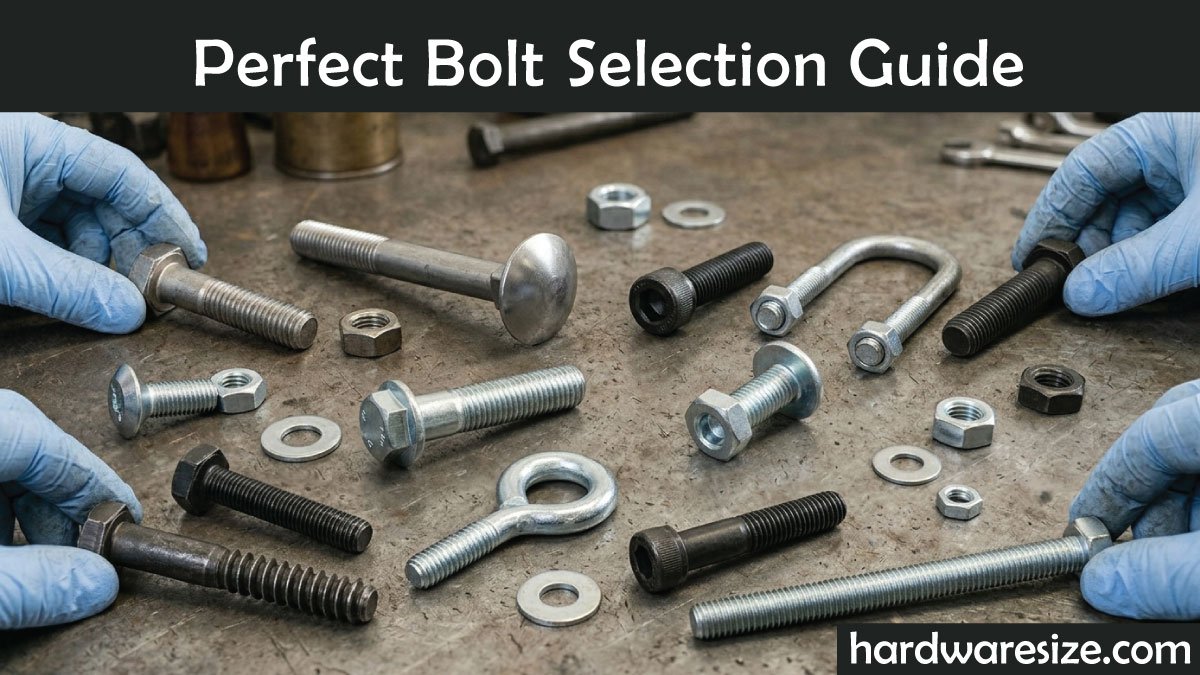
It might be difficult to believe at first that selecting the appropriate bolt is a very important procedure in the life of any mechanical undertaking in terms of its robustness, security and durability.
Be it a home DIY project, repair of heavy machinery or an assembly of an industrial, it is important to know how to pick the right bolt.
We shall take you through all you have to know, including the types and materials of the bolts, the sizes, threads and the torque, all in a natural and easy to understand manner.
Understand the Role of Bolts in Mechanical Projects
Bolts are not mere fasteners but the structural foundation of a large number of assemblies. They bear parts, give them suitable positions, and permit parts to take loads.
Wrongly attached bolt may cause mechanical failure, equipment damage or even a safety hazard. An example is that a short bolt may not give sufficient grip on and a bolt that is not strong enough may shear out of load.
Knowing the use of a bolt in your project assists in choosing the type, size and the material you will utilize. Bolts are chosen according to the load carrying use, weather conditions, exposure to vibrations, and compatibility with other fasteners like nuts and washers.
Types of Bolts and Their Applications
Bolts are available in numerous shapes and designs, which are designed to deal with certain loads and materials as well as installation requirements.
Learning the various kinds of bolts and their application as needed is useful to maintain strong, safe and durable connections in mechanical, building and DIY work.
1. Hex Bolts:
One of the most common fasteners is the 4- hex bolts, which has a six sided head making it easy to tighten using ordinary tools. They are popular in the construction sector, automobile industry and heavy machinery where high level of strength, durability and reliable load carrying capability is needed.
2. Carriage Bolts
Carriage bolts have a smooth, rounded head and a square shaped neck underneath it which fits into wooden surfaces.
This design also ensures that the bolt does not spin when being tightened, and is therefore the most suitable when connecting wood with metal or wood with wood e.g. decks, fences, and furniture.
3. Lag Bolts:
Lag bolts (also lag screws) are a type of heavy-duty fastener that is used in wood. They also have deep threads and can be used in thick timber with a hex head that makes them very powerful in holding.
They are commonly applied in the framing, decks, posts and the establishment of heavy structural parts.
4. Machine Bolts
Machine bolts are intended to fit metal-to-metal and are normally meant to be received in pre-drilled, threaded holes.
They are common in the machinery, equipment assembly, and industrial applications where precision in alignment, uniform clamping force and simple disassembly are significant during maintenance and repair.
5. Eye Bolts:
The eye bolts consist of a circular head that is looped and through which ropes, cables or chains can pass through safely. Their applications are mainly in lifting, rigging, anchoring and load securing. The proper selection of eye bolt will guarantee the sound handling of weight as well as mitigate failure.
Bolt Materials: Matching Strength and Environment
The contents of a bolt are very critical in its service, life, and safety. Various substances have different degrees of strength, corrosion, and durability. The correct bolt material can guarantee stable fastening, in particular, under the influence of moisture, chemicals, heat, or heavy loading.
1. Carbon Steel:
The most commonly used fasteners are the carbon steel bolts, which are cheap and solid in nature. They are good in indoor and general-purpose applications. Their drawback though is that they have a tendency to rust and therefore to enhance the resistance to corrosion, protective finishes such as a zinc plating are frequently added.
2. Stainless Steel:
Stainless steel bolts are also famous in their outstanding abilities against rust and corrosion. They suit best in outdoors or coastal or humid conditions where the water remains always.
Although a little weaker than alloy steel, they are durable in the long run and have a clean look.
3. Alloy Steel:
Alloy steel bolts are designed to be used in stressful and high-strength applications. They have extra features, which increase their resistance to wear and durability.
They are typically employed in the heavy machinery, and car parts, as well as in structural connections with the maximum amount of loads.
4. Brass:
Brass bolts can be praised because of their corrosion resistance and electric conductivity. They find application in electrical equipment, plumbing and decorations.
Whereas they are not applicable in cases of high-loads, the brass bolts do well in cases that value appearance, conductivity, and corrosion-resistance.
Selecting the right material ensures that your bolts will perform under expected environmental and mechanical stresses.
Understand Bolt Grades and Strength
The Bolt grades indicate their mechanical strength and response to load. An example would be in the United States, Grade 2, Grade 5 and Grade 8 are used to identify the grade of a bolt:
Grade 2: Low strength, commonly used in light-duty applications.
Grade 5: Medium strength, suitable for automotive and machinery projects.
Grade 8: High strength, used in critical, load-bearing assemblies.
In metric systems, grading is denoted as 8.8, 10.9 or 12.9 with bigger numbers depicting high tensile strength. The right grade will make sure that your bolts are safe enough to hold the weight and not break down.
Select the Right Bolt Size
There are two key factors by which bolt size is decided, which are diameter and length. The load bearing capacity of a bolt is dependent on its diameter and the length on which the material that the bolt is able to engage is dependent on the length.
Using a bolt that is too small can compromise the joint, while a bolt that is too long may protrude unnecessarily or damage surrounding components.
Here’s a simple Bolt Size Chart for reference:
| Bolt Diameter (mm) | Recommended Length (mm) | Typical Applications |
|---|---|---|
| 6 | 20-50 | Light assemblies, electronics |
| 8 | 30-70 | Furniture, medium-duty machinery |
| 10 | 40-100 | Automotive, medium structural applications |
| 12 | 50-150 | Heavy machinery, construction |
| 16 | 60-200 | Industrial equipment, structural steel |
This chart provides a general guideline, but always consider the specific requirements of your project, including the thickness of the materials being joined.
Understand Bolt Threads
The threading of the bolts is crucial in the way in which a fastener is attached. The thread design has an influence on strength of grip, load distribution and loosening resistance.
Proper choice of type of thread guarantees that it fits perfectly, is stable in use and that it lasts long in the mechanical and structural sphere of use.
1. Coarse Threads:
Coarse threads contain fewer threads per inch and therefore have the ability to cut solidly into the less hard material like wood or aluminum.
They also are simpler to install, less prone to dirt or damage, and on the risk of stripping, and are primarily used in general-purpose and field applications.
2. Fine Threads:
Fine threads have higher count of threads per inch, this enhances the contact of the surface and holding power. They work well with hardened materials and assemblies that are precision.
Fine threads are also better than the others when it comes to vibration and have better control over the tension when tightening.
Consider Environmental Factors
In the choice of bolts, the conditions of the environment are important. Bolt performance may be affected by moisture, chemicals or high temperatures.
The stainless steel and coated bolts are perfect in the outdoor or corrosive environment, whereas high-strength alloy bolts are ideal in high temperature.
Bolts with a non-rusting coating are also of great importance in projects located in the coastal regions in order to avoid rust and deterioration.
Torque and Load Considerations
Correct use of the torque is used to make sure that the bolts are tightened to hold the joint but not to over-stress the joint. Torque wrench can be used as per the specifications of the manufacturer of the bolt to ensure that they do not break or loosen.
Excessive tightening may strip threads or deform parts, whereas inadequate tightening may result in the joint failing when in load. The first step when developing a mechanical project is to figure what the project will be loaded with and what bolts are capable of safely carrying the load under a factor of safety.
Bolts under dynamic or cyclic loads can have lock washers, thread-locking compounds or special bolt grades to provide safety and performance.
Complementary Fasteners: Nuts and Washers
Bolts rarely function alone. The choice of the nuts and washers is also crucial to joint stability.
The washers are used to evenly distribute the load and avoid damaging the surface and nuts are used to provide a tight assembly.
To decrease the probability of joint failure, it is important to select compatible size and material of nuts and washers.
Here’s a Nut and Washer Compatibility Chart for common bolt sizes:
| Bolt Diameter (mm) | Recommended Nut Size | Recommended Washer Size | Notes |
|---|---|---|---|
| 6 | M6 | 12 mm OD | Standard applications |
| 8 | M8 | 16 mm OD | Medium-duty assemblies |
| 10 | M10 | 20 mm OD | Automotive and machinery |
| 12 | M12 | 24 mm OD | Heavy structural applications |
| 16 | M16 | 30 mm OD | Industrial and construction |
Ensuring that your nuts and washers are compatible with the bolt size and grade is crucial for a secure and long-lasting connection.
Practical Tips for Selecting the Perfect Bolt
Selecting the appropriate bolt does not simply concern size, it involves the concern of safety, performance, and durability. With the help of load, material, standards, and environment, you will be able to prevent failures and make sure that your mechanical or DIY project is robust and safe.
1. Know the Load Requirements:
When choosing a bolt, it is always good to compute the maximum load that the joint is going to bear both in dynamic and shock loading.
When selecting a load rating of the bolt that is higher than the necessary one, a safety margin is provided, the probability of failure is minimized and the long-term structural integrity is ensured.
2. Consider Material Compatibility:
Galvanic corrosion may occur when incompatible materials are used in the presence of moisture. As an example, corrosion can be hastened by matching stainless steel bolts with aluminum.
Always use matching materials or apply protective coating and washers to avoid early damage.
3. Check Standards and Specifications:
A bolt being produced as per ASTM, ISO and SAE standards suit certain strength, tolerance and quality standards.
Adherence to these standards leads to uniformity, dependability, and safety, particularly where performance and conformity are paramount, e.g. in the professional or industrial practice.
4. Account for Environmental Conditions:
1- Environmental factors like moisture, chemicals, heat, and vibration directly affect bolt performance. Use corrosion-resistant materials such as stainless steel in humid or marine environments, and high-strength alloy steel bolts in high-temperature or high-stress conditions.
5. Don’t Forget the Accessories:
2- Nuts, washers, and thread-locking compounds are essential for maintaining joint integrity. Washers distribute load evenly, nuts secure the connection, and thread lockers prevent loosening due to vibration, ensuring a durable and reliable fastening system.
6. Consult Bolt Charts:
3- Bolt size charts, grade charts, and torque tables help you select the correct bolt dimensions and tightening force. Using these references prevents over-tightening or under-tightening, improves safety, and ensures optimal performance for your specific application.
Final Thoughts

Engineer Hassan is a Mechanical Engineer with 16+ years of hands-on experience in mechanical hardware, fasteners, and workshop tools. He focuses on size selection, thread identification, and measurement, helping users choose the correct components with accuracy and safety.