
Coupling nuts are small but critical components used in a wide range of mechanical, structural, and industrial applications. Despite their simple appearance, selecting the correct coupling nut size is essential for ensuring strength, safety, and long-term performance. This complete guide explains what coupling nuts are, how their sizing works, how to read a coupling nut size chart, and how to choose the right one for your application.
Whether you are a professional engineer, contractor, machinist, or DIY enthusiast, understanding coupling nut dimensions and standards will help you avoid costly mistakes and ensure reliable connections.
What Is a Coupling Nut?
A coupling nut, often called an extension nut, is an elongated, internally threaded fastener engineered to connect two male-threaded parts. Its extended body increases thread engagement compared with standard hex nuts, improving load distribution, alignment, and strength when joining bolts, threaded rods, or studs in demanding assemblies.
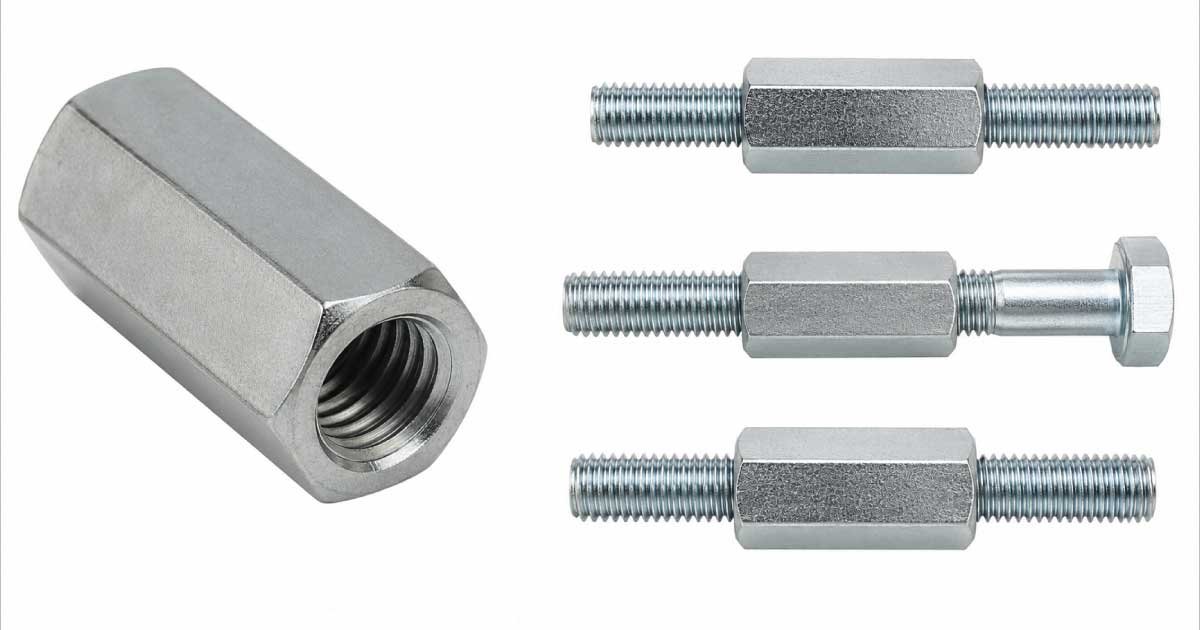
Coupling nuts are commonly used to:
- Extend threaded rods
- Join two bolts or studs end-to-end
- Create adjustable connections
- Provide strong tensile connections in structural assemblies
They are widely used in construction, HVAC systems, electrical installations, plumbing, machinery, and industrial equipment.
Why Coupling Nut Size Matters
Selecting the correct coupling nut size is critical for performance and safety in any assembly. Proper sizing ensures adequate thread engagement, predictable load transfer, and compatibility with mating fasteners, while minimizing risks such as stripping, loosening, vibration-related fatigue, and premature joint failure during service.
Choosing the wrong coupling nut size can result in:
- Insufficient thread engagement
- Reduced load capacity
- Stripped threads
- Joint failure under vibration or tension
- Misalignment in assemblies
A properly sized coupling nut ensures:
- Full thread contact with mating fasteners
- Correct load transfer
- Compliance with industry standards
- Safe and durable connections
This is why coupling nut size charts are essential reference tools.
Metric Coupling Nut Size Chart
Metric coupling nuts are manufactured according to ISO and DIN standards to ensure consistency, strength, and interchangeability across applications. Sizes are identified by the metric thread designation (M) and pitch, helping users quickly select the correct coupling nut for structural, mechanical, or industrial assemblies.
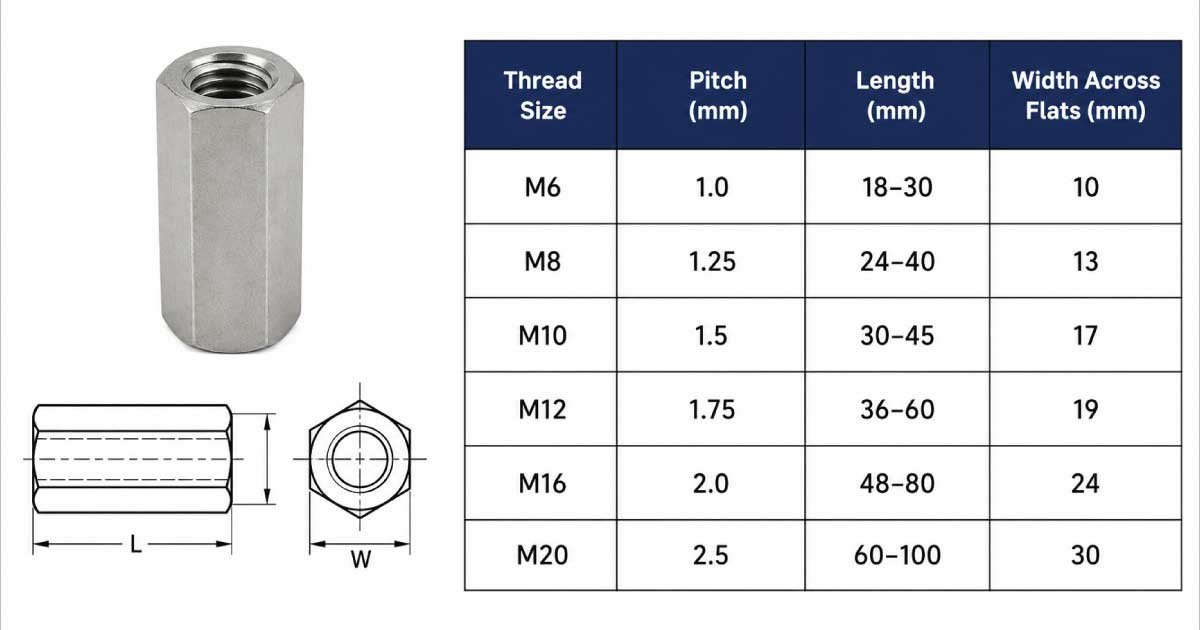
Metric coupling nuts follow ISO and DIN standards. Sizes are designated by the thread diameter (M) and pitch.
Common Metric Coupling Nut Dimensions
| Thread Size | Pitch (mm) | Length (mm) | Width Across Flats (mm) |
|---|---|---|---|
| M6 | 1.0 | 18–30 | 10 |
| M8 | 1.25 | 24–40 | 13 |
| M10 | 1.5 | 30–45 | 17 |
| M12 | 1.75 | 36–60 | 19 |
| M16 | 2.0 | 48–80 | 24 |
| M20 | 2.5 | 60–100 | 30 |
Notes:
- Length varies by manufacturer and application.
- Longer coupling nuts provide greater tensile strength.
- Fine-pitch versions are available for precision or vibration-resistant applications.
Key Dimensions of a Coupling Nut
Before reviewing a coupling nut size chart, it’s essential to understand the key dimensions used to specify coupling nuts. These dimensions determine compatibility, strength, load capacity, and tool fit, helping ensure the coupling nut performs reliably in structural, mechanical, and industrial fastening applications.
1. Thread Size
Thread size defines the internal diameter and thread form of the coupling nut, which must precisely match the bolt, stud, or threaded rod being connected. Correct thread size ensures secure engagement, proper load transfer, and prevents cross-threading or premature failure during installation or service.
The thread size refers to the internal thread diameter and pitch. Common standards include:
- Metric threads (e.g., M6, M8, M10)
- Unified threads (e.g., 1/4″-20, 3/8″-16)
The thread size must match the threaded rod or bolt being joined.
2. Thread Pitch
Thread pitch specifies the spacing between adjacent threads and directly affects how smoothly mating parts engage. Even if the diameter matches, an incorrect pitch will prevent proper assembly, reduce strength, and may permanently damage both the coupling nut and fastener.
Thread pitch is the distance between threads.
- Metric: measured in millimeters (e.g., M10 × 1.5)
- Imperial: measured in threads per inch (TPI)
Using the wrong pitch will prevent proper engagement.
3. Length
The length of a coupling nut determines how much of each male-threaded component is engaged inside the nut. Longer coupling nuts provide greater thread contact, improved alignment, and higher load capacity, making length a critical factor in structural and tensile applications.
Coupling nuts are significantly longer than standard nuts. Length determines:
- How much thread engagement is available
- Load-bearing capacity
- Alignment stability
4. Width Across Flats (WAF)
Width Across Flats refers to the distance between two opposite hex faces of the coupling nut. This dimension is important for installation because it determines the correct wrench or socket size required to apply proper torque without slipping or rounding the nut.
This is the distance across the hex faces of the nut. It determines which wrench or socket size is required.
5. Material and Grade
Material and grade influence the coupling nut’s strength, corrosion resistance, and suitability for specific environments. While not a dimensional measurement, selecting the right material ensures compatibility with load requirements, temperature conditions, and exposure to moisture or chemicals.
While not part of dimensional sizing, material affects strength and compatibility:
- Carbon steel
- Stainless steel
- Alloy steel
- Brass
Imperial (Inch) Coupling Nut Size Chart
Imperial coupling nuts are commonly used in North American applications and are produced according to ANSI or ASME standards. These nuts are measured in inches and specified by thread size and threads per inch, ensuring compatibility, strength, and reliable performance in mechanical, structural, and industrial assemblies.
Imperial coupling nuts are typically manufactured to ANSI or ASME standards and measured in inches.
Common Inch Coupling Nut Dimensions
| Thread Size | Threads Per Inch (TPI) | Length (in) | Width Across Flats (in) |
|---|---|---|---|
| 1/4″-20 | 20 | 7/8–1 | 7/16 |
| 5/16″-18 | 18 | 1–1-1/4 | 1/2 |
| 3/8″-16 | 16 | 1-1/4–1-1/2 | 9/16 |
| 1/2″-13 | 13 | 1-3/4–2 | 3/4 |
| 5/8″-11 | 11 | 2–2-1/2 | 15/16 |
| 3/4″-10 | 10 | 2-1/2–3 | 1-1/8 |
Notes:
- Coarse threads (UNC) are more common for general use.
- Fine threads (UNF) offer higher tensile strength but require precise alignment.
Standard Length Variations
Coupling nuts are manufactured in a range of standard and non-standard lengths to suit different load requirements and assembly conditions. Selecting the appropriate length helps ensure adequate thread engagement, proper alignment, and reliable load distribution, especially in structural, mechanical, and precision-engineered applications.
Coupling nuts are often available in multiple lengths for the same thread size. Common length categories include:
- Standard length – General purpose
- Long coupling nuts – Structural or heavy-load applications
- Custom lengths – Specialized machinery or engineering requirements
When selecting length, ensure that each mating fastener engages at least 1 to 1.5 times the thread diameter.
Material Considerations and Their Impact on Sizing
Although coupling nut dimensions remain consistent across materials, the material selected directly affects strength, durability, corrosion resistance, and load capacity. Choosing the right material ensures the coupling nut can safely handle service conditions without compromising performance or longevity.
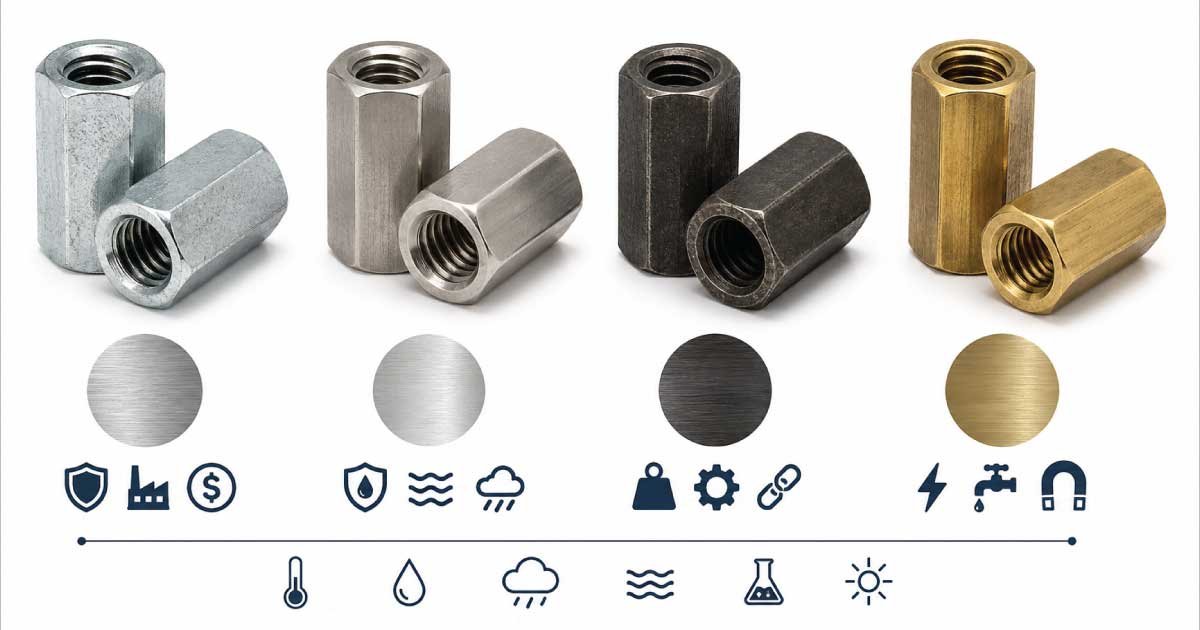
Carbon Steel
Carbon steel coupling nuts offer high strength and are widely used in structural and industrial applications. They are cost-effective, readily available, and typically zinc-plated to improve corrosion resistance in moderately harsh environments.
- High strength
- Common in structural and industrial use
- Often zinc-plated for corrosion resistance
Stainless Steel
Stainless steel coupling nuts provide excellent resistance to rust and corrosion, making them suitable for outdoor, chemical, or marine environments. While slightly lower in strength than carbon steel, they offer superior durability where moisture exposure is a concern.
- Excellent corrosion resistance
- Slightly lower strength than carbon steel
- Ideal for outdoor or marine environments
Alloy Steel
Alloy steel coupling nuts are heat-treated to achieve superior mechanical properties. They are designed for high-load, high-stress, or critical applications where maximum tensile strength and fatigue resistance are required.
- Heat-treated for superior strength
- Used in high-load or high-stress applications
Brass
Brass coupling nuts are non-magnetic and naturally corrosion resistant, making them suitable for electrical and plumbing applications. However, their lower mechanical strength limits their use to lighter-duty connections.
- Non-magnetic and corrosion resistant
- Used in electrical and plumbing systems
- Lower load capacity
Always match material with environmental and load requirements.
How to Choose the Right Coupling Nut Size
Selecting the correct coupling nut size is essential for achieving safe, durable, and reliable connections. By following a systematic selection process, you can avoid installation issues, ensure proper load transfer, and maintain compliance with mechanical and structural design requirements across various applications.
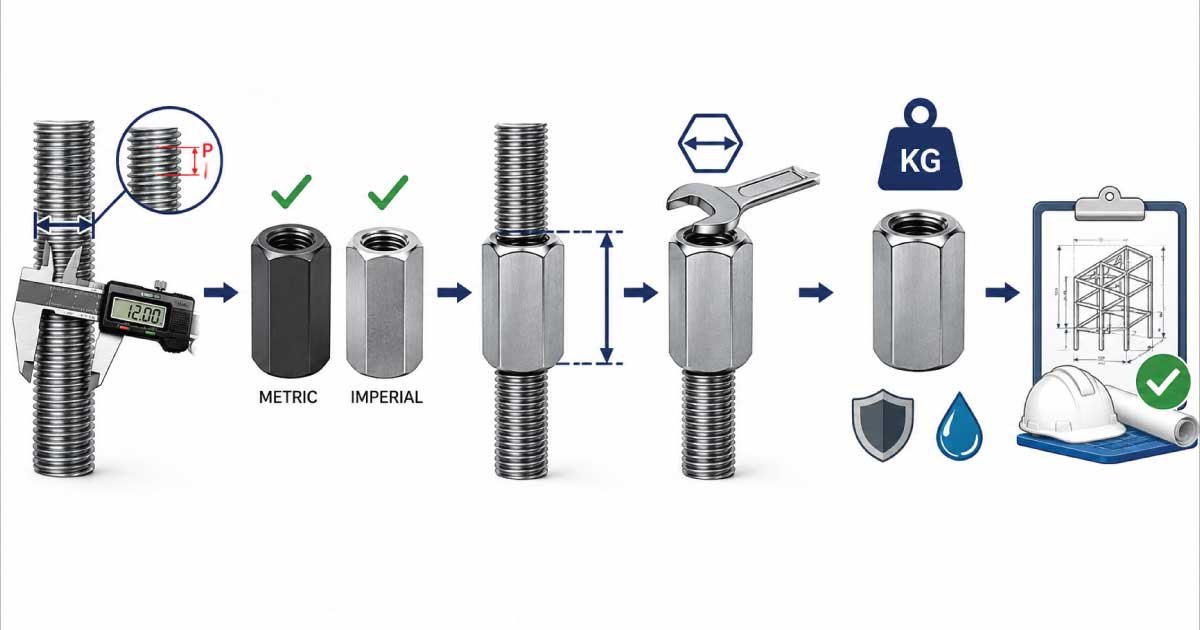
Follow these steps to ensure correct selection:
- Identify Thread Size and Pitch
Measure the diameter and pitch of the threaded rod or bolt. - Check Standard Compatibility
Ensure both components follow the same metric or imperial standard. - Determine Required Length
Consider load requirements and thread engagement. - Verify Wrench Size
Confirm tool compatibility for installation. - Consider Load and Environment
Choose appropriate material and grade. - Consult Engineering Specifications
For structural applications, always follow design codes.
Common Mistakes to Avoid
- Mixing metric and imperial threads
- Using insufficient coupling nut length
- Ignoring thread pitch differences
- Over-tightening beyond recommended torque
- Using low-grade materials for high-load applications
Avoiding these errors significantly improves safety and reliability.
Torque Considerations
Applications of Coupling Nuts
Coupling nuts are widely used across construction, mechanical, and industrial systems where reliable threaded connections are required. Their ability to join or extend threaded components makes them essential in load-bearing, adjustable, and alignment-critical assemblies, where correct sizing directly affects safety, strength, and long-term performance.
Coupling nuts are used in:
- Structural steel frameworks
- Suspended ceiling systems
- HVAC duct supports
- Electrical conduit installations
- Machinery alignment systems
- Threaded rod extensions
Their versatility makes correct sizing especially important.
Custom and Special Coupling Nuts
Standard coupling nuts do not always meet unique engineering or environmental requirements. For specialized applications involving unusual loads, space constraints, or harsh conditions, custom coupling nuts are manufactured to precise specifications, ensuring compatibility, performance, and compliance with project-specific design requirements.
For specialized needs, manufacturers can produce:
- Extra-long coupling nuts
- Reduced or oversized hex designs
- Left-hand threaded versions
- High-temperature or corrosion-resistant alloys
In such cases, custom size charts and engineering drawings should be consulted.
Final Thoughts
A coupling nut may appear simple, but its size, length, and material play a critical role in the safety and effectiveness of mechanical connections. Understanding how to read and apply a coupling nut size chart allows you to select the correct fastener with confidence.
By paying close attention to thread size, pitch, length, and material, you can ensure reliable performance across construction, industrial, and mechanical applications. Always reference size charts, follow standards, and consult engineering guidelines when in doubt.
With the information in this complete guide, you are now well-equipped to choose the right coupling nut for any project.
👉 Need the correct tube size for your project? This Tube Size Chart includes standard tube dimensions, outside diameters, wall thicknesses, metric and inch sizes, materials, and selection tips. Read the full guide to compare tube sizes, understand specifications, and choose the right tube for your application.

Engineer Hassan is a Mechanical Engineer with 16+ years of hands-on experience in mechanical hardware, fasteners, and workshop tools. He focuses on size selection, thread identification, and measurement, helping users choose the correct components with accuracy and safety.