
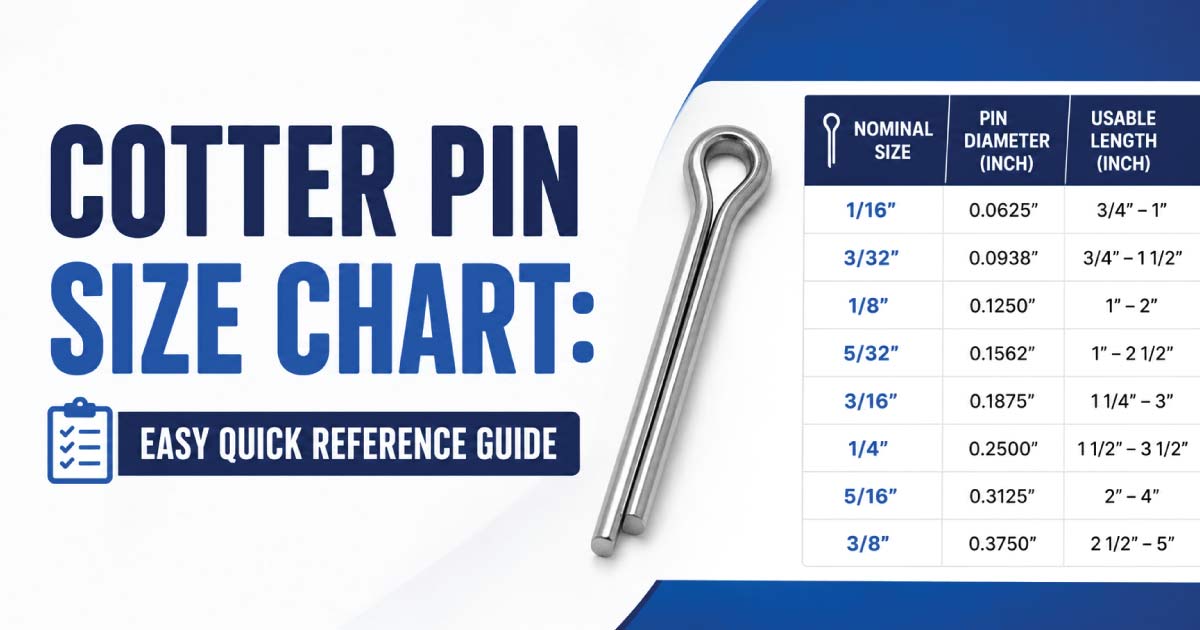
Cotter pins are simple yet essential mechanical fasteners used to lock nuts, bolts, and other components in place. They are widely used in automotive systems, machinery, agriculture equipment, and structural assemblies where vibration resistance and safety are critical.
Understanding a Cotter Pin Size Chart helps you choose the correct pin diameter and length to ensure secure locking and proper performance. In this guide, you will learn everything about cotter pin sizes, dimensions, types, materials, applications, and selection methods.
What Is a Cotter Pin?
A cotter pin is a simple mechanical fastener made from a split metal wire that is bent into two prongs. It is used to secure components such as bolts, shafts, or clevis pins by preventing them from loosening or slipping out of position during operation.
Cotter pins are not designed to carry loads. Instead, they act as a safety locking device that ensures mechanical assemblies remain securely fastened.
Common uses include:
- Locking castle nuts
- Securing wheel axles
- Holding clevis pins
- Preventing nut rotation
- Automotive suspension systems
- Agricultural machinery assemblies
How Does a Cotter Pin Work?
A cotter pin works through a simple mechanical locking action that prevents movement and disengagement of fastened parts.
1. Installation Process
- A hole is drilled or pre-made in the bolt or shaft
- The cotter pin is inserted through the hole
- The two legs are bent outward
- This prevents the pin from sliding back out
- The assembly becomes locked in position
This simple but effective mechanism provides strong vibration resistance and improves safety in mechanical systems.
Cotter Pin Size Chart
The Cotter Pin Size Chart below shows common diameters and their corresponding metric values and length ranges used in industrial applications.
| Pin Diameter | Diameter (Inches) | Diameter (mm) | Common Length Range |
|---|---|---|---|
| 1/32″ | 0.031″ | 0.8 mm | 1/4″ – 1/2″ |
| 3/64″ | 0.047″ | 1.2 mm | 1/4″ – 3/4″ |
| 1/16″ | 0.062″ | 1.6 mm | 3/8″ – 1″ |
| 5/64″ | 0.078″ | 2.0 mm | 1/2″ – 1-1/4″ |
| 3/32″ | 0.094″ | 2.4 mm | 3/4″ – 1-1/2″ |
| 1/8″ | 0.125″ | 3.2 mm | 1″ – 2″ |
| 5/32″ | 0.156″ | 4.0 mm | 1-1/4″ – 2-1/2″ |
| 3/16″ | 0.188″ | 4.8 mm | 1-1/2″ – 3″ |
These sizes are widely used in mechanical, automotive, and industrial fastening systems.
Common Cotter Pin Lengths
Cotter pins are available in different lengths to suit various assembly thicknesses and locking requirements.
| Length (Inches) | Length (mm) |
|---|---|
| 1/2″ | 12.7 mm |
| 3/4″ | 19.05 mm |
| 1″ | 25.4 mm |
| 1-1/4″ | 31.75 mm |
| 1-1/2″ | 38.1 mm |
| 2″ | 50.8 mm |
| 2-1/2″ | 63.5 mm |
| 3″ | 76.2 mm |
Longer cotter pins are typically used in thicker assemblies or when securing larger fasteners that require more bending length for safe locking.
Types of Cotter Pins
Cotter pins are available in different designs to suit various mechanical locking requirements. Each type offers specific advantages in terms of installation speed, strength, reusability, and vibration resistance, making them suitable for different industrial and automotive applications.
1. Standard Cotter Pin
The standard cotter pin is the most commonly used type, featuring a simple split design that provides reliable locking at a low cost. It is easy to install and widely used in general mechanical assemblies.
Features:
- Simple split design
- Easy installation
- Cost-effective
Applications:
- Machinery
- Automotive systems
- General fastening
2. Hairpin Cotter Pin (R-Clip)
Hairpin cotter pins, also known as R-clips, have an R-shaped design that allows for quick installation and removal. They are reusable and ideal for applications where frequent disassembly is required.
Features:
- R-shaped design
- Quick installation and removal
- Reusable
Applications:
- Lawn equipment
- Trailers
- Agricultural machines
3. Taper Cotter Pin
Taper cotter pins are designed with a slightly tapered shape that provides a tight interference fit. This ensures strong holding power and improved stability in heavy-duty applications.
Features:
- Slightly tapered shape
- Strong interference fit
- High holding strength
Applications:
- Heavy machinery
- Structural joints
- Industrial equipment
4. Grooved Cotter Pin
Grooved cotter pins feature a grooved body that enhances grip inside the hole, providing better locking performance. They are especially useful in environments with high vibration or dynamic loads.
Features:
- Grooved body
- Improved grip inside hole
- Strong vibration resistance
Applications:
- Automotive assemblies
- High-vibration machinery
Cotter Pin Materials
Cotter pin performance depends greatly on the material used in manufacturing. Material selection affects strength, corrosion resistance, durability, and suitability for different working environments.
1. Mild Steel
Mild steel cotter pins are widely used due to their good strength and low cost. They are commonly zinc-plated or coated to improve resistance against rust and corrosion, making them suitable for general-purpose applications.
Advantages:
- Affordable
- Strong
- Widely available
Often zinc-plated for corrosion protection to improve service life in normal operating conditions.
2. Stainless Steel
Stainless steel cotter pins are preferred for applications where corrosion resistance and long-term durability are essential. They perform well in harsh environments, including moisture, chemicals, and outdoor exposure.
Advantages:
- Excellent corrosion resistance
- Long service life
- Suitable for outdoor use
Common grades:
- 304 Stainless Steel
- 316 Stainless Steel
3. Brass Cotter Pins
Brass cotter pins are used in specialized applications where corrosion resistance, non-magnetic properties, and appearance are important. They are softer than steel but offer reliable performance in light-duty environments.
Advantages:
- Corrosion resistant
- Non-magnetic
- Decorative appearance
Applications:
- Electrical applications
- Marine environments
- Light mechanical assemblies
How to Read a Cotter Pin Size
Cotter pin sizes are usually written in a simple format that includes the diameter and length. Understanding this format is important for selecting the correct pin for secure and reliable fastening in mechanical assemblies.
1. Imperial Size Example
A typical cotter pin size is written as:
1/8″ × 2″
Meaning:
- Diameter = 1/8 inch
- Length = 2 inches
The diameter represents the thickness of the cotter pin, which affects its strength and ability to withstand load and vibration.
2. Metric Size Example
In metric systems, cotter pin sizes are written as:
3 mm × 50 mm
Meaning:
- Diameter = 3 mm
- Length = 50 mm
The first value always indicates the diameter, while the second value represents the total length of the pin before bending.
3. Understanding Diameter and Length
The diameter of a cotter pin determines its strength and resistance to deformation under stress. A larger diameter provides higher strength. The length determines how much material is available for bending after installation, ensuring the pin can be securely locked in place without slipping out.
How to Choose the Correct Cotter Pin Size
Selecting the correct cotter pin size is essential for ensuring secure locking, safety, and reliability in mechanical assemblies. Cotter pins are used to prevent fasteners from loosening, so proper sizing based on load, environment, and assembly design is critical for long-term performance and stability.
1. Hole Diameter
Hole diameter is the first and most important factor in cotter pin selection. The pin must pass through the hole smoothly while maintaining a snug fit. If the pin is too loose, it may shift or fail under vibration. If too tight, installation becomes difficult and may damage the pin or assembly.
2. Load and Vibration
Applications exposed to high loads or continuous vibration require stronger and thicker cotter pins. Increased vibration can cause loosening if the pin is undersized. Selecting a thicker pin improves resistance to movement, enhances locking strength, and ensures the connection remains secure even under dynamic or heavy-duty operating conditions.
3. Material Thickness
The overall thickness of the assembled components determines the required cotter pin length. Thicker assemblies need longer pins to pass fully through the hole and allow proper bending of the ends. Correct length ensures secure locking, prevents accidental disengagement, and maintains stability across the entire mechanical connection during operation.
4. Environmental Conditions
Environmental exposure significantly affects cotter pin performance and durability. In outdoor, humid, or marine environments, stainless steel cotter pins are preferred due to their corrosion resistance. These materials prevent rust, maintain strength, and extend service life. Proper material selection ensures reliable performance even in harsh and corrosive operating conditions.
5. Application Type
Different applications require different levels of strength and durability. Heavy machinery and industrial equipment demand high-strength cotter pins that can withstand large forces and continuous stress. Light-duty applications may use smaller pins. Matching pin strength to application type ensures safety, reduces failure risk, and improves overall mechanical reliability.
Applications of Cotter Pins
Cotter pins are widely used across multiple industries because they provide a simple, reliable, and cost-effective locking solution. They are especially useful in applications where vibration resistance and quick securing of components are required.
1. Automotive Industry
In the automotive sector, cotter pins are used to secure important moving components and prevent fasteners from loosening due to vibration and motion.
Used in:
- Steering systems
- Suspension assemblies
- Brake linkages
2. Agricultural Equipment
Cotter pins are commonly found in agricultural machinery, where they help secure joints and allow easy maintenance and replacement of parts in tough working conditions.
Applications include:
- Tractor joints
- Harvesters
- Tillage equipment
3. Construction Machinery
Heavy construction equipment relies on cotter pins for securing high-load mechanical connections that must remain stable under continuous stress and vibration.
Used in:
- Cranes
- Excavators
- Loaders
4. Marine Industry
In marine environments, cotter pins are used to secure components exposed to moisture and movement, ensuring safe and stable operation of marine systems.
Used for securing:
- Boat rigging
- Shafts
- Marine fittings
5. General Machinery
Cotter pins are widely used in general mechanical systems to lock rotating and moving parts, ensuring safe and reliable operation in everyday machinery.
Used in:
- Gear assemblies
- Shafts
- Moving joints
Common Installation Mistakes
Correct installation of cotter pins is essential for maintaining secure locking and preventing accidental disassembly of mechanical components. Even small errors in sizing, bending, or material selection can reduce safety and lead to mechanical failure. Understanding these common mistakes helps improve reliability and long-term performance.
1. Incorrect Diameter Selection
Choosing the wrong cotter pin diameter can seriously affect locking performance. If the pin is too small, it may fit loosely, causing movement, vibration loosening, and reduced security. If it is too large, it may not pass through the hole properly, making installation difficult or damaging the assembly components.
2. Improper Bending
Improper bending of cotter pin legs is a frequent installation error. If the ends are not bent correctly, the pin may slip out during operation due to vibration or load changes. Proper bending ensures the pin is locked securely in place, providing stable retention and preventing accidental disengagement of fastened parts.
3. Reusing Damaged Pins
Reusing cotter pins that are already bent, fatigued, or weakened is unsafe and strongly discouraged. Repeated use reduces the metal’s strength and increases the risk of failure under load. Damaged pins may break or slip out unexpectedly, compromising the entire assembly and posing serious safety risks in mechanical systems.
4. Wrong Material Choice
Selecting the wrong material for cotter pins can lead to early failure, especially in harsh environments. Carbon steel pins may corrode quickly in wet or outdoor conditions, weakening their structure over time. Using corrosion-resistant materials like stainless steel ensures better durability, longer service life, and improved safety in exposed environments.
Conclusion
A Cotter Pin Size Chart is essential for selecting the correct diameter and length for safe and reliable mechanical locking. Whether used in automotive systems, agriculture equipment, construction machinery, or industrial assemblies, choosing the right cotter pin ensures strong vibration resistance and long-lasting performance.
By understanding cotter pin sizes, materials, types, and applications, you can confidently select the best fastener for any project and maintain secure mechanical connections in all working conditions.

Engineer Hassan is a Mechanical Engineer with 16+ years of hands-on experience in mechanical hardware, fasteners, and workshop tools. He focuses on size selection, thread identification, and measurement, helping users choose the correct components with accuracy and safety.