
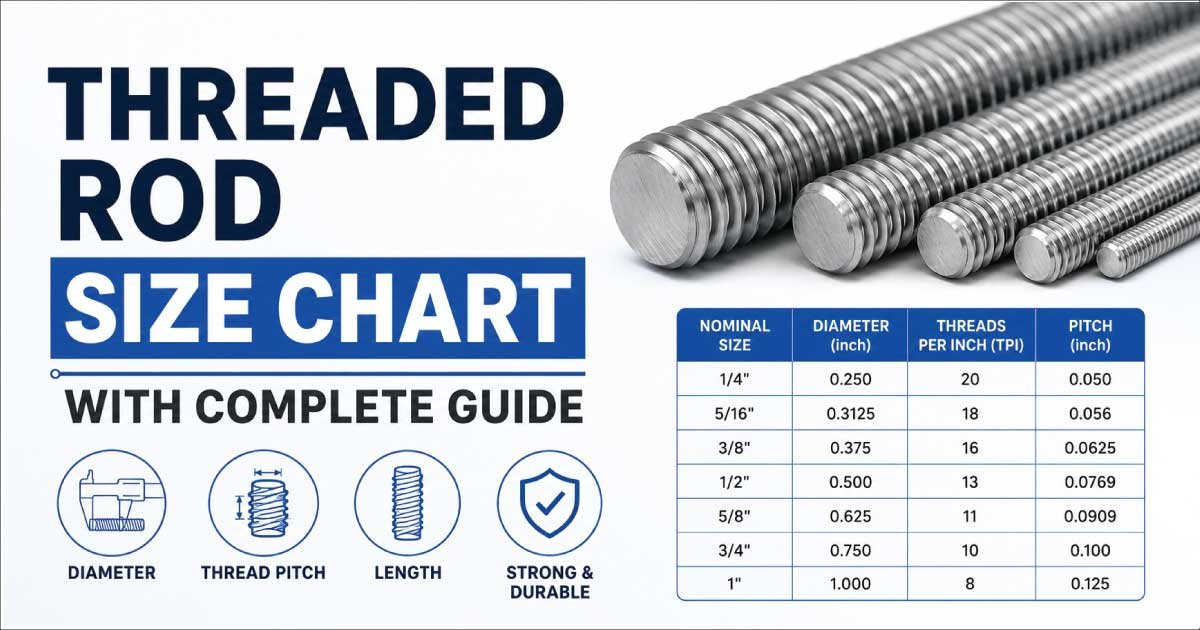
Threaded rods are versatile fastening components widely used in construction, plumbing, electrical installations, manufacturing, and structural engineering. They consist of a straight metal rod with threads running along the entire length or a significant portion of the rod. Because of their strength and flexibility, threaded rods are commonly used to join materials, suspend equipment, anchor structures, and provide adjustable fastening solutions.
Selecting the correct threaded rod size is essential for ensuring proper load capacity, safety, and durability. Factors such as diameter, thread type, material, and length all affect performance.
This complete guide explains threaded rod sizes, dimensions, materials, grades, applications, and how to choose the right threaded rod for your project.
What Is a Threaded Rod?
A threaded rod, sometimes called an all-thread rod, stud rod, or continuous thread rod, is a versatile fastening component designed with threads running along its entire length or a significant portion of it. Unlike standard bolts, threaded rods typically do not have a head, allowing nuts and washers to be installed on either end for secure and adjustable connections. Their simple yet effective design makes them widely used in construction, manufacturing, plumbing, electrical installations, and industrial applications.
Threaded rods are commonly used when long fastening lengths, structural support, or adjustable positioning are required. They can be cut to custom lengths and are available in various materials, grades, and thread configurations to suit different environments and load requirements.
Common characteristics include:
- Continuous threading
- Available in various diameters
- Adjustable length options
- High tensile strength
- Suitable for structural and industrial applications
Threaded rods are available in both imperial and metric sizes, allowing compatibility with various engineering standards and hardware systems used around the world. Choosing the correct size, material, and grade helps ensure safe and reliable performance in any application.
Threaded Rod Size Chart (Imperial)
The following chart shows common threaded rod diameters and their corresponding dimensions.
| Nominal Size | Diameter (Inches) |
|---|---|
| 1/4″ | 0.250″ |
| 5/16″ | 0.312″ |
| 3/8″ | 0.375″ |
| 7/16″ | 0.437″ |
| 1/2″ | 0.500″ |
| 5/8″ | 0.625″ |
| 3/4″ | 0.750″ |
| 7/8″ | 0.875″ |
| 1″ | 1.000″ |
| 1-1/4″ | 1.250″ |
| 1-1/2″ | 1.500″ |
| 2″ | 2.000″ |
These are among the most commonly used threaded rod sizes in North America.
Metric Threaded Rod Size Chart
Metric threaded rods are widely used in Europe, Asia, and international projects.
| Metric Size | Diameter (mm) |
|---|---|
| M6 | 6 mm |
| M8 | 8 mm |
| M10 | 10 mm |
| M12 | 12 mm |
| M16 | 16 mm |
| M20 | 20 mm |
| M24 | 24 mm |
| M30 | 30 mm |
| M36 | 36 mm |
| M42 | 42 mm |
| M48 | 48 mm |
Metric rods are identified by the letter “M” followed by the nominal diameter.
Common Threaded Rod Lengths
Threaded rods are manufactured in standard lengths but can often be cut to custom sizes.
| Standard Length |
|---|
| 12 inches |
| 18 inches |
| 24 inches |
| 36 inches |
| 48 inches |
| 72 inches |
| 10 feet |
| 12 feet |
Longer rods are frequently cut on-site to meet specific project requirements.
Understand The Threaded Rod Dimensions
Understanding threaded rod dimensions is essential for selecting the right rod for construction, mechanical, industrial, and maintenance applications. The three primary dimensions—diameter, length, and thread pitch—determine the rod’s strength, load capacity, installation requirements, and overall performance. Choosing the correct combination helps ensure secure fastening, proper load distribution, and long-term reliability in any project.
1. Diameter
Diameter is the most important sizing factor when selecting a threaded rod because it directly affects the rod’s strength, load-bearing capacity, and overall performance. Choosing the correct diameter helps ensure safe and reliable connections in construction, machinery, structural assemblies, and general fastening applications.
Larger diameters provide:
- Higher tensile strength
- Greater load capacity
- Improved structural performance
Examples:
- 1/4″ rods for light-duty projects
- 1/2″ rods for medium-duty applications
- 1″ rods for heavy structural work
2. Length
The length of a threaded rod determines how far it extends through the materials being connected. Selecting the proper length is essential to achieve a secure connection while allowing enough thread engagement for nuts, washers, and future adjustments when required.
The proper length must account for:
- Material thickness
- Washer thickness
- Nut engagement
- Adjustment requirements
Always allow sufficient thread projection beyond the nut.
3. Thread Pitch
Thread pitch refers to the distance between adjacent threads on a threaded rod. It plays a major role in installation speed, holding power, vibration resistance, and adjustment precision. Threaded rods are generally available with either coarse or fine thread configurations.
4. Coarse Threads
Coarse threads are commonly used in construction, industrial, and general-purpose applications. Their wider thread spacing makes them easier to install and less susceptible to damage during handling. They also perform well in environments where dirt, debris, or frequent assembly and disassembly are common.
Benefits include:
- Faster installation
- Better resistance to thread damage
- Improved performance in construction environments
5. Fine Threads
Fine threads have a smaller distance between thread peaks, allowing for more precise adjustments and stronger clamping force. They are often preferred in automotive, machinery, and vibration-prone applications where accuracy, secure fastening, and higher tensile performance are important.
Benefits include:
- Greater adjustment precision
- Improved vibration resistance
- Higher tensile stress capacity
UNC Threaded Rod Size Chart
UNC stands for Unified National Coarse thread.
| Diameter | Threads Per Inch (TPI) |
|---|---|
| 1/4″ | 20 |
| 5/16″ | 18 |
| 3/8″ | 16 |
| 1/2″ | 13 |
| 5/8″ | 11 |
| 3/4″ | 10 |
| 7/8″ | 9 |
| 1″ | 8 |
UNC threads are the most common choice for general construction and industrial applications.
UNF Threaded Rod Size Chart
UNF stands for Unified National Fine thread.
| Diameter | Threads Per Inch (TPI) |
|---|---|
| 1/4″ | 28 |
| 5/16″ | 24 |
| 3/8″ | 24 |
| 1/2″ | 20 |
| 5/8″ | 18 |
| 3/4″ | 16 |
| 7/8″ | 14 |
| 1″ | 12 |
Fine-thread rods are commonly used where vibration resistance and precise adjustment are required.
Threaded Rod Types
Threaded rods (also called all-thread rods) are long metal fasteners with continuous threading along their entire length. They are available in multiple types depending on material, coating, strength, and application requirements. Each type is designed to perform efficiently in specific environments, ranging from light indoor use to heavy-duty structural and industrial applications.
1. Mild Steel Threaded Rod
Mild steel threaded rods are the most commonly used and economical option. They offer good strength for general-purpose applications but require protective coatings when used in environments exposed to moisture. These rods are widely used in construction and basic fastening tasks where extreme corrosion resistance is not required.
Key features:
- Good strength at low cost
- Easy to work with and widely available
Uses:
- General construction work
- Plumbing systems
- Light structural applications
2. Stainless Steel Threaded Rod
Stainless steel threaded rods provide excellent resistance to corrosion, rust, and chemical exposure. They are ideal for demanding environments where durability and long service life are critical. Although more expensive than other types, they significantly reduce maintenance needs over time.
Key features:
- Excellent corrosion resistance
- High durability and long lifespan
Uses:
- Outdoor installations
- Marine environments
- Chemical and food processing industries
3. Zinc-Plated Threaded Rod
Zinc-plated rods feature a thin protective zinc coating that improves resistance to rust in mild environments. They are a cost-effective option for indoor applications where moisture exposure is limited. These rods balance affordability and basic corrosion protection.
Key features:
- Thin zinc coating for corrosion resistance
- Economical and widely available
Uses:
- Indoor construction
- Electrical supports
- Light-duty fastening
4. Hot-Dip Galvanized Threaded Rod
Hot-dip galvanized rods are coated with a thick layer of zinc, providing strong protection against rust and harsh weather conditions. They are designed for outdoor and structural applications where long-term exposure to rain, humidity, and environmental stress is expected.
Key features:
- Thick zinc coating
- High resistance to weather and corrosion
Uses:
- Outdoor construction
- Fencing systems
- Structural supports
5. High-Tensile Threaded Rod
High-tensile threaded rods are manufactured from high-strength steel grades to handle heavy loads and extreme stress conditions. They are designed for critical applications where maximum structural integrity and safety are required.
Key features:
- Very high strength capacity
- Designed for heavy load applications
Uses:
- Bridges and infrastructure
- Industrial machinery
- Load-bearing structures
6. Left-Hand Threaded Rod
Left-hand threaded rods are specially designed with reverse threading, meaning they tighten in the opposite direction of standard rods. They are used in mechanical systems where standard threads may loosen due to rotational forces.
Key features:
- Reverse threading design
- Prevents loosening in rotating systems
Uses:
- Specialized mechanical assemblies
- Anti-rotation applications
- Custom engineering systems
7. Fully Threaded (All-Thread) Rod
Fully threaded rods have threads running along their entire length, providing maximum flexibility during installation. They can be easily cut to size and used in a wide variety of structural and fastening applications.
Key features:
- Continuous threading along full length
- Easily adjustable and customizable
Uses:
- Construction projects
- Anchoring systems
- Suspension applications
8. Cut-to-Length Threaded Rod
Cut-to-length rods are standard threaded rods that are trimmed on-site to meet specific project requirements. They are not a separate material type but a practical installation form used for customized applications where exact measurements are needed.
Key features:
- Customizable length
- Flexible on-site installation
Uses:
- Tailored construction work
- Repair and maintenance tasks
- Custom structural setups
Threaded Rod Materials
The material of a threaded rod plays a critical role in determining its strength, durability, corrosion resistance, and overall service life. Selecting the right material ensures reliable performance in specific environments, whether the application involves indoor construction, outdoor exposure, marine conditions, or industrial processing facilities. Material choice also affects maintenance requirements and project costs.
1. Carbon Steel
Carbon steel is one of the most commonly used threaded rod materials due to its excellent strength and affordability. It is suitable for a wide range of general-purpose applications where exposure to moisture and corrosive substances is limited. Its availability in numerous sizes makes it a popular choice across many industries.
Advantages:
- Affordable
- Strong
- Widely available
Applications:
- Construction
- Machinery
- General fastening
2. Zinc-Plated Steel
Zinc-plated steel threaded rods feature a protective zinc coating that helps resist rust and corrosion better than plain carbon steel. They offer a cost-effective solution for indoor environments where moderate moisture protection is needed without the higher expense of stainless steel.
Advantages:
- Better corrosion resistance
- Economical
Applications:
- Indoor installations
- Electrical supports
- HVAC systems
3. Hot-Dip Galvanized Steel
Hot-dip galvanized threaded rods are coated with a thick layer of zinc, providing superior protection against weather, moisture, and corrosion. These rods are commonly used in outdoor and structural applications where long-term durability is essential and exposure to harsh environmental conditions is expected.
Advantages:
- Excellent outdoor protection
- Long service life
Applications:
- Decks
- Utility structures
- Outdoor construction
4. Stainless Steel
Stainless steel threaded rods provide exceptional corrosion resistance and long-lasting performance in demanding environments. They are widely used where cleanliness, moisture resistance, and minimal maintenance are required. Although more expensive than carbon steel options, their durability often makes them a cost-effective long-term solution.
Advantages:
- Outstanding corrosion resistance
- Low maintenance
Applications:
- Marine environments
- Food processing facilities
- Chemical plants
Popular grades include:
- 304 Stainless Steel
- 316 Stainless Steel
5. 304 Stainless Steel
304 stainless steel is the most widely used stainless steel grade for threaded rods. It offers excellent resistance to rust, moisture, and many common chemicals, making it suitable for a broad range of indoor and outdoor applications. It balances performance, durability, and cost effectively.
6. 316 Stainless Steel
316 stainless steel contains added molybdenum, which significantly improves resistance to saltwater, chemicals, and highly corrosive environments. It is commonly selected for marine, coastal, and industrial applications where maximum corrosion protection and long-term reliability are required.
🔢 Flange Size Chart is a complete guide explaining types, sizes, and uses of flanges in piping systems. Read full post to understand measurements, standards, and selection tips for accurate installation and better engineering performance in all projects highly recommended guide
Common Applications of Threaded Rods
Threaded rods are among the most versatile fastening products available and are used across numerous industries. Their fully threaded design allows them to provide strong, adjustable, and secure connections in structural, mechanical, electrical, and industrial applications. Because they are available in various materials, grades, and sizes, threaded rods can be adapted to meet a wide range of project requirements.
1. Construction
In the construction industry, threaded rods are widely used for structural support and anchoring applications. They provide reliable load transfer and help secure critical building components. Their strength and adaptability make them essential for both residential and commercial construction projects.
Used for:
- Steel connections
- Concrete anchoring
- Structural reinforcement
2. HVAC Systems
Threaded rods play an important role in heating, ventilation, and air conditioning systems. They provide a simple and effective method for suspending equipment and supporting ductwork. Their adjustable nature allows installers to achieve precise positioning and alignment during installation.
Applications include:
- Hanging ductwork
- Supporting air handlers
- Equipment suspension
3. Plumbing
In plumbing systems, threaded rods are commonly used to support pipes, equipment, and various mechanical installations. They help maintain proper alignment while reducing strain on piping systems. Their durability makes them suitable for both commercial and industrial plumbing applications.
Used to support:
- Water lines
- Pipe systems
- Mechanical equipment
4. Electrical Installations
Electrical contractors frequently use threaded rods to mount and support electrical infrastructure. The rods provide a strong attachment point for suspended systems while allowing easy adjustment during installation and maintenance activities.
Commonly used for:
- Cable trays
- Conduit supports
- Lighting systems
5. Manufacturing
Manufacturing facilities rely on threaded rods for equipment assembly, machine installation, and structural support systems. Their ability to handle heavy loads and provide adjustable connections makes them valuable in production environments where precision and reliability are essential.
Used in:
- Machinery assembly
- Production equipment
- Industrial structures
Threaded rods continue to be a preferred fastening solution because they offer flexibility, strength, and ease of installation across a wide variety of construction, industrial, and maintenance applications.
🔩 Spring Pin Size Chart is a complete guide covering types, sizes, and uses of spring pins in mechanical and engineering applications. Read the full post to learn proper selection, installation tips, and improve accuracy in assemblies and machine design for better performance and reliability.
How to Choose the Correct Threaded Rod Size
Selecting the correct threaded rod size is essential for ensuring safety, performance, and long-term reliability. The right choice depends on several factors, including load requirements, environmental conditions, thread compatibility, and applicable building codes. Evaluating these factors before installation helps prevent structural failures, equipment damage, and costly repairs.
1. Determine Load Requirements
The first step in choosing a threaded rod is determining the load it must support. The rod diameter and grade should be capable of handling both static and dynamic loads while maintaining an appropriate safety margin. As load requirements increase, larger diameters and stronger grades become necessary.
Heavier loads require:
- Larger diameters
- Higher-strength grades
- Appropriate safety factors
For example:
- Light-duty support: 1/4″ to 3/8″
- Medium-duty support: 1/2″ to 5/8″
- Heavy structural support: 3/4″ and above
Proper load calculations help ensure that the threaded rod can safely perform under expected operating conditions without excessive stress or deformation.
2. Consider Environmental Conditions
Environmental exposure significantly affects the lifespan and performance of a threaded rod. Factors such as moisture, chemicals, temperature changes, and outdoor weather conditions should be considered when selecting the rod material and protective coating.
For indoor use:
- Zinc-plated steel often provides adequate protection.
For outdoor use:
- Hot-dip galvanized steel is recommended.
For corrosive environments:
- Stainless steel is usually the best choice.
Choosing a material suited to the environment helps prevent corrosion, reduces maintenance requirements, and extends service life.
3. Verify Thread Compatibility
Thread compatibility is critical for achieving a secure and reliable connection. All components within the fastening system should use matching thread standards and dimensions to ensure proper engagement and load distribution.
Ensure compatibility between:
- Threaded rod
- Nuts
- Washers
- Anchors
Mixing thread standards can cause installation failures.
Using mismatched threads may lead to stripped threads, poor clamping force, or complete fastening failure, especially in high-load applications.
4. Check Building Codes
Many structural and commercial installations must comply with local building regulations and engineering standards. These requirements often specify minimum material grades, corrosion protection, installation methods, and load capacities for threaded rod systems.
Structural installations should comply with applicable building and engineering standards. Always verify local requirements before installation.
Following approved codes and standards helps ensure safety, regulatory compliance, and proper system performance throughout the life of the installation.
How to Cut a Threaded Rod
Threaded rods are often supplied in standard lengths and may need to be cut to fit a specific project. Following the correct cutting procedure helps ensure clean threads, proper nut engagement, and a professional finish while reducing the risk of damaging the rod.
1. Mark the Desired Length
Begin by measuring the required rod length carefully using a tape measure or ruler. Mark the cutting point clearly with a marker, chalk, or scribe. Accurate measurements help prevent material waste and ensure the threaded rod fits correctly within the intended application.
2. Thread a Nut Past the Cut Location
Before making the cut, thread a nut onto the rod and position it slightly beyond the marked cutting line. This simple step protects the threads during cutting. After the cut is completed, removing the nut helps realign and restore any threads that may have been slightly damaged.
3. Use a Hacksaw, Reciprocating Saw, or Cutoff Wheel
Secure the threaded rod firmly in a vise to prevent movement. Cut along the marked line using a hacksaw, reciprocating saw, or abrasive cutoff wheel. Apply steady pressure and maintain a straight cut to achieve a clean edge and minimize thread damage.
4. Smooth Rough Edges
After cutting, inspect the end of the rod for burrs, sharp edges, or rough surfaces. Use a metal file, deburring tool, or grinder to smooth the cut end. Removing rough edges improves safety and makes it easier to install nuts and other threaded components.
5. Remove the Nut to Restore Damaged Threads
Once the cut edge has been cleaned, slowly back the nut off the rod. As the nut passes over the freshly cut section, it helps straighten and reform any slightly damaged threads. This ensures smooth nut engagement and maintains proper fastening performance.
This simple method helps maintain clean thread engagement, improves installation efficiency, and extends the usability of the threaded rod after cutting.
Threaded Rod vs Bolt
| Feature | Threaded Rod | Bolt |
|---|---|---|
| Head | No | Yes |
| Thread Length | Full length | Partial |
| Adjustability | High | Limited |
| Custom Lengths | Easy | Limited |
| Suspension Applications | Excellent | Limited |
Threaded rods are preferred when adjustable fastening or long spans are required.
Common Threaded Rod Selection Mistakes
Selecting the wrong threaded rod can lead to reduced performance, premature failure, safety hazards, and expensive repairs. Many installation problems occur because important factors such as load requirements, environmental exposure, and thread compatibility are overlooked. Understanding and avoiding common mistakes helps ensure a safe, durable, and reliable fastening system.
Avoid these common errors:
- Choosing insufficient diameter
- Ignoring load calculations
- Using indoor materials outdoors
- Mixing thread standards
- Using incorrect nuts
- Improper installation torque
- Neglecting corrosion protection
1. Choosing Insufficient Diameter
Selecting a rod with a diameter that is too small can significantly reduce load capacity and structural strength. An undersized threaded rod may bend, stretch, or fail under load, especially in critical support applications. Always choose a diameter that matches the expected load requirements and includes an appropriate safety factor.
2. Ignoring Load Calculations
Failing to calculate the actual load requirements can result in choosing the wrong rod size or grade. Proper load analysis helps ensure the threaded rod can safely support both static and dynamic forces throughout its service life. Accurate calculations are especially important for structural and industrial installations.
3. Using Indoor Materials Outdoors
Materials designed for indoor environments may not provide adequate corrosion resistance when exposed to weather, moisture, or temperature changes. Outdoor applications typically require hot-dip galvanized or stainless steel threaded rods to prevent rust and maintain long-term structural integrity.
4. Mixing Thread Standards
Combining incompatible thread types can create poor thread engagement and unreliable connections. Metric and imperial threads should never be mixed, and coarse and fine thread pitches must match. Using compatible hardware ensures proper fastening strength and installation reliability.
5. Using Incorrect Nuts
Even when the rod size is correct, using the wrong nut grade or thread type can weaken the entire assembly. Nuts should match the threaded rod’s diameter, thread pitch, and strength grade to achieve maximum holding power and safe load distribution.
6. Improper Installation Torque
Applying too much or too little torque can cause fastening problems. Excessive torque may damage threads and hardware, while insufficient torque can result in loose connections. Following recommended torque specifications helps maintain a secure and dependable installation.
7. Neglecting Corrosion Protection
Corrosion can gradually weaken threaded rods and reduce their load-carrying capacity. Selecting the proper material, coating, or finish based on environmental conditions helps extend service life and minimize maintenance costs, particularly in outdoor or corrosive environments.
Proper planning prevents costly failures. By carefully evaluating load requirements, environmental conditions, hardware compatibility, and installation procedures, you can select the right threaded rod and achieve reliable long-term performance.
Maintenance and Inspection
Proper maintenance and routine inspections are essential for ensuring the long-term reliability and safety of threaded rod installations. Over time, factors such as vibration, heavy loads, moisture, and environmental exposure can affect performance. Regular inspections help identify potential issues early, reducing the risk of equipment damage, structural problems, and costly repairs.
For long-term reliability:
- Inspect rods periodically
- Check for corrosion
- Verify nut tightness
- Replace damaged hardware
- Monitor heavily loaded systems
1. Inspect Rods Periodically
Threaded rods should be inspected at regular intervals to identify signs of wear, bending, thread damage, or other physical defects. Routine inspections help detect problems before they become serious and allow for timely corrective action.
2. Check for Corrosion
Corrosion is one of the most common causes of threaded rod deterioration. Examine rods for rust, pitting, discoloration, or coating damage, especially in outdoor, marine, or high-humidity environments where corrosion can develop more rapidly.
3. Verify Nut Tightness
Vibration, thermal expansion, and normal operating conditions can cause nuts to loosen over time. Periodically checking and tightening nuts according to recommended torque specifications helps maintain proper clamping force and system stability.
4. Replace Damaged Hardware
Any hardware showing signs of excessive wear, cracking, deformation, stripped threads, or severe corrosion should be replaced immediately. Continuing to use damaged components can compromise the strength and safety of the entire assembly.
5. Monitor Heavily Loaded Systems
Systems subjected to heavy loads, dynamic forces, or continuous vibration require more frequent inspections. Monitoring these installations helps ensure that threaded rods continue to perform safely under demanding operating conditions.
Regular maintenance improves safety and service life. By conducting routine inspections and addressing issues promptly, threaded rod systems can remain reliable, secure, and structurally sound for many years.
🔩 Rivet Size Chart is a complete guide explaining types, sizes, and uses of rivets in mechanical, construction, and fabrication work. Read the full post to learn proper selection methods, standard dimensions, and installation tips for strong, reliable, and long-lasting fastening results in every project.
Conclusion
Threaded rods are essential fastening components used in construction, manufacturing, plumbing, HVAC systems, and structural applications. Selecting the correct threaded rod size requires understanding diameter, thread pitch, material, grade, and load requirements.
By using the threaded rod size chart and considering environmental conditions, installation methods, and strength requirements, you can choose the ideal threaded rod for any project. Whether supporting mechanical equipment, anchoring structures, or creating adjustable connections, the right threaded rod ensures a safe, durable, and reliable fastening solution.
FAQs
What is the most common threaded rod size?
The most common threaded rod sizes are 3/8-inch and 1/2-inch. These sizes are widely used in construction, plumbing, and HVAC systems because they offer a good balance of strength and flexibility. They are suitable for hanging supports, framing, and mechanical installations where medium load capacity is required in practice today.
What does M12 threaded rod mean?
M12 threaded rod refers to a metric fastener with a nominal diameter of 12 millimeters. The “M” stands for metric system sizing, and 12 indicates the diameter of the rod. It is commonly used in engineering, machinery, and construction applications requiring precise and standardized measurements for reliable assembly connections systems.
Can threaded rods be cut to length?
Yes, threaded rods can be cut to length using hacksaws, angle grinders, or cutting tools depending on the material. After cutting, the threads may need cleaning or rethreading with a die. This allows customization for specific installation requirements in construction, electrical work, and mechanical support systems on site projects work.
Which threaded rod is best for outdoor use?
Hot-dip galvanized and stainless steel threaded rods are best for outdoor use because they resist corrosion, rust, and environmental damage. Stainless steel offers superior durability in harsh conditions, while galvanized rods provide cost-effective protection. Both options ensure long-lasting performance in exposed structures, marine environments, and outdoor construction applications reliably always.
Are threaded rods stronger than bolts?
Threaded rods are not automatically stronger than bolts. Strength depends on material grade, diameter, thread design, and application conditions. In some cases bolts perform better due to head design and load distribution. Proper selection based on engineering requirements is essential for safe structural performance and long-term durability in use applications.
What is all-thread rod?
An all-thread rod is a type of fastener that has continuous threading along its entire length. It is used for tensioning, anchoring, and structural support in construction and mechanical systems. It can be cut to size and paired with nuts and washers for flexible installation in various applications projects safely.
Can threaded rods be welded?
Some carbon steel threaded rods can be welded, but welding may affect their mechanical strength and thread integrity. It is important to follow engineering standards and material specifications before welding. Stainless steel and coated rods are generally not recommended for welding without proper procedures and post-weld treatment for safety guidelines.

Engineer Hassan is a Mechanical Engineer with 16+ years of hands-on experience in mechanical hardware, fasteners, and workshop tools. He focuses on size selection, thread identification, and measurement, helping users choose the correct components with accuracy and safety.