
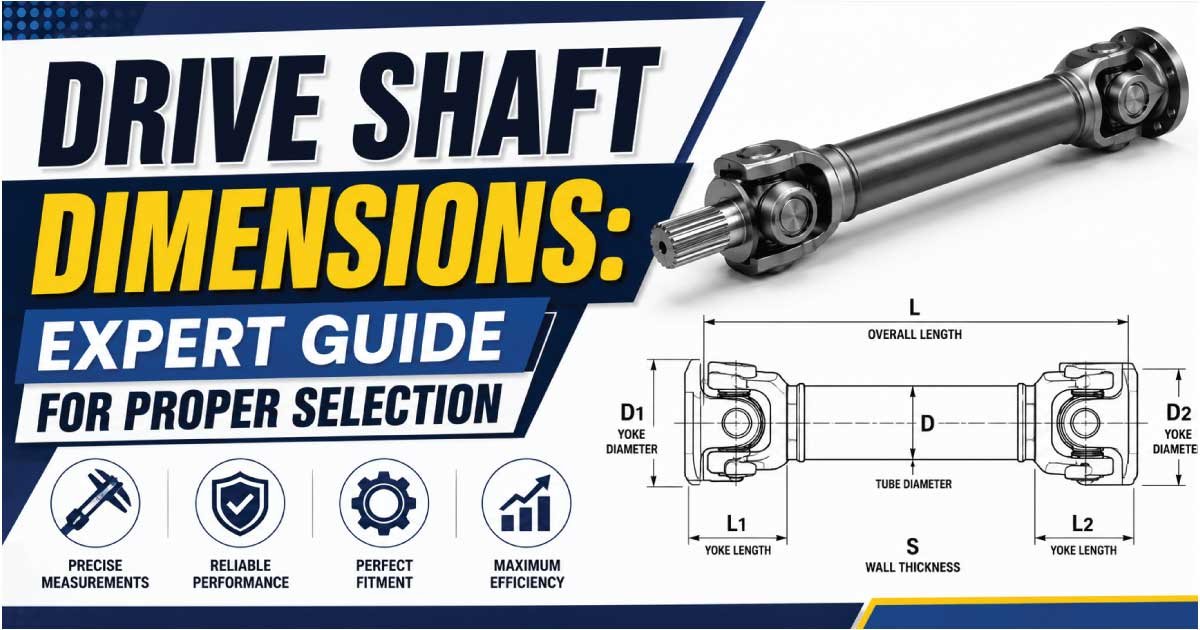
A drive shaft is one of the most important components in a vehicle or industrial power transmission system. It transfers rotational power from the transmission or transfer case to the differential, allowing wheels or machinery to move efficiently.
Selecting the correct drive shaft size improves torque transfer, reduces vibration, increases durability, and ensures smooth operation.
This complete guide explains drive shaft sizes, measurement methods, common materials, applications, and how to choose the right shaft for your equipment.
What Is a Drive Shaft?
A drive shaft, also called a propeller shaft or кардан shaft, is a rotating mechanical component that transmits torque between two parts of a drivetrain. It is designed to handle high rotational speeds while maintaining balance and strength. Drive shafts are commonly found in rear-wheel-drive vehicles, four-wheel-drive trucks, agricultural machinery, industrial machines, marine equipment, and heavy construction vehicles. Proper sizing ensures efficient power delivery and minimizes wear on connected components.
Key Functions
- Transfers engine power to the wheels
- Handles rotational torque
- Compensates for movement between drivetrain components
- Reduces vibration during operation
- Maintains drivetrain efficiency
Drive Shaft Size Chart (Steel Tubing)
The following chart lists common drive shaft tube sizes used in automotive and industrial applications.
| Tube Diameter | Wall Thickness | Length Range | Typical Application |
|---|---|---|---|
| 2.0 in | 0.065 in | 24–48 in | Small passenger cars |
| 2.5 in | 0.083 in | 30–60 in | Compact SUVs |
| 3.0 in | 0.083 in | 36–72 in | Pickup trucks |
| 3.5 in | 0.095 in | 40–80 in | Heavy-duty trucks |
| 4.0 in | 0.120 in | 48–96 in | Commercial vehicles |
| 4.5 in | 0.125 in | 60–120 in | Industrial equipment |
| 5.0 in | 0.188 in | Custom | Heavy machinery |
Metric Drive Shaft Size Chart
Metric sizes are widely used in European, Asian, and industrial equipment.
| Outside Diameter (mm) | Wall Thickness (mm) | Typical Length (mm) |
|---|---|---|
| 50 | 2.0 | 600–1200 |
| 60 | 2.5 | 700–1400 |
| 70 | 3.0 | 800–1600 |
| 80 | 3.5 | 900–1800 |
| 90 | 4.0 | 1000–2000 |
| 100 | 5.0 | Custom |
Understanding Drive Shaft Dimensions
Choosing the correct drive shaft involves understanding several important dimensions rather than simply matching the diameter. Every measurement affects strength, rotational balance, torque capacity, and overall drivetrain performance. Even a small sizing error can create excessive vibration, reduce efficiency, and shorten the service life of universal joints, bearings, and differential components.
1. Outside Diameter
The outside diameter determines the shaft’s overall strength and resistance to bending. Larger diameters generally provide greater torque capacity and improved rigidity while reducing the chance of shaft deflection during high-speed operation. However, larger shafts also increase weight, so selecting the proper balance between strength and weight is essential.
2. Wall Thickness
Wall thickness directly influences torque capacity and durability. Thick-wall tubing can withstand higher loads and shock forces, making it ideal for heavy-duty trucks, off-road vehicles, and industrial machinery. Thin-wall shafts are lighter and better suited for applications where weight reduction and rotational efficiency are priorities.
3. Overall Length
Drive shaft length is measured from the center of one universal joint to the center of the opposite universal joint. The correct length ensures smooth suspension movement while preventing binding, excessive slip yoke travel, or drivetrain vibration during acceleration and braking.
How to Measure a Drive Shaft Correctly
Accurate measurements are critical when replacing or upgrading a drive shaft. Using incorrect dimensions can lead to premature wear, imbalance, or complete drivetrain failure. Always measure with the vehicle resting at its normal ride height for the most accurate results.
Step 1: Measure Overall Length
Measure from the center of the front U-joint to the center of the rear U-joint.
Tips
- Keep the shaft level
- Measure twice
- Record in inches or millimeters
- Verify suspension height
Step 2: Measure Tube Diameter
Use a digital caliper to measure the outside diameter of the shaft tube.
Important points include:
- Measure several locations
- Avoid damaged sections
- Record the largest accurate diameter
Step 3: Measure Wall Thickness
Wall thickness can be measured using specialized calipers or by referencing manufacturer specifications if the shaft is still original equipment.
Common Drive Shaft Materials
The material used to manufacture a drive shaft significantly affects its weight, strength, corrosion resistance, and performance. Modern vehicles and industrial machines use several materials depending on their intended application.
Steel Drive Shafts
Steel remains the most common material because it offers excellent strength and affordability.
Advantages
- High durability
- Excellent torque capacity
- Cost-effective
- Easy to repair
- Suitable for heavy-duty use
Aluminum Drive Shafts
Aluminum shafts reduce rotational weight while maintaining good strength.
Benefits
- Lightweight
- Improved acceleration
- Reduced drivetrain inertia
- Corrosion resistant
- Better fuel efficiency
Carbon Fiber Drive Shafts
Carbon fiber is increasingly used in high-performance vehicles due to its exceptional strength-to-weight ratio.
Advantages
- Extremely lightweight
- High torsional strength
- Reduced vibration
- Corrosion resistant
- Excellent high-speed stability
Types of Drive Shafts
Different vehicles and machinery require different drive shaft configurations depending on suspension design, drivetrain layout, and operating conditions.
Single-Piece Drive Shaft
A single-piece drive shaft uses one continuous tube connecting the transmission and differential.
Common uses include:
- Passenger cars
- Sports cars
- Light trucks
- Performance vehicles
Advantages:
- Simple design
- Lower maintenance
- Reduced weight
- Better balance
Two-Piece Drive Shaft
Long-wheelbase vehicles often require a two-piece drive shaft with a center support bearing.
Benefits include:
- Reduced vibration
- Improved balance
- Better support over long distances
- Higher stability
- Increased durability
Slip-In-Tube Drive Shaft
Slip-in-tube shafts allow changes in length as suspension travel changes during operation.
These are commonly used in:
- Four-wheel-drive vehicles
- Agricultural equipment
- Heavy trucks
- Off-road vehicles
📏 View Accurate Size Guide 👉 Hammer Size Chart: Complete Guide to Hammer Types and Sizes
Factors That Determine Drive Shaft Size
Selecting the proper drive shaft size requires evaluating several mechanical and operating factors. A shaft designed only for diameter without considering torque, speed, and length may fail under heavy loads or develop excessive vibration.
Important considerations include:
- Engine horsepower
- Maximum torque
- Vehicle weight
- Wheelbase
- Operating RPM
- Suspension travel
- Transmission type
- Differential location
- Off-road or highway use
- Safety factor
Each of these factors contributes to determining the ideal diameter, wall thickness, and overall length for reliable performance.
Drive Shaft Applications
Drive shafts are used in a wide variety of industries because they efficiently transmit rotational power between mechanical components. Their design varies depending on speed, load, and operating environment.
Automotive Industry
Modern vehicles rely on drive shafts to transfer power from the transmission to the differential.
Typical applications include:
- Rear-wheel-drive cars
- Four-wheel-drive trucks
- SUVs
- Vans
- Racing vehicles
Agricultural Equipment
Farm machinery operates under heavy loads and rough terrain, making durable drive shafts essential.
Examples include:
- Tractors
- Harvesters
- Rotary cutters
- Balers
- Seed drills
Industrial Machinery
Industrial drive shafts power equipment that requires continuous torque transmission.
Common examples include:
- Conveyor systems
- Manufacturing equipment
- Pumps
- Compressors
- Material handling machines
📏 View Accurate Size Guide 👉 What Is a Ratchet? Sizes, Types, Uses and Materials
How to Choose the Correct Drive Shaft Size
Selecting the correct drive shaft size requires balancing strength, weight, rotational speed, and available installation space. A shaft that is too small may twist or fail under heavy torque, while an oversized shaft adds unnecessary weight and rotational inertia. Always consider manufacturer specifications, operating conditions, and drivetrain geometry before making a final selection to ensure maximum reliability and long service life.
Selection Checklist
- Measure overall drive shaft length accurately
- Choose the correct outside diameter
- Verify wall thickness
- Calculate engine torque output
- Consider maximum operating RPM
- Match U-joint series
- Check transmission yoke compatibility
- Verify differential yoke size
- Select suitable shaft material
- Confirm clearance around the shaft
Drive Shaft Diameter vs Torque Capacity
Larger drive shaft diameters generally support greater torque because they resist twisting and bending more effectively. However, wall thickness, material type, and manufacturing quality also influence torque capacity. Engineers select shaft dimensions based on the intended horsepower, vehicle weight, operating speed, and expected load conditions rather than diameter alone.
| Shaft Diameter | Approximate Torque Capacity | Common Applications |
|---|---|---|
| 2.0 in | Up to 250 lb-ft | Small cars |
| 2.5 in | 250–400 lb-ft | Sedans and compact SUVs |
| 3.0 in | 400–600 lb-ft | Pickup trucks |
| 3.5 in | 600–900 lb-ft | Performance vehicles |
| 4.0 in | 900–1,200 lb-ft | Heavy-duty trucks |
| 5.0 in | 1,200+ lb-ft | Industrial equipment |
Understanding Universal Joint (U-Joint) Sizes
Universal joints connect the drive shaft to the transmission and differential while allowing movement as the suspension travels. Selecting the correct U-joint size is just as important as choosing the proper drive shaft because mismatched components can create vibration, excessive wear, and drivetrain failure under heavy loads or high operating speeds.
Common U-Joint Series
Several standard U-joint series are used across automotive and industrial applications.
Popular sizes include:
- 1310 Series
- 1330 Series
- 1350 Series
- 1410 Series
- 1480 Series
- 1550 Series
- 1710 Series
Larger series generally provide higher torque capacity and are commonly installed on heavy-duty trucks, racing vehicles, and commercial equipment.
Signs Your Drive Shaft Is the Wrong Size
An improperly sized drive shaft often causes noticeable drivability problems. Whether the shaft is too short, too long, too small in diameter, or improperly balanced, incorrect sizing can reduce efficiency and damage surrounding drivetrain components over time if left uncorrected.
Common warning signs include:
- Excessive vibration
- Clunking noises
- Premature U-joint wear
- Slip yoke damage
- Transmission vibration
- Differential noise
- Difficulty accelerating
- Shaft imbalance
- Increased fuel consumption
- Driveline binding
📏 View Accurate Size Guide 👉 Hacksaw Size Chart, Blade Sizes, Types and Uses
Common Drive Shaft Problems
Even properly sized drive shafts experience wear after years of operation. Routine inspections help identify problems before they become major failures that require expensive drivetrain repairs or complete shaft replacement.
Typical issues include:
- Bent shaft tubing
- Worn universal joints
- Damaged center support bearing
- Corrosion
- Out-of-balance shaft
- Loose mounting bolts
- Cracked welds
- Damaged slip yoke
- Excessive runout
- Surface dents
Early detection greatly reduces repair costs and prevents unexpected breakdowns.
Drive Shaft Maintenance Tips
Routine maintenance keeps the drive shaft operating smoothly while extending the lifespan of connected drivetrain components. Regular inspections help identify wear before it leads to costly repairs, especially in vehicles used for towing, off-road driving, or heavy industrial work.
Maintenance recommendations:
- Inspect U-joints regularly
- Lubricate greaseable joints
- Tighten mounting bolts
- Check shaft balance
- Remove dirt and debris
- Inspect for corrosion
- Replace worn center bearings
- Examine slip yokes
- Monitor unusual vibrations
- Schedule routine inspections
Consistent maintenance improves reliability and minimizes unexpected downtime.
Drive Shaft Installation Mistakes to Avoid
Incorrect installation is one of the leading causes of drive shaft vibration and premature failure. Careful installation following manufacturer guidelines ensures proper alignment, balanced rotation, and maximum component life.
Avoid these common mistakes:
- Installing the wrong shaft length
- Using incorrect U-joints
- Ignoring balance marks
- Overtightening mounting bolts
- Poor lubrication
- Incorrect yoke alignment
- Damaging seals during installation
- Reusing severely worn hardware
- Ignoring driveline angles
- Skipping final inspection
Proper installation protects both the drive shaft and surrounding drivetrain components.
Advantages of Choosing the Correct Drive Shaft Size
A properly sized drive shaft delivers smoother power transfer while reducing mechanical stress throughout the drivetrain. Correct sizing also improves vehicle performance, fuel efficiency, and long-term reliability under a wide range of operating conditions.
Major benefits include:
- Reduced vibration
- Better drivetrain efficiency
- Increased torque transfer
- Longer U-joint life
- Improved fuel economy
- Lower maintenance costs
- Enhanced driving comfort
- Better high-speed stability
- Reduced wear on transmission
- Longer differential life
Drive Shaft Safety Tips
Because drive shafts rotate at high speeds, safe inspection and maintenance procedures are essential. Never work beneath a vehicle supported only by a jack, and always inspect components after heavy impacts or off-road use.
Safety recommendations include:
- Use quality jack stands
- Wear protective gloves
- Inspect before long trips
- Replace damaged U-joints immediately
- Never weld a bent shaft for repair
- Balance replacement shafts professionally
- Follow torque specifications
- Test drive after installation
Following these precautions helps prevent accidents and expensive drivetrain failures.
Frequently Asked Questions
1. How do I measure a drive shaft correctly?
Measure from the center of the front universal joint to the center of the rear universal joint while the vehicle is at normal ride height. Also record the outside diameter, wall thickness, and U-joint series. Accurate measurements ensure proper fitment and smooth drivetrain operation.
2. What is the best material for a drive shaft?
Steel is the most common choice because it is strong, durable, and affordable. Aluminum offers reduced weight for improved acceleration, while carbon fiber provides exceptional strength, minimal vibration, and excellent performance for racing or high-performance vehicles.
3. Can I install a larger drive shaft?
A larger drive shaft may increase torque capacity, but it must fit within the available clearance and remain properly balanced. Oversized shafts can interfere with suspension components or increase rotational weight if not selected carefully.
4. What causes drive shaft vibration?
Drive shaft vibration is commonly caused by imbalance, incorrect shaft length, worn universal joints, damaged center support bearings, bent tubing, poor driveline angles, or improper installation. Identifying the exact cause early prevents further damage to the drivetrain.
5. How long does a drive shaft last?
A properly maintained drive shaft can last well over 100,000 miles, although lifespan depends on operating conditions, maintenance, driving habits, towing loads, and environmental factors. Regular inspections and timely replacement of worn U-joints significantly extend overall service life.
Your Complete Guide Recap About Drive Shaft Size
Choosing the correct drive shaft size is essential for efficient power transmission, smooth vehicle operation, and long-term drivetrain reliability.
By understanding drive shaft diameter, wall thickness, overall length, U-joint compatibility, material selection, and torque capacity, you can confidently select the right shaft for automotive, agricultural, industrial, or commercial applications.
Combining accurate measurements with proper installation and routine maintenance reduces vibration, prevents premature component wear, and maximizes the lifespan of the entire drivetrain.
Whether replacing an original shaft or upgrading for higher performance, using a reliable drive shaft size chart ensures the best results and dependable operation for years to come.

Engineer Hassan is a Mechanical Engineer with 16+ years of hands-on experience in mechanical hardware, fasteners, and workshop tools. He focuses on size selection, thread identification, and measurement, helping users choose the correct components with accuracy and safety.