
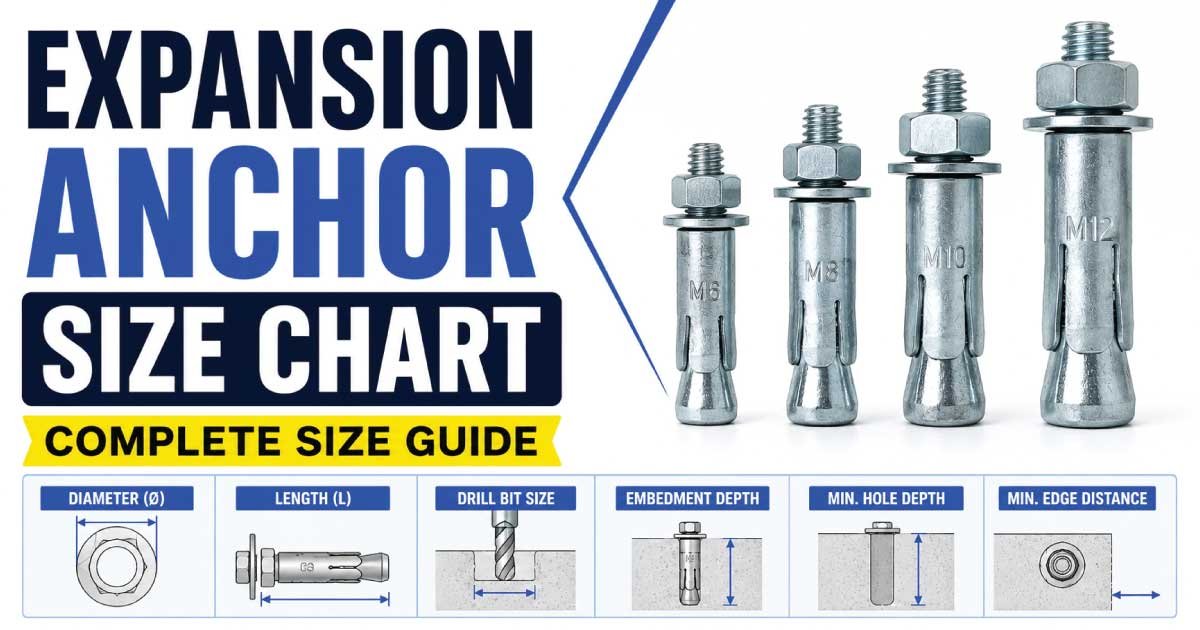
Expansion anchors are widely used for fastening objects to concrete, brick, block, and other masonry materials. Unlike ordinary screws, expansion anchors create a secure connection by expanding inside a drilled hole and gripping the surrounding base material.
Choosing the correct expansion anchor size depends on several factors, including anchor diameter, anchor length, bolt diameter, hole diameter, embedment depth, material thickness, load requirements, and the type of masonry.
This complete expansion anchor size chart and guide explains common anchor sizes, dimensions, types, installation methods, load considerations, hole sizes, embedment, materials, applications, and how to choose the correct expansion anchor for your project.
What Is an Expansion Anchor?
An expansion anchor is a mechanical fastening system designed to secure an object to a solid base material.
When the anchor is installed and tightened, part of the anchor expands against the walls of the drilled hole. This expansion creates friction and mechanical interlock that holds the fastener in place.
Expansion anchors are commonly used in:
- Concrete
- Reinforced concrete
- Brick
- Masonry
- Concrete blocks
- Stone
- Construction projects
- Industrial equipment
- Handrails
- Shelving
- Machinery
- Electrical installations
- Pipe supports
- Brackets
The exact suitability depends on the anchor design and the base material.
How Expansion Anchors Work
Expansion anchors generally work by converting tightening force into outward pressure against the hole.
A typical expansion anchor system contains:
- Anchor body
- Expansion sleeve or wedge
- Bolt or stud
- Nut
- Washer
As the bolt or nut is tightened, the expansion component moves or deforms against the anchor body.
This causes the anchor to press firmly against the drilled hole.
The resulting connection depends on:
- Anchor diameter
- Embedment depth
- Concrete strength
- Hole diameter
- Installation quality
- Edge distance
- Spacing
- Applied load
For structural applications, the manufacturer’s tested values should always be followed.
Expansion Anchor Size Chart
Because expansion anchors are manufactured in different styles, there is no single universal dimensional chart. The following table provides common nominal sizes found across many mechanical expansion-anchor systems.
| Nominal Anchor Size | Approx. Diameter | Common Bolt/Stud Size | Typical Hole Diameter* | Typical Application |
|---|---|---|---|---|
| 1/4 in | 6.4 mm | 1/4 in | 1/4 in | Light-duty fixtures |
| 5/16 in | 7.9 mm | 5/16 in | 5/16 in | Brackets and equipment |
| 3/8 in | 9.5 mm | 3/8 in | 3/8 in | General construction |
| 1/2 in | 12.7 mm | 1/2 in | 1/2 in | Heavy fixtures |
| 5/8 in | 15.9 mm | 5/8 in | 5/8 in | Heavy-duty applications |
| 3/4 in | 19.1 mm | 3/4 in | 3/4 in | Heavy equipment |
| 7/8 in | 22.2 mm | 7/8 in | 7/8 in | Large installations |
| 1 in | 25.4 mm | 1 in | 1 in | Heavy-duty fastening |
*Hole diameter shown is a common nominal relationship for certain wedge-style systems, not a universal specification. Always follow the anchor manufacturer’s published drilling requirements.
Metric Expansion Anchor Size Chart
Metric expansion anchors are commonly identified by nominal diameter and length.
| Anchor Size | Nominal Diameter | Common Lengths | Typical Application |
|---|---|---|---|
| M6 | 6 mm | 40–75 mm | Light fixtures |
| M8 | 8 mm | 50–100 mm | Brackets and supports |
| M10 | 10 mm | 60–120 mm | Equipment mounting |
| M12 | 12 mm | 75–150 mm | Heavy fixtures |
| M16 | 16 mm | 100–200 mm | Machinery and structural fixtures |
| M20 | 20 mm | 125–250 mm | Heavy-duty installations |
| M24 | 24 mm | 150–300 mm | Large industrial applications |
The actual available lengths and hole requirements vary significantly by anchor type and manufacturer.
Imperial Expansion Anchor Size Chart
Imperial expansion anchors are commonly specified by nominal diameter.
| Anchor Size | Diameter in Inches | Diameter in mm | Common Application |
|---|---|---|---|
| 1/4 in | 0.250 in | 6.35 mm | Light fixtures |
| 5/16 in | 0.313 in | 7.94 mm | Brackets |
| 3/8 in | 0.375 in | 9.53 mm | General fastening |
| 1/2 in | 0.500 in | 12.70 mm | Equipment |
| 5/8 in | 0.625 in | 15.88 mm | Heavy fixtures |
| 3/4 in | 0.750 in | 19.05 mm | Machinery |
| 7/8 in | 0.875 in | 22.23 mm | Large installations |
| 1 in | 1.000 in | 25.40 mm | Heavy-duty fastening |
The anchor diameter alone does not determine its allowable load capacity.
Understanding Expansion Anchor Dimensions
Several measurements are important when choosing an expansion anchor.
Anchor Diameter
The nominal anchor diameter indicates the general size of the fastening system.
A larger diameter generally provides a larger bearing area and may provide greater capacity, but load capacity depends on the entire anchor system and installation conditions.
Anchor Length
Anchor length is measured along the anchor from one end to the other.
A longer anchor may allow deeper embedment or accommodate thicker fixtures.
Hole Diameter
The drilled hole must match the manufacturer’s specified diameter.
A hole that is too small may prevent proper installation, while a hole that is too large can reduce expansion and holding capacity.
Embedment Depth
Embedment is the depth of the anchor inside the base material.
Adequate embedment is essential for achieving the specified performance.
Fixture Thickness
Fixture thickness refers to the material being attached to the concrete or masonry.
The anchor must be long enough to accommodate the fixture while still providing sufficient embedment.
Discover More: Screwdriver Size Chart: Sizes, Types & Applications
What Is Anchor Embedment Depth?
Embedment depth is the distance that the anchor extends into the base material.
For expansion anchors, embedment is one of the most important installation dimensions.
For example, a longer anchor may be required when fastening:
- Thick steel plates
- Brackets
- Equipment bases
- Multiple layers of material
- Pipe supports
However, simply choosing the longest available anchor is not always correct.
The required embedment should be based on the anchor manufacturer’s specifications and the strength of the base material.
Expansion Anchor Hole Size
The drilled hole is critical to proper anchor performance.
The hole diameter should match the manufacturer’s specified drill diameter.
For many wedge-style anchors, the nominal anchor diameter and required drill diameter may be closely related, but this is not true for every type of expansion anchor.
Different designs can require different drilling dimensions.
Before drilling, verify:
- Drill diameter
- Minimum hole depth
- Required embedment
- Fixture thickness
- Hole cleaning procedure
- Minimum edge distance
- Minimum anchor spacing
Never assume that all anchors of the same nominal diameter use the same drilling specification.
Types of Expansion Anchors
Expansion anchors are available in several designs.
Wedge Anchors
Wedge anchors consist of a threaded stud and expansion clip or wedge mechanism.
When the nut is tightened, the wedge is drawn into the expansion component, forcing it outward against the concrete.
They are commonly used for:
- Machinery
- Structural fixtures
- Steel brackets
- Handrails
- Equipment
- Concrete mounting
Sleeve Anchors
Sleeve anchors use an expansion sleeve around a bolt or threaded stud.
When tightened, the sleeve expands against the hole.
They are widely used for:
- Concrete
- Brick
- Block
- General construction
- Light and medium-duty fixtures
Drop-In Anchors
Drop-in anchors are internally threaded expansion anchors designed for installation in solid concrete.
A separate bolt or threaded rod can then be installed into the anchor.
They are commonly used for:
- Pipe supports
- Electrical equipment
- HVAC installations
- Suspended fixtures
- Mechanical equipment
Shield Anchors
Shield anchors use an expansion shield that expands against the surrounding material when tightened.
They may be used in concrete and masonry depending on the particular anchor design.
Wedge Anchor Size Guide
Wedge anchors are commonly available in sizes such as:
- 1/4 inch
- 5/16 inch
- 3/8 inch
- 1/2 inch
- 5/8 inch
- 3/4 inch
- 7/8 inch
- 1 inch
Metric versions may include:
- M6
- M8
- M10
- M12
- M16
- M20
- M24
The correct size depends on the load, concrete strength, embedment, spacing, edge distance, and manufacturer’s design data.
Sleeve Anchor Size Guide
Sleeve anchors are commonly available in a broad range of diameters and lengths.
Common nominal diameters include:
- 1/4 inch
- 5/16 inch
- 3/8 inch
- 1/2 inch
- 5/8 inch
- 3/4 inch
Lengths can vary from relatively short anchors for thin fixtures to substantially longer anchors for thicker applications.
When selecting a sleeve anchor, consider both:
Diameter + length
rather than selecting based on diameter alone.
Expansion Anchor Length Selection
Choosing the correct anchor length requires calculating the total required installation depth.
A simplified concept is:
Required anchor length = fixture thickness + required embedment + allowances for the anchor assembly
For example, if a thick mounting plate is being attached to concrete, the anchor must be long enough to pass through the plate while maintaining the required embedment.
The manufacturer’s published minimum and maximum fixture thickness should always take priority over a general formula.
How to Choose the Correct Expansion Anchor Size
Selecting the right anchor involves several steps.
1. Identify the Base Material
Determine whether the anchor will be installed in:
- Concrete
- Reinforced concrete
- Brick
- Concrete block
- Stone
- Other masonry
An anchor designed for concrete may not be suitable for hollow block or brick.
2. Determine the Load
Consider:
- Tension load
- Shear load
- Combined loading
- Static load
- Dynamic load
- Impact or vibration
3. Measure Fixture Thickness
Measure the material being attached.
4. Select the Required Embedment
Use the manufacturer’s installation requirements.
5. Select Anchor Diameter
Choose the diameter appropriate for the design load and base material.
6. Check Edge Distance
The anchor should not be installed too close to a concrete edge.
7. Check Anchor Spacing
Multiple anchors require sufficient spacing to prevent interaction and loss of capacity.
8. Select the Correct Material
Choose an appropriate steel grade and corrosion-resistant finish.
Discover More: Spanner Size Chart: Sizes, Types & Applications Guide
Expansion Anchor Load Capacity
Expansion anchor capacity depends on much more than diameter.
Important factors include:
- Concrete compressive strength
- Anchor diameter
- Embedment depth
- Anchor material
- Installation torque
- Edge distance
- Anchor spacing
- Load direction
- Concrete thickness
- Cracked or uncracked concrete
- Installation quality
For this reason, a simple statement such as “1/2-inch anchor holds X pounds” can be misleading.
The manufacturer’s tested load values should be used for engineered installations.
Expansion Anchor Pull-Out Strength
Pull-out strength describes the resistance of an anchor against a force attempting to pull it out of the base material.
Pull-out performance can be affected by:
- Embedment
- Concrete strength
- Anchor design
- Hole diameter
- Installation torque
- Edge distance
- Concrete condition
Increasing anchor diameter does not automatically produce a proportional increase in allowable load.
For critical applications, use the manufacturer’s published design values.
Expansion Anchor Shear Strength
Shear occurs when a load acts sideways across the anchor.
Examples include:
- Wall-mounted brackets
- Handrails
- Equipment supports
- Steel plates
- Pipe supports
Shear capacity depends on both the anchor and base material.
The concrete may fail before the steel anchor reaches its ultimate strength.
Therefore, the entire connection must be evaluated rather than looking only at the bolt diameter.
Expansion Anchors for Concrete
Concrete is one of the most common applications for mechanical expansion anchors.
Suitable applications can include:
- Equipment mounting
- Steel brackets
- Handrails
- Guardrails
- Machinery
- Shelving
- Pipe supports
- Electrical equipment
The condition and strength of the concrete are important.
Cracked concrete, thin slabs, weak concrete, and installations near edges may require specially approved anchor systems.
Expansion Anchors for Brick and Masonry
Not every expansion anchor is suitable for brick or masonry.
Masonry can vary significantly in:
- Density
- Strength
- Hollow sections
- Mortar condition
- Surface condition
A heavy-duty wedge anchor designed for solid concrete should not automatically be used in hollow brick or block.
Instead, select an anchor specifically approved for the masonry type.
Expansion Anchor Installation Steps
Correct installation is essential.
Step 1: Mark the Hole Location
Position the fixture and mark the drilling point.
Step 2: Select the Correct Drill Bit
Use the drill diameter specified by the anchor manufacturer.
Step 3: Drill to the Required Depth
Drill to at least the specified hole depth.
Avoid stopping short of the required embedment.
Step 4: Clean the Hole
Remove dust and drilling debris according to the manufacturer’s cleaning requirements.
Hole cleaning is particularly important for reliable anchor performance.
Step 5: Insert the Anchor
Insert the anchor through the fixture or into the prepared hole, depending on the anchor design.
Step 6: Set the Anchor
Some expansion anchors require a specific setting procedure.
Step 7: Tighten the Fastener
Tighten the nut or bolt to the specified torque.
Step 8: Inspect the Installation
Verify that the fixture is secure and the anchor is properly seated.
Discover More: Drill Bit Size Chart: Types, Sizes & Uses Explained
Common Expansion Anchor Installation Mistakes
Using the Wrong Drill Size
An incorrectly sized hole can compromise the anchor.
Insufficient Hole Depth
A shallow hole can prevent the anchor from achieving the required embedment.
Failing to Clean the Hole
Dust and debris can interfere with proper installation.
Installing Too Close to an Edge
Insufficient edge distance can cause concrete breakout.
Incorrect Torque
Too little or too much torque can affect anchor performance.
Using the Wrong Anchor for the Base Material
A concrete anchor may not be suitable for hollow block, brick, or other masonry.
Ignoring Fixture Thickness
The anchor must accommodate the fixture while maintaining the required embedment.
Expansion Anchor Materials and Finishes
Expansion anchors are available in different materials and coatings.
Carbon Steel
Carbon steel anchors are widely used in general construction and indoor applications.
Zinc-Plated Steel
Zinc-plated anchors provide additional corrosion protection for many indoor and moderately exposed environments.
Stainless Steel
Stainless steel expansion anchors provide improved corrosion resistance and are useful for:
- Outdoor installations
- Moist environments
- Marine environments
- Industrial facilities
- Corrosive conditions
Hot-Dip Galvanized
Hot-dip galvanized anchors provide a thicker zinc coating and may be suitable for certain outdoor environments.
Always verify that the anchor’s corrosion resistance is appropriate for the specific environment.
Expansion Anchor vs Concrete Screw
Expansion anchors and concrete screws work differently.
| Feature | Expansion Anchor | Concrete Screw |
|---|---|---|
| Installation principle | Expands inside hole | Cuts/forms thread |
| Common base | Concrete and masonry | Concrete and masonry |
| Expansion mechanism | Yes | No |
| Removability | Depends on type | Generally removable |
| Typical applications | Heavy fixtures and equipment | General fastening |
| Installation | Requires specific drilling and setting | Drilling and driving |
The best choice depends on the application, load, base material, and manufacturer’s specifications.
Expansion Anchor vs Sleeve Anchor
A sleeve anchor is actually one type of expansion anchor.
The term expansion anchor describes a broader category of mechanical anchors that grip the base material through expansion.
Sleeve anchors use a sleeve that expands around the bolt.
Wedge anchors use a wedge mechanism.
Drop-in anchors use an internal expansion mechanism.
Therefore, “expansion anchor” and “sleeve anchor” should not always be treated as interchangeable terms.
Expansion Anchor Applications
Expansion anchors are commonly used in:
- Construction
- Concrete fastening
- Machinery installation
- Electrical systems
- HVAC equipment
- Plumbing
- Pipe supports
- Steel fabrication
- Handrails
- Guardrails
- Shelving
- Brackets
- Industrial equipment
- Sign mounting
The anchor type should always be matched to the base material and loading conditions.
Expansion Anchor Size Chart Quick Reference
| Size | Approx. Diameter | Common Type | Typical Use |
|---|---|---|---|
| 1/4 in | 6.35 mm | Sleeve / wedge | Light fixtures |
| 5/16 in | 7.94 mm | Sleeve / wedge | Brackets |
| 3/8 in | 9.53 mm | Sleeve / wedge | General construction |
| 1/2 in | 12.70 mm | Wedge / sleeve | Equipment |
| 5/8 in | 15.88 mm | Wedge | Heavy fixtures |
| 3/4 in | 19.05 mm | Wedge | Machinery |
| 7/8 in | 22.23 mm | Wedge | Large installations |
| 1 in | 25.40 mm | Wedge | Heavy-duty applications |
| M6 | 6 mm | Mechanical anchor | Light fixtures |
| M8 | 8 mm | Mechanical anchor | Brackets |
| M10 | 10 mm | Mechanical anchor | Equipment |
| M12 | 12 mm | Mechanical anchor | Heavy fixtures |
| M16 | 16 mm | Mechanical anchor | Machinery |
| M20 | 20 mm | Mechanical anchor | Heavy installations |
| M24 | 24 mm | Mechanical anchor | Large industrial applications |
Important: This chart is a general size reference. Expansion-anchor dimensions, drill diameter, embedment, minimum hole depth, fixture thickness, spacing, edge distance, and load capacity vary by anchor design and manufacturer.
Frequently Asked Questions About Expansion Anchor Sizes
What are the common expansion anchor sizes?
Common expansion anchor sizes include 1/4, 5/16, 3/8, 1/2, 5/8, 3/4, 7/8, and 1 inch in imperial systems. Metric sizes commonly include M6, M8, M10, M12, M16, M20, and M24. Availability varies by anchor type and manufacturer.
How do I choose the correct expansion anchor size?
Choose an expansion anchor based on base material, load, anchor diameter, embedment depth, fixture thickness, edge distance, spacing, and corrosion environment. Do not select an anchor based only on bolt diameter. For critical applications, use the manufacturer’s tested and published design information.
What size hole is needed for an expansion anchor?
The required hole diameter depends on the specific anchor design. Some wedge anchors use a drill diameter close to their nominal diameter, while other expansion anchors have different requirements. Always use the drill size specified by the anchor manufacturer rather than assuming the hole size.
How deep should an expansion anchor be installed?
The required embedment depth depends on the anchor type, diameter, base material, and load. Larger or heavier-duty anchors often require greater embedment. The manufacturer’s installation instructions should specify the minimum embedment and minimum hole depth for the particular anchor.
Are expansion anchors good for concrete?
Yes. Many expansion anchors are specifically designed for solid concrete, including wedge anchors and certain sleeve anchors. However, the concrete strength, thickness, cracking condition, edge distance, spacing, and applied load must be suitable for the selected anchor.
Can expansion anchors be used in brick?
Some expansion anchors can be used in suitable masonry, but not every concrete expansion anchor is suitable for brick. Hollow or weak masonry may require a different fastening system. Always select an anchor specifically approved for the particular brick or masonry substrate.
What is the difference between a wedge anchor and sleeve anchor?
A wedge anchor uses a wedge-based expansion mechanism, while a sleeve anchor uses an expanding sleeve around the bolt. Both are mechanical expansion anchors, but they have different installation methods, dimensions, and performance characteristics.
Are expansion anchors removable?
Some expansion anchors can be removed by loosening the nut and extracting the fastener, but the anchor may not be reusable. Certain anchors are designed primarily for permanent installation. Check the manufacturer’s instructions before attempting to reuse or reinstall an expansion anchor.
Does a larger expansion anchor always hold more weight?
No. A larger diameter does not automatically mean a connection can support a specific larger load. Concrete strength, embedment, edge distance, spacing, anchor design, installation quality, and loading direction all affect capacity. Use published design values for load-bearing applications.
Final Thoughts
An expansion anchor size chart is useful for identifying common anchor diameters and metric or imperial sizes, but selecting the correct anchor requires consideration of the complete installation.
The most important factors include anchor diameter, length, hole diameter, embedment depth, fixture thickness, base material, edge distance, anchor spacing, load, and corrosion resistance.
Common sizes range from small 1/4-inch and M6 anchors to larger 1-inch and M24 systems, depending on the anchor design.
For concrete applications, wedge and sleeve anchors are common mechanical fastening solutions. However, the same nominal diameter does not guarantee the same hole size, embedment, load capacity, or installation procedure.
For reliable results, always follow the manufacturer’s specifications for drill diameter, minimum hole depth, embedment, cleaning, setting procedure, torque, spacing, edge distance, and allowable loads. For structural, overhead, safety-critical, or heavily loaded installations, the connection should be selected using the manufacturer’s engineering data rather than a general size chart.

Engineer Hassan is a Mechanical Engineer with 16+ years of hands-on experience in mechanical hardware, fasteners, and workshop tools. He focuses on size selection, thread identification, and measurement, helping users choose the correct components with accuracy and safety.