
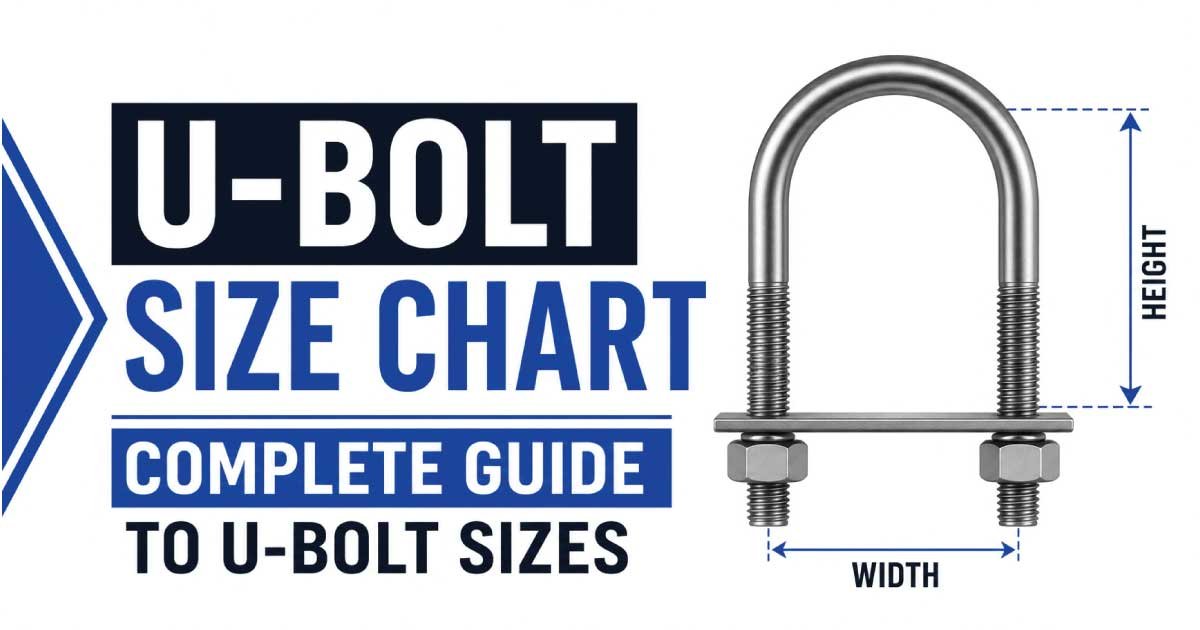
U-bolts are widely used fasteners designed to secure pipes, tubes, cables, axles, mechanical components, and other round or similarly shaped objects to a supporting surface. Their U-shaped design wraps around the component while the two threaded ends pass through a mounting plate, bracket, or cross member.
Choosing the correct U-bolt size requires more than measuring the threaded diameter. You also need to consider the inside width, inside length, thread length, bend radius, material thickness, pipe diameter, thread pitch, and application requirements.
This complete U-bolt size chart and guide explains common metric and imperial U-bolt sizes, how U-bolts are measured, how to select the correct dimensions, U-bolt types, pipe-size considerations, thread specifications, materials, installation methods, and common sizing mistakes.
Whether you are working on automotive suspension, exhaust systems, plumbing, pipe supports, trailers, agricultural machinery, construction equipment, or industrial piping, this guide will help you understand U-bolt dimensions and choose the appropriate size.
What Is a U-Bolt?
A U-bolt is a U-shaped metal fastener with two threaded legs. The curved portion surrounds a pipe, tube, axle, leaf spring, cable bundle, or other component, while the threaded legs extend through a mounting plate or bracket.
Nuts are installed onto the threaded legs to clamp the component securely against the supporting surface.
U-bolts are commonly manufactured from:
- Carbon steel
- Stainless steel
- Alloy steel
- Galvanized steel
- Zinc-plated steel
- High-strength steel
Common applications include:
- Pipe supports
- Automotive suspension
- Trailer axles
- Exhaust systems
- Cable fastening
- Agricultural equipment
- Structural brackets
- Machinery
- Plumbing installations
- Electrical conduit
- Marine equipment
- Industrial piping
Because U-bolts can be designed for very different applications, the correct dimensions and material depend on the intended service.
Understanding U-Bolt Dimensions
A U-bolt is described using several important dimensions. Understanding these measurements makes it much easier to identify a replacement or order a new fastener.
U-Bolt Diameter
The diameter normally refers to the diameter of the round bar or threaded legs.
Common sizes include:
- M6
- M8
- M10
- M12
- M16
- M20
- 1/4 inch
- 5/16 inch
- 3/8 inch
- 1/2 inch
- 5/8 inch
- 3/4 inch
The diameter affects the strength and compatibility of the fastener.
Inside Width
Inside width is the distance between the two legs of the U-bolt, measured across the inside of the curved section.
This dimension is extremely important because the U-bolt must fit around the component being secured.
Inside Length
Inside length generally refers to the usable vertical space inside the U-shaped portion.
The exact definition can vary by manufacturer, so always check the supplier’s dimensional drawing when ordering a precision replacement.
Thread Length
Thread length is the portion of each leg that contains threads.
There must be sufficient thread available for the washer and nut while maintaining the required engagement.
Outside Width
Outside width is measured across the outer edges of the two legs.
It is useful when determining whether the U-bolt will fit through a mounting plate or bracket.
Bend Radius
The bend radius describes the curvature of the U-shaped portion.
The bend should be compatible with the shape and diameter of the component being clamped.
Metric U-Bolt Size Chart
Metric U-bolts are commonly identified by the diameter of the threaded legs and their overall dimensions.
The following chart provides common metric thread sizes and general application examples.
| U-Bolt Size | Nominal Thread Diameter | Common Coarse Pitch | Typical Application |
|---|---|---|---|
| M6 | 6 mm | 1.0 mm | Small tubing and light-duty fastening |
| M8 | 8 mm | 1.25 mm | Pipes, brackets, equipment |
| M10 | 10 mm | 1.5 mm | Automotive and machinery |
| M12 | 12 mm | 1.75 mm | Pipe supports and heavy equipment |
| M14 | 14 mm | 2.0 mm | Heavy mechanical applications |
| M16 | 16 mm | 2.0 mm | Trailers and machinery |
| M18 | 18 mm | 2.5 mm | Heavy-duty assemblies |
| M20 | 20 mm | 2.5 mm | Large equipment and structures |
| M22 | 22 mm | 2.5 mm | Heavy-duty applications |
| M24 | 24 mm | 3.0 mm | Large industrial assemblies |
These are common thread-size references. U-bolt inside width, inside length, bend radius, and other dimensions vary substantially depending on the application and manufacturer.
Imperial U-Bolt Size Chart
Imperial U-bolts are commonly specified by their nominal diameter in inches and thread specification.
| U-Bolt Size | Nominal Diameter | Common Coarse TPI | Typical Application |
|---|---|---|---|
| 1/4-20 | 0.250 in | 20 | Small pipes and brackets |
| 5/16-18 | 0.313 in | 18 | Light machinery |
| 3/8-16 | 0.375 in | 16 | General pipe supports |
| 7/16-14 | 0.438 in | 14 | Equipment assemblies |
| 1/2-13 | 0.500 in | 13 | Automotive and machinery |
| 9/16-12 | 0.563 in | 12 | Heavy equipment |
| 5/8-11 | 0.625 in | 11 | Trailers and industrial equipment |
| 3/4-10 | 0.750 in | 10 | Heavy-duty applications |
| 7/8-9 | 0.875 in | 9 | Large machinery |
| 1-8 | 1.000 in | 8 | Large industrial assemblies |
The exact U-bolt dimensions should be verified against the applicable manufacturer’s specification because the same thread diameter can be available with many different widths and lengths.
How to Read a U-Bolt Size
U-bolt specifications often include several dimensions.
For example, a manufacturer might describe a U-bolt as:
M10 × 60 × 100 mm
Depending on the manufacturer’s notation, these values may refer to thread diameter, inside width, and leg or inside length.
However, U-bolt dimension conventions are not completely universal. One supplier may list width and length in a different order from another.
For this reason, always look for a dimensional drawing showing:
- Thread diameter
- Inside width
- Inside length
- Thread length
- Outside width
- Overall height
For an imperial U-bolt, a specification such as:
1/2-13 × 3 in
usually identifies a 1/2-inch diameter with 13 threads per inch and a specified dimensional length, but the manufacturer’s drawing should be checked to determine exactly how the length is defined.
Discover More: V-Belt Size Chart: Guide to Dimensions, Types & Selection
How to Measure a U-Bolt
If you already have a U-bolt and need a replacement, measuring the original is the most reliable approach.
Step 1: Measure Thread Diameter
Use a caliper to measure the diameter of the threaded portion.
Compare the measurement with metric and imperial thread sizes.
Step 2: Measure Inside Width
Measure the distance between the inside surfaces of the two legs.
This is one of the most important measurements because the U-bolt must fit around the component.
Step 3: Measure Inside Length
Measure from the inside of the curved section toward the open end of the legs.
This tells you how much space is available around the component.
Step 4: Measure Thread Length
Measure the threaded section on each leg.
Make sure the replacement has enough thread for the washer, mounting plate, and nut.
Step 5: Measure the Bar Diameter
The threaded diameter and bar diameter are normally closely related, but measuring the unthreaded curved section can help identify the original specification.
Step 6: Measure the Bend
If exact replacement is important, record the radius and shape of the curved section.
U-Bolt Size for Pipe Diameter
One of the most common U-bolt applications is securing pipe.
The U-bolt must fit around the outside diameter of the pipe, not simply the nominal pipe size.
This distinction is important because nominal pipe size does not always equal the actual outside diameter.
For example, a pipe described by a nominal size may have an actual outside diameter determined by its pipe standard and schedule.
Therefore, before ordering a pipe U-bolt:
- Identify the pipe standard.
- Determine the actual outside diameter.
- Measure the required clearance.
- Select the U-bolt inside width.
- Check the mounting plate or support.
- Confirm thread diameter and length.
A U-bolt that is too narrow may not fit around the pipe, while one that is excessively wide may not provide the desired clamping position.
U-Bolt Size Chart by Common Pipe Diameter
For general identification, U-bolts are often selected according to the outside diameter of the pipe or tube.
| Approximate Component Diameter | Common U-Bolt Thread Sizes | Typical Application |
|---|---|---|
| 10–20 mm | M6 / M8 | Small tubing |
| 20–30 mm | M8 / M10 | Light pipe supports |
| 30–40 mm | M8 / M10 | Tubing and equipment |
| 40–50 mm | M10 / M12 | General pipe support |
| 50–65 mm | M10 / M12 | Industrial piping |
| 65–80 mm | M12 / M16 | Larger pipe systems |
| 80–100 mm | M12 / M16 | Heavy pipe support |
| 100–125 mm | M16 / M20 | Large piping |
| 125–150 mm | M16 / M20 | Industrial applications |
This table is a general sizing guide rather than a universal pipe U-bolt specification. The actual inside width should be selected according to the pipe’s measured outside diameter and the required clearance.
Discover More: U-Bolt Size Chart: Dimensions, Types & Applications
U-Bolt Size for Leaf Springs
U-bolts are commonly used in vehicle suspension systems to secure leaf springs to an axle.
Automotive leaf-spring U-bolts are different from many ordinary pipe U-bolts because they may be designed for specific:
- Axle dimensions
- Spring-pack thickness
- Thread diameter
- Leg length
- Bend radius
- Seat configuration
- Load requirements
When replacing a leaf-spring U-bolt, it is generally better to use a replacement specifically designed for the vehicle or axle rather than choosing a generic U-bolt based only on diameter.
The correct U-bolt must fit around the axle and spring assembly while providing the required clamping force.
U-Bolt Size for Exhaust Systems
U-bolts are also frequently used for exhaust pipe and tubing connections.
Exhaust U-bolts are commonly available for different pipe diameters and may have smaller diameters than heavy suspension U-bolts.
When selecting an exhaust U-bolt, consider:
- Exhaust pipe outside diameter
- U-bolt inside width
- Thread diameter
- Thread length
- Material
- Heat exposure
- Corrosion resistance
Stainless steel may be preferred in some exhaust applications because it can provide better corrosion resistance than untreated carbon steel.
Types of U-Bolts
Not all U-bolts have the same shape or purpose.
Pipe U-Bolt
Pipe U-bolts are designed specifically to secure round pipes and tubes.
They are commonly used in plumbing, HVAC, industrial piping, and mechanical installations.
Round U-Bolt
A round U-bolt has a curved section designed around round components.
It is one of the most common general-purpose designs.
Square U-Bolt
Square U-bolts have a more squared or rectangular bend.
They can be useful for securing square tubing, frames, and certain structural components.
Semi-Round U-Bolt
Semi-round designs provide a flatter or specialized curvature for particular components.
Automotive U-Bolt
Automotive U-bolts are designed for suspension, axle, and chassis applications.
These should be selected according to the vehicle manufacturer’s or component manufacturer’s requirements.
Custom U-Bolt
Custom U-bolts can be manufactured with specific:
- Width
- Length
- Thread size
- Bend radius
- Material
- Finish
- Leg spacing
Custom dimensions are useful when standard U-bolts do not fit the application.
U-Bolt Materials
Material selection affects strength, corrosion resistance, and service life.
Carbon Steel U-Bolts
Carbon steel is widely used because it provides good mechanical strength and is economical.
It is common in machinery, automotive applications, construction, and general fastening.
Galvanized U-Bolts
Galvanized U-bolts have a zinc coating that helps protect the steel against corrosion.
They are commonly used outdoors and in pipe-support applications.
Stainless Steel U-Bolts
Stainless steel U-bolts provide improved corrosion resistance.
They are commonly used in:
- Marine applications
- Outdoor equipment
- Food-processing environments
- Plumbing
- Chemical environments
- Exhaust systems
The appropriate stainless steel grade depends on the environment and mechanical requirements.
Alloy Steel U-Bolts
Alloy steel can provide high strength and is commonly used in demanding mechanical and automotive applications.
U-Bolt Thread Pitch
Thread pitch must match the nut used on the U-bolt.
Metric U-bolts commonly use thread pitches such as:
- M6 × 1.0
- M8 × 1.25
- M10 × 1.5
- M12 × 1.75
- M16 × 2.0
- M20 × 2.5
Imperial U-bolts commonly use:
- 1/4-20
- 5/16-18
- 3/8-16
- 1/2-13
- 5/8-11
- 3/4-10
Fine-thread configurations are also available for certain applications.
Never select a nut solely because it appears to fit. Verify the exact thread diameter and pitch.
U-Bolt Washer and Nut Selection
A U-bolt normally uses two nuts, often with washers or a specially designed mounting plate.
The nuts must match the U-bolt thread.
For example:
| U-Bolt | Matching Nut |
|---|---|
| M8 | M8 nut |
| M10 | M10 nut |
| M12 | M12 nut |
| M16 | M16 nut |
| M20 | M20 nut |
| 3/8-16 | 3/8-16 nut |
| 1/2-13 | 1/2-13 nut |
| 5/8-11 | 5/8-11 nut |
| 3/4-10 | 3/4-10 nut |
Washer size should also be suitable for the threaded leg and mounting surface.
In heavy-duty applications, a U-bolt plate may be used to distribute the clamping force.
Discover More: Socket Size Chart: Sizes, Types & Applications Guide
How to Choose the Correct U-Bolt Size
Choosing a U-bolt involves several measurements.
1. Measure the Component
Determine the outside diameter or overall dimensions of the pipe, tube, axle, or component being secured.
2. Select the Inside Width
The inside width must provide enough clearance for the component without excessive looseness.
3. Determine Required Length
The legs must be long enough to pass through the mounting plate and accommodate washers and nuts.
4. Select Thread Diameter
Choose the appropriate diameter according to the application and required load.
5. Match the Thread Pitch
Make sure the nuts use exactly the same thread specification.
6. Select the Material
Choose carbon steel, galvanized steel, stainless steel, or another material based on environmental and mechanical requirements.
7. Check the Bend Radius
The bend should properly fit the component being secured.
8. Verify the Load Requirements
Heavy-duty or safety-critical applications require an appropriately rated fastener.
U-Bolt Installation Guide
Correct installation is essential for maintaining the clamping force.
Position the U-Bolt Correctly
Place the curved portion evenly around the component.
Avoid forcing the U-bolt into a shape that does not match the component.
Install the Mounting Plate
Place the mounting plate or bracket over the threaded legs.
Ensure that the plate sits evenly.
Install Washers and Nuts
Install the appropriate washers and nuts on both threaded legs.
Tighten Evenly
Tighten the two nuts gradually and alternately.
Uneven tightening can cause the plate to sit at an angle and produce uneven clamping force.
Use the Correct Torque
For applications with specified torque requirements, use the manufacturer’s recommended torque value.
Over-tightening can deform the U-bolt or damage the component being clamped.
Common U-Bolt Sizing Mistakes
Choosing by Thread Diameter Only
An M12 U-bolt can have many different inside widths and lengths.
M12 alone does not identify the complete U-bolt.
Confusing Pipe Size With Outside Diameter
Nominal pipe size does not necessarily equal the actual pipe outside diameter.
Using a U-Bolt That Is Too Narrow
A narrow U-bolt may not fit correctly around the component.
Using Excessively Wide U-Bolts
An oversized U-bolt may provide poor clamping geometry.
Insufficient Thread Length
The nuts may not achieve adequate thread engagement if the legs are too short.
Mixing Metric and Imperial Threads
Metric and imperial nuts and U-bolts should not be mixed.
Over-Tightening
Excessive tightening can deform the U-bolt or crush thin-wall tubing.
U-Bolt Size Chart Quick Reference
The following table provides a quick reference to common U-bolt thread sizes.
| U-Bolt Size | Diameter | Common Thread | Typical Application |
|---|---|---|---|
| M6 | 6 mm | 1.0 mm | Small tubing |
| M8 | 8 mm | 1.25 mm | Pipes and brackets |
| M10 | 10 mm | 1.5 mm | Machinery |
| M12 | 12 mm | 1.75 mm | Pipe supports |
| M16 | 16 mm | 2.0 mm | Trailers and heavy equipment |
| M20 | 20 mm | 2.5 mm | Heavy-duty assemblies |
| 1/4 in | 0.250 in | 20 TPI | Small applications |
| 5/16 in | 0.313 in | 18 TPI | Light equipment |
| 3/8 in | 0.375 in | 16 TPI | General fastening |
| 1/2 in | 0.500 in | 13 TPI | Automotive and machinery |
| 5/8 in | 0.625 in | 11 TPI | Heavy equipment |
| 3/4 in | 0.750 in | 10 TPI | Large assemblies |
Remember that this is a thread-size reference. The inside width and inside length must also be specified to identify the complete U-bolt.
Frequently Asked Questions About U-Bolt Sizes
How is a U-bolt size measured?
A U-bolt is measured by its thread diameter, inside width, inside length, thread length, and bend dimensions. Thread diameter is measured across the threaded leg, while inside width is measured between the two legs. The exact dimension terminology can vary between manufacturers.
What is the most common U-bolt size?
There is no single universal U-bolt size. Common metric sizes include M8, M10, M12, and M16, while common imperial sizes include 3/8 inch, 1/2 inch, 5/8 inch, and 3/4 inch. The correct size depends on the component diameter, application, and required clamping strength.
How do I choose a U-bolt for a pipe?
First measure the actual outside diameter of the pipe. Then select a U-bolt with a suitable inside width, adequate leg length, compatible thread size, and appropriate material. For industrial piping, also consider pipe movement, support requirements, temperature, corrosion, and the applicable piping specification.
What size U-bolt do I need for a 2-inch pipe?
The correct U-bolt should be selected according to the actual outside diameter of the pipe, not simply the nominal 2-inch pipe designation. Pipe outside diameter can vary by pipe standard and type. Measure the pipe or consult its dimensional specification before selecting the U-bolt inside width.
What size nut fits an M12 U-bolt?
An M12 U-bolt requires an M12 nut with the same thread pitch. A common coarse metric M12 thread uses a 1.75 mm pitch, but the exact thread should be verified before purchasing the replacement nut.
Are U-bolts measured inside or outside?
U-bolts can be described using both inside and outside dimensions. The inside width is particularly important because it determines the space available for the component being secured. Manufacturers may also provide outside width, overall height, thread length, and bend dimensions.
Can a U-bolt be used for lifting?
A standard U-bolt should not automatically be used as a lifting device. U-bolts are generally designed for clamping and fastening rather than overhead lifting. If lifting is required, use hardware specifically designed, rated, and approved for lifting.
Can I bend a U-bolt to make it fit?
Generally, you should not bend or modify a U-bolt unless the manufacturer specifically permits the procedure. Bending can change the material properties, thread alignment, bend radius, and load performance. It is usually safer to select a U-bolt with dimensions designed for the application.
Final Thoughts
A U-bolt size chart is useful for identifying common thread diameters and understanding the basic dimensions used to specify U-bolts. However, selecting the correct U-bolt requires more information than simply choosing an M10, M12, or 1/2-inch thread.
The most important dimensions include thread diameter, inside width, inside length, thread length, bend radius, and overall dimensions.
For pipe applications, always measure the actual outside diameter of the pipe rather than relying only on nominal pipe size. For automotive applications, such as leaf springs and axle assemblies, use a U-bolt designed specifically for the vehicle or suspension system.
Metric U-bolts commonly use sizes such as M6, M8, M10, M12, M16, and M20, while imperial versions commonly include 1/4 inch, 5/16 inch, 3/8 inch, 1/2 inch, 5/8 inch, and 3/4 inch.
Material is another important consideration. Carbon steel works for many general applications, while galvanized and stainless steel provide increased corrosion resistance in suitable environments.
Finally, do not select a U-bolt based on diameter alone. A complete U-bolt specification should identify the thread size, inside width, inside length, thread pitch, material, finish, and intended application. For suspension, structural, or other safety-critical applications, always follow the relevant manufacturer’s specifications and required torque values.

Engineer Hassan is a Mechanical Engineer with 16+ years of hands-on experience in mechanical hardware, fasteners, and workshop tools. He focuses on size selection, thread identification, and measurement, helping users choose the correct components with accuracy and safety.