
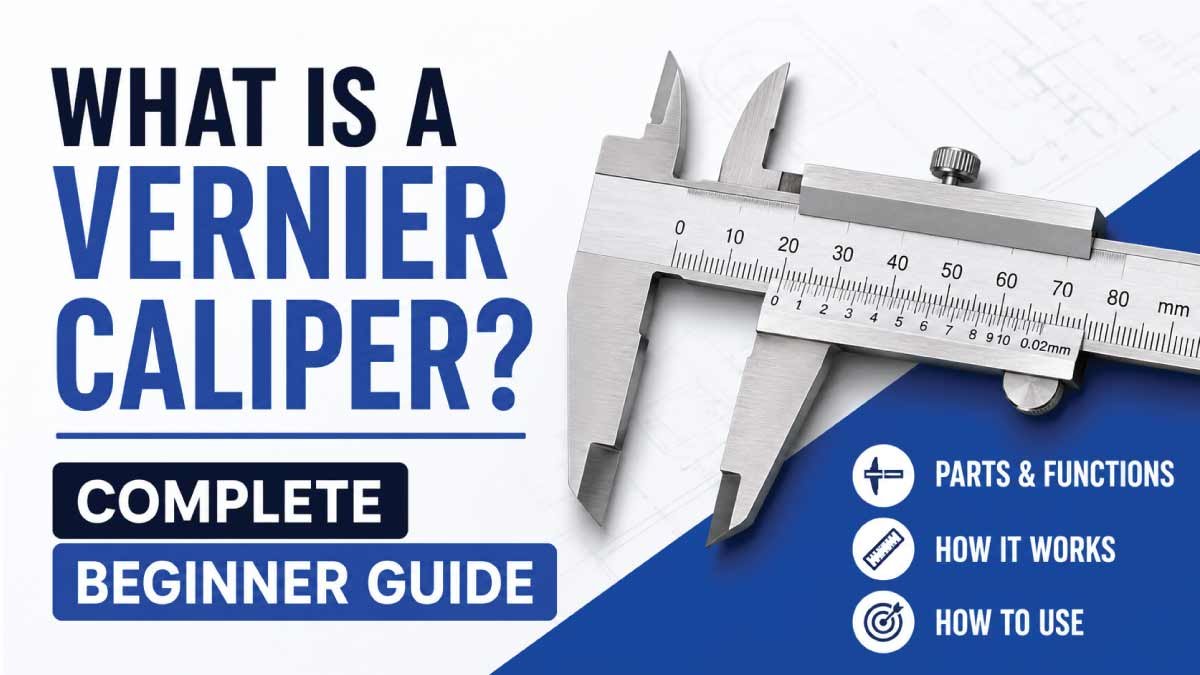
If you work in mechanics, engineering, workshops, or even simple DIY home projects, you will quickly realize that guessing measurements is never enough. Even a small mistake in size can cause a bolt not to fit, a hole to be misaligned, or a part to fail.
This is where a Vernier Caliper becomes one of the most important measuring tools. It is designed to give highly accurate measurements that simple rulers cannot provide.
In this beginner guide, you will learn what a Vernier caliper is, how it works, its parts, how to read it, and where it is used in real life.
What Is a Vernier Caliper?
A Vernier caliper is a precision measuring tool widely used in engineering, workshops, and manufacturing. It helps measure very small dimensions with high accuracy that a normal ruler cannot achieve. It is designed to measure internal, external, and depth dimensions with reliable precision for mechanical and technical work.
A Vernier caliper is a precision measuring tool used to measure:
- Internal dimensions (like hole diameter)
- External dimensions (like bolt thickness)
- Depth (like hole depth or slot depth)
It provides much higher accuracy than a normal ruler, often up to 0.02 mm or 0.001 inch depending on the type.
In simple words: 👉 A Vernier caliper is a tool that helps you measure very small distances accurately when a ruler is not enough.
Why Is a Vernier Caliper Important?
A Vernier caliper is important because precise measurement is critical in mechanical work. Even a small error can affect fitting, alignment, or performance of parts. It ensures accuracy, reduces production mistakes, and improves quality control in engineering, automotive, and manufacturing industries.
In mechanical work, accuracy matters a lot. A difference of even 0.5 mm can cause major fitting problems.
A Vernier caliper helps you:
- Ensure perfect fit between bolt and nut
- Measure machine parts precisely
- Avoid manufacturing errors
- Improve product quality
- Save time and material waste
For example: If a bolt hole is supposed to be 10 mm but is actually 10.5 mm, the bolt may become loose. A caliper helps detect this difference instantly.
Main Parts of a Vernier Caliper
To use a Vernier caliper correctly, you must understand its main parts. Each component has a specific role in ensuring accurate measurement of internal, external, and depth dimensions. These parts work together to provide precise readings, making the tool essential for mechanical and engineering applications.
1. Main Scale
The main scale is the fixed ruler portion of the Vernier caliper. It is marked in millimeters or inches and provides the primary measurement value. This scale forms the base reading, which is later refined by the Vernier scale to achieve high accuracy.
2. Vernier Scale
The Vernier scale is the sliding scale that moves along the main scale. It is designed to measure very small differences that the main scale cannot detect. By aligning with main scale markings, it allows precise fractional readings, improving overall measurement accuracy significantly.
3. Jaws (Outside Jaws)
Outside jaws are used to measure external dimensions of objects. They are commonly used for measuring bolt diameter, rod thickness, or outer width of components. These jaws must be placed firmly around the object to ensure accurate and stable external measurement.
- Bolt diameter
- Rod thickness
- Outer width
4. Inside Jaws
Inside jaws are smaller and are designed for measuring internal dimensions. They are inserted into openings to measure inner diameters accurately. This makes them useful for checking hole sizes, pipe inner dimensions, and other internal cavities in mechanical parts.
- Hole diameter
- Pipe inner size
5. Depth Rod
The depth rod is a thin, extendable rod located at the end of the caliper. It is used to measure the depth of holes, slots, or recesses. This feature is especially useful in machining and mechanical inspection work.
- Hole depth
- Slot depth
6. Locking Screw
The locking screw is used to fix the position of the sliding scale once a measurement is taken. It prevents movement during reading, ensuring accuracy and stability. This is especially useful when working in tight or precise measurement conditions.
How Does a Vernier Caliper Work?
A Vernier caliper works on the principle of two scales working together: the main scale and the Vernier scale. The main scale gives the basic measurement, while the Vernier scale provides fine precision. When both scales align at different points, they produce an accurate final reading.
The working principle is based on two scales working together:
- Main scale gives basic measurement
- Vernier scale gives extra precise measurement
When both scales align at different points, they create a more accurate reading than a normal ruler.
This is called the Vernier principle, which improves measurement accuracy significantly.
Types of Vernier Calipers
There are mainly three types of Vernier calipers used in workshops, engineering, and manufacturing industries. Each type works on the same basic measuring principle but differs in how the reading is displayed. The choice depends on accuracy needs, budget, and ease of use for beginners or professionals.
1. Manual Vernier Caliper
The manual Vernier caliper is the traditional and most commonly used type in workshops. It uses a main scale and Vernier scale to take readings manually. It does not require any battery and is very durable, making it reliable for long-term mechanical and industrial use.
- Traditional type
- Uses scale and human reading
- No battery required
- Most common in workshops
2. Dial Vernier Caliper
The dial Vernier caliper includes a circular dial that shows the measurement more clearly. Instead of calculating Vernier scale readings manually, the dial makes it easier to read results. It offers better speed and reduces human reading errors compared to manual calipers.
- Has a dial gauge
- Easier to read than manual type
- More accurate and faster
3. Digital Vernier Caliper
The digital Vernier caliper displays measurements on an electronic screen, making it the easiest type to use. It provides quick and highly accurate readings without manual calculation. It requires a battery but is very popular among beginners and professionals for its simplicity.
- Shows measurement on a digital screen
- Very easy to use
- High accuracy
- Requires battery
For beginners, digital calipers are easiest to use because they reduce reading errors. However, manual Vernier calipers are still widely used in industries due to their durability, reliability, and independence from electronic components.
👉 Learn Metric vs Imperial Units in Engineering with this simple guide. Understand differences, conversions, and real-world use in design and manufacturing. Read full post for clear, practical engineering insights.
How to Use a Vernier Caliper (Step by Step)
Using a Vernier caliper is not difficult if you follow the correct method in a proper sequence. Each step is important because even a small mistake can affect measurement accuracy. By practicing these steps, beginners can quickly learn how to measure parts correctly and confidently.
Step 1: Clean the Tool
Before starting measurement, always clean the Vernier caliper properly. Dust, oil, or metal particles on the jaws can affect accuracy and give wrong readings. A clean surface ensures smooth movement and correct contact between the object and measuring jaws.
Step 2: Close the Jaws and Check Zero Error
Close the jaws completely to check if the reading shows zero. If it does not show zero, it means there is a zero error that must be adjusted or noted before measurement. This step is very important for accurate and reliable results.
Step 3: Place the Object
Place the object carefully depending on what you are measuring. Proper positioning ensures correct readings and avoids measurement errors.
- For external measurement: place object between outside jaws
- For internal measurement: use inside jaws
- For depth: use depth rod
Step 4: Tighten Gently
After placing the object, close the jaws gently. Do not apply excessive pressure because it can damage the object or affect accuracy. The object should be held firmly but without force to ensure a stable and correct measurement.
Step 5: Lock the Screw
Once the object is properly placed, use the locking screw to fix the position. This prevents any movement while reading the measurement and ensures that the value remains stable for accurate interpretation.
Step 6: Read the Measurement
First, read the main scale value, then check which Vernier scale line aligns perfectly with the main scale. Combine both readings to get the final measurement. This method ensures high precision and accurate results in mechanical work.
How to Read a Vernier Caliper
Reading a Vernier caliper may look confusing at first, but it becomes very easy once you understand the step-by-step method. The key is to correctly read the main scale first, then identify the matching Vernier scale division, and finally combine both values for the final accurate measurement.
Step 1: Read Main Scale
Start by observing the main scale on the Vernier caliper. Note the last full millimeter mark that is just before the zero line of the Vernier scale. This value represents the main measurement and forms the base of your final reading.
Step 2: Read Vernier Scale
Next, check the Vernier scale carefully. Find the line on the Vernier scale that perfectly aligns with any line on the main scale. This matching line gives the fractional part of the measurement and adds precision to the final reading.
Step 3: Add Both Values
After identifying both readings, combine them to get the final measurement. The main scale gives the whole number, while the Vernier scale provides the decimal value. Adding both ensures an accurate and precise result.
Final measurement = Main scale reading + Vernier scale reading
Example:
Main scale = 12 mm
Vernier scale = 0.04 mm
👉 Final reading = 12.04 mm
Least Count of Vernier Caliper
The least count of a Vernier caliper refers to the smallest measurement difference that the tool can accurately detect. It represents the precision level of the instrument and determines how finely it can measure small dimensions. A smaller least count means the caliper is more precise and suitable for detailed engineering work.
Most common Vernier calipers have:
- 0.02 mm (metric)
- 0.001 inch (imperial)
Lower least count = higher accuracy.
Common Mistakes Beginners Make
Many beginners make small but important mistakes while using a Vernier caliper. These errors may look minor, but they can significantly affect measurement accuracy and lead to wrong results in mechanical work. Understanding these mistakes helps improve precision and builds proper measuring habits.
- Not checking zero error
- Applying too much pressure
- Reading scale incorrectly
- Using dirty or damaged caliper
- Confusing metric and imperial units
Avoiding these mistakes improves measurement accuracy significantly.
Applications of Vernier Caliper
Vernier calipers are widely used in different industries where precise measurement is required. They help in checking small dimensions accurately, ensuring proper fitting, quality control, and reliable performance of mechanical parts. From engineering workshops to simple home repairs, this tool is essential for accurate measurement tasks.
1. Mechanical Engineering
In mechanical engineering, Vernier calipers are used to measure machine components with high precision. They help engineers ensure correct dimensions for assembly and smooth functioning of parts. Accurate measurement of shafts, bearings, and other components is critical for avoiding mechanical failure and ensuring efficiency.
- Machine parts measurement
- Shaft and bearing sizing
2. Automotive Industry
In the automotive sector, Vernier calipers play an important role in measuring engine and vehicle components. They help mechanics and engineers ensure that parts fit correctly and function properly. Even small measurement errors can affect engine performance and safety.
- Engine parts measurement
- Brake component fitting
3. Manufacturing
In manufacturing industries, Vernier calipers are commonly used for quality control and inspection. They help ensure that produced parts meet required specifications and standards. This reduces defects, improves product consistency, and ensures that components fit correctly during assembly.
- Quality control
- Product inspection
4. DIY and Home Projects
Vernier calipers are also useful in simple DIY and home repair tasks. They help measure small objects like screws, bolts, and fittings accurately. This makes them helpful for hobby work, repairs, and small technical projects where precision is needed.
- Measuring screws and bolts
- Small repair work
Final Thoughts
A Vernier caliper is one of the most essential tools in measurement and engineering work. Whether you are a student, mechanic, or DIY enthusiast, understanding how to use it correctly can greatly improve your accuracy and work quality.
Once you master this tool, you will find it much easier to handle other measurement tasks like bolt sizing, hole measurement, and mechanical fitting.
👉 Learn How to Measure Bolt Size with this simple guide. Understand diameter, length, thread pitch, and standard sizing methods for accurate selection. Read full post for practical steps and clear engineering tips.
FAQs:
What is the simple definition of vernier caliper?
A vernier caliper is a precise measuring tool used to measure internal, external, and depth dimensions of objects. It provides more accurate readings than a normal ruler by using a main scale and a sliding vernier scale for fine measurement adjustments.
What is a vernier caliper in short notes?
A vernier caliper is a measuring instrument used in workshops and labs for precise measurement of length, diameter, and depth. It has two scales: main scale and vernier scale, which together help measure very small differences accurately in millimeters or inches.
What are the uses of vernier caliper?
Vernier calipers are used to measure external dimensions like length and diameter, internal dimensions such as pipe width, and depth of holes. They are widely used in engineering, mechanical work, machining, scientific laboratories, and quality control for accurate measurements.
What is the difference between a caliper and a vernier?
A caliper is a general measuring tool, while a vernier caliper is a more precise version that includes a vernier scale for higher accuracy. Vernier calipers can measure smaller units more precisely compared to standard calipers or simple measuring tools.
What are the two types of vernier calipers?
The two main types of vernier calipers are the metric vernier caliper and the imperial (inch) vernier caliper. Some modern versions also include digital vernier calipers, which display readings electronically for faster and easier measurement.
What is the SI unit for vernier calliper?
The SI unit used in vernier calipers is the millimeter (mm), which is the standard unit for measuring small lengths. In some cases, measurements may also be shown in centimeters or inches depending on the scale type used.
Why is it called a vernier?
It is called a vernier caliper because it uses the vernier scale, invented by Pierre Vernier. This scale helps measure very small differences by comparing main scale markings with sliding scale divisions, improving measurement accuracy significantly.
What is the formula of vernier?
The least count formula of a vernier caliper is: Least Count = Value of one main scale division ÷ Total number of vernier scale divisions. This formula helps determine the smallest measurable value of the instrument.
What is a caliper used for?
A caliper is used to measure the size of objects with high accuracy. It can measure length, thickness, internal diameter, external diameter, and depth. Calipers are commonly used in engineering, mechanical workshops, manufacturing, and scientific research.

Engineer Hassan is a Mechanical Engineer with 16+ years of hands-on experience in mechanical hardware, fasteners, and workshop tools. He focuses on size selection, thread identification, and measurement, helping users choose the correct components with accuracy and safety.