
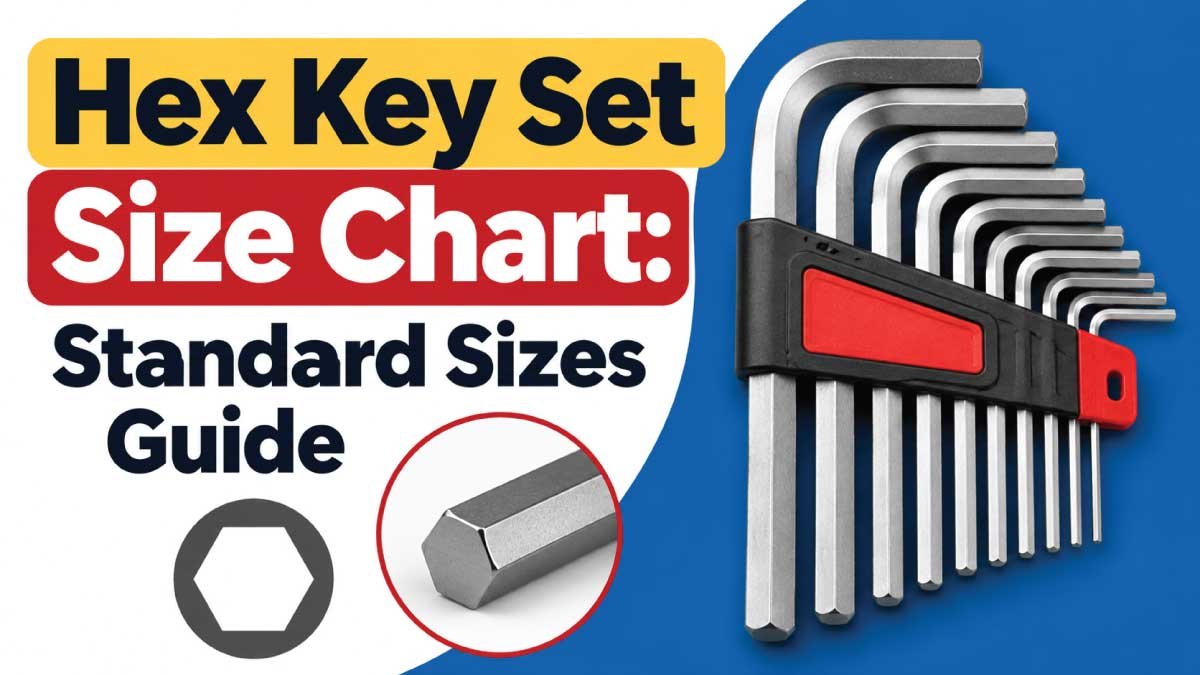
Choosing the correct hex key is essential when working with socket-head screws, bolts, machinery, furniture, bicycles, automotive components, and equipment. A key that is too small can slip and damage the fastener, while a key that is too large will not fit properly.
This hex key set size chart explains common metric and SAE/imperial hex key sizes, their approximate conversions, sizing systems, measurement methods, and practical selection tips. It also explains the difference between Allen keys and hex keys, how to identify an unknown size, and which sizes are commonly found in standard sets.
What Is a Hex Key?
A hex key is a small hand tool with a hexagonal cross-section designed to turn fasteners with an internal hexagonal socket. It is also commonly called an Allen key, Allen wrench, or hex wrench.
Hex keys are available as individual tools or in sets containing multiple sizes. The most important specification is the across-flats dimension of the hexagonal working end. For example, a 5 mm hex key has approximately 5 mm between two opposite flat sides.
The tool may be L-shaped, T-shaped, folding, or part of a multi-bit driver system. Although the basic purpose is the same, handle design, working length, material, and finish can vary considerably.
Common Applications
Hex keys are widely used for:
- Socket-head cap screws
- Set screws and grub screws
- Furniture fasteners
- Bicycle components
- Machinery and industrial equipment
- Automotive assemblies
- Electrical and electronic equipment
- Tools and fixtures
- Plumbing and mechanical components
- Equipment maintenance and repair
The correct key must match the socket size and shape, not simply the apparent diameter of the screw.
Hex Key Set Size Chart
Hex key sets are generally divided into metric and SAE/imperial sizes. Metric sets use millimeters, while SAE sets traditionally use fractions of an inch.
The following charts show common sizes encountered in general-purpose hex key sets. Exact contents vary by manufacturer and application.
Common Metric Hex Key Sizes
| Hex Key Size (mm) | Approx. SAE Equivalent (in) | Common Use |
|---|---|---|
| 1.5 | 1/16 | Small fasteners |
| 2 | 5/64 | Small machinery and electronics |
| 2.5 | 3/32 | General small hardware |
| 3 | 1/8 | Furniture and machinery |
| 4 | 5/32 | General mechanical work |
| 5 | 3/16 | Machinery and bicycles |
| 6 | 1/4 | Larger socket-head screws |
| 8 | 5/16 | Heavy-duty assemblies |
| 10 | 3/8 | Large mechanical fasteners |
| 12 | 1/2 | Heavy machinery |
| 14 | 9/16 | Large industrial fasteners |
| 17 | 11/16 | Specialized heavy-duty work |
| 19 | 3/4 | Large industrial applications |
The SAE equivalents in this table are approximate size comparisons, not interchangeable specifications. A metric key should not automatically be substituted for an SAE key simply because the dimensions appear close.
Common SAE Hex Key Sizes
| Hex Key Size (in) | Approx. Metric Equivalent (mm) | Common Use |
|---|---|---|
| 0.028 | 0.7 | Very small fasteners |
| 0.035 | 0.9 | Small precision work |
| 0.050 | 1.27 | Small assemblies |
| 1/16 | 1.59 | Small fasteners |
| 5/64 | 1.98 | Small hardware |
| 3/32 | 2.38 | General small work |
| 7/64 | 2.78 | General-purpose assemblies |
| 1/8 | 3.18 | Furniture and machinery |
| 9/64 | 3.57 | Mechanical applications |
| 5/32 | 3.97 | General mechanical work |
| 3/16 | 4.76 | Machinery and equipment |
| 7/32 | 5.56 | Medium-size fasteners |
| 1/4 | 6.35 | Common larger fasteners |
| 5/16 | 7.94 | Heavy-duty assemblies |
| 3/8 | 9.53 | Large fasteners |
| 7/16 | 11.11 | Heavy equipment |
| 1/2 | 12.70 | Large mechanical work |
Because nominal metric and fractional-inch dimensions can be close without being identical, use the exact matching size whenever possible.
Metric vs SAE Hex Key Sizes
The two major sizing systems are metric and SAE/imperial.
Metric hex keys are specified directly in millimeters, such as 2 mm, 3 mm, 4 mm, 5 mm, and 6 mm. SAE hex keys are generally specified using fractions of an inch, such as 1/8″, 3/16″, 1/4″, and 5/16″.
Metric Hex Keys
Metric Allen keys are especially common in equipment and products designed around metric fasteners. Typical sets may contain sizes such as:
- 1.5 mm
- 2 mm
- 2.5 mm
- 3 mm
- 4 mm
- 5 mm
- 6 mm
- 8 mm
- 10 mm
The actual set can contain more or fewer sizes depending on its intended application.
SAE Hex Keys
SAE sets use inch-based dimensions. Common sizes include:
- 1/16″
- 5/64″
- 3/32″
- 7/64″
- 1/8″
- 5/32″
- 3/16″
- 7/32″
- 1/4″
- 5/16″
- 3/8″
The required size depends on the internal socket of the fastener.
Can Metric and SAE Hex Keys Be Interchanged?
Generally, they should not be treated as interchangeable.
Some sizes are close enough that an incorrect key may appear to fit. However, even a small dimensional difference can reduce contact between the tool and socket. Applying significant torque with an undersized or poorly fitting key can damage the fastener recess or tool.
For important or high-torque work, always identify whether the fastener uses a metric or inch-based specification.
Hex Key Dimensions Explained
The term “size” usually refers to the width across the flats of the hexagonal working section. However, a hex key has several physical dimensions that affect usability.
Across-Flats Size
The across-flats dimension is the most important measurement.
For a 5 mm hex key, the distance between opposite flat faces is approximately 5 mm. This is the dimension that must match the internal hexagonal socket.
Overall Length
L-shaped hex keys have a long leg and a short leg. The overall dimensions vary according to the manufacturer and tool series.
A longer leg can provide better access to recessed fasteners, while a shorter working end can be useful in confined spaces.
Long and Short Ends
Traditional L-shaped keys provide two working ends:
- Long end: useful when greater reach is needed.
- Short end: useful when more leverage or faster turning is convenient.
The exact geometry varies between tool designs, so length should be considered a usability specification rather than a universal standard.
Also Read:
Types of Hex Key Sets
Different hex key designs are intended for different working conditions. The hexagonal working profile remains the defining feature, but the handle and construction can vary.
L-Shaped Hex Key Sets
L-shaped keys are among the most common designs. They are simple, compact, and versatile.
The long arm provides reach, while the short arm can provide additional leverage. Standard L-key sets are particularly convenient for general mechanical maintenance.
T-Handle Hex Keys
T-handle designs provide a dedicated grip that can make repeated fastening more comfortable.
They are useful when the user needs to turn many fasteners or apply controlled hand force. Their larger handles can, however, require more storage space than traditional L-shaped sets.
Folding Hex Key Sets
Folding sets place several hex keys inside a compact handle. This makes storage and transport convenient.
They are useful for maintenance kits, bicycles, equipment servicing, and general field work. The trade-off is that they may provide less flexibility than individual L-shaped keys in some confined locations.
Ball-End Hex Keys
Ball-end hex keys have a rounded working end that allows the tool to engage a socket at an angle.
They are particularly useful when a straight approach is difficult. However, the ball end is not always intended for maximum torque, so the straight end is generally preferable when high torque is required and access permits.
Also Read:
How to Measure a Hex Key Size
If the size is not marked, you can identify it by measuring the working end.
Measure Across the Flats
Use a caliper to measure the distance across opposite flat surfaces of the hexagonal section.
For example, if the measurement is close to 4 mm, the key is likely a 4 mm hex key. Small measurement differences can result from tool tolerances, wear, or measuring technique.
Avoid measuring from corner to corner because that is the across-corners dimension, not the nominal hex key size.
Compare With a Known Set
If a caliper is unavailable, compare the unknown key with a known metric or SAE set.
Try the keys carefully in the fastener rather than forcing one that seems close. A properly fitting key should enter the socket fully and have minimal unwanted movement.
Check Markings
Many quality hex key sets have size markings on the tool, holder, case, or handle.
If markings are present, use them as the first identification method and confirm the physical fit when necessary.
How to Choose the Correct Hex Key Size
Selecting a hex key is primarily about achieving a secure, full-depth fit inside the fastener socket.
Match the Socket Size
The working end should correspond exactly to the internal hex size.
Do not select a key based only on the outside diameter of the fastener. A bolt may have a particular thread diameter while its internal hex socket has a completely different dimension.
Identify the Measurement System
Determine whether the fastener is metric or SAE.
If the equipment uses metric hardware, start with a metric set. If the hardware is specified in inches, use the appropriate SAE set.
Check Full Engagement
Insert the key completely into the socket before applying force.
A properly seated key provides contact with the internal faces of the socket. Partial engagement can increase the risk of damaging the socket.
Consider Working Space
Choose the tool configuration based on access:
- Use a long-reach L-key for recessed locations.
- Use a short arm where space around the fastener is limited.
- Use a ball-end key when an angled approach is useful.
- Use a T-handle for repeated work.
The correct size is important, but the correct tool configuration can also make a substantial difference.
Also Read:
Common Hex Key Size Sets
Hex key sets are often sold as collections rather than individual sizes. A general-purpose metric set might cover small to medium sizes, while an industrial set may extend to much larger keys.
Typical Small Metric Set
A compact metric set may include:
| Size (mm) | Typical Application |
|---|---|
| 1.5 | Small precision hardware |
| 2 | Small fasteners |
| 2.5 | Small machinery |
| 3 | Furniture and equipment |
| 4 | General assemblies |
| 5 | Mechanical components |
| 6 | Medium fasteners |
Typical Larger Metric Set
For heavier mechanical work, a set may extend through sizes such as:
| Size (mm) | Typical Application |
|---|---|
| 6 | Medium mechanical hardware |
| 8 | Larger socket-head screws |
| 10 | Heavy assemblies |
| 12 | Large machinery |
| 14 | Industrial applications |
| 17 | Large fasteners |
| 19 | Heavy-duty equipment |
These are examples of useful size ranges rather than a universal definition of what every set must contain.
Hex Key Size Conversion Guide
Conversion charts are useful when working with equipment that mixes metric and inch-based hardware. However, a conversion does not mean two sizes are interchangeable.
| Metric (mm) | Decimal Inch (approx.) | Common Fraction Near This Size |
|---|---|---|
| 1.5 | 0.0591 | 1/16″ |
| 2 | 0.0787 | 5/64″ |
| 2.5 | 0.0984 | 3/32″ |
| 3 | 0.1181 | 1/8″ |
| 4 | 0.1575 | 5/32″ |
| 5 | 0.1969 | 3/16″ |
| 6 | 0.2362 | 1/4″ |
| 8 | 0.3150 | 5/16″ |
| 10 | 0.3937 | 3/8″ |
| 12 | 0.4724 | 1/2″ |
The values are mathematical conversions between units. The nearby fractional size may still differ enough to make substitution inappropriate.
Hex Key vs Allen Key
Hex key and Allen key generally describe the same basic type of tool.
“Allen key” is a widely used term originating from a historical trademarked product name, while “hex key” describes the tool based on its hexagonal geometry.
You may also encounter terms such as:
- Hex wrench
- Allen wrench
- Hexagonal key
- Hex driver
- Internal hex wrench
The terminology can vary by country, manufacturer, and industry. When purchasing or selecting one, the important characteristics are the hex size, measurement system, profile, and tool design.
Hex Key Size and Fastener Selection
Hex key dimensions are directly related to the internal socket of the mating fastener. Different fastener designs use different socket sizes, so there is no universal relationship in which a particular bolt diameter always requires one specific hex key.
When identifying a fastener, consider:
- Thread diameter
- Thread pitch
- Fastener head style
- Internal socket shape
- Socket size
- Material
- Application
- Required tightening torque
For replacement work, matching the original fastener specification is generally more reliable than selecting a socket based only on the apparent bolt diameter.
Common Problems When Using the Wrong Hex Key
Using the wrong size can create problems even when the tool initially appears to fit.
Rounded Fastener Socket
An undersized key may contact only part of the socket walls. Under force, the edges can deform or round over.
Once the internal socket is damaged, removing the fastener can become considerably more difficult.
Slipping During Use
A loose-fitting key may twist or slip when torque is applied. This can damage both the fastener and the tool.
Tool Damage
Using excessive force with an incorrectly sized key can bend, twist, or otherwise damage the tool.
Incomplete Engagement
A key that is not inserted deeply enough may concentrate force near the opening of the socket. Always push the key fully into the recess before applying torque.
Tips for Using Hex Keys Correctly
Good technique helps protect both the tool and fastener.
- Clean the socket before inserting the key.
- Use the exact size whenever possible.
- Insert the key fully into the internal hex.
- Keep the tool aligned with the fastener when applying high torque.
- Use the straight end rather than a ball end when maximum torque is needed and access allows.
- Avoid hammering a standard hex key into an incorrectly sized socket.
- Replace keys that have visibly rounded or damaged ends.
- Store metric and SAE sets separately or keep their markings clear.
- Use a torque-controlled tool when the fastener specification requires a defined tightening torque.
A hex key is simple, but correct tool selection becomes increasingly important as fastener size and required torque increase.
How to Organize a Hex Key Set
Keeping sizes organized saves time and reduces the likelihood of selecting the wrong tool.
A practical arrangement is to store keys in ascending size order. Separate metric and SAE tools should have clearly identified holders.
For frequently used sets, check that:
- Every key is returned to its correct position.
- Size markings remain readable.
- Working ends are free of excessive wear.
- Ball ends have not been damaged.
- The holder does not obscure size identification.
For professional maintenance environments, maintaining separate metric and SAE storage can make identification faster and reduce accidental substitution.
Frequently Asked Questions
What are the most common hex key sizes?
Common sizes depend on whether the set is metric or SAE. Metric sets frequently include sizes such as 2, 2.5, 3, 4, 5, 6, 8, and 10 mm. Common SAE sets often include 1/16″, 5/64″, 3/32″, 1/8″, 5/32″, 3/16″, 1/4″, and 5/16″.
Is a 5 mm hex key the same as 3/16 inch?
No. A 5 mm hex key and a 3/16-inch key are close in size but not identical. A 5 mm key is approximately 0.1969 inches, while 3/16 inch is 0.1875 inches.
How do I know whether I need metric or SAE?
Check the fastener, equipment documentation, or existing tool set. If the hardware is specified in millimeters, use metric keys. If it is specified in fractional inches, use SAE keys.
Can I use a slightly smaller hex key?
It is not recommended. A smaller key may have excessive clearance and can slip or damage the socket when torque is applied.
What is the difference between a ball-end and standard hex key?
A standard end is designed for straight engagement and is generally preferred for high-torque applications. A ball end can allow angled access, making it useful where a straight approach is difficult.
What does hex key size mean?
Hex key size normally refers to the across-flats measurement of its hexagonal working section. A 6 mm hex key therefore has a nominal 6 mm across-flats dimension.
Are all hex key sets the same?
No. Set contents, size ranges, lengths, materials, finishes, and handle designs can vary. Select a set based on the fasteners and working conditions you encounter.
Final Takeaway
A hex key set size chart is useful for quickly identifying metric and SAE sizes, but the most important rule is simple: match the hex key to the internal socket exactly. Metric and inch-based sizes can appear similar without being interchangeable.
For general work, a selection covering frequently used small and medium sizes is practical. For specialized machinery or large fasteners, a wider range may be necessary. When identifying an unknown key, measure across the flats rather than across the corners, and always confirm that the tool seats fully inside the fastener.
Choosing the correct size, keeping the key aligned, and avoiding excessive force with a poor fit will help prevent rounded sockets, damaged tools, and unnecessary fastening problems.

Engineer Hassan is a Mechanical Engineer with 16+ years of hands-on experience in mechanical hardware, fasteners, and workshop tools. He focuses on size selection, thread identification, and measurement, helping users choose the correct components with accuracy and safety.