
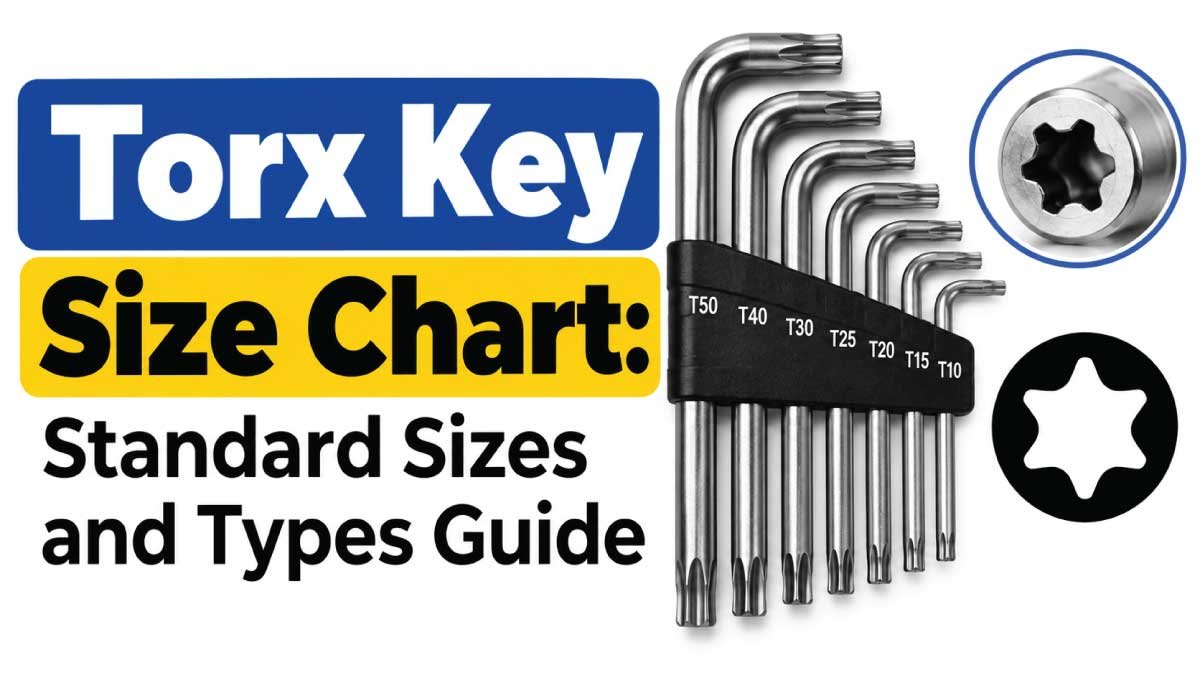
Choosing the correct Torx key can be confusing because Torx sizes use T-numbers rather than familiar metric or imperial measurements. A T10, T20, and T30 may look similar at first glance, but each is designed for a different recess size. Using the wrong key can damage the fastener or make removal unnecessarily difficult.
This Torx key size chart explains common Torx sizes, types of Torx keys, how the sizing system works, how to identify a key, and how to choose the correct size for a fastener. It also covers standard, security, external Torx, and practical sizing considerations for workshop, automotive, mechanical, electronics, and maintenance applications.
What Is a Torx Key?
A Torx key is a hand tool designed to turn a fastener with a six-point star-shaped recess. Torx is commonly associated with screws and bolts used in mechanical equipment, vehicles, machinery, appliances, electronics, and general maintenance.
Unlike a Phillips or slotted screwdriver, a Torx key engages several surfaces around the star-shaped recess. This geometry provides a secure connection between the tool and fastener when the correct size is used.
Torx keys are commonly available as:
- L-shaped keys
- Folding key sets
- T-handle keys
- Screwdriver-style drivers
- Bit sets
- Long-reach keys
- Security Torx keys
- Torx socket tools
The most important identification feature is the T-size, such as T5, T10, T20, T25, T30, or T40.
A larger T-number generally indicates a larger Torx profile, although the T-number should not be treated as a direct millimeter or inch measurement.
Torx Key Size Chart
The following chart provides a practical reference for commonly encountered Torx key sizes. Torx sizes are identified by their T-number, rather than by a simple diameter measurement.
| Torx Size | Relative Size | Common General Uses |
|---|---|---|
| T1 | Very small | Precision electronics |
| T2 | Very small | Small electronic assemblies |
| T3 | Very small | Precision components |
| T4 | Very small | Electronics and miniature hardware |
| T5 | Very small | Electronics and small devices |
| T6 | Small | Electronics and appliances |
| T7 | Small | Small mechanical assemblies |
| T8 | Small | Electronics and equipment |
| T9 | Small | Small machinery and devices |
| T10 | Small | Electronics and general hardware |
| T15 | Small–medium | Appliances and machinery |
| T20 | Medium | General mechanical applications |
| T25 | Medium | Automotive and machinery |
| T27 | Medium | Mechanical fasteners |
| T30 | Medium–large | Automotive and equipment |
| T40 | Large | Machinery and larger fasteners |
| T45 | Large | Automotive and mechanical work |
| T50 | Large | Heavy mechanical applications |
| T55 | Very large | Larger bolts and machinery |
The sizes above are useful for identifying and organizing Torx keys, but the exact fastener dimensions and recommended tool specifications can vary by manufacturer and application.
Understanding Torx T-Sizes
What Does the T Number Mean?
The letter T identifies the standard internal Torx profile, while the number identifies its size.
For example:
- T10 is smaller than T20.
- T20 is smaller than T30.
- T30 is smaller than T40.
- T50 is larger than T30.
The T-number is therefore primarily a size designation, not a direct measurement such as 10 mm or 20 mm.
This distinction is important because a T20 Torx key is not equivalent to a 20 mm hex key. The two tools use completely different geometries.
Why Torx Sizes Are Not Direct Metric Sizes
A common mistake is assuming that T20 means the star profile measures 20 mm. It does not.
Torx profiles have a specific six-lobed geometry, and their dimensions are determined by the profile design. Consequently, converting a Torx size directly into a metric wrench measurement can produce an incorrect result.
For reliable identification, use the T-number marked on the key or tool set and match it to the fastener.
Common Torx Key Sizes and Applications
Different Torx sizes tend to appear in different types of equipment. There is no universal rule that assigns a particular T-size to one application, but some sizes are frequently encountered.
T5 to T10 Torx Keys
The smaller Torx sizes are commonly associated with compact assemblies.
They may be encountered in:
- Electronic devices
- Small appliances
- Computer hardware
- Cameras
- Precision equipment
- Small mechanical components
- Consumer products
Because these fasteners are small, the recess can be easily damaged by using a tool that does not fit correctly.
T15 to T25 Torx Keys
T15, T20, and T25 are among the more useful sizes for general-purpose work.
They can appear in:
- Household equipment
- Power tools
- Machinery
- Automotive components
- Fixtures
- General mechanical assemblies
A complete set containing several sizes around this range is useful because nearby sizes can look deceptively similar.
T27 to T40 Torx Keys
These medium-to-large sizes are frequently useful in mechanical and automotive work.
Typical applications may include:
- Automotive components
- Industrial machinery
- Equipment frames
- Mechanical assemblies
- Larger machine fasteners
- Maintenance applications
The appropriate size depends on the fastener specification rather than simply the application category.
T45 to T55 Torx Keys
Larger Torx sizes are designed for fasteners with correspondingly larger Torx profiles.
They can be found in:
- Heavy mechanical equipment
- Automotive assemblies
- Machinery
- Industrial maintenance
- Larger structural or equipment fasteners
When working with large fasteners, the tool should fit completely into the recess before significant torque is applied.
Types of Torx Keys
Torx keys are available in several configurations. The basic star profile may be similar, but the tool design can affect accessibility, leverage, and convenience.
L-Shaped Torx Keys
L-shaped Torx keys are among the simplest and most recognizable designs.
One end or both ends may provide access to the fastener, depending on the key design. The longer arm can provide additional leverage, while the shorter arm can be useful where clearance is limited.
Advantages include:
- Simple construction
- Compact storage
- Easy carrying
- Good access to many fasteners
- Useful leverage
L-shaped sets are particularly convenient for workshops and general maintenance.
Folding Torx Key Sets
Folding sets store multiple Torx keys inside a single handle.
They are convenient when several sizes are needed regularly. Instead of carrying separate keys, the tools fold into a compact unit.
They are useful for:
- Field maintenance
- Bicycle work
- General repairs
- Workshop tasks
- Portable tool kits
The main limitation is that the handle can sometimes restrict access in confined areas.
T-Handle Torx Keys
T-handle Torx keys have a crossbar handle that allows the user to grip the tool with greater control.
They are useful where frequent operation is required because the handle provides:
- Comfortable grip
- Better rotational control
- Useful leverage
- Faster operation
T-handle tools are common in workshop and maintenance environments.
Long-Arm Torx Keys
Long-reach Torx keys provide additional reach for recessed fasteners.
They can be particularly useful when surrounding components prevent a short tool from reaching the fastener directly.
Long keys can also allow the user to approach a fastener from a more convenient position.
Security Torx Keys
Security Torx, often called tamper-resistant Torx, has a modified recess design with a central obstruction.
A standard Torx key cannot properly engage this type of fastener because the center of the tool profile is blocked by the pin.
Security Torx tools have a corresponding opening in the center so they can fit over the security pin.
Torx vs Security Torx
Although both use a six-point star-shaped profile, standard Torx and security Torx are not interchangeable in every situation.
| Feature | Standard Torx | Security Torx |
|---|---|---|
| Basic profile | Six-point star | Six-point star |
| Center of fastener | Open recess | Usually has central pin |
| Standard Torx key | Fits standard recess | Usually will not fit |
| Security Torx key | Can fit standard recess in many designs | Designed for pin-style recess |
| Typical purpose | General fastening | Tamper-resistant fastening |
If the fastener has a small pin in the middle, select the appropriate security Torx key rather than forcing a conventional key into it.
External Torx and Internal Torx
Not every Torx fastener uses an internal recess.
Internal Torx
Internal Torx fasteners have the star-shaped recess inside the head of the screw or bolt.
A Torx key or Torx bit enters the recess and turns the fastener.
This is the configuration most people mean when they refer to a Torx key.
External Torx
External Torx fasteners have the star-shaped profile on the outside of the fastener head.
These require a compatible E-Torx socket rather than a conventional internal Torx key.
External Torx sizes are designated differently from internal Torx sizes. Therefore, an E-size socket should not be confused with a T-size key.
How to Choose the Correct Torx Key Size
Selecting the right Torx size is primarily a matter of achieving a full and secure fit.
Step 1: Inspect the Fastener
Look closely at the recess.
Check whether it is:
- Six-point Torx
- Security Torx
- Damaged Torx
- Another star-shaped profile
Good lighting makes identification easier, particularly for small fasteners.
Step 2: Start With the Suspected Size
If the fastener is marked or its size is known, select the corresponding Torx key.
If the size is unknown, begin with a key that appears appropriate rather than immediately using force.
Step 3: Check the Fit
Insert the key fully into the recess.
The correct key should:
- Seat deeply
- Engage the lobes properly
- Have minimal unwanted movement
- Remain stable when light turning force is applied
A loose fit is a warning sign.
Step 4: Test Carefully
Apply modest turning force.
If the tool slips, stop and reassess the size. Continuing to turn with an improperly fitted key can round or damage the recess.
Step 5: Confirm Before Applying High Torque
For tight fasteners, make sure the tool is fully seated before using additional leverage.
This is especially important when dealing with corroded, seized, or heavily tightened fasteners.
Also Read:
How to Measure a Torx Key
Measuring a Torx key is less straightforward than measuring a conventional hex key because its star-shaped profile contains multiple geometric features.
Visual Identification
The easiest approach is normally to compare the key with a known Torx size.
Most quality Torx key sets have the size permanently marked on the tool or handle.
Using a Caliper
A caliper can help when the size marking is missing, but measuring only one point of the star does not necessarily provide a direct T-size identification.
The profile includes:
- Six lobes
- Recesses between lobes
- Specific angular geometry
- Defined dimensional relationships
Therefore, a measurement should be compared against an appropriate manufacturer dimension chart rather than simply treating the largest measured distance as the Torx size.
Measuring the Fastener Recess
When identifying a fastener, inspect both its overall head and the internal profile.
Do not assume that a measured value in millimeters corresponds directly to a T-number.
Also Read:
Torx Key Size Chart for Tool Selection
For practical workshop use, the following grouping can make a Torx set easier to understand.
| Size Group | Representative Sizes | Typical Use Category |
|---|---|---|
| Micro | T1–T4 | Precision components |
| Small | T5–T10 | Electronics and small hardware |
| Small/Medium | T15–T20 | General equipment |
| Medium | T25–T30 | Mechanical and automotive work |
| Medium/Large | T40 | Larger mechanical fasteners |
| Large | T45–T50 | Automotive and machinery |
| Very Large | T55 and above | Larger equipment applications |
These groupings are intended as a convenient reference rather than a universal application standard.
Why Using the Correct Torx Size Matters
The six-point geometry of a Torx fastener is intended to provide reliable engagement between the tool and fastener.
Using the correct size helps reduce several common problems.
Prevents Recess Damage
A correctly fitted key contacts the intended surfaces. An incorrect key can move within the recess and damage the fastener.
Improves Torque Transfer
A secure fit allows turning force to be transferred more effectively.
This becomes especially important when loosening a fastener that requires substantial force.
Reduces Tool Slippage
A loose-fitting tool can slip unexpectedly. Proper seating reduces unnecessary movement during normal use.
Protects Small Fasteners
Small Torx screws have relatively small recesses. Selecting the correct key is particularly important when working with delicate equipment.
Also Read:
Common Torx Key Mistakes
Even experienced users can encounter problems when identifying Torx sizes.
Using a Nearby Size
T20 and T25, for example, may appear similar when viewed quickly. A key that seems to fit may still be incorrect.
Always check whether the tool seats completely.
Forcing the Wrong Tool
If the key does not enter properly, do not hammer or force it into the recess unless the tool and application specifically require that procedure.
Forcing an incorrect tool can permanently damage the fastener.
Confusing T-Sizes With Metric Sizes
T30 does not mean 30 mm.
Torx and metric hex sizes are separate systems with different profiles.
Ignoring Security Features
If a fastener has a center pin, a conventional Torx key may not work. Use a suitable security Torx tool.
Using a Damaged Key
A worn or damaged Torx key may no longer provide the intended contact with the fastener.
Inspect frequently used tools for:
- Rounded edges
- Damaged points
- Excessive wear
- Bent shafts
- Corrosion
Torx Key Selection for Different Applications
Automotive Work
Automotive assemblies can use a broad range of Torx sizes. Keep several small, medium, and large sizes available rather than relying on one common key.
Security-style fasteners may also appear in particular assemblies.
Electronics
Electronics frequently require smaller Torx tools.
For these applications, precision and correct fit are particularly important because small fastener heads can be easily damaged.
Machinery
Machinery may use larger Torx fasteners where controlled torque and reliable engagement are important.
The correct tool should be selected according to the fastener specification.
General Maintenance
A mixed Torx set is usually more useful than purchasing a single size because maintenance tasks can involve many different fasteners.
Torx Key Set Sizes: What Should a Set Include?
A practical Torx key set should cover the sizes most relevant to the equipment being serviced.
For general-purpose use, a set spanning small through larger common T-sizes provides broader coverage than a set containing only a few keys.
When selecting a set, consider:
- Number of included sizes
- Smallest and largest size
- Standard Torx availability
- Security Torx availability
- Key length
- Handle style
- Material and construction
- Size markings
- Storage method
For specialized work, it is better to select the range according to the fasteners actually used on the equipment.
Torx Key vs Torx Screwdriver vs Torx Bit
These tools use the same general Torx profile but are designed differently.
| Tool Type | Main Characteristic | Useful For |
|---|---|---|
| L-Key | Bent metal key | Compact general work |
| T-Handle | Crossbar grip | Frequent workshop use |
| Screwdriver | Fixed handle and shaft | Quick access |
| Bit | Interchangeable tip | Ratchets and power tools |
| Socket | Torx profile in socket form | High-access and mechanical work |
| Security Bit | Central opening | Pin-style fasteners |
The best format depends on access, required torque, frequency of use, and available equipment.
How to Read a Torx Size Chart
When using a Torx size chart, focus first on the T-number.
For example, if the fastener requires T25:
- Find T25 in the chart.
- Select a T25 tool.
- Confirm that the tool fits the recess.
- Make sure it is fully seated.
- Apply controlled turning force.
Do not replace a T25 with a metric or imperial key simply because its physical size appears similar.
A size chart is primarily an identification and selection aid; exact manufacturer specifications should be checked when a particular fastener requires controlled torque or dimensional verification.
Frequently Asked Questions
What is the most common Torx key size?
There is no single Torx size that is universal across all industries. Sizes such as T10, T15, T20, T25, and T30 are commonly encountered in various general-purpose applications, but the required size depends entirely on the fastener.
Is T20 bigger than T15?
Yes. T20 represents a larger Torx profile than T15.
Is T30 the same as 30 mm?
No. T30 is a Torx size designation and should not be interpreted as a 30 mm measurement.
What is the difference between Torx and security Torx?
Standard Torx uses a normal six-point internal profile. Security Torx fasteners commonly include a center pin, requiring a tool with a corresponding center opening.
Can a Torx key remove an external Torx bolt?
Generally, an internal Torx key is designed for an internal Torx recess. External Torx fasteners require an appropriately sized E-Torx socket or equivalent external-profile tool.
How do I know what Torx size I need?
Check the fastener marking when available, consult the equipment documentation, or carefully compare the recess with a Torx size set. The correct key should fit fully and securely without excessive movement.
Why does my Torx key keep slipping?
The tool may be the wrong size, may not be fully seated, or the fastener recess may already be damaged. Stop applying force and inspect both the key and fastener.
Are Torx keys available in metric and imperial sizes?
Torx uses its own standardized size designation rather than being a conventional metric or imperial wrench system. Some tool sets may be marketed alongside metric or imperial tools, but the T-number remains the Torx identification.
Tips for Using Torx Keys Correctly
For reliable results, follow a few basic practices:
- Choose the exact T-size whenever possible.
- Fully seat the key before turning.
- Keep the tool aligned with the fastener.
- Avoid excessive side loading.
- Do not substitute metric or hex keys.
- Use security Torx tools for pin-style fasteners.
- Replace heavily worn keys.
- Clean dirt from the fastener recess before inserting the tool.
- Use the appropriate Torx socket when greater torque is required.
- Check manufacturer instructions for critical assemblies.
For difficult fasteners, taking a few seconds to confirm the size can prevent much more time-consuming damage.
Final Thoughts
A Torx key size chart makes it easier to identify and select the correct tool for six-point star-shaped fasteners. The T-number is the primary size designation, with larger numbers generally representing larger Torx profiles.
For everyday work, understanding common sizes such as T10, T15, T20, T25, T30, T40, T45, and T50 provides a useful starting point. However, the correct choice should always be based on the actual fastener rather than an assumed metric conversion.
Remember that standard Torx, security Torx, and external Torx are different tool configurations. A properly fitted key should sit securely in the recess before torque is applied. When exact dimensions or torque requirements matter, use the relevant fastener or manufacturer specifications.

Engineer Hassan is a Mechanical Engineer with 16+ years of hands-on experience in mechanical hardware, fasteners, and workshop tools. He focuses on size selection, thread identification, and measurement, helping users choose the correct components with accuracy and safety.