
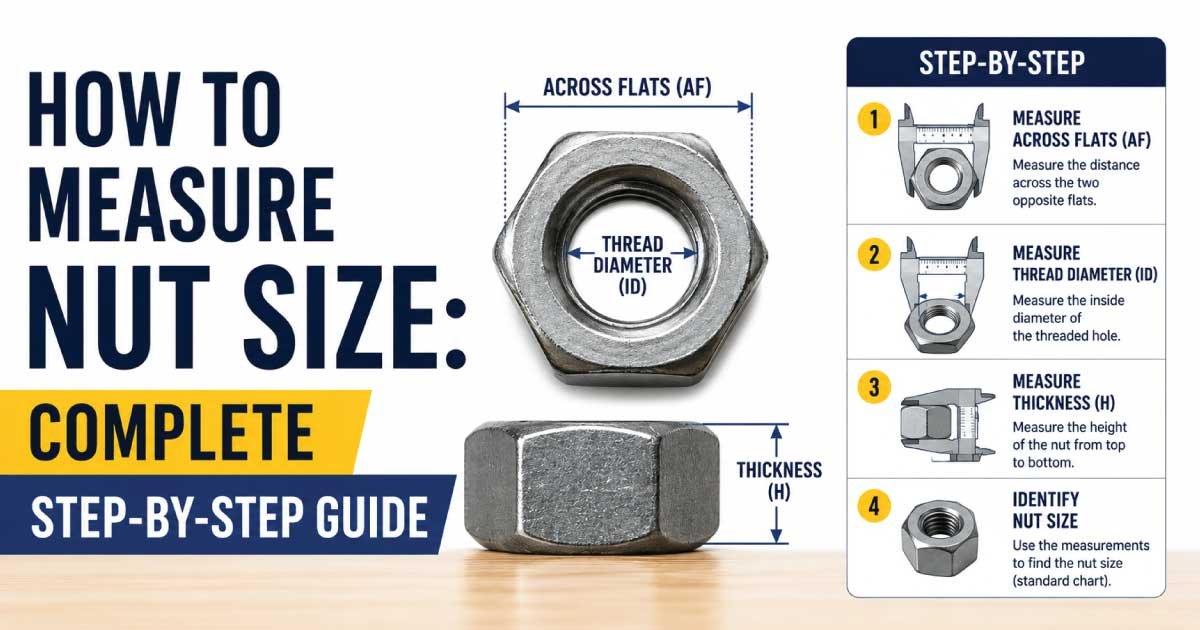
Selecting the correct nut size is essential for any fastening project. Whether you’re replacing a missing nut, matching a nut to a bolt, or working on automotive, construction, or machinery repairs, knowing how to measure a nut correctly can save time and prevent costly mistakes.
Many people assume all nuts are the same, but nuts come in different thread sizes, diameters, widths, and standards. Understanding these measurements helps ensure a secure connection and proper fit.
In this guide, you will learn how to measure nut size accurately, identify common nut dimensions, and avoid common measurement mistakes.
What Is a Nut?
A nut is a threaded fastener designed to work together with a bolt, screw, or threaded rod to create a secure mechanical connection. The internal threads of the nut engage with the external threads of the mating fastener, allowing components to be clamped tightly together. Nuts are available in many shapes, materials, and sizes to suit different applications and load requirements.
Because nuts can be removed and reused, they are widely used in assemblies that may require maintenance, adjustment, or disassembly. Their versatility makes them one of the most common fastening components in construction, manufacturing, and repair work.
Common Uses of Nuts
Nuts are used across numerous industries and applications where reliable fastening is required. They help secure structural components, machinery, and equipment while allowing easy assembly and maintenance.
- Construction projects
- Automotive repairs
- Industrial machinery
- Furniture assembly
- Plumbing systems
- Electrical installations
Since nuts come in various sizes, proper measurement is important when replacing or selecting one.
Why Measuring Nut Size Matters
Accurate nut measurement is essential for ensuring compatibility with bolts, threaded rods, and other threaded fasteners. Selecting the correct size helps maintain joint strength, prevents thread damage, and improves the overall safety and reliability of the assembly.
Proper Fit on Bolts and Threaded Rods
A correctly sized nut must match the diameter and thread pitch of the bolt or threaded rod. Proper fit ensures smooth installation and full thread engagement, creating a secure and dependable connection.
Strong and Secure Connections
Using the correct nut size allows the fastener assembly to achieve the intended clamping force. This helps prevent loosening under vibration, load, or repeated use.
Reduced Risk of Thread Damage
When a nut matches the thread specifications of the bolt, installation is easier and the risk of cross-threading or stripping is significantly reduced. This helps protect both the nut and the mating fastener.
Improved Safety and Reliability
Properly sized nuts contribute to the structural integrity of mechanical and structural assemblies. Secure fastening reduces the likelihood of component movement, equipment failure, or safety hazards.
Compliance with Engineering Specifications
Many projects require specific nut dimensions and thread standards to meet design requirements, industry standards, and building codes. Accurate measurement helps ensure compliance and reliable performance.
Correct nut measurements help ensure:
- Proper fit on bolts and threaded rods
- Strong and secure connections
- Reduced risk of thread damage
- Improved safety and reliability
- Compliance with engineering specifications
Using the wrong size nut can cause stripped threads, loose assemblies, or complete fastening failure.
Tools Needed to Measure a Nut
Before measuring a nut, it is important to gather the proper tools to ensure accurate and reliable measurements. Using precision measuring instruments helps identify the correct nut size, thread specifications, and compatibility with bolts or threaded rods. Accurate measurements reduce the risk of selecting the wrong fastener and help ensure safe, secure assemblies.
1. Vernier Caliper
A vernier caliper is one of the most accurate tools for measuring nuts. It can measure the width across flats, outside dimensions, and other critical fastener dimensions with high precision. Digital calipers are especially popular because they provide quick and easy readings. Provides precise measurements of width and diameter.
2. Steel Ruler
A steel ruler is a simple and readily available tool that can be used for quick measurements when high precision is not required. Although it is less accurate than a caliper, it can still help identify approximate nut sizes in the field. Useful for quick measurements.
3. Thread Gauge
A thread gauge is used to determine the thread pitch of a nut. Matching the gauge teeth with the internal threads helps identify the correct thread spacing, ensuring compatibility with bolts and threaded rods. Helps identify thread pitch.
4. Nut and Bolt Gauge
A nut and bolt gauge is specifically designed to identify standard fastener sizes quickly. It allows users to compare a nut against known measurements, making size identification faster and more convenient. Used to compare standard fastener sizes.
5. Measuring Tape
A measuring tape is useful when working with larger nuts and fasteners that may be difficult to measure using smaller precision tools. While not as accurate as a caliper, it can provide general dimensions for large-scale applications. Helpful for larger fasteners.
Using accurate measuring tools improves measurement reliability, helps ensure proper fastener selection, and reduces the risk of installation problems caused by incorrect sizing.
How to Measure Nut Size
Accurately measuring a nut size is important when selecting the correct wrench, socket, replacement fastener, or matching bolt. A small measurement error can lead to using the wrong tool, causing damage to the nut corners or poor fastening performance. The most reliable method is measuring the width across the flats using a caliper, which provides precise and consistent results for identification.
Step 1: Measure Across the Flats
The most common and widely accepted measurement for identifying a nut size is the width across the flats. This refers to the distance between two opposite flat sides of a hex nut. Manufacturers use this dimension to determine the correct wrench and socket size, making it the primary measurement used in mechanical, automotive, industrial, and construction applications worldwide.
How to Do It
To obtain an accurate measurement, use a digital or vernier caliper and follow these steps carefully. Ensure the nut is clean and free from dirt, rust, paint, or debris before measuring, as contaminants can affect accuracy. Position the caliper correctly on the flat surfaces and avoid measuring across the corners.
- Place the caliper on two opposite flat sides.
- Close the jaws gently.
- Read the measurement.
For example:
- 13 mm
- 17 mm
- 19 mm
- 24 mm
This measurement helps identify the wrench or socket size required. It is also useful when replacing missing hardware, verifying specifications, matching nuts with corresponding bolts, and ensuring proper tool selection for maintenance and repair tasks.
Example
If the measurement across flats is 19 mm, the nut likely fits an M12 bolt in standard metric fastener systems. However, thread pitch and specific standards may vary between manufacturers, so it is always recommended to verify the bolt diameter and thread specifications before purchasing replacement parts. Using the correct size ensures proper torque application, improved safety, reduced wear, and a secure mechanical connection.
Measuring Hex Nut Width
Hex nuts are the most common nut type.
Step-by-Step
- Measure across opposite flats.
- Record the width.
- Compare with standard charts.
Common metric hex nut widths include:
| Nut Size | Width Across Flats |
|---|---|
| M6 | 10 mm |
| M8 | 13 mm |
| M10 | 17 mm |
| M12 | 19 mm |
| M16 | 24 mm |
| M20 | 30 mm |
This measurement determines the correct wrench size.
Measuring Square Nuts
Square nuts are measured using a process similar to that used for standard hex nuts. The goal is to determine the external dimensions, thread diameter, and thread pitch so that the correct replacement nut, wrench, or matching bolt can be selected. Accurate measurements help ensure proper fitment and reliable fastening in woodworking, machinery, and restoration applications.
Procedure
Follow these steps to identify the size of a square nut accurately. Using a digital caliper and a thread gauge will provide the most precise results and help avoid measurement errors.
- Measure one side length.
- Measure thread diameter.
- Determine thread pitch.
Square nuts are commonly found in woodworking and restoration projects. They are also used in certain machinery, agricultural equipment, antique furniture, and vintage vehicles where their larger surface area provides improved resistance to loosening and better load distribution.
👉 How to Measure a Lag Bolt: Complete Step-by-Step Guide explains the correct way to measure diameter, length, thread count, and head size for accurate selection. Read the full guide to understand step-by-step methods and practical tips for choosing the right Lag Bolt for strong, safe, and reliable fastening in any project.
How to Identify Metric Nut Sizes
Metric nuts are designated according to the thread diameter measured in millimeters. The letter “M” indicates a metric thread, while the number represents the nominal diameter of the bolt that the nut is designed to fit. Metric fasteners are standardized internationally, making identification and replacement relatively straightforward.
Common Metric Nut Sizes
Examples include:
- M6
- M8
- M10
- M12
- M16
- M20
These sizes are widely used across automotive, construction, manufacturing, maintenance, and industrial sectors. Larger metric sizes are typically selected for applications that require greater load-carrying capacity and higher fastening strength.
Example
If the internal thread diameter measures approximately 12 mm, the nut is likely an:
M12 Nut
Metric nuts are commonly used worldwide because they follow international standards, making them easy to source and compatible with a wide range of machinery, tools, and equipment manufactured in different countries.
How to Identify Imperial Nut Sizes
Imperial nuts are measured in inches rather than millimeters. They are commonly used in North America and on older machinery, vehicles, and equipment. Proper identification requires measuring both the thread diameter and thread pitch to ensure compatibility with matching bolts.
Common Imperial Nut Sizes
Common sizes include:
- 1/4 inch
- 5/16 inch
- 3/8 inch
- 1/2 inch
- 5/8 inch
- 3/4 inch
These sizes are frequently used in North America and older equipment. Many industrial machines, agricultural tools, and vintage automotive systems continue to rely on imperial fasteners for maintenance and replacement purposes.
Example
A nut fitting a 1/2-inch bolt is classified as a:
1/2-inch Nut
The designation refers to the bolt diameter rather than the external dimensions of the nut. Always verify thread pitch as well, since bolts of the same diameter may have different thread counts.
Common Nut Sizes and Their Uses
Different nut sizes are designed for different load requirements and applications. Understanding where each size is commonly used helps in selecting the correct fastener for a project and ensuring adequate strength and durability.
M6 Nuts
M6 nuts are relatively small fasteners used in applications that require moderate holding strength and easy installation. They are commonly found in lightweight assemblies and general-purpose fastening tasks.
Commonly used for:
- Furniture
- Light machinery
- Household applications
M8 Nuts
M8 nuts provide greater strength than M6 fasteners and are widely used in automotive and industrial environments. They offer a good balance between size, durability, and load-carrying capability.
Often found in:
- Automotive components
- Equipment mounting
M10 Nuts
M10 nuts are considered medium-duty fasteners and are frequently used where stronger and more secure connections are required. They are common in structural and mechanical assemblies.
Used for:
- Structural connections
- Heavy-duty assemblies
M12 Nuts
M12 nuts are designed for demanding applications that require higher clamping force and increased load capacity. They are often selected for construction and industrial projects.
Popular in:
- Construction projects
- Industrial equipment
M16 and Larger
M16 and larger nuts are used in applications where maximum fastening strength and durability are critical. These larger fasteners are capable of handling significant loads, vibration, and harsh operating conditions.
Used where high-strength fastening is required. Common examples include steel structures, heavy machinery, bridges, industrial equipment, mining operations, and large construction projects where reliability and safety are essential.
👉 How to Read a Tape Measure: Complete Beginner’s Guide helps you understand inches, fractions, centimeters, and millimeters for accurate measurement in any project. Read the full guide to learn step-by-step reading techniques and practical tips for using a Tape Measure with confidence, precision, and ease in construction and DIY work.
Measuring a Nut Without a Caliper
While a digital caliper provides the most accurate measurements, it is not always available. Fortunately, you can still estimate a nut’s size using basic tools such as a ruler or measuring tape. Although this method is less precise, it is often sufficient for identifying common nut sizes and selecting replacement hardware for general repair and maintenance tasks.
Using a Ruler
A standard ruler can help determine the approximate width of a nut across its flat sides. For the best results, place the ruler carefully and measure as accurately as possible. After recording the measurement, compare it with a standard nut size chart to identify the most likely size.
- Measure across the flats.
- Record the measurement.
- Compare with standard sizing charts.
Although less accurate, this method works for basic identification. It can be especially useful when working in the field, performing emergency repairs, or checking fastener sizes when specialized measuring tools are unavailable.
Matching a Nut to a Bolt
The easiest and most reliable way to identify a nut size is by matching it to the bolt it was originally designed to fit. Since nuts and bolts are manufactured to work together, measuring the bolt often provides the quickest path to finding the correct replacement nut.
Steps
To ensure compatibility, verify both the diameter and thread pitch of the bolt before selecting a replacement nut. Even a small difference in thread specifications can prevent proper installation.
- Measure bolt diameter.
- Determine thread pitch.
- Select a nut with identical specifications.
Both thread diameter and pitch must match exactly. A nut with the correct diameter but the wrong thread pitch may appear to fit initially but can damage the threads and compromise the strength of the connection.
Common Mistakes When Measuring Nut Size
Accurate measurements are essential when identifying or replacing nuts. Many sizing problems occur because of simple measurement mistakes that lead to selecting incompatible hardware. Avoiding these common errors can save time, prevent thread damage, and ensure a secure fastening connection.
Measuring Across Corners Instead of Flats
One of the most common mistakes is measuring the distance across opposite corners of a hex nut rather than across the flat sides. Measurements taken across corners are larger and do not correspond to standard wrench or socket sizes.
Nut sizes are generally identified by measurements across the flats. Always position the measuring tool on two opposite flat surfaces to obtain the correct dimension.
Ignoring Thread Pitch
Many people focus only on thread diameter and overlook thread pitch. However, thread spacing is equally important when determining compatibility between nuts and bolts.
A matching diameter does not guarantee thread compatibility. Two fasteners may have the same diameter but different thread pitches, making them incompatible with each other.
Using Damaged Threads
Threads that are worn, corroded, deformed, or damaged can produce inaccurate measurements and make identification difficult. Damaged threads may also prevent proper gauge readings.
Worn or damaged threads can cause inaccurate readings. Inspect the threads carefully and clean them before taking measurements whenever possible.
Mixing Metric and Imperial Sizes
Metric and imperial fasteners often look very similar, especially in medium-sized ranges. This can lead to confusion and incorrect replacements if measurements are not verified carefully.
Metric and imperial nuts often appear similar but are not interchangeable. Attempting to force mismatched fasteners together can damage threads and weaken the connection.
Estimating Without Measuring
Guessing a nut size based solely on appearance is a common cause of purchasing the wrong replacement hardware. Even experienced technicians verify dimensions before making a final selection.
Always verify measurements before purchasing replacement hardware. Taking a few extra minutes to measure accurately can prevent installation issues, unnecessary expenses, and repeated trips to obtain the correct fastener.
👉 How to Remove Stripped Screws from Metal: Complete Guide explains simple and effective methods to extract damaged or stuck screws without harming the surface. Read the full guide to learn step-by-step techniques, useful tools, and expert tips for safely removing a Stripped Screw from metal in any repair or maintenance work.
Nut Size Chart Reference
| Thread Size | Across Flats |
|---|---|
| M6 | 10 mm |
| M8 | 13 mm |
| M10 | 17 mm |
| M12 | 19 mm |
| M14 | 22 mm |
| M16 | 24 mm |
| M20 | 30 mm |
| M24 | 36 mm |
This chart provides a quick reference for common metric nuts.
Tips for Accurate Nut Measurement
For the most accurate results:
- Clean dirt and rust from the nut first.
- Use a digital caliper whenever possible.
- Measure multiple times.
- Verify thread pitch separately.
- Compare measurements with a standard chart.
- Keep metric and imperial fasteners separate.
These simple steps reduce sizing errors and improve fastening reliability.
Conclusion
Knowing how to measure nut size correctly is an essential skill for mechanics, contractors, DIY enthusiasts, and maintenance professionals. The process involves measuring the width across flats, determining the thread diameter, and identifying the thread pitch. These measurements ensure compatibility with bolts and threaded rods while helping maintain strong and secure connections.
Whether you are replacing a lost nut, repairing machinery, or working on a construction project, accurate measurements eliminate guesswork and help you choose the right fastener every time.
FAQs:
Is Nut Size the Same as Wrench Size?
No, nut size and wrench size are not the same. Nut size usually refers to the thread diameter, while wrench size refers to the width across flats. This means a nut can have a specific thread size but require a different wrench size to tighten or loosen it properly.
How Do I Know if a Nut Is Metric or Imperial?
You can identify whether a nut is metric or imperial by measuring its diameter and thread pitch. Then compare these measurements with a standard sizing chart. Metric nuts are measured in millimeters, while imperial nuts use inches and threads per inch for accurate identification and matching.
Can Two Nuts Have the Same Width but Different Threads?
Yes, two nuts can have the same width across flats but different thread sizes or pitches. This is why it is important to check both measurements carefully. Using only wrench size is not enough; always verify thread diameter and pitch for correct fitting and secure fastening.
What Tool Is Best for Measuring Nuts?
A digital vernier caliper is the best and most accurate tool for measuring nuts. It allows precise measurement of both inner diameter and width across flats. This ensures correct identification of nut size, helps in selecting proper bolts, and improves accuracy in mechanical and engineering applications.

Engineer Hassan is a Mechanical Engineer with 16+ years of hands-on experience in mechanical hardware, fasteners, and workshop tools. He focuses on size selection, thread identification, and measurement, helping users choose the correct components with accuracy and safety.