
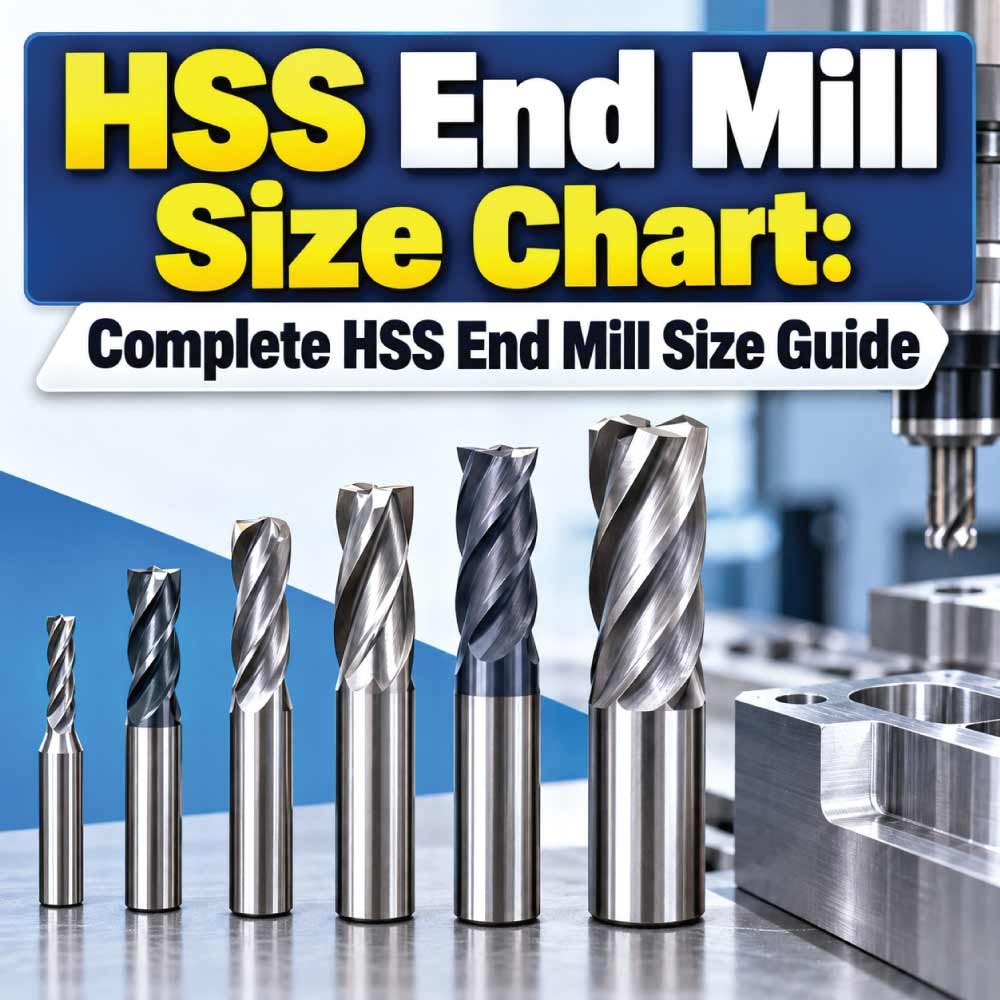
Choosing the correct end mill is easier when the cutter’s diameter, cutting length, overall length, shank diameter, flute count, and end geometry are clearly understood. An HSS end mill size chart provides a practical way to compare these dimensions before selecting a tool for a milling operation.
High-speed steel (HSS) end mills are widely used for machining metals because they offer a useful combination of toughness, cutting performance, heat resistance, and cost. They are available in many diameters and configurations, from small cutters for detailed work to larger tools for general material removal.
This guide explains common HSS end mill dimensions, size terminology, flute configurations, types, measurement methods, applications, and the factors that influence tool selection.
What Is an HSS End Mill?
An HSS end mill is a rotary cutting tool manufactured primarily from high-speed steel and designed to remove material from a workpiece. Unlike a drill, which is mainly intended to cut in an axial direction, an end mill can cut along its sides as well as its end.
HSS provides good toughness, particularly in applications where a cutting tool may experience interrupted cuts or less-than-ideal machining conditions. It is commonly used on materials such as:
- Mild and carbon steels
- Alloy steels
- Stainless steel
- Aluminum and aluminum alloys
- Brass and bronze
- Cast iron
- Plastics and engineering materials
The tool’s geometry determines how it performs. Diameter, flute count, helix angle, rake geometry, cutting length, and overall length all affect cutting behavior.
An HSS end mill should therefore be selected based on both physical dimensions and machining requirements, rather than diameter alone.
HSS End Mill Size Chart
The following chart shows commonly encountered nominal HSS end mill diameters. Exact cutting lengths, overall lengths, and shank configurations vary according to the cutter design and manufacturer.
| Nominal Diameter (mm) | Approx. Diameter (in.) | Typical Use |
|---|---|---|
| 2 mm | 0.079 in | Fine slotting and detail work |
| 3 mm | 0.118 in | Small slots and profiles |
| 4 mm | 0.157 in | Light general machining |
| 5 mm | 0.197 in | Small pockets and profiles |
| 6 mm | 0.236 in | General-purpose milling |
| 8 mm | 0.315 in | Slots, pockets, and profiling |
| 10 mm | 0.394 in | General machining |
| 12 mm | 0.472 in | Heavy general-purpose work |
| 16 mm | 0.630 in | Larger slots and material removal |
| 20 mm | 0.787 in | Heavy milling applications |
| 25 mm | 0.984 in | Large-scale material removal |
These are nominal diameter examples rather than a universal dimensional standard. A cutter listed as 10 mm, for example, can have different flute lengths, overall lengths, shank dimensions, and geometries depending on its design.
When ordering a tool, always use the manufacturer’s complete dimensional specification rather than relying on diameter alone.
Understanding HSS End Mill Dimensions
An end mill contains several dimensions that describe its physical size and cutting capability. Understanding these terms makes an HSS end mill size chart much easier to use.
Cutting Diameter
The cutting diameter is the diameter of the cylindrical cutting portion of the tool.
It is one of the most important dimensions because it determines the approximate width of a slot or the radial engagement possible during side milling.
For example, a 10 mm end mill has a nominal cutting diameter of approximately 10 mm.
Shank Diameter
The shank is the portion held by the tool holder, collet, or milling machine spindle.
The shank diameter does not always equal the cutting diameter. Some end mills have reduced shanks, while others use a shank matching the cutter diameter.
Correct shank compatibility is essential because the tool must fit securely into the selected holder.
Cutting Length
Cutting length refers to the usable fluted portion of the end mill.
A longer cutting length allows the tool to reach deeper features, but excessive stick-out can reduce rigidity and increase deflection.
Overall Length
Overall length is the distance from the end of the cutting tool to the opposite end of the shank.
A longer overall length may help reach recessed areas, but it can also increase vibration when the tool extends farther from the holder.
Flute Length
Flute length describes the portion containing the cutting flutes. It is closely related to cutting depth but should not automatically be treated as the maximum recommended machining depth.
The appropriate cutting depth depends on tool geometry, workpiece material, machine rigidity, tool diameter, and cutting conditions.
Common HSS End Mill Sizes by Diameter
End mills are available in numerous diameter increments. Metric and inch-based systems are both widely encountered.
Small-Diameter HSS End Mills
Small cutters, generally in the low single-digit millimeter range, are useful when machining narrow slots, small pockets, and detailed profiles.
Their smaller cross-section makes them more sensitive to:
- Excessive feed
- Tool deflection
- Vibration
- Poor workholding
- Excessive cutting depth
- Improper spindle speed
Small-diameter tools should therefore be used with appropriate machining parameters and sufficient rigidity.
Medium-Diameter HSS End Mills
Diameters around 6 to 12 mm are commonly suited to general-purpose milling operations.
They provide a practical balance between accessibility and rigidity and can be used for:
- Slot milling
- Pocketing
- Profiling
- Shoulder milling
- General material removal
The exact capability depends on the tool’s flute geometry and machine setup.
Large-Diameter HSS End Mills
Larger HSS cutters provide a greater cutting cross-section and can be useful for heavier milling operations.
They generally require a machine and holder capable of handling the corresponding cutting forces. Workpiece clamping also becomes increasingly important as the cutting load increases.
Metric vs. Imperial HSS End Mill Sizes
HSS end mills are commonly specified using either metric dimensions or imperial dimensions.
Metric cutters are normally identified in millimeters, such as 6 mm, 8 mm, 10 mm, or 12 mm.
Imperial cutters are specified in inches, such as 1/4 inch, 3/8 inch, 1/2 inch, or 3/4 inch.
These systems should not be casually substituted simply because two dimensions appear close after conversion.
For example, a metric and imperial cutter may have slightly different nominal diameters even if their converted dimensions appear similar.
When replacing an existing tool, check:
- Cutter diameter
- Shank diameter
- Cutting length
- Overall length
- Flute count
- Tool-holder compatibility
- Required slot width
HSS End Mill Types
Diameter is only one part of end mill selection. Different cutter designs are intended for different machining operations.
Square End Mill
A square end mill has a flat cutting end and is one of the most versatile HSS end mill configurations.
It is commonly used for:
- Squaring shoulders
- Slotting
- Pocketing
- Profiling
- General milling
The flat end produces a relatively sharp corner at the bottom of a machined feature.
Ball Nose End Mill
A ball nose end mill has a rounded cutting tip.
It is particularly useful for contoured surfaces, curved profiles, molds, and three-dimensional machining.
The rounded end changes the way the tool contacts the workpiece, making it different from a square-ended cutter.
Corner Radius End Mill
A corner-radius cutter has a small radius between the end and side cutting edges.
This geometry can reduce the sharp corner at the tool tip and is useful where a small radius is acceptable or desirable.
Roughing End Mill
Roughing cutters use specialized tooth geometry to remove material efficiently.
The flute design breaks chips into smaller segments, which can be useful during rough machining.
Tapered End Mill
A tapered end mill has a cutting diameter that changes along its length.
This design can be useful for specific angled walls, mold work, and other applications requiring tapered geometry.
HSS End Mill Flute Count
The number of flutes is another important specification.
Common HSS end mills may have 2, 3, 4, or more flutes, depending on their intended use.
Two-Flute End Mills
Two-flute cutters provide relatively large spaces between cutting edges. This creates greater chip space and can be useful for materials and operations where chip evacuation is important.
They are commonly encountered in aluminum and slotting applications, although the appropriate geometry depends on the specific tool.
Three-Flute End Mills
Three-flute cutters provide a middle ground between chip space and the number of cutting edges.
They may be useful where a balance between productivity and chip evacuation is required.
Four-Flute End Mills
Four-flute cutters have more cutting edges and are widely used for general-purpose machining.
They can provide good surface finish and allow more cutting edges to participate in the operation, provided the machining parameters and material are appropriate.
HSS End Mill Size Chart by Flute Count
The following is a practical way to think about common configurations rather than a universal manufacturer specification.
| Flute Count | Typical Characteristic | Common Applications |
|---|---|---|
| 2 | Larger chip spaces | Slotting, aluminum, chip-sensitive work |
| 3 | Balanced flute spacing | General milling and aluminum applications |
| 4 | More cutting edges | General milling and finishing |
| 5+ | Higher tooth count | Specialized production applications |
Flute count should be considered together with material, feed rate, spindle speed, coolant, chip evacuation, and tool geometry.
How to Read an HSS End Mill Size Chart
A size chart becomes more useful when each specification is interpreted correctly.
Suppose a cutter is identified as:
10 mm × 22 mm × 72 mm
The numbers may represent different dimensions depending on the manufacturer’s notation, so the associated labels must always be checked.
A typical dimensional specification may include:
- Diameter
- Cutting length
- Overall length
- Shank diameter
Never assume the order of dimensions without checking the chart’s column headings.
This is particularly important because different manufacturers and catalogs can use different abbreviations and dimensional sequences.
Also Read:
How to Measure an HSS End Mill
If the original packaging or specification is unavailable, several dimensions can be measured directly.
Measure the Cutter Diameter
Use a suitable micrometer or precision measuring instrument across the cutting diameter.
Measure across the appropriate cylindrical cutting area rather than measuring an irregular or damaged cutting edge.
Measure the Shank
Measure the smooth cylindrical shank using a micrometer or suitable caliper.
The shank measurement is important for selecting the correct collet or holder.
Measure Cutting Length
Measure the length of the fluted cutting portion.
Do not confuse this with the maximum safe cutting depth. Actual machining depth depends on many additional factors.
Measure Overall Length
Measure from the cutting end to the opposite end of the shank.
Record the result in the same unit used by the rest of your tooling inventory.
How to Choose the Correct HSS End Mill Size
Selecting an HSS end mill should begin with the machining operation rather than the tool diameter alone.
Consider the Slot Width
For slotting, the cutter diameter is directly related to the desired slot width.
A tool that is too small may require multiple passes. A tool that is too large may not fit into the feature.
Consider the Required Cutting Depth
Check how deep the feature must be machined.
A cutter needs sufficient usable cutting length, but using an unnecessarily long tool can reduce rigidity.
Consider Machine Rigidity
A rigid milling machine can generally tolerate more demanding operations than a lightweight or flexible setup.
The machine spindle, tool holder, workholding system, and workpiece all contribute to overall rigidity.
Consider the Workpiece Material
HSS end mill geometry should be matched to the material being machined.
Different materials have different requirements for:
- Cutting speed
- Feed
- Flute geometry
- Lubrication
- Chip evacuation
- Number of flutes
Consider Accessibility
Sometimes the ideal diameter cannot physically reach the feature.
For narrow pockets or restricted areas, a smaller cutter may be necessary even if a larger cutter would be more efficient for material removal.
Also Read:
HSS vs. Carbide End Mills
HSS and carbide end mills are both useful, but their characteristics differ.
| Characteristic | HSS End Mill | Carbide End Mill |
|---|---|---|
| Toughness | Generally high | Generally lower than HSS |
| Rigidity requirement | Moderate | Often higher |
| Typical cutting speeds | Lower | Higher |
| Cost | Often lower | Often higher |
| Shock resistance | Good | More sensitive to impact |
| General suitability | Broad range of jobs | High-performance machining |
HSS can be attractive when toughness, affordability, and versatility are important. Carbide is frequently selected when higher cutting speeds, greater wear resistance, or higher productivity are priorities.
The correct choice depends on the machine, material, tool geometry, production requirements, and machining conditions.
Advantages of HSS End Mills
HSS remains useful because of several practical characteristics.
- Good toughness: HSS can tolerate interrupted cutting and mechanical shock comparatively well.
- Versatility: HSS cutters are available for many common milling operations.
- Cost effectiveness: They can be economical for general workshop use.
- Resharpenability: Many HSS cutting tools can be resharpened when appropriate equipment and expertise are available.
- Wide material compatibility: Properly selected HSS tools can machine numerous engineering materials.
- Availability: Standard HSS sizes are commonly available in metric and imperial configurations.
These advantages make HSS particularly relevant for general machining, maintenance work, toolrooms, and applications where extreme cutting speeds are not the primary requirement.
Limitations of HSS End Mills
HSS is not automatically the best choice for every machining environment.
Important limitations include:
- Lower allowable cutting speeds than many carbide tools
- Greater sensitivity to excessive heat at high speeds
- Potentially lower wear resistance than carbide
- Reduced productivity in some high-speed production applications
- Possible deflection when using long, small-diameter cutters
The tool should therefore be selected according to the complete machining requirement rather than price or availability alone.
Also Read:
Common HSS End Mill Problems
Incorrect sizing or machining conditions can cause several problems.
Tool Chatter
Chatter can result from inadequate rigidity, excessive tool stick-out, unsuitable cutting conditions, poor workholding, or an inappropriate tool geometry.
Reducing unsupported tool length and improving workholding can often help, but machining parameters must also be reviewed.
Poor Surface Finish
Poor finish may result from:
- Dull cutting edges
- Excessive vibration
- Incorrect feed
- Inappropriate spindle speed
- Deflection
- Insufficient rigidity
A larger cutter is not necessarily the solution. The complete machining setup should be evaluated.
Premature Tool Wear
Excessive heat, unsuitable speeds and feeds, inadequate lubrication, or cutting a material beyond the tool’s intended capability can accelerate wear.
Inspect the cutting edges regularly and adjust the process according to the tool manufacturer’s recommendations.
Tips for Better HSS End Mill Selection
A few practical habits can prevent many sizing errors.
- Measure the existing tool before purchasing a replacement.
- Confirm shank diameter as well as cutting diameter.
- Choose the shortest practical cutting length for the required feature.
- Avoid unnecessary tool stick-out.
- Match flute count and geometry to the workpiece material.
- Check the machine’s spindle and holder compatibility.
- Use appropriate coolant or cutting fluid where required.
- Confirm manufacturer specifications for unusual tools or demanding applications.
- Inspect cutters for chipped, worn, or damaged teeth before use.
- Do not assume two tools with the same diameter are interchangeable.
For precision work, the manufacturer’s dimensional drawing should take precedence over a generalized size chart.
Frequently Asked Questions
What are the most common HSS end mill sizes?
Common nominal sizes include 6 mm, 8 mm, 10 mm, 12 mm, 16 mm, and 20 mm, along with numerous smaller and larger options. Availability varies by tool type and manufacturer.
What does end mill diameter mean?
End mill diameter refers to the nominal diameter of the cutting portion of the tool. It is a key dimension for determining slot width, radial engagement, and tool clearance.
Is HSS good for milling steel?
Yes. HSS end mills are widely used for milling various steels when the tool geometry and machining conditions are appropriate. Cutting parameters should be selected according to the specific steel and tool design.
What is the difference between flute length and overall length?
Flute length describes the portion containing the cutting flutes, while overall length is the total length of the tool from one end to the other.
Should end mill diameter match shank diameter?
Not necessarily. Some end mills have a shank diameter equal to the cutting diameter, while others use reduced shanks. Always verify the actual dimensions.
Are metric and imperial end mills interchangeable?
Not always. Although dimensions can be converted between millimeters and inches, tooling systems may require specific nominal sizes and holder compatibility. Select the exact size required by the application.
How many flutes should an HSS end mill have?
There is no single ideal flute count. Two-flute cutters provide greater chip space, while four-flute designs provide more cutting edges. Material, operation, and tool geometry should determine the choice.
Can HSS end mills be resharpened?
Many HSS end mills can be professionally resharpened, provided sufficient tool material remains and the cutting geometry can be restored accurately.
Final Takeaway
An HSS end mill size chart is useful for comparing cutter diameter, cutting length, shank size, overall length, flute count, and different end mill configurations. However, diameter alone should never determine tool selection.
For the best fit, consider the workpiece material, slot or feature dimensions, required cutting depth, machine rigidity, holder compatibility, flute configuration, and machining conditions. When exact dimensions matter, verify the manufacturer’s specification before ordering or installing the cutter.
Choosing the correct HSS end mill means matching the tool’s physical dimensions and geometry to the job. A properly selected cutter can provide predictable cutting, good accessibility, and reliable performance across a wide range of conventional milling applications.

Engineer Hassan is a Mechanical Engineer with 16+ years of hands-on experience in mechanical hardware, fasteners, and workshop tools. He focuses on size selection, thread identification, and measurement, helping users choose the correct components with accuracy and safety.