
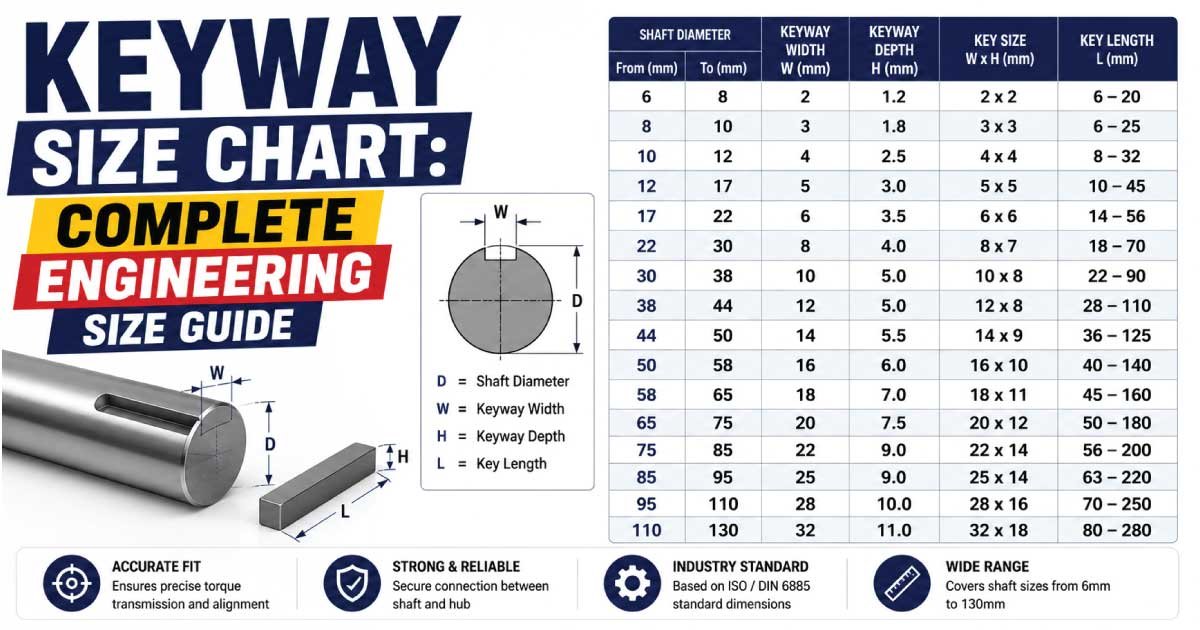
A keyway is a machined slot cut into a shaft and the bore of a hub to accommodate a key, creating a secure mechanical connection that transmits torque without slippage.
Selecting the correct keyway size is essential for ensuring reliable power transmission, preventing shaft damage, and extending the lifespan of gears, pulleys, sprockets, couplings, and other rotating components.
This complete guide explains keyway dimensions, standard size charts, measurement methods, materials, and selection tips.
What Is a Keyway?
A keyway is a precisely machined groove in a shaft and its mating hub that holds a metal key. Together, the key and keyway lock the shaft and rotating component so they rotate together while transmitting torque efficiently. Properly sized keyways minimize movement, reduce wear, and maintain alignment under heavy mechanical loads.
Key Functions
- Transmits rotational torque
- Prevents component slipping
- Maintains shaft alignment
- Supports heavy loads
- Simplifies component assembly
- Allows easy replacement of parts
Types of Keyways
Different machinery requires different keyway designs depending on torque, operating conditions, and assembly requirements. Understanding the common types helps engineers and technicians choose the most suitable option for reliable power transmission and long-term performance.
1. Parallel Keyway
The parallel keyway is the most commonly used design in industrial equipment. It uses a rectangular key with parallel sides that fits tightly into matching slots on the shaft and hub.
Advantages
- Easy to manufacture
- High torque capacity
- Simple installation
- Widely standardized
- Suitable for most machinery
2. Woodruff Keyway
A Woodruff keyway uses a semicircular key that fits into a circular recess in the shaft. It provides excellent alignment and is commonly found in automotive engines, electric motors, and machine tools.
Benefits
- Self-aligning design
- Easy assembly
- Ideal for tapered shafts
- Excellent positioning accuracy
- Reliable under vibration
3. Taper Keyway
Taper keyways use slightly tapered keys that tighten as they are installed. This design creates a strong mechanical connection suitable for heavy-duty machinery and high-torque applications.
Applications
- Flywheels
- Heavy industrial equipment
- Marine machinery
- Large pumps
- Compressors
4. Feather Keyway
Feather keys allow axial movement between the shaft and hub while still transmitting torque. They are commonly used in gearboxes and sliding gear mechanisms where controlled movement is required.
Metric Keyway Size Chart
The following chart lists commonly used metric keyway dimensions according to standard engineering practices.
| Shaft Diameter (mm) | Key Size (Width × Height mm) | Keyway Depth (mm) |
|---|---|---|
| 6–8 | 2 × 2 | 1.2 |
| 8–10 | 3 × 3 | 1.8 |
| 10–12 | 4 × 4 | 2.5 |
| 12–17 | 5 × 5 | 3.0 |
| 17–22 | 6 × 6 | 3.5 |
| 22–30 | 8 × 7 | 4.0 |
| 30–38 | 10 × 8 | 5.0 |
| 38–44 | 12 × 8 | 5.0 |
| 44–50 | 14 × 9 | 5.5 |
| 50–58 | 16 × 10 | 6.0 |
| 58–65 | 18 × 11 | 7.0 |
| 65–75 | 20 × 12 | 7.5 |
| 75–85 | 22 × 14 | 9.0 |
| 85–95 | 25 × 14 | 9.0 |
| 95–110 | 28 × 16 | 10.0 |
Inch Keyway Size Chart
Many North American machines and legacy equipment use inch-based keyway dimensions.
| Shaft Diameter (Inch) | Key Size (Inch) | Typical Keyway Depth |
|---|---|---|
| 1/2 | 1/8 × 1/8 | 1/16 |
| 5/8 | 3/16 × 3/16 | 3/32 |
| 3/4 | 3/16 × 3/16 | 3/32 |
| 7/8 | 1/4 × 1/4 | 1/8 |
| 1 | 1/4 × 1/4 | 1/8 |
| 1-1/4 | 5/16 × 5/16 | 5/32 |
| 1-1/2 | 3/8 × 3/8 | 3/16 |
| 1-3/4 | 7/16 × 7/16 | 7/32 |
| 2 | 1/2 × 1/2 | 1/4 |
| 2-1/2 | 5/8 × 5/8 | 5/16 |
Understanding Keyway Dimensions
A keyway consists of several important dimensions that determine how securely the shaft and hub connect. Accurate measurements ensure proper torque transmission, prevent excessive stress, and reduce wear on rotating components. Understanding each dimension is essential when selecting replacement keys or machining new keyways.
1. Key Width
Key width is the horizontal dimension of the key that fits inside the shaft and hub slots. It determines the contact area available for transmitting torque. Selecting the correct width ensures a secure fit without excessive looseness or interference.
2. Key Height
The height, sometimes called thickness, is the vertical dimension of the key. Part of the key sits inside the shaft while the remaining portion engages the hub. Proper height provides balanced load distribution during operation.
3. Keyway Depth
Keyway depth is measured from the shaft surface to the bottom of the machined groove. The correct depth ensures the key fits properly while maintaining sufficient shaft strength and minimizing stress concentration.
How to Measure a Keyway
Accurate measurement is essential when replacing worn keys or machining new shafts and hubs. Precision measuring tools help ensure compatibility and reduce installation problems.
Step 1: Measure Shaft Diameter
Use a digital caliper or micrometer to measure the shaft diameter.
Tips
- Clean the shaft first
- Measure at several points
- Record measurements carefully
- Use millimeters or inches consistently
Step 2: Measure Keyway Width
Measure the inside width of the shaft slot using a caliper.
Important considerations:
- Check for wear
- Measure multiple locations
- Compare with standard charts
- Verify against manufacturer specifications
Step 3: Measure Keyway Depth
Measure from the shaft surface to the bottom of the groove using a depth gauge or caliper depth rod. Accurate depth ensures the key sits correctly without excessive clearance or interference.
Common Key Materials
The material used for keys significantly affects durability, wear resistance, and torque capacity. Selecting the correct material improves mechanical performance and extends service life.
Carbon Steel
Carbon steel is the most widely used key material due to its excellent strength and affordability.
Advantages
- High strength
- Cost-effective
- Easy to machine
- Good wear resistance
- Suitable for general industrial applications
Alloy Steel
Alloy steel keys are heat-treated for improved hardness and higher torque capacity.
Benefits
- Greater durability
- Higher load capacity
- Better fatigue resistance
- Long service life
- Ideal for heavy-duty machinery
Stainless Steel
Stainless steel keys are preferred in corrosive environments where rust resistance is important.
Common applications include:
- Food processing equipment
- Marine machinery
- Chemical plants
- Outdoor equipment
- Pharmaceutical machinery
Applications of Keyways
Keyways are found in nearly every mechanical power transmission system where shafts and hubs must rotate together without slipping. Their standardized dimensions make them suitable for a wide range of industrial and automotive applications.
Automotive Industry
Keyways are widely used in automotive systems to securely mount rotating components.
Examples include:
- Crankshaft pulleys
- Timing gears
- Flywheels
- Water pumps
- Steering systems
Industrial Machinery
Industrial machines rely on keyways for reliable torque transmission between shafts and rotating components.
Common applications include:
- Gearboxes
- Electric motors
- Conveyor systems
- Compressors
- Hydraulic pumps
- Industrial fans
Agricultural Equipment
Heavy-duty farming machinery uses keyways to withstand continuous operation under high loads.
Typical equipment includes:
- Tractors
- Harvesters
- Seed drills
- Rotary cutters
- Balers
How to Choose the Correct Keyway Size
Selecting the correct keyway size is essential for safe and efficient power transmission. The keyway must match the shaft diameter, key dimensions, hub specifications, and expected torque load. Choosing an undersized keyway may cause shearing or slipping, while an oversized keyway reduces shaft strength and creates excessive movement. Always refer to standard keyway charts and manufacturer recommendations before machining or replacing components.
Selection Checklist
- Measure the shaft diameter accurately.
- Select the standard key size.
- Verify keyway width and depth.
- Calculate the transmitted torque.
- Check hub dimensions.
- Confirm material compatibility.
- Review industry standards.
- Consider operating speed.
- Inspect existing wear.
- Use proper machining tolerances.
📐 Explore Latest Size Guide 👉 Oil Seal Size Chart: Ultimate Guide to Standard Sizes
Standard Keyway Tolerances
Keyway tolerances ensure that the key fits securely while allowing proper assembly and disassembly. Excessive clearance can lead to vibration and wear, while an overly tight fit makes installation difficult and may damage the shaft or hub. Standard tolerances help maintain consistent mechanical performance across different equipment.
Typical tolerance considerations include:
- Shaft keyway width tolerance
- Hub keyway width tolerance
- Key height tolerance
- Key width tolerance
- Surface finish requirements
- Parallelism
- Squareness
- Corner radius
Following recognized standards such as ISO, DIN, or ANSI helps achieve proper fit and reliable torque transmission.
Keyway Width vs Shaft Diameter
The relationship between shaft diameter and keyway size is standardized to provide adequate torque capacity while preserving shaft strength. Larger shafts require wider and deeper keyways to handle increased mechanical loads.
| Shaft Diameter (mm) | Standard Key Width (mm) | Standard Key Height (mm) |
|---|---|---|
| 10 | 4 | 4 |
| 16 | 5 | 5 |
| 22 | 6 | 6 |
| 30 | 8 | 7 |
| 38 | 10 | 8 |
| 44 | 12 | 8 |
| 50 | 14 | 9 |
| 58 | 16 | 10 |
| 65 | 18 | 11 |
| 75 | 20 | 12 |
| 85 | 22 | 14 |
| 95 | 25 | 14 |
Common Keyway Installation Mistakes
Improper installation is one of the leading causes of premature keyway failure. Even a correctly sized key can perform poorly if installed incorrectly or if damaged components are reused. Careful preparation and proper machining practices significantly improve reliability and service life.
Avoid these common mistakes:
- Using the wrong key size
- Installing worn keys
- Poor keyway alignment
- Excessive hammering during installation
- Ignoring machining tolerances
- Using damaged hubs
- Reusing bent keys
- Failing to lubricate when required
- Improper shaft preparation
- Neglecting inspection after assembly
Advantages of Proper Keyway Sizing
Correctly sized keyways improve overall drivetrain efficiency and reduce stress on connected components. Proper sizing ensures even load distribution, minimizes backlash, and extends the lifespan of shafts, hubs, gears, and bearings under continuous operation.
Major benefits include:
- Reliable torque transmission
- Reduced vibration
- Longer component life
- Lower maintenance costs
- Improved shaft strength
- Better alignment
- Easier assembly
- Reduced wear
- Increased safety
- Higher mechanical efficiency
📐 Explore Latest Size Guide 👉 Reamer Size Chart: Complete Guide 2026 with PDF
Signs of a Worn or Damaged Keyway
Over time, repeated loading and vibration can damage keyways and keys. Early identification of wear helps prevent expensive repairs and unexpected equipment failure.
Common warning signs include:
- Excessive shaft play
- Metal shavings around the key
- Unusual vibration
- Clicking or knocking noises
- Visible wear marks
- Rounded keyway corners
- Cracked hub
- Loose rotating components
- Difficulty maintaining alignment
- Reduced torque transmission
Replace worn keys and inspect both the shaft and hub before installing new components.
Keyway Maintenance Tips
Routine inspection and maintenance help maximize keyway life while preventing costly downtime. Regular cleaning and proper lubrication reduce wear and corrosion in demanding operating environments.
Maintenance recommendations:
- Inspect keys regularly
- Keep keyways clean
- Remove rust immediately
- Check for deformation
- Replace worn keys
- Verify proper fit
- Monitor vibration
- Lubricate where recommended
- Tighten connected components
- Schedule routine inspections
Preventive maintenance significantly extends equipment lifespan.
Applications of Standard Keyways
Standard keyways are used in countless mechanical systems because they provide a simple, economical, and highly reliable method of transmitting torque between shafts and hubs.
Common applications include:
Electric Motors
Electric motors use keyways to connect shafts with pulleys, couplings, and gears while ensuring efficient power transmission.
Gearboxes
Industrial gearboxes rely on precision-machined keyways to secure gears and maintain accurate rotational alignment under heavy loads.
Pumps and Compressors
Pumps and compressors use keyed shafts to prevent slipping between rotating components during continuous operation.
Machine Tools
Lathes, milling machines, drilling machines, and CNC equipment depend on keyways for accurate torque transmission and positioning.
Agricultural Machinery
Tractors, harvesters, balers, seed drills, and rotary cutters all utilize keyed shafts for reliable operation in demanding environments.
How to Increase Keyway Service Life
Several practices help maximize the lifespan of keys and keyways while reducing maintenance costs. Proper design, quality materials, and routine inspections are equally important.
Best practices include:
- Use hardened steel keys
- Follow standard dimensions
- Avoid overload conditions
- Maintain proper lubrication
- Inspect during scheduled maintenance
- Replace damaged components promptly
- Machine keyways accurately
- Avoid excessive shock loading
- Maintain shaft alignment
- Use high-quality replacement parts
📐 Explore Latest Size Guide 👉 Punch Size Chart: Complete Guide 2026 + PDF
Putting It All Together
Selecting the correct keyway size is essential for ensuring reliable torque transmission, maintaining shaft alignment, and extending the service life of mechanical components.
By understanding standard keyway dimensions, key materials, shaft measurements, and installation practices, you can confidently choose the appropriate keyway for automotive, industrial, agricultural, and manufacturing applications.
Using a standard keyway size chart, following proper machining tolerances, and performing routine maintenance minimizes wear, reduces downtime, and improves the overall efficiency and reliability of power transmission systems.
FAQs:
How do I determine the correct keyway size?
Measure the shaft diameter first, then consult a standard metric or inch keyway size chart. Verify the required key width, key height, and keyway depth according to the shaft dimensions and manufacturer specifications. Accurate sizing ensures a proper fit, efficient torque transmission, and reliable long-term mechanical performance.
What is the difference between a key and a keyway?
A key is the removable metal component placed between a shaft and a hub to transmit rotational force. A keyway is the precisely machined slot cut into both the shaft and the hub. Together, they create a secure connection that prevents slipping and ensures efficient power transmission.
Which material is best for machine keys?
The best material depends on the application. Carbon steel is widely used for general machinery because of its strength and affordability. Alloy steel offers greater load capacity for heavy-duty equipment, while stainless steel provides excellent corrosion resistance, making it suitable for marine, food processing, and outdoor environments.
What causes keyway failure?
Keyway failure can result from excessive torque, incorrect key size, poor machining, improper installation, shaft misalignment, corrosion, repeated shock loading, worn components, or inadequate maintenance. Regular inspections, proper lubrication, and correct component selection help prevent premature wear and reduce the risk of costly mechanical failures.
Can a damaged keyway be repaired?
Minor keyway damage can often be repaired through machining, metal buildup, or the use of repair sleeves and oversized keys. However, severely worn, cracked, or deformed keyways usually require replacing the shaft or hub. Always inspect the complete assembly before selecting the most appropriate repair method.

Engineer Hassan is a Mechanical Engineer with 16+ years of hands-on experience in mechanical hardware, fasteners, and workshop tools. He focuses on size selection, thread identification, and measurement, helping users choose the correct components with accuracy and safety.