
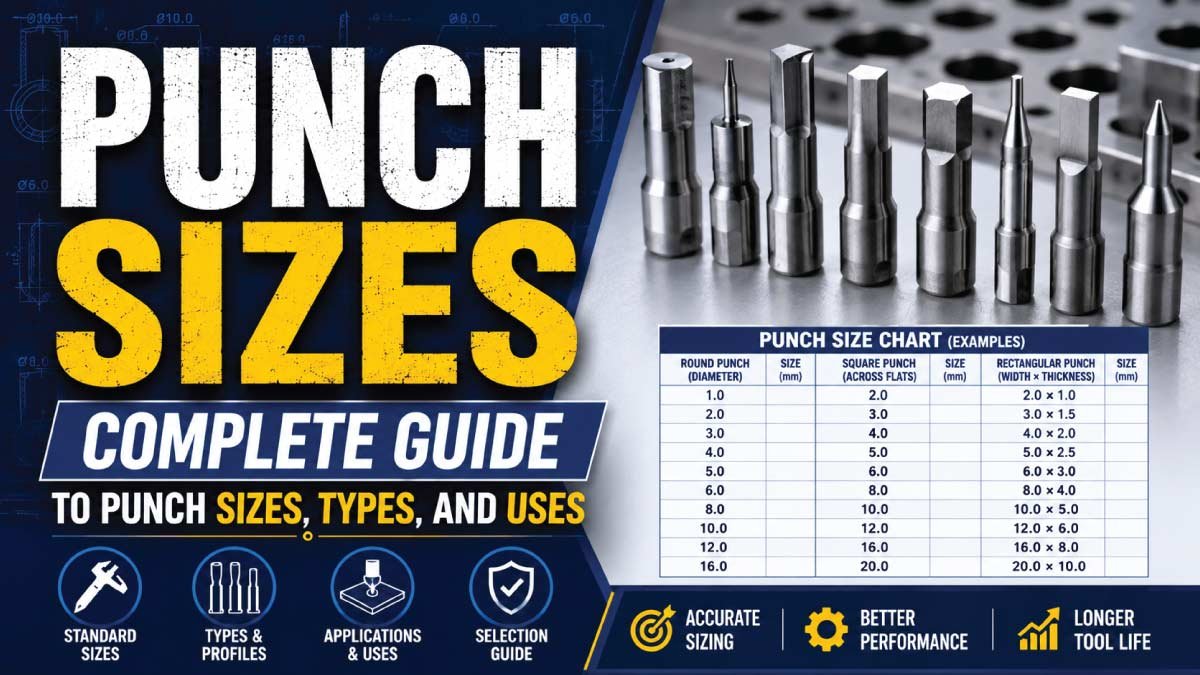
Punch tools are essential in metalworking, woodworking, automotive repair, construction, machining, and DIY projects. They are used for marking, aligning, removing pins, creating holes, and transferring force accurately. Choosing the correct punch size is important because using the wrong punch can damage materials, deform pins, or reduce work accuracy.
In this detailed guide, you will learn everything about punch sizes, common punch types, measurements, applications, and proper selection methods. You will also find a complete punch size chart that helps beginners and professionals choose the correct punch quickly and safely.
What Is a Punch Tool?
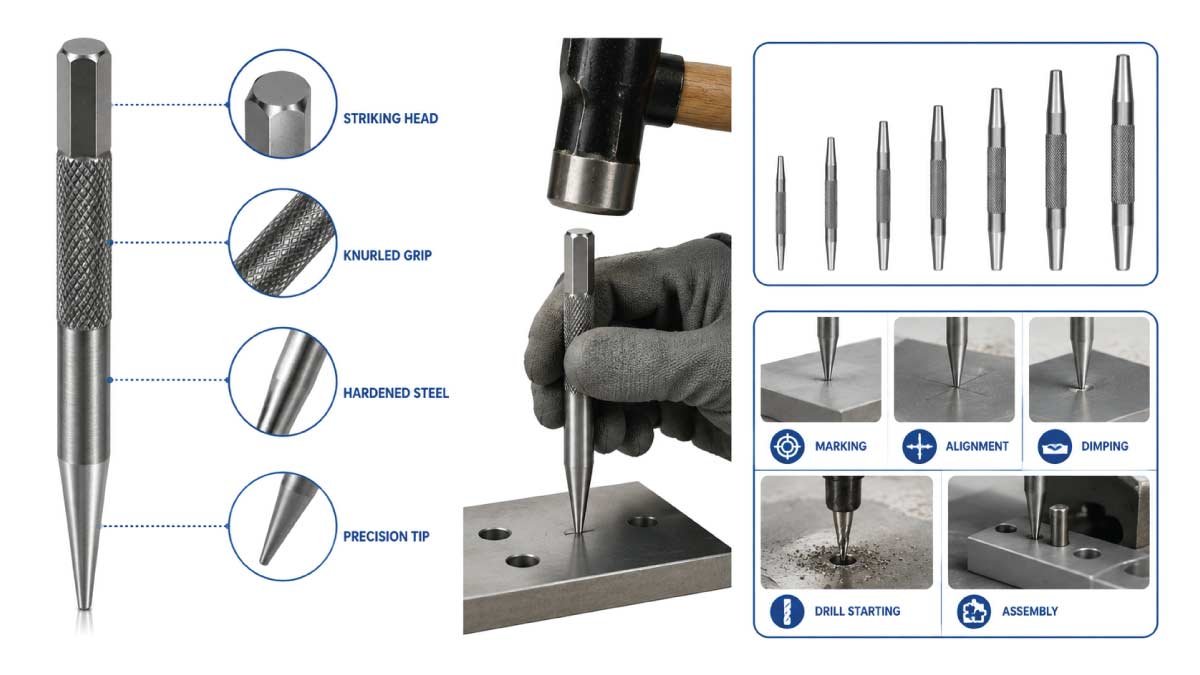
A punch is a hardened hand tool designed to apply controlled force through impact, usually by striking it with a hammer. It is used in metalworking, machining, and fabrication tasks where precision marking, alignment, or material displacement is required. Punch tools help improve accuracy and efficiency in drilling and assembly operations.
Punches are commonly used for several important tasks such as:
- Driving out pins
- Marking drilling locations
- Aligning holes
- Creating indentations
- Cutting shapes in metal or leather
Punch tools are typically manufactured from high-strength materials to withstand repeated hammer impacts without deformation. Common materials include hardened steel, tool steel, and alloy steel. These materials ensure durability, wear resistance, and long service life, especially in heavy industrial and workshop environments where consistent performance is essential.
Understand Punch Sizes
Punch size generally refers to the diameter of the punch tip or the working end that comes into direct contact with the material. This size is important because it determines how accurately the punch can mark, align, or drive out pins without damaging the surrounding surface. Proper sizing ensures precision and reduces the risk of material deformation.
Punch sizes are typically defined in either inch or metric measurements depending on the system used in manufacturing or workshop standards.
For example:
- A 1/8-inch punch has a tip diameter of 1/8 inch
- A 5 mm punch has a 5 mm tip diameter
Choosing the correct punch size is essential for safe and accurate work. It depends on several practical factors that affect performance and alignment in different applications.
Choosing the proper size depends on:
- Pin diameter
- Hole size
- Material thickness
- Application type
Punch Size Chart
Below is a standard punch size chart showing common punch diameters and typical uses.
| Punch Size | Metric Equivalent | Common Uses |
|---|---|---|
| 1/16 inch | 1.5 mm | Small pins, electronics |
| 3/32 inch | 2.5 mm | Roll pins, light repairs |
| 1/8 inch | 3 mm | General pin removal |
| 5/32 inch | 4 mm | Mechanical repairs |
| 3/16 inch | 5 mm | Automotive applications |
| 1/4 inch | 6 mm | Heavy-duty pins |
| 5/16 inch | 8 mm | Machinery maintenance |
| 3/8 inch | 10 mm | Industrial applications |
| 1/2 inch | 12 mm | Large pin removal |
This punch size chart covers the most commonly used punch sizes in workshops and industrial settings.
Punch Size Chart PDf
A Punch Size Chart PDF is a helpful reference guide for machinists, mechanics, and workshop professionals who need accurate punch measurements for different applications. It includes standard punch sizes, metric equivalents, and common uses to ensure precision in metalworking, engineering, and repair tasks. This easy-to-use PDF chart improves efficiency, reduces errors, and helps you select the right punch size quickly for any job.
- Punch_Size_Chart PDF
Types of Punch Tools
Different types of punch tools are designed for specific mechanical, industrial, and fabrication tasks. Each punch has a unique shape and function that helps improve accuracy, reduce damage, and make assembly or marking processes more efficient. Selecting the correct punch type ensures better results in metalworking, automotive repair, and manufacturing work.
1. Pin Punch
A pin punch is used to fully drive pins out of holes after they have been loosened using a starter punch. It provides controlled force to remove solid pins without damaging surrounding material or components. It is widely used in mechanical maintenance and assembly tasks where precision removal is required.
Features
- Flat tip
- Straight shaft
- Precise sizing
Common Uses
- Removing dowel pins
- Driving out solid pins
- Mechanical assembly work
Pin punches are among the most commonly used punch tools in workshops and repair environments.
2. Roll Pin Punch
Roll pin punches are specially designed for hollow spring pins, also known as roll pins. They have a small nipple on the tip that helps center the punch and prevents slipping during impact. This design reduces the risk of damaging delicate or hollow pins during removal or installation.
Features
- Small nipple on the tip
- Prevents slipping
- Protects roll pins from damage
Applications
- Automotive repairs
- Firearm maintenance
- Machinery assembly
Using a standard punch on roll pins may damage or deform the pin.
3. Center Punch
A center punch is used to create an indentation on a surface before drilling. This indentation helps guide the drill bit and prevents it from wandering, ensuring accurate hole placement. It is an essential tool in metalworking and layout marking tasks.
Features
- Sharp pointed tip
- Prevents drill bit wandering
Common Uses
- Metal drilling preparation
- Layout marking
- Precision machining
4. Transfer Punch
A transfer punch is used to accurately transfer hole positions from one material to another. It ensures perfect alignment during fabrication and assembly processes. This tool is especially useful when matching bolt holes or duplicating patterns in metalwork.
Applications
- Machining
- Fabrication
- Precision alignment
5. Drift Punch
A drift punch is designed to align holes before inserting bolts or pins. Its tapered body allows gradual adjustment of misaligned holes, making it easier to assemble structural components safely and accurately.
Features
- Tapered design
- Long body
Common Uses
- Structural steel work
- Automotive alignment
- Construction assembly
6. Prick Punch
A prick punch is used for making small, light marks during layout work. It is more precise than a center punch and is commonly used when detailed marking is required before final drilling or fabrication.
Applications
- Precision layout work
- Fine marking
- Metal fabrication
7. Hollow Punch
A hollow punch is designed to cut clean circular holes in soft materials. It removes material rather than displacing it, making it ideal for non-metal applications where smooth edges are required.
Used For
- Leather work
- Rubber gaskets
- Plastic sheets
- Fabric
8. Letter and Number Punches
Letter and number punches are used to permanently stamp characters into metal surfaces. They are commonly used for identification, labeling, and traceability in manufacturing and industrial settings.
Common in:
- Manufacturing
- Tool marking
- Identification labeling
Pin Punch Size Chart
Below is a quick reference chart for pin punch applications. This chart helps you select the correct punch size based on the pin diameter, ensuring safe removal without damaging the pin or surrounding material. Using the correct size improves accuracy and reduces the risk of slipping or deformation during mechanical work.
| Pin Diameter | Recommended Punch Size |
|---|---|
| 1/16″ pin | 1/16″ punch |
| 3/32″ pin | 3/32″ punch |
| 1/8″ pin | 1/8″ punch |
| 5/32″ pin | 5/32″ punch |
| 3/16″ pin | 3/16″ punch |
| 1/4″ pin | 1/4″ punch |
A punch should closely match the pin diameter without exceeding it.
Metric Punch Size Chart
Many industrial punch sets are also available in metric sizing, which is widely used in automotive, engineering, and manufacturing systems around the world. Metric punches offer standardized measurements for international compatibility and precision fitting.
| Metric Punch Size | Inch Equivalent |
|---|---|
| 1 mm | 0.039″ |
| 2 mm | 0.078″ |
| 3 mm | 0.118″ |
| 4 mm | 0.157″ |
| 5 mm | 0.196″ |
| 6 mm | 0.236″ |
| 8 mm | 0.315″ |
| 10 mm | 0.393″ |
Metric punches are common in international machinery and automotive systems.
Also Read:
Punch Materials
Punch durability and performance largely depend on the material used in their construction. Since punches are exposed to repeated hammer impacts and mechanical stress, the right material ensures long service life, accuracy, and resistance to wear or deformation. Different materials are selected based on application type and working conditions.
1. Hardened Steel Punches
Hardened steel punches are the most widely used type in workshops and general mechanical work. They offer a good balance of strength, durability, and cost-effectiveness, making them suitable for everyday use in maintenance and fabrication tasks.
Advantages:
- Strong
- Durable
- Affordable
They are suitable for general workshop use and routine mechanical operations.
2. Chrome Vanadium Steel Punches
Chrome vanadium steel punches provide enhanced strength and improved wear resistance compared to standard hardened steel. They are designed to withstand repeated impact without losing shape or sharpness, making them ideal for professional and industrial applications.
Common in:
- Professional-grade toolkits
- Heavy-duty mechanical work
- High-frequency usage environments
3. Alloy Steel Punches
Alloy steel punches are built for demanding industrial applications where high impact resistance and long-term durability are required. They perform well under tough working conditions and are commonly used in manufacturing and construction industries.
Applications:
- Heavy industrial work
- High-impact operations
- Engineering and fabrication environments
4. Brass Punches
Brass punches are softer than steel punches and are used when protecting the surface of the workpiece is important. They help prevent scratches, dents, and surface damage while also reducing the risk of sparking in sensitive environments.
Advantages:
- Prevent surface damage
- Reduce sparking risk
They are commonly used on delicate components and in applications where safety and surface protection are critical.
Also Read:
How to Choose the Correct Punch Size
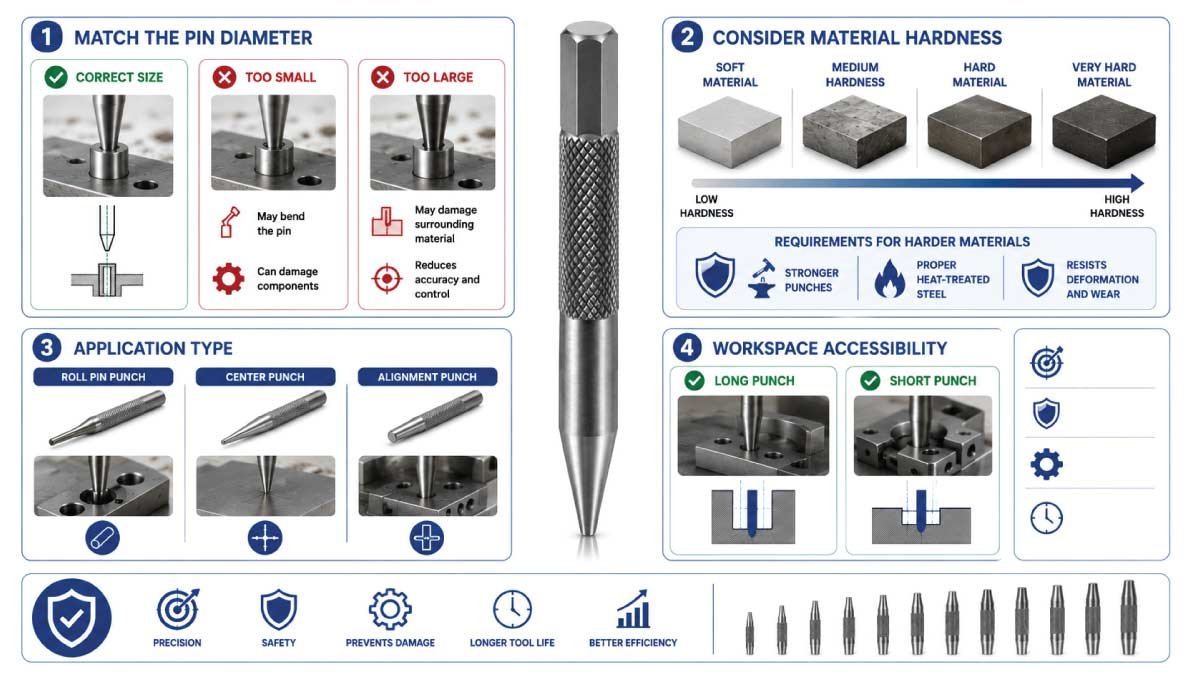
Selecting the correct punch size is extremely important for safe, accurate, and damage-free work. The right size ensures proper force transfer, prevents tool failure, and improves efficiency in mechanical, automotive, and fabrication tasks. A poor selection can damage both the punch and the workpiece.
1. Match the Pin Diameter
The punch tip should closely match the pin size to ensure controlled force application and proper alignment during removal or installation. A correct fit reduces slipping and improves precision.
Too small:
- May bend the pin
- Can damage components
Too large:
- May damage surrounding material
- Reduces accuracy and control
2. Consider Material Hardness
The hardness of the material being worked on directly affects punch selection. Harder materials require stronger and more durable punches to withstand repeated impact without deformation or wear.
Requirements for harder materials:
- Stronger punches
- Proper heat-treated steel
3. Application Type
Different tasks require different punch styles and designs. Choosing the correct type improves performance and prevents tool or component damage during use.
Example:
- Roll pin punch for spring pins
- Center punch for drilling
4. Workspace Accessibility
Working space also plays an important role in punch selection. Limited access areas require tools that match the space constraints for better control and safety.
- Long punches reach deep areas more easily
- Short punches provide better control in tight spaces
Using the correct punch size and type ensures precision, safety, and longer tool life in all mechanical applications.
Punch Length Chart
Punches also vary in length.
| Punch Size | Typical Length |
|---|---|
| 1/16″ | 4″ |
| 1/8″ | 5″ |
| 3/16″ | 6″ |
| 1/4″ | 7″ |
| 3/8″ | 8″ |
Longer punches are useful for deep holes and hard-to-reach areas.
Also Read:
Common Punch Applications
Punch tools are widely used across many industries because they provide accuracy, control, and efficiency in a variety of mechanical and crafting tasks. From heavy industrial work to fine detailing, punches help with alignment, removal, marking, and shaping operations.
1. Automotive Repair
In automotive work, punches are essential for removing and installing small pins and components without causing damage. They help mechanics work efficiently on assemblies that require precision and controlled force.
Punches help remove:
- Roll pins
- Brake pins
- Suspension pins
2. Metalworking
Punches play a key role in metal fabrication and machining processes. They are used to improve accuracy during drilling, assembly, and layout work by creating precise reference points and alignment marks.
Used for:
- Marking holes
- Aligning components
- Fabrication work
3. Woodworking
In woodworking, punches are used for making starter marks and ensuring proper alignment of joints and fasteners. This helps prevent material splitting and improves the accuracy of drilling and assembly tasks.
4. Firearm Maintenance
Roll pin punches are particularly important in firearm disassembly and repair. They allow safe removal of small, tightly fitted pins without damaging delicate firearm components or affecting performance.
5. Leather Crafting
Hollow punches are commonly used in leatherwork to create clean and uniform circular holes. They are ideal for belts, straps, and decorative leather products where precision and smooth edges are required.
6. Construction
In construction and structural steel work, drift punches are used to align bolt holes before final fastening. This ensures proper fitment of heavy steel components and helps maintain structural integrity during assembly.
How to Use a Punch Properly
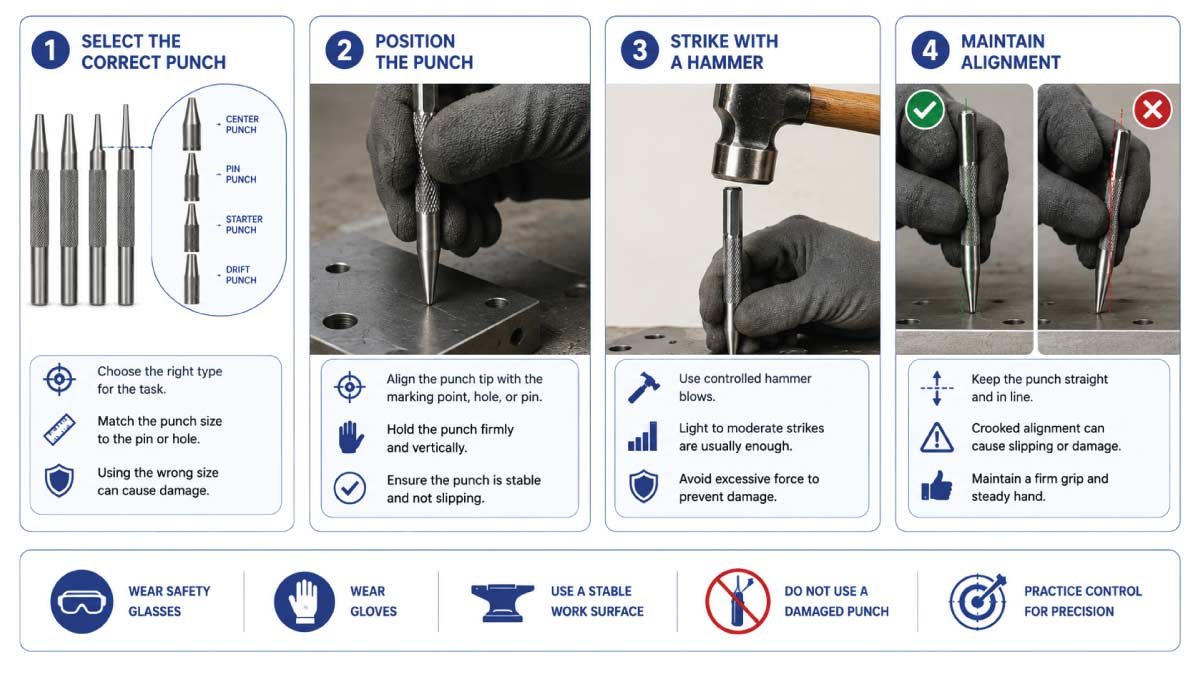
Using a punch correctly is important for achieving accurate marking, safe pin removal, and clean metalwork results. Proper technique also prevents tool damage and improves control during fabrication or repair tasks. Following the right steps ensures precision while reducing the risk of slipping, bending, or damaging the workpiece.
Step 1: Select the Correct Punch
Choosing the correct punch type and size is the first step for effective use. Different punches are designed for specific tasks such as marking, driving pins, or aligning holes. Using the wrong size can lead to inaccurate results or tool damage. Always match the punch to the job requirement carefully.
Step 2: Position the Punch
Proper positioning ensures accuracy before striking. Align the punch tip precisely with the marking point, hole, or pin location. A stable grip is important to prevent slipping during impact. Careful positioning helps maintain control and ensures that the force is applied exactly where it is needed for best results.
Step 3: Strike with a Hammer
Use controlled hammer blows to operate the punch effectively. Light to moderate strikes are usually enough for most tasks. Excessive force can damage the punch tip or deform the workpiece. Consistent and controlled hammering improves accuracy, reduces fatigue, and ensures safer operation during repeated or precision-based metalworking tasks.
Step 4: Maintain Alignment
Keeping the punch perfectly straight during use is essential for safety and accuracy. Crooked alignment can cause the punch to slip, bend, or damage the surface of the material. Always maintain a firm grip and steady hand position to ensure vertical impact and clean, controlled marking or pin driving results.
Punch Safety Tips
Using a punch safely is essential to prevent injuries and maintain tool efficiency. Since punches are used with impact force, even small mistakes can cause metal chips, tool breakage, or hand injuries. Following basic safety practices helps ensure controlled operation, longer tool life, and safer working conditions in metalwork.
1. Wear Eye Protection
Eye protection is extremely important when using punches. During impact, small metal fragments or chips can break off and become airborne. These particles can cause serious eye injuries if proper protection is not worn. Always use safety glasses or a face shield to ensure safe and controlled working conditions.
2. Inspect Punches Regularly
Regular inspection of punches helps prevent unexpected tool failure. Cracks, bends, or worn tips can reduce accuracy and increase the risk of breakage during use. Damaged punches should not be used, as they may chip under impact. Checking tools before each use ensures safety and improves overall work quality.
3. Avoid Mushroomed Heads
A mushroomed head occurs when repeated hammering deforms the top of the punch. This condition is dangerous because metal edges can chip off during impact. Such fragments may cause injuries or damage surrounding surfaces. To maintain safety, avoid using heavily deformed punches and address the issue as soon as it appears.
4. Grind Damaged Heads Smooth Before Reuse
If a punch head becomes slightly mushroomed, it can be restored by grinding it smooth. This process removes sharp edges and reduces the risk of metal splinters during impact. However, excessive damage means the punch should be replaced. Proper maintenance ensures safer use and extends the usable life of the tool.
5. Use Proper Hammers
Using the correct hammer is essential for safe and effective punch operation. A hammer that is too heavy or too light can reduce control and accuracy. Matching hammer size to the punch type ensures balanced force application. Proper tool pairing improves precision, reduces fatigue, and minimizes the risk of accidents during work.
Common Punch Problems
Punch tools are strong, but improper use or poor handling can lead to damage and reduced performance. These issues not only affect accuracy but also increase safety risks during operation. Understanding common punch problems helps users identify early warning signs and take corrective action before serious tool failure occurs.
1. Bent Punches
Bent punches are usually caused by side loading, incorrect alignment, or applying force at an angle instead of straight impact. This weakens the tool structure and reduces accuracy during use. A bent punch should not be used further, as it may slip during striking and cause damage or injury.
2. Chipped Tips
Chipped tips often occur when punches are used on excessively hardened materials or struck with improper force. This leads to small fragments breaking off from the tip, reducing precision. A damaged tip affects marking accuracy and can damage the work surface. Proper material selection and correct striking technique help prevent this issue.
3. Mushroomed Heads
Mushroomed heads develop when the top of the punch repeatedly absorbs hammer impacts over time. This causes the metal to spread outward and form a deformed edge. Such deformation is dangerous because small metal pieces can break off during use. Regular inspection and grinding help control this problem and improve safety.
4. Regular Maintenance Prevents Safety Hazards
Routine maintenance of punches plays a key role in preventing accidents and ensuring reliable performance. Checking for bends, chips, or mushrooming allows early detection of damage. Keeping tools in good condition reduces failure risk, improves accuracy, and ensures safer operation in both workshop and industrial environments.
Punch Maintenance Tips
Proper maintenance significantly extends the life of punch tools and ensures consistent performance. Simple care practices like cleaning, correct storage, light lubrication, and tip dressing help maintain tool quality. Regular maintenance also improves safety, reduces replacement costs, and ensures accurate results in repetitive or precision-based metalworking tasks.
1. Keep Punches Clean
Keeping punches clean after use is essential for maintaining performance. Dirt, oil, and metal debris can accumulate on the surface and affect accuracy over time. Wiping tools after each use prevents buildup and corrosion. Clean punches also provide better grip and reduce the risk of slipping during operation.
2. Store Properly
Proper storage protects punches from unnecessary damage and wear. Using tool organizers, racks, or protective pouches prevents them from knocking against other tools. This reduces the risk of bending, chipping, or dulling. Safe storage also helps maintain tool organization and ensures punches are always ready for accurate and safe use.
3. Lubricate When Necessary
Light lubrication helps protect punches from rust and corrosion, especially in humid environments. A thin layer of machine oil is usually enough to maintain surface protection. However, excess oil should be avoided as it may attract dust. Proper lubrication ensures smoother maintenance and extends the overall lifespan of the tool.
4. Sharpen or Dress Tips
Maintaining the correct tip shape is important for accurate marking and punching. Over time, tips may wear down or become dull, reducing precision. Sharpening or dressing the tip restores its original shape and improves performance. Properly maintained tips ensure clean, accurate results and reduce effort during repeated use.
Punch vs Chisel
Punches and chisels are different tools.
| Feature | Punch | Chisel |
|---|---|---|
| Main Purpose | Driving or marking | Cutting material |
| Tip Shape | Rounded or pointed | Sharp cutting edge |
| Common Use | Pins and holes | Metal or wood cutting |
Final Thoughts
Understanding punch sizes is essential for accurate and safe work in automotive repair, metalworking, woodworking, construction, and industrial maintenance. Using the correct punch size helps prevent damage to pins, tools, and surrounding materials.
A punch size chart makes it easier to select the proper punch for each task, whether removing roll pins, aligning holes, marking drill points, or cutting soft materials. Pin punches, roll pin punches, center punches, and drift punches each serve unique purposes and should be chosen carefully.
By using high-quality punches, following proper safety practices, and maintaining your tools regularly, you can achieve cleaner results and extend the life of both your punches and your equipment.

Engineer Hassan is a Mechanical Engineer with 16+ years of hands-on experience in mechanical hardware, fasteners, and workshop tools. He focuses on size selection, thread identification, and measurement, helping users choose the correct components with accuracy and safety.