
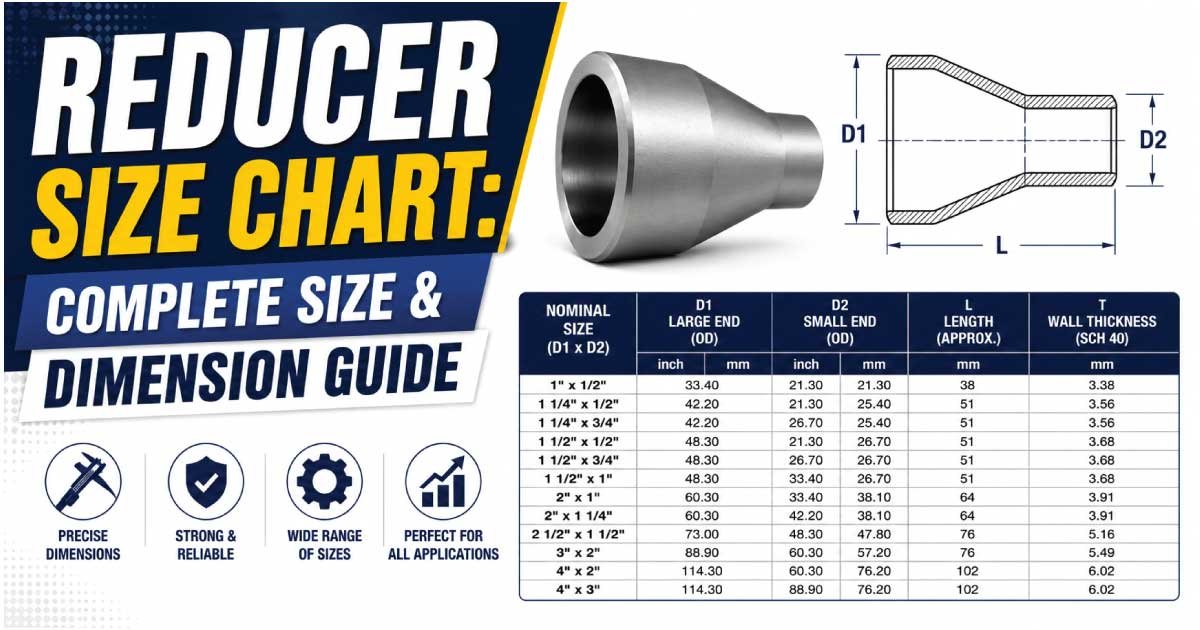
Pipe reducers are essential fittings used to connect two pipes of different diameters within a piping system. They help maintain smooth fluid flow, reduce turbulence, and allow gradual transitions between pipe sizes.
Reducers are widely used in plumbing, HVAC, oil and gas, chemical processing, water treatment, and industrial piping systems.
Selecting the correct reducer size ensures proper flow, minimizes pressure loss, and improves overall system efficiency. This complete guide explains reducer sizes, standard size charts, measurement methods, reducer types, materials, and selection tips.
What Is a Pipe Reducer?
A pipe reducer is a pipe fitting that joins two pipes with different diameters. It gradually changes the flow area, allowing fluid or gas to move smoothly between larger and smaller pipes. Reducers help maintain system performance while minimizing turbulence, pressure drop, and vibration. They are available in concentric and eccentric designs to meet different installation requirements.
Primary Functions
- Connects different pipe sizes
- Reduces flow turbulence
- Maintains smooth fluid flow
- Minimizes pressure loss
- Saves installation space
- Improves piping efficiency
Common Types of Pipe Reducers
Different piping systems require different reducer designs depending on pipe orientation, fluid characteristics, and installation requirements. Understanding reducer types helps ensure the correct choice for reliable system performance.
1. Concentric Reducer
A concentric reducer has a symmetrical cone shape with the centerlines of both pipe ends aligned. It is commonly used in vertical piping systems and applications where maintaining the centerline is important.
Advantages
- Smooth flow transition
- Reduced pressure loss
- Easy installation
- Symmetrical design
- Suitable for vertical pipelines
2. Eccentric Reducer
An eccentric reducer has one flat side, allowing the bottom or top of the pipe to remain level. It prevents air pockets in liquid systems and liquid accumulation in gas pipelines.
Benefits
- Prevents air entrapment
- Reduces cavitation
- Maintains pipe elevation
- Ideal for pump suction lines
- Improves flow efficiency
3. Socket Weld Reducer
Socket weld reducers are used in small-diameter, high-pressure piping systems. The pipe fits into a recessed socket before welding, creating a strong and reliable connection.
Applications
- Steam systems
- Hydraulic systems
- Chemical plants
- High-pressure pipelines
- Industrial processing
4. Threaded Reducer
Threaded reducers feature internal or external threads, allowing easy installation without welding. They are commonly used in residential plumbing and low-pressure piping systems.
ANSI Pipe Reducer Size Chart (NPS)
The following table lists common ANSI reducer sizes used in industrial piping systems.
| Large End (NPS) | Small End (NPS) | Typical Application |
|---|---|---|
| 1″ | 3/4″ | Residential plumbing |
| 1-1/4″ | 1″ | Water supply |
| 1-1/2″ | 1″ | HVAC systems |
| 2″ | 1-1/2″ | Industrial piping |
| 2″ | 1″ | Pump connections |
| 3″ | 2″ | Process piping |
| 4″ | 3″ | Manufacturing plants |
| 6″ | 4″ | Municipal pipelines |
| 8″ | 6″ | Water treatment |
| 10″ | 8″ | Oil and gas |
| 12″ | 10″ | Power generation |
| 16″ | 12″ | Large industrial systems |
Metric Reducer Size Chart (DN)
Metric reducers are widely used in ISO, DIN, and EN piping systems.
| Large End (DN) | Small End (DN) | Typical Applications |
|---|---|---|
| DN20 | DN15 | Domestic plumbing |
| DN25 | DN20 | Water supply |
| DN32 | DN25 | HVAC systems |
| DN40 | DN32 | Commercial piping |
| DN50 | DN40 | Industrial pipelines |
| DN65 | DN50 | Water treatment |
| DN80 | DN65 | Chemical plants |
| DN100 | DN80 | Manufacturing |
| DN150 | DN100 | Process industries |
| DN200 | DN150 | Oil and gas |
| DN250 | DN200 | Power plants |
| DN300 | DN250 | Municipal systems |
Understanding Reducer Dimensions
Understanding reducer dimensions is essential for selecting compatible fittings and maintaining proper flow characteristics. Accurate dimensions ensure smooth transitions, reduce turbulence, and improve the overall efficiency of the piping system.
1. Large End Diameter
The large end diameter matches the larger connecting pipe. This measurement determines the reducer’s inlet size and must correspond with the pipe’s nominal size according to the selected piping standard.
2. Small End Diameter
The small end diameter connects to the smaller pipe. Proper sizing ensures a secure connection while maintaining consistent flow through the piping system.
3. Reducer Length
Reducer length is the distance between the two ends of the fitting. A properly designed length provides a gradual transition that minimizes pressure loss and flow disturbance.
How to Measure a Pipe Reducer
Accurate measurements help identify the correct replacement reducer or specify the proper fitting for a new installation. Measuring both ends and the fitting length ensures compatibility.
Step 1: Measure the Large Pipe Diameter
Measure the outside diameter of the larger pipe using a digital caliper or measuring tape.
Measurement Tips
- Clean the pipe surface
- Measure multiple locations
- Record dimensions accurately
- Compare with NPS or DN charts
Step 2: Measure the Small Pipe Diameter
Measure the outside diameter of the smaller pipe and verify it against the reducer specification to ensure proper compatibility.
Step 3: Measure Overall Reducer Length
Measure the total length from one end of the reducer to the other. This dimension helps maintain proper pipe spacing during installation.
Common Pipe Reducer Materials
Reducer material selection depends on operating pressure, temperature, corrosion resistance, and the type of fluid flowing through the system. Selecting the correct material improves durability and long-term reliability.
Carbon Steel Reducers
Carbon steel reducers are widely used in industrial piping because they offer high strength, excellent weldability, and economical performance.
Advantages
- High mechanical strength
- Cost-effective
- Good weldability
- Suitable for high-pressure systems
- Long service life
Stainless Steel Reducers
Stainless steel reducers provide exceptional corrosion resistance and are commonly used in food processing, pharmaceutical manufacturing, marine applications, and chemical plants.
Benefits
- Excellent corrosion resistance
- Hygienic surface
- High-temperature capability
- Long service life
- Low maintenance
PVC Reducers
PVC reducers are lightweight, corrosion-resistant fittings commonly used in water supply, irrigation, drainage, and chemical handling systems where metal fittings are unnecessary.
📐 Explore Latest Size Guide 👉 Tap and Die Size Chart: Complete Threading Guide
Applications of Pipe Reducers
Pipe reducers are used across many industries to connect different pipe sizes while maintaining efficient flow and minimizing pressure losses.
Oil and Gas Industry
Reducers connect pipelines of varying diameters throughout refineries, offshore platforms, compressor stations, and processing facilities.
Common Applications
- Refineries
- Natural gas pipelines
- Offshore platforms
- Petrochemical plants
- Storage terminals
Water Supply and Treatment
Water treatment facilities use reducers to connect pumps, filters, valves, and pipelines of different sizes while maintaining efficient water distribution.
Typical Uses
- Water treatment plants
- Pump stations
- Irrigation systems
- Distribution pipelines
- Wastewater treatment facilities
How to Choose the Correct Reducer Size
Selecting the correct reducer size is essential for maintaining smooth fluid flow, reducing pressure loss, and ensuring compatibility between different pipe diameters. The reducer must match the larger and smaller pipe sizes, pressure rating, material, and application requirements. Proper selection improves system efficiency, minimizes turbulence, and extends the service life of the piping system.
Selection Checklist
- Measure the large pipe size
- Measure the small pipe size
- Verify the pressure rating
- Check the operating temperature
- Choose concentric or eccentric design
- Match the reducer material
- Verify wall thickness
- Follow piping standards
- Consider fluid characteristics
- Confirm installation orientation
Pipe Reducer Standards
Pipe reducers are manufactured according to international standards that ensure dimensional accuracy, compatibility, and safe operation. Selecting reducers built to recognized standards simplifies installation and replacement.
Common Industry Standards
The most widely used reducer standards include:
- ASME B16.9
- ASME B16.11
- MSS SP-75
- ASTM A234
- ASTM A403
- ASTM A420
- DIN Standards
- EN Standards
- JIS Standards
- ISO Standards
These standards define dimensions, materials, tolerances, pressure ratings, and manufacturing requirements for various reducer types.
Concentric vs. Eccentric Reducers
Choosing between a concentric and eccentric reducer depends on the piping layout and the type of fluid being transported.
Concentric Reducer
Concentric reducers maintain a common centerline between both pipe ends, making them suitable for vertical piping systems and applications where symmetrical flow is required.
Advantages
- Uniform flow transition
- Reduced turbulence
- Easy alignment
- Compact design
- Ideal for vertical installations
Eccentric Reducer
Eccentric reducers have one flat side that helps eliminate trapped air in liquid systems or prevents liquid accumulation in gas pipelines. They are commonly installed on horizontal pump suction lines.
📐 Explore Latest Size Guide 👉 Hose Clamp Size Chart: Best Guide for Every Project
Pipe Reducer Material Comparison
Choosing the proper reducer material improves corrosion resistance, mechanical strength, and service life while ensuring compatibility with the transported fluid.
| Material | Best Applications | Main Advantages |
|---|---|---|
| Carbon Steel | Industrial piping | High strength and economical |
| Stainless Steel | Chemical and food industries | Excellent corrosion resistance |
| Alloy Steel | High-temperature systems | Superior mechanical strength |
| PVC | Water supply | Lightweight and corrosion resistant |
| CPVC | Hot water systems | Higher temperature resistance |
| Duplex Stainless Steel | Offshore pipelines | Excellent corrosion and fatigue resistance |
Common Pipe Reducer Installation Mistakes
Improper installation can reduce system efficiency and increase maintenance requirements. Following correct installation procedures helps ensure reliable long-term performance.
Avoid these common mistakes:
- Choosing the wrong reducer size
- Installing the wrong reducer type
- Poor pipe alignment
- Incorrect welding procedures
- Using incompatible materials
- Ignoring pressure ratings
- Damaging sealing surfaces
- Improper gasket installation
- Failing to support heavy pipelines
- Skipping pressure testing
Pipe Reducer Maintenance Tips
Routine inspections help maintain reliable system performance and identify wear before serious failures occur. Preventive maintenance extends the service life of reducers and connected piping.
Maintenance recommendations include:
- Inspect for corrosion
- Check welded joints
- Verify pipe alignment
- Monitor system pressure
- Inspect for leakage
- Clean internal surfaces
- Replace damaged fittings
- Tighten flange connections
- Inspect coating condition
- Schedule routine inspections
Regular maintenance reduces downtime and helps maintain efficient flow throughout the piping system.
Advantages of Using the Correct Reducer Size
Properly sized reducers improve fluid flow while protecting pumps, valves, and other piping components from unnecessary stress and pressure fluctuations.
Major benefits include:
- Smooth flow transition
- Reduced pressure loss
- Improved energy efficiency
- Lower turbulence
- Reduced vibration
- Better pump performance
- Longer equipment life
- Easier installation
- Improved system reliability
- Lower maintenance costs
Signs a Pipe Reducer Needs Replacement
Reducers are exposed to pressure, corrosion, vibration, and temperature changes throughout their service life. Routine inspections help identify problems before they lead to leaks or system failures.
Common warning signs include:
- Visible corrosion
- Cracked fitting
- Wall thinning
- Leakage around joints
- Excessive vibration
- Internal erosion
- Deformed reducer body
- Damaged welds
- Pressure loss
- Frequent maintenance issues
Replacing damaged reducers promptly helps maintain safe and efficient piping system operation.
Applications of Pipe Reducers Across Industries
Pipe reducers are widely used wherever piping systems require a transition between different pipe diameters while maintaining smooth flow characteristics.
Chemical Processing Plants
Chemical facilities use corrosion-resistant reducers to connect process piping while safely transporting acids, solvents, and other aggressive chemicals.
Power Generation
Power plants install reducers in steam, cooling water, condensate, and boiler feed systems to accommodate changing pipe sizes throughout the facility.
Marine Industry
Marine piping systems use stainless steel and duplex reducers for seawater cooling systems, ballast pipelines, fuel lines, and hydraulic circuits where corrosion resistance is critical.
HVAC Systems
Heating, ventilation, and air conditioning systems use reducers to connect ducts, chilled water lines, hot water piping, and mechanical equipment with different connection sizes.
📐 Explore Latest Size Guide 👉 O-Ring Size Chart: Ultimate Guide to Standard Sizes
Frequently Asked Questions
1. How do I determine the correct reducer size?
Measure the outside diameter or nominal size of both connecting pipes and compare the measurements with standard reducer size charts. Ensure the reducer matches the required pressure rating, material, and applicable piping standard for your system.
2. What is the difference between a concentric and an eccentric reducer?
A concentric reducer has aligned centerlines and is mainly used in vertical piping systems. An eccentric reducer has one flat side and is commonly used in horizontal pipelines to prevent air pockets or liquid accumulation.
3. Can I use a reducer to increase pipe size?
Yes. A reducer can connect pipes of different diameters in either direction. Depending on the flow direction, it may function as a reducer or an expander, provided it is correctly selected for the application.
4. Which material is best for pipe reducers?
The best material depends on the application. Carbon steel is ideal for general industrial service, stainless steel offers superior corrosion resistance, PVC is suitable for water systems, and alloy steel performs well in high-temperature environments.
5. How long does a pipe reducer last?
A properly selected and installed pipe reducer can last 20 years or more. Its service life depends on operating pressure, temperature, fluid type, corrosion exposure, material quality, and routine maintenance.
Bottom Line
Choosing the correct reducer size is essential for maintaining efficient fluid flow, minimizing pressure loss, and ensuring reliable piping system performance.
By understanding reducer dimensions, types, materials, standards, and installation practices, engineers, contractors, and maintenance professionals can confidently select the appropriate fitting for any application.
Using accurate reducer size charts, following industry standards, and performing regular inspections significantly improves system reliability, extends equipment lifespan, reduces maintenance costs, and enhances operational efficiency in industries such as oil and gas, water treatment, chemical processing, manufacturing, HVAC, marine engineering, and power generation.

Engineer Hassan is a Mechanical Engineer with 16+ years of hands-on experience in mechanical hardware, fasteners, and workshop tools. He focuses on size selection, thread identification, and measurement, helping users choose the correct components with accuracy and safety.