
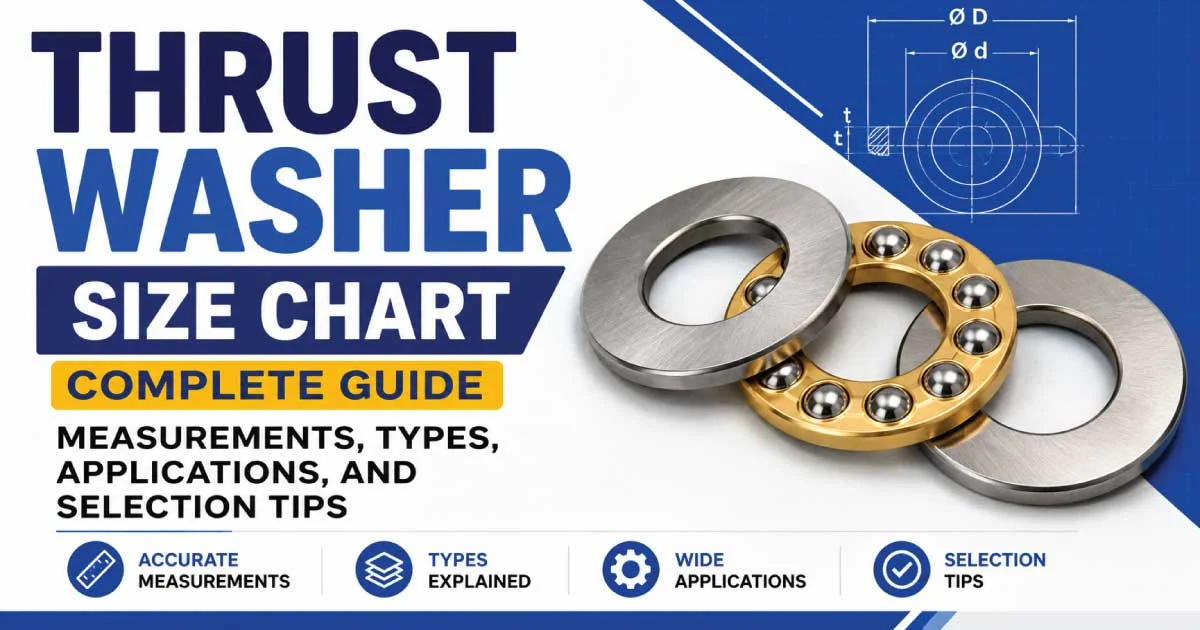
Thrust washer size charts provide essential measurements that help engineers, mechanics, and manufacturers select the correct washer for controlling axial loads. Understanding dimensions such as inner diameter, outer diameter, thickness, and material specifications ensures proper performance, reduced friction, and longer service life in mechanical assemblies.
Thrust washers are small but critical components used in many machines where rotating or sliding parts create axial movement. Choosing the wrong size can lead to excessive wear, overheating, noise, and equipment failure. A complete size guide makes identification easier and improves maintenance accuracy.
Understanding What a Thrust Washer Does in Mechanical Systems
A thrust washer is designed to support axial forces between rotating components and stationary surfaces. It creates a smooth bearing surface that reduces friction while preventing damage caused by direct metal-to-metal contact. These washers are commonly found in automotive systems, industrial machinery, engines, transmissions, and precision equipment.
The primary functions of thrust washers include:
- Managing axial movement between machine parts.
- Reducing friction during rotation or sliding.
- Protecting expensive components from premature wear.
- Maintaining proper spacing between mechanical elements.
- Improving overall machine efficiency and reliability.
Key Measurements Included in a Thrust Washer Size Chart
A thrust washer size chart typically includes several important dimensions that determine compatibility. These measurements help users compare existing washers or choose replacements for new applications. Accurate sizing is necessary because even small dimensional differences can affect load distribution, clearance, and mechanical performance.
The most common measurements include:
- Inner diameter (ID): The size of the center opening.
- Outer diameter (OD): The total outside measurement.
- Thickness: The distance between washer faces.
- Material type: Determines strength and durability.
- Load capacity: Indicates maximum supported force.
Thrust Washer Dimensions Explained for Easy Identification
Identifying a thrust washer requires understanding how each measurement affects the final application. The inner diameter must fit the shaft, while the outer diameter should properly contact the surrounding component. Thickness determines spacing and clearance, making it one of the most important specifications.
A basic dimensional reference may include:
- Small thrust washers: Used in lightweight mechanisms.
- Medium washers: Common in automotive and industrial equipment.
- Large washers: Designed for heavy-duty machinery applications.
- Custom washers: Manufactured for special engineering requirements.
Standard Thrust Washer Size Chart Reference Guide
A standard thrust washer chart helps users quickly compare common sizes used across industries. Although exact dimensions vary by manufacturer, many washers follow standard measurement ranges. Always verify manufacturer specifications before installation because different materials and designs may have unique tolerances.
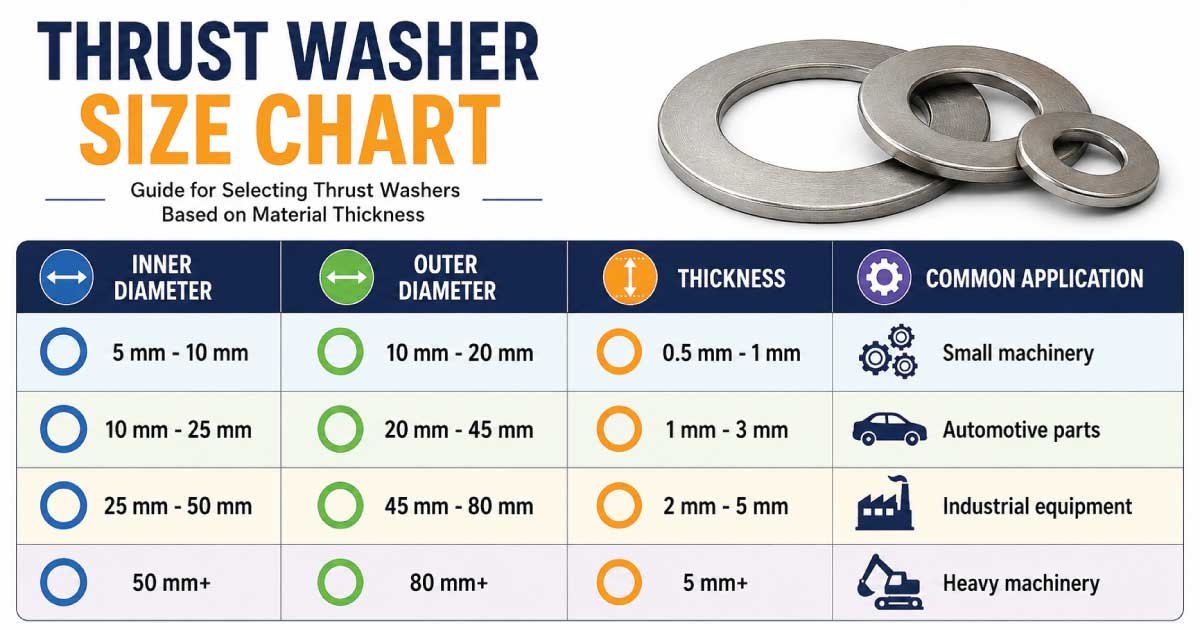
| Inner Diameter | Outer Diameter | Thickness | Common Application |
|---|---|---|---|
| 5 mm – 10 mm | 10 mm – 20 mm | 0.5 mm – 1 mm | Small machinery |
| 10 mm – 25 mm | 20 mm – 45 mm | 1 mm – 3 mm | Automotive parts |
| 25 mm – 50 mm | 45 mm – 80 mm | 2 mm – 5 mm | Industrial equipment |
| 50 mm+ | 80 mm+ | 5 mm+ | Heavy machinery |
Thrust Washer Size Chart PDF
The Thrust Washer Size Chart helps you quickly identify suitable washer dimensions based on inner diameter, outer diameter, and thickness. It also highlights common applications for each size range, making it easier to select the right thrust washer for automotive, industrial, and heavy machinery projects while improving performance and reducing wear.
How to Measure a Thrust Washer Correctly Before Replacement
Measuring a thrust washer accurately prevents incorrect replacement and installation problems. Use precision measuring tools such as digital calipers or micrometers to check dimensions. Measurements should be taken carefully because worn washers may have changed thickness or damaged edges that affect accuracy.
Follow these measurement steps:
- Measure the inner hole diameter across the center.
- Measure the outside edge-to-edge diameter.
- Check thickness at several points.
- Inspect for uneven wear or deformation.
- Compare measurements with manufacturer specifications.
Different Types of Thrust Washers and Their Size Variations
Thrust washers are available in multiple designs depending on operating conditions and load requirements. Each type has different size ranges, materials, and performance characteristics. Selecting the correct style ensures better durability and prevents failures caused by unsuitable load handling or excessive friction.
Common thrust washer types include:
- Flat thrust washers for general applications.
- Spherical thrust washers for alignment needs.
- Flanged thrust washers for additional stability.
- Metal thrust washers for high-load environments.
- Plastic thrust washers for low-friction applications.
Material Selection and Its Effect on Thrust Washer Performance
The material of a thrust washer directly influences strength, temperature resistance, friction level, and lifespan. Different machines require different materials depending on operating conditions. A correct size combined with the right material provides better efficiency and reduces maintenance requirements.
Popular thrust washer materials include:
- Steel for heavy-duty applications.
- Bronze for excellent wear resistance.
- Brass for moderate-load machinery.
- Nylon and plastic for lightweight systems.
- Composite materials for specialized environments.
Common Applications Where Thrust Washer Sizes Matter Most
Thrust washers are used in many industries where controlled movement and load management are required. Their dimensions must match the equipment design to maintain proper function. From small electronic devices to large industrial machines, correct sizing improves performance and prevents unnecessary mechanical stress.
Typical applications include:
- Vehicle transmissions and engines.
- Electric motors and pumps.
- Construction equipment.
- Agricultural machinery.
- Gear systems and rotating assemblies.
Factors to Consider When Choosing the Correct Thrust Washer Size
Selecting a thrust washer requires more than matching diameter measurements. Engineers must consider load requirements, speed, temperature, lubrication conditions, and operating environment. A properly selected washer provides smooth movement while protecting connected components from damage and reducing long-term repair costs.
Important selection factors include:
- Maximum axial load capacity.
- Shaft and housing dimensions.
- Operating temperature range.
- Required lubrication method.
- Expected service life.
Advanced Thrust Washer Size Selection Methods for Professional Applications
Selecting the correct thrust washer size for professional applications requires detailed analysis of mechanical requirements. Engineers must evaluate dimensions, operating conditions, load pressure, and component compatibility. Advanced selection methods help prevent failures, improve equipment efficiency, and ensure that the washer performs reliably under demanding industrial environments.
Professional sizing considerations include:
- Accurate shaft and housing measurements.
- Required axial load support.
- Operating speed and rotation conditions.
- Temperature and environmental factors.
- Manufacturer tolerance specifications.
How Load Capacity Affects Thrust Washer Size Requirements
Load capacity is one of the most important factors when selecting a thrust washer. A washer that is too small may experience excessive pressure, deformation, or early failure. Larger washers usually provide better load distribution, making them suitable for heavy-duty applications where constant axial forces are present.
The load capacity depends on:
- Washer surface area.
- Material strength.
- Thickness design.
- Lubrication conditions.
- Operating frequency and pressure.
Thrust Washer Size Chart Based on Industrial Load Applications
Industrial equipment often requires specific thrust washer dimensions based on operating conditions. Heavy machinery generally uses larger and thicker washers compared with small mechanical devices. The following reference chart provides general sizing guidance, but exact requirements should always follow equipment manufacturer recommendations.
| Application Type | Inner Diameter Range | Outer Diameter Range | Thickness Range |
|---|---|---|---|
| Small mechanical devices | 3 mm – 15 mm | 8 mm – 30 mm | 0.5 mm – 2 mm |
| Automotive systems | 10 mm – 60 mm | 25 mm – 100 mm | 1 mm – 5 mm |
| Industrial machines | 25 mm – 150 mm | 60 mm – 250 mm | 3 mm – 10 mm |
| Heavy equipment | 100 mm+ | 200 mm+ | 8 mm+ |
Also Read:
Difference Between Standard and Custom Thrust Washer Sizes
Standard thrust washers are manufactured according to commonly used dimensions and are easily available for replacement purposes. Custom thrust washers are produced when special applications require unique measurements, unusual materials, or specific performance characteristics that standard products cannot provide.
Custom designs may be required for:
- Unusual shaft dimensions.
- Extreme temperature environments.
- Specialized industrial machinery.
- Higher load requirements.
- Limited installation space.
Thrust Washer Installation Guidelines for Maximum Performance
Proper installation is essential for achieving maximum thrust washer performance. Incorrect placement, poor alignment, or contamination can reduce operating life. Before installation, all components should be inspected and cleaned to ensure smooth contact between surfaces.
Recommended installation steps include:
- Clean the shaft and surrounding components.
- Verify washer dimensions before fitting.
- Apply suitable lubrication if required.
- Install with correct orientation.
- Check movement and clearance after assembly.
Common Mistakes When Choosing Incorrect Thrust Washer Sizes
Many mechanical problems occur because the wrong thrust washer size is installed. Even a slightly incorrect measurement can create excessive clearance, increased friction, or uneven pressure distribution. Understanding common mistakes helps technicians avoid unnecessary repairs and equipment downtime.
Frequent selection mistakes include:
- Ignoring thickness requirements.
- Choosing washers based only on diameter.
- Using unsuitable materials.
- Replacing without checking wear patterns.
- Installing damaged or deformed washers.
Signs That a Thrust Washer Needs Replacement or Inspection
A worn or damaged thrust washer can affect the entire mechanical system. Recognizing early warning signs allows timely replacement and prevents expensive component damage. Regular inspection is especially important in machines operating under heavy loads, high speeds, or continuous working conditions.
Common warning signs include:
- Increased mechanical noise.
- Excessive shaft movement.
- Higher operating temperatures.
- Reduced equipment efficiency.
- Visible wear marks or cracks.
Thrust Washer Maintenance Tips to Extend Service Life
Proper maintenance increases thrust washer durability and improves machine reliability. Although these components are designed for long-term use, regular inspection and correct lubrication help reduce wear. Preventive maintenance programs are especially valuable in industrial environments where unexpected failures can cause major production losses.
Maintenance recommendations include:
- Inspect washers during scheduled servicing.
- Maintain proper lubrication levels.
- Monitor operating temperatures.
- Replace worn components quickly.
- Keep surrounding parts clean.
Also Read:
Comparing Metal, Bronze, and Plastic Thrust Washer Sizes
Different materials offer unique advantages depending on the application. Metal washers usually handle higher loads, while bronze provides excellent wear resistance. Plastic washers are often selected for lightweight applications where low friction and corrosion resistance are more important than extreme strength.
Material comparisons:
- Steel: High strength and suitable for heavy loads.
- Bronze: Excellent durability and reduced friction.
- Brass: Good performance for moderate applications.
- Nylon: Lightweight and corrosion-resistant.
- Composite materials: Designed for specialized requirements.
How Temperature and Environment Influence Washer Selection
Operating environments can significantly affect thrust washer performance. Extreme heat, moisture, chemicals, and contamination may reduce the lifespan of unsuitable materials. Selecting the correct size and material combination ensures stable performance even in challenging working conditions.
Environmental factors to evaluate include:
- Temperature limits.
- Exposure to chemicals.
- Presence of moisture.
- Dust and contamination levels.
- Required corrosion resistance.
Also Read:
Final Thought:
A thrust washer size chart is an essential reference for selecting the correct component for various mechanical applications. Understanding key measurements, material options, load requirements, and installation procedures helps ensure reliable performance and efficient operation.
Choosing the right thrust washer improves machine efficiency, reduces friction, and protects valuable equipment from unnecessary wear and damage. Before making a selection, always confirm exact dimensions, evaluate operating conditions, choose suitable materials, follow manufacturer recommendations, and inspect components regularly.
With accurate sizing and proper maintenance, thrust washers can deliver long-lasting performance in automotive, industrial, and mechanical systems. A careful selection process helps reduce maintenance costs, improve equipment reliability, and ensure smoother operation over time.

Engineer Hassan is a Mechanical Engineer with 16+ years of hands-on experience in mechanical hardware, fasteners, and workshop tools. He focuses on size selection, thread identification, and measurement, helping users choose the correct components with accuracy and safety.