
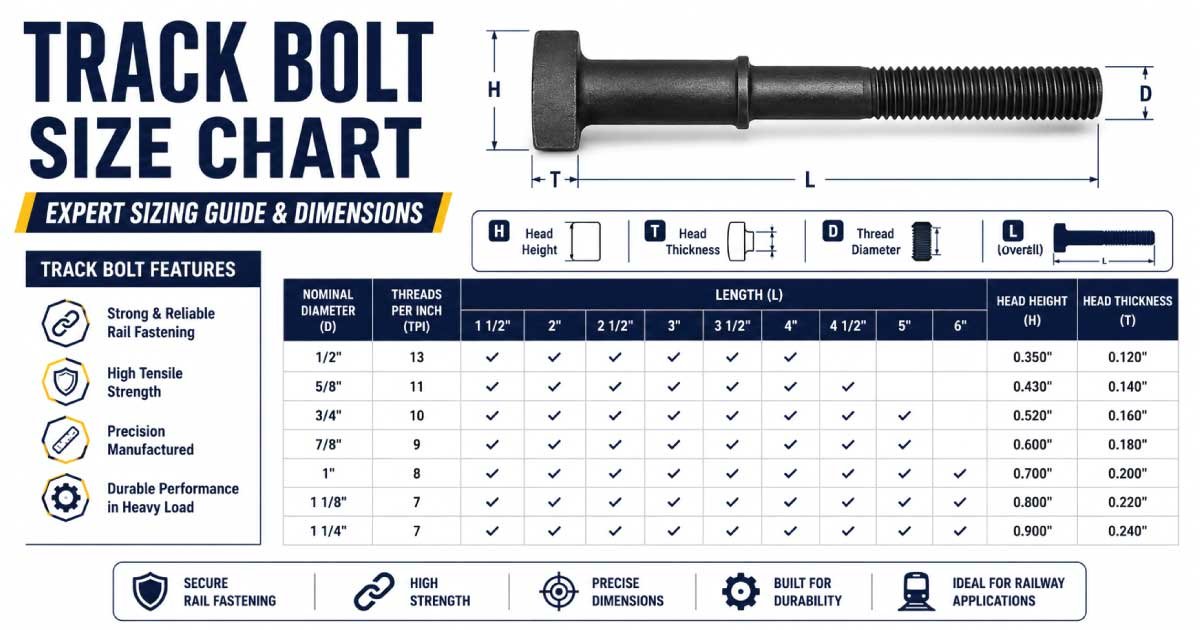
Track bolts are specialized heavy-duty fasteners used to secure rail tracks, crane rails, and railway components to sleepers, base plates, and supporting structures.
They are engineered to withstand extreme loads, continuous vibration, impact forces, and harsh environmental conditions. Selecting the correct track bolt size ensures rail stability, improves operational safety, and extends the service life of railway infrastructure.
This guide explains standard track bolt sizes, dimensions, grades, materials, and common applications.
What Is a Track Bolt?
A track bolt is a high-strength fastening bolt specifically designed for railway and rail-mounted systems. It typically features a large head, precision threads, and is used with matching nuts and washers to secure rail components. Track bolts provide reliable clamping force that helps maintain rail alignment under repeated heavy loads.
Key features include:
- High-strength construction
- Precision-machined threads
- Excellent vibration resistance
- Available in metric and imperial sizes
- Corrosion-resistant finishes
- Designed for heavy-duty rail systems
Why Track Bolt Size Matters
Selecting the proper track bolt size is essential for maintaining rail integrity and preventing loosening under dynamic loads. An incorrectly sized bolt can reduce clamping force, increase maintenance requirements, and compromise track safety.
Benefits of proper sizing include:
- Secure rail fastening
- Improved structural stability
- Reduced maintenance
- Better vibration resistance
- Longer service life
- Enhanced operational safety
Track Bolt Size Chart (Metric)
The following table shows common metric track bolt sizes used in railway and industrial rail applications.
| Bolt Size | Thread Pitch | Common Length Range | Typical Applications |
|---|---|---|---|
| M16 | 2.0 mm | 50–120 mm | Light rail systems |
| M20 | 2.5 mm | 60–150 mm | Industrial rail |
| M22 | 2.5 mm | 70–180 mm | Rail joints |
| M24 | 3.0 mm | 80–200 mm | Main railway tracks |
| M27 | 3.0 mm | 90–220 mm | Heavy freight rail |
| M30 | 3.5 mm | 100–250 mm | Crane rails |
| M36 | 4.0 mm | 120–300 mm | Mining rail systems |
Track Bolt Size Chart (Imperial)
Imperial-sized track bolts are commonly used in older railway systems and certain industrial applications.
| Bolt Diameter | Thread | Common Length Range | Typical Applications |
|---|---|---|---|
| 5/8″ | UNC | 2″–5″ | Light-duty rail |
| 3/4″ | UNC | 2-1/2″–6″ | Rail joints |
| 7/8″ | UNC | 3″–7″ | Freight tracks |
| 1″ | UNC | 3″–8″ | Heavy railway |
| 1-1/8″ | UNC | 4″–9″ | Crane rails |
| 1-1/4″ | UNC | 4″–10″ | Mining operations |
Main Parts of a Track Bolt
Understanding the components of a track bolt helps ensure proper installation and long-term fastening reliability in railway systems.
1. Bolt Head
The bolt head provides the surface for tightening and transmits the clamping force to the rail assembly. Depending on the design, it may be hexagonal, oval, or specially shaped to fit railway fastening systems.
2. Threaded Shank
The threaded shank engages with the matching nut to create a secure clamping force. Thread length varies according to bolt size and application, ensuring adequate engagement for heavy-duty railway installations.
3. Nut and Washer
Track bolts are typically installed with high-strength nuts and hardened washers. These components distribute the clamping force evenly, reduce loosening caused by vibration, and help protect the rail fastening assembly.
Common Track Bolt Grades
Track bolts are manufactured in different strength grades to meet the demands of railway infrastructure, industrial rail systems, and heavy machinery.
Grade 8.8 Track Bolts
Grade 8.8 track bolts are widely used in general railway construction because they provide excellent tensile strength and durability. They are suitable for moderate to heavy loading conditions and offer reliable long-term performance.
Advantages include:
- High tensile strength
- Good fatigue resistance
- Cost-effective
- Suitable for standard rail systems
Grade 10.9 Track Bolts
Grade 10.9 track bolts are heat-treated alloy steel fasteners designed for demanding applications. They are commonly used in heavy freight railways, crane rails, and mining operations where maximum strength is essential.
Benefits include:
- Superior strength
- Excellent wear resistance
- High load capacity
- Long service life
Grade 12.9 Track Bolts
Grade 12.9 track bolts are among the strongest fasteners available for specialized industrial and railway applications. Their exceptional tensile strength makes them ideal for extreme loading environments and critical structural connections.
Common Track Bolt Materials
Material selection affects the bolt’s mechanical strength, corrosion resistance, and service life. Choosing the correct material ensures reliable performance under varying environmental and operational conditions.
1. Carbon Steel
Carbon steel is the most commonly used material for track bolts because it offers excellent strength, affordability, and durability. Heat treatment further improves hardness and fatigue resistance for demanding railway applications.
2. Alloy Steel
Alloy steel track bolts provide enhanced strength and impact resistance compared to standard carbon steel. They are preferred for high-speed railways, heavy freight systems, and industrial crane tracks.
3. Stainless Steel
Stainless steel track bolts are selected for environments where corrosion resistance is a priority, such as coastal railways, marine terminals, and chemical processing facilities. Although less common, they provide excellent long-term durability.
Common Applications of Track Bolts
Track bolts are essential fasteners used wherever rails or rail-mounted equipment require secure attachment under heavy loads and continuous vibration.
Major applications include:
- Railway tracks
- High-speed rail systems
- Freight railways
- Metro rail networks
- Crane rails
- Mining rail systems
- Industrial rail tracks
- Port container terminals
- Steel mills
- Rail maintenance equipment
How to Choose the Correct Track Bolt Size
Selecting the correct track bolt size is essential for maintaining rail alignment, preventing loosening, and ensuring long-term structural stability. The bolt should match the rail section, base plate, hole diameter, and load requirements while complying with railway engineering standards and manufacturer specifications.
1. Measure the Bolt Diameter
The bolt diameter must match the mounting hole in the rail fastening system. A properly sized bolt provides maximum clamping force while minimizing movement caused by vibration and repeated loading.
Check the following:
- Bolt diameter
- Hole diameter
- Rail section
- Base plate dimensions
- Manufacturer specifications
2. Select the Correct Bolt Length
Bolt length should allow sufficient thread engagement after passing through the rail, base plate, washer, and nut. Choosing the proper length ensures secure fastening without excessive thread projection.
Consider:
- Rail thickness
- Base plate thickness
- Washer thickness
- Nut height
- Thread engagement
3. Choose the Appropriate Strength Grade
The required bolt grade depends on axle loads, train speed, vibration levels, and environmental conditions. Higher-grade bolts provide greater tensile strength and fatigue resistance for demanding railway applications.
Common grades include:
- Grade 8.8
- Grade 10.9
- Grade 12.9
- ASTM A325
- ASTM A490
4. Consider the Operating Environment
Environmental conditions significantly affect bolt performance. Corrosive environments may require protective coatings or stainless steel bolts to maximize service life and reduce maintenance.
Typical environments include:
- Railway tracks
- Coastal railways
- Mining operations
- Industrial facilities
- Ports
- Chemical plants
📘 Explore Complete Size Guide 👉 Bolt Size Chart: Complete Guide to Standard Bolt Sizes
Track Bolt Thread Size Chart
The following table lists common metric thread specifications used for railway and industrial track bolts.
| Bolt Size | Thread Pitch | Thread Type |
|---|---|---|
| M16 | 2.0 mm | Coarse |
| M20 | 2.5 mm | Coarse |
| M22 | 2.5 mm | Coarse |
| M24 | 3.0 mm | Coarse |
| M27 | 3.0 mm | Coarse |
| M30 | 3.5 mm | Coarse |
| M36 | 4.0 mm | Coarse |
Recommended Tightening Torque Chart
Applying the correct tightening torque ensures proper clamping force while preventing bolt damage or loosening during service. Always follow the railway manufacturer’s specifications whenever available.
| Bolt Size | Grade 8.8 (Approx.) | Grade 10.9 (Approx.) |
|---|---|---|
| M16 | 150 Nm | 210 Nm |
| M20 | 300 Nm | 420 Nm |
| M22 | 410 Nm | 560 Nm |
| M24 | 520 Nm | 730 Nm |
| M27 | 770 Nm | 1,070 Nm |
| M30 | 1,040 Nm | 1,450 Nm |
Track Bolt Material Comparison
Different materials offer varying levels of strength and corrosion resistance. Selecting the appropriate material improves durability and reduces maintenance requirements.
| Material | Strength | Corrosion Resistance | Typical Applications |
|---|---|---|---|
| Carbon Steel | High | Moderate | Standard railway tracks |
| Alloy Steel | Very High | Moderate | Heavy freight and crane rails |
| Stainless Steel | High | Excellent | Coastal and corrosive environments |
Advantages of Track Bolts
Track bolts are specifically engineered to maintain secure rail connections under continuous heavy loading, vibration, and environmental exposure. Their robust construction provides dependable long-term performance.
Advantages include:
- High tensile strength
- Excellent fatigue resistance
- Reliable vibration resistance
- Long service life
- Secure clamping force
- Available in multiple grades
- Suitable for heavy loads
- Easy replacement during maintenance
Limitations of Track Bolts
Although highly reliable, track bolts require proper installation and routine inspection to maintain safe railway operation. Incorrect selection or maintenance can reduce fastening performance.
Common limitations include:
- Require precise torque
- Higher cost than standard bolts
- Regular inspection required
- Specialized replacement hardware
- Corrosion protection may be necessary
📘 Explore Complete Size Guide 👉 Eye Bolt Size Chart: Types, Uses and Complete Guide
How to Install a Track Bolt
Proper installation is essential for maintaining railway safety and preventing fastener loosening during operation.
Basic Installation Steps
- Clean the bolt hole and mating surfaces.
- Insert the track bolt through the rail assembly.
- Install the hardened washer.
- Thread the matching nut onto the bolt.
- Tighten by hand initially.
- Apply the specified torque using a calibrated torque wrench.
- Inspect alignment and recheck torque after installation.
Maintenance Tips for Track Bolts
Routine maintenance helps identify loose fasteners, corrosion, and wear before they affect railway safety. Scheduled inspections extend service life and minimize unexpected failures.
Maintenance recommendations:
- Inspect bolts regularly.
- Check tightening torque.
- Replace damaged bolts.
- Monitor corrosion.
- Inspect washers and nuts.
- Clean accumulated debris.
- Follow scheduled maintenance intervals.
Common Installation Mistakes
Improper installation can compromise rail stability and reduce the lifespan of the fastening system. Careful attention to specifications helps prevent failures.
Avoid these mistakes:
- Using incorrect bolt sizes
- Selecting the wrong grade
- Applying improper torque
- Reusing damaged fasteners
- Ignoring corrosion
- Misaligning rail components
- Omitting washers
- Skipping post-installation inspections
Track Bolt vs Hex Bolt
Although both are threaded fasteners, track bolts are specifically designed for railway applications and heavy-duty fastening systems.
| Feature | Track Bolt | Hex Bolt |
|---|---|---|
| Primary Use | Railway fastening | General fastening |
| Strength | Very High | High |
| Vibration Resistance | Excellent | Moderate |
| Heavy Rail Applications | Yes | Limited |
| Specialized Design | Yes | No |
| Maintenance Frequency | Scheduled inspections | General maintenance |
Final Thoughts
Track bolts play a critical role in maintaining the strength, stability, and safety of railway and industrial rail systems.
Choosing the correct bolt size, grade, material, and tightening torque ensures secure fastening, minimizes maintenance, and extends the service life of rail infrastructure.
Whether used in freight railways, high-speed networks, crane rails, or mining operations, properly selected and installed track bolts provide dependable performance under the most demanding operating conditions.
📘 Explore Complete Size Guide 👉 Rivet Size Chart: Types, Uses and Complete Guide
FAQs:
What is a track bolt used for?
Track bolts are specially designed fasteners used in railway construction and maintenance. They secure rails, fish plates, base plates, crane rails, and other track components together. Their primary purpose is to provide strong clamping force, maintain proper rail alignment, and withstand heavy train loads, constant vibration, and harsh outdoor operating conditions.
What grades are commonly available for track bolts?
Track bolts are commonly available in Grade 8.8, Grade 10.9, and Grade 12.9, as well as ASTM structural grades for specialized railway applications. Higher-grade bolts offer greater tensile strength and durability. The correct grade depends on rail design, expected loads, environmental conditions, maintenance requirements, and applicable industry standards for safety.
Why is tightening torque important for track bolts?
Proper tightening torque ensures the correct clamping force between railway components, preventing bolts from loosening under vibration and repeated train traffic. Under-tightened bolts may shift or fail, while over-tightened bolts can stretch or break. Following manufacturer torque specifications improves safety, reliability, service life, and reduces maintenance costs over time.
What materials are used to manufacture track bolts?
Track bolts are typically manufactured from carbon steel, alloy steel, or stainless steel to meet different performance requirements. Carbon steel provides strength and affordability, alloy steel offers higher durability for heavy-duty applications, and stainless steel delivers excellent corrosion resistance in harsh environments, coastal areas, and moisture-prone railway installations.
How do I choose the correct track bolt size?
Choose the correct track bolt size by considering the rail system specifications, bolt hole diameter, required grip length, thread type, strength grade, and applicable industry standards. Always follow the railway manufacturer’s recommendations to ensure proper fit, maximum clamping force, safe operation, long service life, and dependable track performance.

Engineer Hassan is a Mechanical Engineer with 16+ years of hands-on experience in mechanical hardware, fasteners, and workshop tools. He focuses on size selection, thread identification, and measurement, helping users choose the correct components with accuracy and safety.