
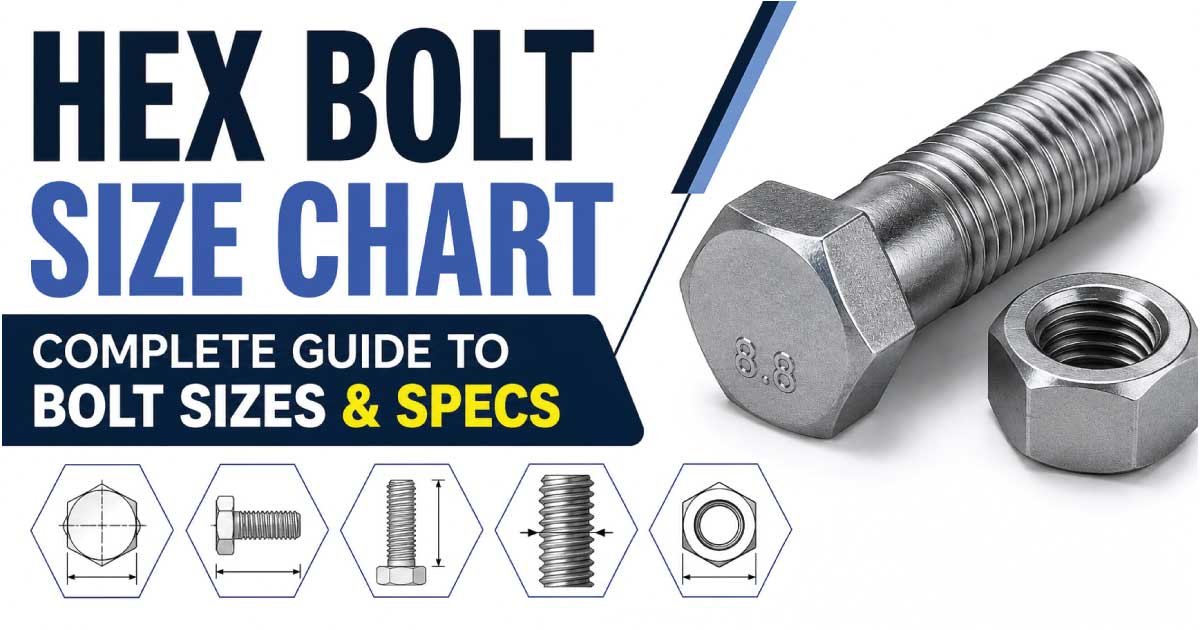
Hex bolts are one of the most commonly used fasteners in mechanical, automotive, construction, manufacturing, maintenance, and industrial applications. Their six-sided heads make them easy to tighten with a wrench or socket, while their threaded shafts provide strong and reliable connections.
Choosing the correct hex bolt size involves more than simply measuring the diameter. You also need to consider the bolt length, thread pitch, thread type, head dimensions, wrench size, material, and strength grade.
This complete hex bolt size chart and guide explains how to identify metric and imperial hex bolts, understand bolt dimensions, measure an existing fastener, select the correct wrench or socket, and distinguish between common bolt standards.
Whether you are replacing a missing fastener, working on machinery, selecting hardware for a fabrication project, or comparing metric and SAE bolts, this guide provides the essential information needed to choose the right hex bolt.
What Is a Hex Bolt?
A hex bolt is a threaded fastener with a six-sided head that can be tightened or removed using a wrench or socket. The hexagonal head provides multiple flat surfaces for applying torque, making hex bolts suitable for applications where a secure mechanical connection is required.
Hex bolts are manufactured in many diameters and lengths. They are also available with different thread pitches, materials, coatings, and strength grades.
Common applications include:
- Automotive repairs and assemblies
- Industrial machinery
- Construction equipment
- Agricultural machinery
- Steel fabrication
- Mechanical equipment
- Manufacturing machinery
- Maintenance and repair
- General hardware assemblies
- Brackets, frames, and supports
A standard hex bolt should not automatically be considered interchangeable with a heavy hex bolt, flange bolt, structural bolt, or socket head cap screw because these fasteners can have different dimensions and performance requirements.
Understanding Hex Bolt Dimensions
Before using a hex bolt size chart, it is important to understand what the different dimensions mean.
A bolt is normally identified by several measurements rather than one number. The most important dimensions include the nominal diameter, length, thread pitch, head width, and thread type.
1. Nominal Bolt Diameter
The nominal diameter describes the approximate outside diameter of the threaded portion.
For example:
- M6 = approximately 6 mm diameter
- M8 = approximately 8 mm diameter
- M10 = approximately 10 mm diameter
- M12 = approximately 12 mm diameter
- 1/2 inch = 0.500 inch diameter
- 3/4 inch = 0.750 inch diameter
The nominal diameter must match the mating nut or threaded hole.
2. Bolt Length
Bolt length is generally measured from the underside of the head to the end of the bolt.
For example, an M10 × 60 mm hex bolt has a nominal diameter of 10 mm and a length of 60 mm.
The correct length depends on the thickness of the materials being joined, washer thickness, nut thickness, and required thread engagement.
3. Thread Pitch
Metric bolts use thread pitch, which is the distance between adjacent thread peaks measured in millimeters.
For example:
M10 × 1.5
means:
- 10 mm nominal diameter
- 1.5 mm thread pitch
Imperial bolts use threads per inch, or TPI, instead.
4. Across-Flats Measurement
Across flats, often abbreviated as AF, is the distance between two opposite flat surfaces of the hexagonal bolt head.
This measurement determines the wrench or socket size.
For example, a typical M10 hex bolt has a 17 mm across-flats head, meaning a 17 mm wrench or socket is commonly used.
5. Head Height
Head height is the thickness of the hexagonal head. It can vary depending on the bolt type and applicable standard.
This dimension becomes important when the available space above the bolt is restricted.
Metric Hex Bolt Size Chart
Metric hex bolts are identified using the letter M, followed by their nominal diameter in millimeters.
For example, M8 means an 8 mm nominal diameter metric bolt.
The following chart provides common metric hex bolt sizes, standard coarse thread pitches, and typical wrench sizes.
| Metric Bolt Size | Nominal Diameter | Coarse Thread Pitch | Typical Wrench Size |
|---|---|---|---|
| M3 | 3 mm | 0.5 mm | 5.5 mm |
| M4 | 4 mm | 0.7 mm | 7 mm |
| M5 | 5 mm | 0.8 mm | 8 mm |
| M6 | 6 mm | 1.0 mm | 10 mm |
| M8 | 8 mm | 1.25 mm | 13 mm |
| M10 | 10 mm | 1.5 mm | 17 mm |
| M12 | 12 mm | 1.75 mm | 19 mm |
| M14 | 14 mm | 2.0 mm | 22 mm |
| M16 | 16 mm | 2.0 mm | 24 mm |
| M18 | 18 mm | 2.5 mm | 27 mm |
| M20 | 20 mm | 2.5 mm | 30 mm |
| M22 | 22 mm | 2.5 mm | 34 mm |
| M24 | 24 mm | 3.0 mm | 36 mm |
| M27 | 27 mm | 3.0 mm | 41 mm |
| M30 | 30 mm | 3.5 mm | 46 mm |
| M33 | 33 mm | 3.5 mm | 50 mm |
| M36 | 36 mm | 4.0 mm | 55 mm |
These are common reference dimensions for standard metric hex bolts. Exact head dimensions can vary according to the applicable product standard, bolt type, and manufacturer.
How to Read a Metric Hex Bolt Size
Metric bolt markings are relatively easy to understand once you know what each number represents.
Consider the example:
M12 × 1.75 × 60 mm
It means:
- M = metric thread
- 12 = 12 mm nominal diameter
- 1.75 = 1.75 mm thread pitch
- 60 mm = bolt length
Another common example is:
M10 × 50 mm
This identifies a 10 mm diameter bolt that is 50 mm long. If no pitch is specified, the bolt may use the standard coarse pitch for that diameter, depending on the product specification.
Imperial Hex Bolt Size Chart
Imperial or SAE hex bolts are measured in inches. Their thread specification is generally expressed using threads per inch.
For example, 1/2-13 means a 1/2-inch nominal diameter with 13 threads per inch.
| Imperial Bolt Size | Decimal Diameter | UNC TPI | Typical Wrench Size |
|---|---|---|---|
| 1/4-20 | 0.250 in | 20 | 7/16 in |
| 5/16-18 | 0.313 in | 18 | 1/2 in |
| 3/8-16 | 0.375 in | 16 | 9/16 in |
| 7/16-14 | 0.438 in | 14 | 5/8 in |
| 1/2-13 | 0.500 in | 13 | 3/4 in |
| 9/16-12 | 0.563 in | 12 | 7/8 in |
| 5/8-11 | 0.625 in | 11 | 15/16 in |
| 3/4-10 | 0.750 in | 10 | 1-1/8 in |
| 7/8-9 | 0.875 in | 9 | 1-5/16 in |
| 1-8 | 1.000 in | 8 | 1-1/2 in |
| 1-1/8-7 | 1.125 in | 7 | 1-11/16 in |
| 1-1/4-7 | 1.250 in | 7 | 1-7/8 in |
| 1-3/8-6 | 1.375 in | 6 | 2-1/16 in |
| 1-1/2-6 | 1.500 in | 6 | 2-1/4 in |
UNC stands for Unified National Coarse, while UNF stands for Unified National Fine.
The exact dimensions of an imperial hex bolt can vary according to the applicable standard and bolt type, so this chart should be used as a general identification reference rather than a substitute for a dimensional standard.
Discover More: Bolt Size Chart: Complete Guide to Standard Bolt Sizes
Metric vs SAE Hex Bolt Sizes
Metric and SAE bolts use different measurement systems and thread specifications.
Metric fasteners are identified using millimeters, while SAE or imperial fasteners are normally identified using inches.
| Feature | Metric Hex Bolt | SAE / Imperial Hex Bolt |
|---|---|---|
| Diameter | Millimeters | Inches |
| Thread measurement | Pitch in mm | Threads per inch |
| Example | M10 × 1.5 | 3/8-16 |
| Wrench size | Usually mm | Usually inches |
| Common thread types | Metric coarse/fine | UNC/UNF |
| Length | Millimeters | Inches |
Metric and SAE bolts that look similar are not necessarily interchangeable.
For example, an M10 bolt and a 3/8-inch bolt have relatively similar diameters, but their thread dimensions are different. Trying to force one into the wrong nut or threaded hole can damage the threads and create an unsafe connection.
Coarse Thread vs Fine Thread Hex Bolts
Thread pitch is one of the most important factors when selecting a replacement hex bolt.
Coarse Thread Hex Bolts
Coarse threads have a larger distance between adjacent threads.
They are commonly selected for general-purpose fastening because they are relatively easy to install and are more tolerant of minor contamination or thread damage.
Typical metric coarse-thread examples include:
- M6 × 1.0
- M8 × 1.25
- M10 × 1.5
- M12 × 1.75
- M16 × 2.0
- M20 × 2.5
Fine Thread Hex Bolts
Fine-thread bolts have a smaller pitch and more threads per unit of length.
Fine threads can be useful where greater adjustment precision, increased thread engagement, or specific engineering requirements are needed.
However, fine and coarse threads cannot be substituted for each other unless the mating component is designed for that particular thread.
Common Hex Bolt Sizes and Their Uses
Some bolt sizes are encountered much more frequently than others.
M6 Hex Bolt
M6 bolts have a nominal diameter of 6 mm and commonly use a 1.0 mm coarse thread pitch.
A typical standard M6 hex bolt has a 10 mm wrench size.
M6 fasteners are often used for:
- Equipment covers
- Small brackets
- Machine guards
- Panels
- Light mechanical assemblies
- Automotive components
M8 Hex Bolt
M8 bolts have an 8 mm nominal diameter and commonly use a 1.25 mm coarse pitch.
The typical wrench size is 13 mm.
They are widely used for brackets, machinery, frames, automotive components, and general fabrication.
M10 Hex Bolt
M10 bolts have a nominal diameter of 10 mm and commonly use a 1.5 mm coarse thread pitch.
A typical wrench size is 17 mm.
M10 bolts are widely used in mechanical equipment, automotive assemblies, machinery frames, mounting brackets, and industrial applications.
M12 Hex Bolt
M12 bolts have a 12 mm nominal diameter and commonly use a 1.75 mm coarse pitch.
A typical standard wrench size is 19 mm.
M12 bolts are frequently used for heavier mechanical assemblies, equipment frames, vehicle components, machinery, and industrial applications.
M16 Hex Bolt
M16 bolts have a nominal diameter of 16 mm and commonly use a 2.0 mm coarse pitch.
A typical wrench size is 24 mm.
They are commonly used in heavy machinery, equipment frames, large brackets, industrial assemblies, and structural-related applications where the appropriate specification calls for them.
How to Measure a Hex Bolt
If you have an unidentified hex bolt, you can determine most of its important dimensions with a ruler, caliper, and thread pitch gauge.
Step 1: Measure the Bolt Diameter
Measure the outside diameter of the threaded shaft.
A caliper provides the most accurate measurement.
If the measurement is approximately 10 mm, it may be an M10 bolt. If it is close to 0.500 inch, it may be a 1/2-inch bolt.
Do not identify the thread solely by diameter because different thread standards can have similar nominal diameters.
Step 2: Measure the Bolt Length
Place the measuring tool at the underside of the head and measure to the end of the bolt.
For most conventional hex bolts, the head is not included in the specified bolt length.
Step 3: Measure the Thread Pitch
For metric bolts, use a thread pitch gauge or measure the distance between thread peaks.
For imperial bolts, determine the number of threads per inch.
Step 4: Measure the Head
Measure across two opposite flat surfaces of the hexagonal head.
This gives you the across-flats dimension, which helps determine the correct wrench or socket.
Step 5: Check Bolt Markings
Look at the top of the bolt head for markings.
These markings may indicate:
- Manufacturer
- Strength grade
- Product classification
- Applicable fastener system
The markings are particularly useful when identifying high-strength fasteners.
Hex Bolt Wrench and Socket Sizes
The correct wrench or socket must match the bolt head across-flats dimension.
Common metric combinations include:
| Hex Bolt | Typical Wrench / Socket |
|---|---|
| M5 | 8 mm |
| M6 | 10 mm |
| M8 | 13 mm |
| M10 | 17 mm |
| M12 | 19 mm |
| M14 | 22 mm |
| M16 | 24 mm |
| M18 | 27 mm |
| M20 | 30 mm |
| M22 | 34 mm |
| M24 | 36 mm |
| M30 | 46 mm |
Always verify the actual head dimension when working with specialized bolts because different standards can use different head sizes.
Discover More: Hammer Size Chart: Complete Guide to Hammer Types and Sizes
Hex Bolt Grades and Strength Classes
Bolt diameter does not tell you how strong a fastener is.
Metric bolts are commonly marked with property classes such as:
- 8.8
- 10.9
- 12.9
Imperial fasteners can use grades such as:
- Grade 2
- Grade 5
- Grade 8
Higher-strength fasteners are designed for applications requiring specific mechanical properties, but choosing the highest available grade is not automatically the correct engineering decision.
The bolt, nut, washer, joint design, tightening method, operating environment, and applicable specification should all be considered.
For structural applications, specialized structural fasteners may be required instead of ordinary general-purpose hex bolts.
How to Choose the Correct Hex Bolt
Selecting the correct hex bolt requires matching several specifications.
Check the Diameter
The diameter must be compatible with the threaded hole or nut.
Check the Thread Pitch
The thread pitch must match the mating thread exactly.
Check the Length
Select enough length to provide the required thread engagement while avoiding unnecessary protrusion or interference.
Check the Head Size
Make sure there is enough clearance for the required wrench or socket.
Check the Strength Grade
Select a bolt with the required mechanical properties for the application.
Check the Material
Common choices include carbon steel, alloy steel, and stainless steel.
Material selection should consider load, corrosion, temperature, and environmental conditions.
Check the Finish
Zinc plating and other protective finishes may improve corrosion resistance, while stainless steel can be suitable for certain corrosive environments.
Hex Bolt Clearance Hole Size
A clearance hole allows the bolt shaft to pass through a component without engaging its threads.
The hole is normally larger than the nominal bolt diameter.
For example, an M10 bolt requires a clearance hole larger than 10 mm.
The exact hole diameter depends on the required fit and application. A loose clearance hole may be appropriate for general assembly, while a close or precision fit may require a more tightly controlled dimension.
For structural, precision, or engineering applications, use the appropriate hole-size standard rather than relying on a general rule.
Hex Bolt vs Heavy Hex Bolt
A standard hex bolt and a heavy hex bolt have similar general shapes, but their head dimensions and intended applications can differ.
Heavy hex bolts typically have a larger head than standard hex bolts of the same nominal diameter.
Heavy hex structural bolts are commonly used in structural steel connections where a specific standard and strength classification are required.
Therefore, replacing a heavy hex structural bolt with an ordinary hex bolt simply because the thread diameter matches may not provide an equivalent connection.
Hex Bolt vs Hex Cap Screw
Hex bolts and hex cap screws both have six-sided heads, but they can differ in product specifications, dimensional requirements, and intended applications.
A hex bolt is commonly used with a nut or threaded assembly, while a hex cap screw may be manufactured to tighter dimensional requirements for applications where the screw is installed into a tapped hole or used with a nut.
Because terminology varies between suppliers and industries, the applicable fastener standard is more reliable than the product name alone.
Common Hex Bolt Problems
Incorrect bolt selection can cause several problems during assembly.
Cross-Threading
Cross-threading occurs when the bolt and mating thread do not start correctly. This can permanently damage the threads.
Wrong Thread Pitch
A metric fine-thread bolt cannot properly replace a metric coarse-thread bolt unless the mating component is also designed for the fine thread.
Incorrect Length
A bolt that is too short may provide insufficient thread engagement, while an excessively long bolt may interfere with other components.
Incorrect Strength Grade
Using a bolt with inadequate strength can result in deformation or failure under load.
Wrong Wrench Size
Using an incorrectly sized wrench or socket can damage the hex head and make future removal difficult.
Hex Bolt Size Chart Quick Reference
For quick identification, the following common metric sizes are useful to remember:
| Bolt Size | Coarse Pitch | Typical Wrench |
|---|---|---|
| M6 | 1.0 mm | 10 mm |
| M8 | 1.25 mm | 13 mm |
| M10 | 1.5 mm | 17 mm |
| M12 | 1.75 mm | 19 mm |
| M14 | 2.0 mm | 22 mm |
| M16 | 2.0 mm | 24 mm |
| M18 | 2.5 mm | 27 mm |
| M20 | 2.5 mm | 30 mm |
| M22 | 2.5 mm | 34 mm |
| M24 | 3.0 mm | 36 mm |
| M27 | 3.0 mm | 41 mm |
| M30 | 3.5 mm | 46 mm |
This quick-reference table is useful for general identification, but exact dimensions should be verified against the applicable bolt specification when precision is important.
Discover More: Pipe Wrench Size Chart: Types, Uses and Complete Guide
Frequently Asked Questions About Hex Bolt Sizes
What is the most common hex bolt size?
There is no single universal hex bolt size used in every industry. However, M6, M8, M10, M12, and M16 are extremely common metric sizes. In general mechanical and maintenance applications, M8, M10, and M12 are frequently encountered.
What size wrench fits an M10 hex bolt?
A typical standard M10 hex bolt uses a 17 mm wrench or socket. However, specialized bolt standards may use different head dimensions. If you are replacing an existing fastener, measuring the actual head is the safest way to select the correct wrench.
What does M12 mean on a bolt?
M12 means the bolt has a nominal metric thread diameter of approximately 12 mm. A standard coarse M12 bolt commonly has a 1.75 mm thread pitch. The bolt length is specified separately, such as M12 × 60 mm.
What does 1/2-13 mean on a bolt?
1/2-13 means the bolt has a nominal diameter of 1/2 inch and 13 threads per inch. This is a common Unified National Coarse thread configuration. The bolt length is added separately, such as 1/2-13 × 2 inches.
Are metric and SAE hex bolts interchangeable?
No. Metric and SAE bolts use different diameter and thread measurement systems. Some sizes may look similar, but their thread pitch can be different. Using the wrong bolt can damage the mating threads and result in an unreliable connection.
How is hex bolt length measured?
For a standard hex bolt, length is generally measured from the underside of the bolt head to the end of the threaded shaft. The head height is normally excluded from the stated bolt length.
How do I know what size hex bolt I have?
Measure the bolt’s diameter, length, thread pitch, and head across flats. Then compare these measurements with a metric or imperial hex bolt size chart. Checking markings on the head can also help identify the bolt’s strength grade or manufacturer.
What is the difference between M10 and 3/8-inch bolts?
M10 has a nominal diameter of 10 mm, while 3/8 inch has a nominal diameter of 9.525 mm. Although their diameters are relatively close, their thread specifications can differ. They should not be considered interchangeable without verifying the exact thread and mating component.
Final Thoughts
A hex bolt size chart is an excellent reference for identifying common fastener sizes, selecting wrench and socket sizes, and understanding metric and imperial bolt dimensions. However, selecting the correct hex bolt requires more than matching its diameter.
Always consider the bolt diameter, length, thread pitch, thread type, head dimensions, material, strength grade, and applicable standard before choosing a fastener.
Metric hex bolts are identified using millimeters and thread pitch, while imperial bolts use inches and threads per inch. Common metric sizes such as M6, M8, M10, M12, M16, M20, and M24 cover many general mechanical applications.
For ordinary maintenance and fabrication work, a reliable bolt size chart can make fastener identification much easier. For structural, pressure, safety-critical, or heavily loaded applications, however, the relevant engineering standard and manufacturer’s specifications should always take priority.
Understanding hex bolt dimensions also helps prevent common problems such as cross-threading, incorrect wrench selection, insufficient thread engagement, and using a bolt with an unsuitable strength grade.
By learning how to measure hex bolt diameter, length, thread pitch, head size, and grade, you can identify replacement fasteners more accurately and select the correct bolt for your application.

Engineer Hassan is a Mechanical Engineer with 16+ years of hands-on experience in mechanical hardware, fasteners, and workshop tools. He focuses on size selection, thread identification, and measurement, helping users choose the correct components with accuracy and safety.