
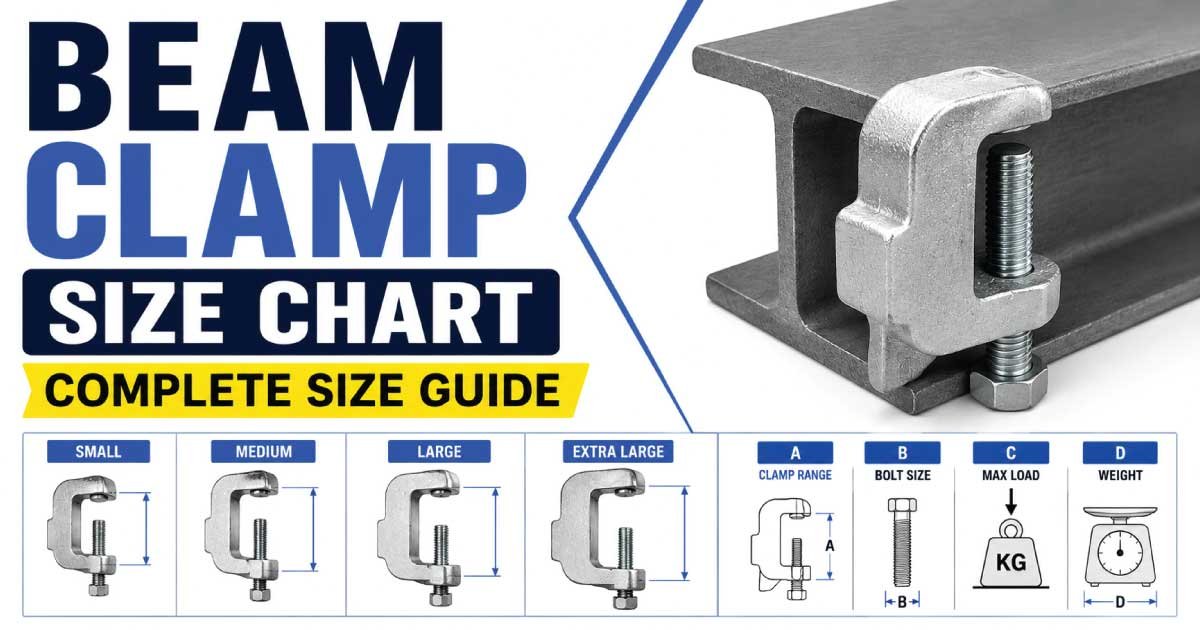
A beam clamp is a mechanical fastening device used to attach pipes, conduit, cable trays, threaded rods, equipment, and other components to structural steel beams without drilling or welding. Beam clamps are widely used in construction, plumbing, HVAC, electrical installations, industrial facilities, and mechanical support systems.
Selecting the correct beam clamp size requires attention to more than the beam thickness. The clamp must match the beam flange dimensions, threaded-rod or bolt size, required load capacity, installation method, and application environment.
This complete beam clamp size chart and guide explains common sizes, dimensions, types, load considerations, materials, installation methods, and how to choose the right beam clamp.
What Is a Beam Clamp?
A beam clamp is a fastening component designed to connect equipment or support hardware to a structural beam.
Instead of drilling holes through the beam, a beam clamp grips the beam flange mechanically.
This provides a convenient attachment point for:
- Threaded rods
- Pipe hangers
- Electrical conduit
- Cable trays
- HVAC equipment
- Sprinkler piping
- Lighting fixtures
- Mechanical supports
- Suspended ceilings
- Industrial equipment
Beam clamps are especially useful when modifying a structural steel member by drilling or welding is undesirable or prohibited.
How Does a Beam Clamp Work?
A typical beam clamp grips the edge or flange of a structural beam.
The clamp body is positioned over the beam flange and tightened using a bolt, screw, or other fastening mechanism. A threaded hole or attachment point provides a connection for the supported component.
A typical installation may look like:
Structural Beam → Beam Clamp → Threaded Rod → Pipe Hanger → Pipe
The clamp transfers the load from the supported component into the structural beam.
The exact load path depends on the clamp design, beam geometry, fastener arrangement, and installation orientation.
Beam Clamp Size Chart
Beam clamps are manufactured in many sizes and designs. The following chart provides a general reference for common beam flange and attachment sizes.
| Beam Clamp Size | Typical Beam Flange Range | Common Thread Size | Typical Application |
|---|---|---|---|
| Small | Up to about 1/4 in | 1/4 in | Light-duty supports |
| Small | Up to about 3/8 in | 3/8 in | Conduit and small tubing |
| Medium | Up to about 1/2 in | 3/8 in | Pipe and electrical supports |
| Medium | Up to about 5/8 in | 1/2 in | HVAC and piping |
| Medium | Up to about 3/4 in | 1/2 in | Mechanical supports |
| Large | Up to about 1 in | 5/8 in | Heavy-duty supports |
| Large | Up to about 1-1/4 in | 5/8 in | Industrial applications |
| Heavy Duty | Up to about 1-1/2 in | 3/4 in | Large pipe and equipment |
| Heavy Duty | Up to about 2 in | 3/4 in | Industrial structures |
Important: These are general size ranges, not universal dimensions. Actual beam clamp capacity and flange range vary significantly by manufacturer and clamp design. Always use the manufacturer’s dimensional and load-rating data for a specific clamp.
Metric Beam Clamp Size Chart
Metric beam clamps may be specified according to the supported threaded rod, bolt, or attachment size.
| Thread Size | Approx. Thread Diameter | Typical Application |
|---|---|---|
| M6 | 6 mm | Light-duty supports |
| M8 | 8 mm | Small conduit and cable |
| M10 | 10 mm | Pipe and equipment support |
| M12 | 12 mm | HVAC and mechanical systems |
| M16 | 16 mm | Heavy-duty supports |
| M20 | 20 mm | Industrial applications |
| M24 | 24 mm | Large structural supports |
The beam flange thickness range must also be checked because a clamp with an M12 thread may be available in several different beam-gripping configurations.
What Does Beam Clamp Size Mean?
The term beam clamp size can refer to several different measurements depending on the manufacturer.
It may identify:
- Thread size
- Bolt diameter
- Beam flange thickness
- Beam flange width
- Clamp opening
- Load capacity
- Clamp series
For example, a beam clamp listed as 1/2-inch may refer to its threaded attachment point rather than the thickness of the beam flange.
This is why it is important to read the manufacturer’s complete specification instead of selecting a clamp based on one dimension.
Important Beam Clamp Dimensions
Several dimensions should be checked before choosing a beam clamp.
Beam Flange Thickness
The flange thickness is the thickness of the structural steel flange where the clamp will attach.
The clamp must be designed to accommodate this thickness.
Beam Flange Width
Some clamps have limitations on how far the clamp can reach over the beam flange.
Check the manufacturer’s maximum flange width or applicable beam geometry.
Thread Size
The threaded connection determines which threaded rod, bolt, or fitting can be attached.
Common sizes include:
- 1/4 inch
- 3/8 inch
- 1/2 inch
- 5/8 inch
- 3/4 inch
- M6
- M8
- M10
- M12
- M16
Clamp Opening
The clamp opening determines whether the clamp can be positioned correctly over the beam flange.
Overall Height
The height of the clamp affects clearance between the structural beam and supported equipment.
How to Measure a Beam for a Beam Clamp
Correct measurement is essential.
Step 1: Identify the Beam Type
Determine whether the structural member is:
- I-beam
- H-beam
- Wide-flange beam
- Channel
- Angle
- Other structural steel
Not every beam clamp is suitable for every structural profile.
Step 2: Measure Flange Thickness
Use a caliper or suitable measuring tool to determine the flange thickness.
Step 3: Measure Flange Width
Measure the width of the beam flange where the clamp will be installed.
Step 4: Determine the Required Attachment
Identify whether you need:
- Threaded rod
- Bolt
- Screw
- Eye
- Hook
- Other attachment
Step 5: Determine the Load
Calculate the approximate supported load, including the weight of the pipe, equipment, fittings, insulation, and contents where applicable.
Discover More:
Beam Clamp Types
Beam clamps are available in several designs for different applications.
Standard Beam Clamp
A standard beam clamp grips a structural beam and provides a threaded connection for support hardware.
These clamps are commonly used for:
- Pipes
- Conduit
- Threaded rods
- HVAC systems
Adjustable Beam Clamp
Adjustable designs allow the clamp opening or attachment position to accommodate different beam configurations.
They are useful when beam dimensions vary.
Swivel Beam Clamp
A swivel or rotating beam clamp can provide additional flexibility in the orientation of the attached rod or support.
These are useful where alignment is important.
Universal Beam Clamp
Universal designs are intended to accommodate a range of beam flange configurations.
However, the actual permissible beam dimensions must always be checked.
Heavy-Duty Beam Clamp
Heavy-duty beam clamps are designed for larger loads and structural support applications.
They may have:
- Larger bodies
- Larger fasteners
- Higher-strength materials
- Higher rated capacities
Beam Clamp for Threaded Rod
One of the most common uses of a beam clamp is supporting threaded rod.
The arrangement may be:
Beam → Beam Clamp → Threaded Rod → Support Hardware
Threaded rod can then be used to suspend:
- Pipe
- Cable tray
- HVAC components
- Conduit
- Equipment
- Lighting
- Mechanical systems
The beam clamp thread and threaded rod must be compatible.
Beam Clamp for Pipe Support
Beam clamps are frequently used to create attachment points for pipe-support systems.
Applications include:
- Plumbing
- HVAC
- Fire protection
- Industrial piping
- Refrigeration
- Process piping
The clamp itself must be rated for the supported load.
The complete support assembly must also be evaluated, including the beam, clamp, rod, hanger, fasteners, and pipe.
Beam Clamp for Electrical Applications
Electrical contractors use beam clamps to attach:
- Conduit
- Cable trays
- Electrical boxes
- Lighting fixtures
- Support rods
Beam clamps can be useful where drilling the structural beam would be inconvenient or prohibited.
Electrical installations should follow applicable electrical codes and the manufacturer’s instructions.
Beam Clamp for HVAC Systems
HVAC systems often require suspended supports for:
- Ductwork
- Pipes
- Refrigeration lines
- Cable systems
- Mechanical equipment
Beam clamps can provide attachment points for threaded rods and other suspension hardware.
For HVAC applications, consider vibration, thermal movement, equipment weight, and environmental conditions.
Beam Clamp Materials
Beam clamps are generally manufactured from materials selected for strength and environmental resistance.
Carbon Steel
Carbon steel is commonly used for general-purpose beam clamps because of its strength and availability.
Stainless Steel
Stainless steel provides improved corrosion resistance and may be suitable for:
- Outdoor installations
- Wet environments
- Marine areas
- Food-processing facilities
- Corrosive environments
Ductile or Cast Iron
Some heavy-duty clamp designs may use cast or ductile iron for structural strength.
Material selection should be based on the manufacturer’s specifications.
Discover More:
Beam Clamp Finishes
Beam clamps may receive protective finishes to improve corrosion resistance.
Common finishes include:
- Zinc plating
- Galvanizing
- Black oxide
- Painted finishes
- Stainless steel finish
The appropriate finish depends on the environment.
For outdoor or corrosive environments, use a product specifically rated for those conditions.
Beam Clamp Load Capacity
Load capacity is one of the most important considerations when selecting a beam clamp.
A clamp’s capacity depends on:
- Clamp material
- Clamp design
- Beam flange thickness
- Beam geometry
- Fastener size
- Installation orientation
- Load direction
- Bolt torque
- Supported equipment
- Structural beam capacity
The load rating of one beam clamp cannot automatically be applied to another clamp of the same nominal thread size.
For example, two clamps with a 1/2-inch threaded connection may have completely different load ratings.
Always use the manufacturer’s published load rating.
Beam Clamp Load Direction
The direction in which the load acts can affect the clamp’s performance.
Loads may act:
- Vertically downward
- Laterally
- Horizontally
- At an angle
Some beam clamps are specifically designed for vertical loads, while others may support additional loading configurations.
Never assume that a clamp rated for a vertical hanging load has the same capacity for lateral or angled loading.
How to Choose the Correct Beam Clamp
Selecting the correct beam clamp requires several steps.
1. Identify the Beam
Determine the beam profile and dimensions.
2. Measure the Flange
Measure the flange thickness and width.
3. Determine the Attachment Size
Select the required thread or bolt size.
4. Calculate the Load
Include the total weight supported by the clamp.
5. Check Load Direction
Determine whether the load is vertical, horizontal, or angled.
6. Select the Material
Choose steel, stainless steel, or another appropriate material.
7. Check the Environment
Consider moisture, chemicals, outdoor exposure, and temperature.
8. Verify Manufacturer Specifications
Confirm:
- Beam range
- Thread size
- Load capacity
- Required torque
- Installation orientation
- Approved applications
Beam Clamp Installation Guide
Installing a beam clamp correctly is important for reliable support.
Step 1: Inspect the Beam
Make sure the beam is suitable for the intended attachment.
Step 2: Check the Clamp
Inspect the clamp for cracks, deformation, corrosion, or damaged threads.
Step 3: Position the Clamp
Place the clamp over the beam flange according to the manufacturer’s instructions.
Step 4: Install the Attachment
Install the threaded rod, bolt, or other connection.
Step 5: Tighten the Clamp
Tighten the clamp to the specified torque when a torque value is provided.
Step 6: Check Alignment
Make sure the clamp is seated correctly and the supported component is properly aligned.
Step 7: Verify the Load
Confirm that the installed assembly remains within the clamp’s rated capacity.
Discover More:
Common Beam Clamp Installation Mistakes
Using the Wrong Flange Thickness
A clamp designed for a thinner flange may not properly grip a thicker structural member.
Ignoring Load Capacity
Thread size alone does not determine clamp capacity.
Incorrect Installation Orientation
Some clamps have specific installation orientations.
Over-Tightening
Excessive tightening can damage the clamp or beam flange.
Under-Tightening
Insufficient tightening can allow movement or slipping.
Using the Wrong Threaded Rod
The rod must match the clamp thread and be suitable for the required load.
Drilling the Beam Without Approval
One advantage of beam clamps is avoiding structural modification. Drilling or welding structural steel may require engineering approval and should not be assumed to be acceptable.
Beam Clamp vs U-Bolt
Beam clamps and U-bolts serve different purposes.
| Feature | Beam Clamp | U-Bolt |
|---|---|---|
| Main purpose | Attach hardware to structural beam | Secure pipe or tube |
| Connection | Clamps to beam flange | Wraps around pipe |
| Threaded connection | Often integrated | Threaded legs |
| Structural beam use | Yes | Requires additional support arrangement |
| Common application | Pipe hangers and threaded rod | Pipe support |
| Installation | No beam drilling normally required | Depends on mounting arrangement |
A beam clamp is particularly useful when you need to suspend a component from an existing structural beam.
Beam Clamp vs Beam Hanger
A beam clamp grips directly onto a structural beam.
A beam hanger may be a broader support assembly that suspends equipment from the beam.
Beam clamps are often used as one component within a larger hanger system.
For example:
Beam → Beam Clamp → Threaded Rod → Pipe Hanger → Pipe
Each component must be appropriately rated.
Beam Clamp Applications
Beam clamps are used in many industries.
Common applications include:
- Plumbing
- HVAC
- Electrical installations
- Fire-protection systems
- Industrial piping
- Manufacturing facilities
- Warehouses
- Construction
- Mechanical equipment
- Cable management
- Lighting systems
- Suspended equipment
They are particularly valuable where structural steel provides a convenient support point.
Discover More:
Advantages of Beam Clamps
Beam clamps offer several benefits.
- No routine beam drilling required
- Fast installation
- Easy adjustment
- Reusable in many applications
- Suitable for threaded rod
- Available in many sizes
- Useful for temporary and permanent supports
- Wide range of load capacities
- Compatible with many support systems
The exact benefits depend on the clamp design.
Limitations of Beam Clamps
Beam clamps are not suitable for every situation.
Potential limitations include:
- Limited load capacity
- Dependence on beam geometry
- Requirement for correct flange thickness
- Possible slipping if incorrectly installed
- Limited suitability for certain load directions
- Need for appropriate structural support
For critical structural or heavy-load applications, an engineer or qualified professional should verify the complete connection.
Beam Clamp Size Chart Quick Reference
| Attachment Size | Approx. Thread Diameter | Typical Use |
|---|---|---|
| 1/4 in | 0.250 in | Light-duty supports |
| 3/8 in | 0.375 in | Conduit and small pipe |
| 1/2 in | 0.500 in | General pipe support |
| 5/8 in | 0.625 in | Heavy mechanical support |
| 3/4 in | 0.750 in | Heavy-duty applications |
| M6 | 6 mm | Light metric systems |
| M8 | 8 mm | Small supports |
| M10 | 10 mm | Mechanical systems |
| M12 | 12 mm | Pipe and HVAC support |
| M16 | 16 mm | Heavy-duty systems |
| M20 | 20 mm | Industrial applications |
| M24 | 24 mm | Large structural supports |
Note: Thread size is only one part of beam clamp selection. The clamp’s beam flange range and load rating must also match the application.
Frequently Asked Questions About Beam Clamp Sizes
What size beam clamp do I need?
Choose a beam clamp based on the beam flange thickness and width, required attachment thread, load capacity, and load direction. Do not select a clamp based only on the threaded connection. Always compare the beam dimensions with the manufacturer’s specified clamp range.
What are the common beam clamp sizes?
Common attachment sizes include 1/4, 3/8, 1/2, 5/8, and 3/4 inch, along with metric sizes such as M6, M8, M10, M12, M16, and M20. The available beam flange range varies by manufacturer and clamp design.
How do you measure a beam for a beam clamp?
Measure the beam flange thickness and width at the proposed mounting location. Also identify the beam profile and determine the required attachment size. These measurements should be compared with the manufacturer’s beam clamp dimensional specifications.
Can a beam clamp be used without drilling a beam?
Yes. One major advantage of a beam clamp is that it can attach to a structural beam without normally requiring a drilled hole. However, the clamp must be correctly selected and installed according to the manufacturer’s requirements.
How much weight can a beam clamp hold?
Beam clamp capacity varies widely depending on the clamp design, material, beam dimensions, installation orientation, fastener, and load direction. Always use the manufacturer’s published load rating rather than estimating capacity from thread size alone.
Can beam clamps be used for pipe support?
Yes. Beam clamps are commonly used to create attachment points for threaded rods and pipe hangers. The complete support assembly must be rated for the combined weight of the pipe, contents, insulation, fittings, and other supported components.
What is the difference between a beam clamp and a pipe clamp?
A beam clamp attaches hardware to a structural beam, while a pipe clamp generally surrounds or supports the pipe itself. They can work together in a support system, such as beam clamp → threaded rod → pipe hanger → pipe.
Are beam clamps suitable for structural loads?
Some beam clamps are specifically engineered for structural or heavy-duty loads, but not every clamp is suitable for structural applications. Check the manufacturer’s certified load ratings and installation requirements before using a beam clamp for a critical or high-load connection.
What material is best for beam clamps?
Carbon steel is commonly used for general applications because of its strength. Stainless steel is preferred where corrosion resistance is important. The correct material depends on the load, environment, temperature, and manufacturer’s specifications.
Can beam clamps be reused?
Some beam clamps can be reused if they remain within the manufacturer’s specified condition and have not been damaged or permanently deformed. Always inspect the clamp, threads, fasteners, and contact surfaces before reuse.
Final Thoughts
A beam clamp size chart is useful for identifying common attachment and thread sizes, but the correct clamp must be selected using the complete application requirements.
The most important factors include beam flange thickness, beam flange width, attachment thread size, clamp load rating, load direction, material, and installation orientation.
Common beam clamp attachment sizes range from small 1/4-inch and 3/8-inch clamps to larger 3/4-inch and metric M20 or M24 connections. However, the thread size does not tell you how much weight the clamp can safely support.
For reliable installation, measure the structural beam carefully, choose a clamp designed for that beam profile, follow the manufacturer’s installation instructions, and verify the complete support system’s load capacity. For heavy, structural, or safety-critical applications, use appropriate engineering guidance and manufacturer-certified specifications.

Engineer Hassan is a Mechanical Engineer with 16+ years of hands-on experience in mechanical hardware, fasteners, and workshop tools. He focuses on size selection, thread identification, and measurement, helping users choose the correct components with accuracy and safety.