
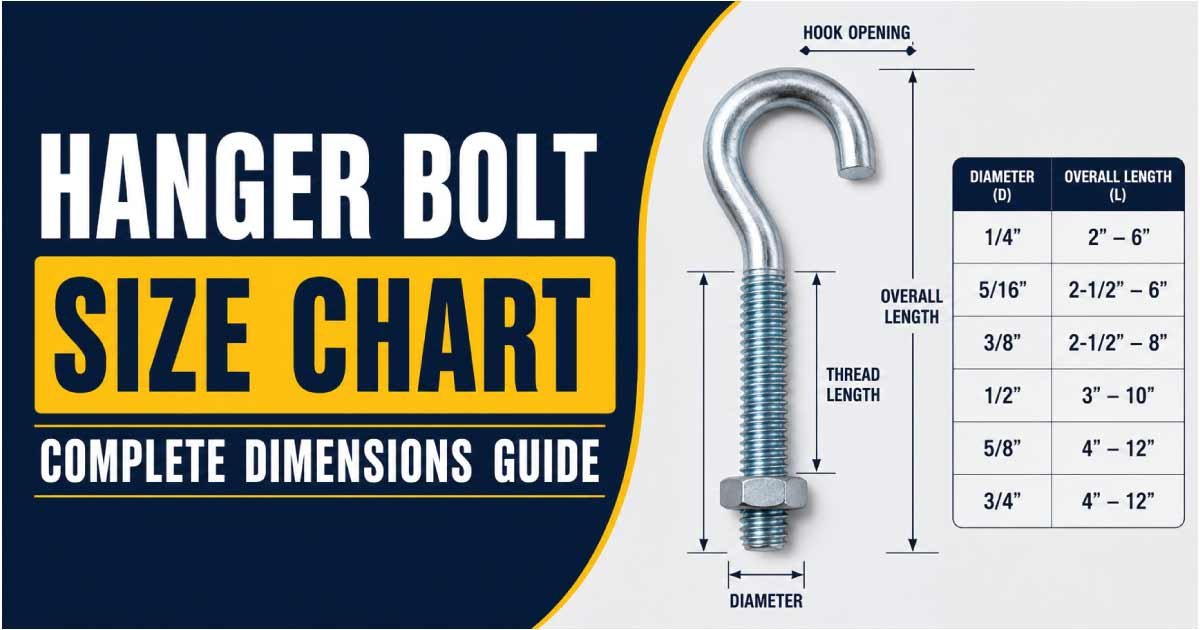
Hanger bolts are specialized fasteners designed with machine screw threads on one end and wood screw or lag-style threads on the other. They are commonly used to attach fixtures, threaded rods, electrical components, furniture hardware, and other items to wood or similar materials.
Choosing the correct hanger bolt size is important because the bolt must provide enough thread engagement while fitting the fixture or component being installed. The correct diameter, overall length, thread size, and thread configuration all affect strength and installation.
This hanger bolt size chart explains common hanger bolt dimensions, sizes, thread types, applications, installation methods, and selection tips. Whether you are working on furniture, electrical installations, woodworking, or general construction, this guide can help you select the right hanger bolt.
What Is a Hanger Bolt?
A hanger bolt is a double-ended fastener with two different thread types. One end typically has a wood screw thread, while the opposite end has a machine screw thread.
The wood-threaded portion is driven into wood or another suitable material, while the machine-threaded portion is used to attach a nut, bracket, fixture, or threaded component.
A hanger bolt may look simple, but its two-thread design makes it useful for applications where a threaded connection needs to be created in wood.
Common applications include:
- Furniture assembly
- Table legs
- Electrical boxes
- Lighting fixtures
- Shelving
- Woodworking projects
- Threaded rod connections
- Plumbing supports
- Cabinet hardware
- Mechanical fixtures
How Hanger Bolt Sizes Are Determined
Hanger bolt sizes are generally specified by several important dimensions rather than length alone.
The main measurements include:
- Diameter
- Overall length
- Machine thread size
- Machine thread pitch
- Wood thread size
- Wood-thread length
- Machine-thread length
- Thread type
- Drive style
For example, a hanger bolt may be identified as 1/4-20 × 2 inches, indicating a nominal 1/4-inch diameter, 20 threads per inch on the machine-thread side, and a specified overall length.
Metric hanger bolts are typically identified by diameter and thread pitch, such as M6 × 50 mm.
Because manufacturers can use different thread-length combinations, always check the product drawing when an exact dimension is required.
Common Hanger Bolt Size Chart
The following chart provides common hanger bolt sizes used for woodworking, furniture, electrical, and general fastening applications. Dimensions can vary by manufacturer and thread configuration.
| Hanger Bolt Size | Approx. Diameter | Common Lengths | Typical Application |
|---|---|---|---|
| #8 | 4.2 mm | 1½–3 in | Light-duty woodworking |
| #10 | 4.8 mm | 1½–3 in | Furniture and fixtures |
| 1/4 in | 6.35 mm | 1½–4 in | General woodworking |
| 5/16 in | 7.94 mm | 2–5 in | Furniture and supports |
| 3/8 in | 9.53 mm | 2–6 in | Heavy-duty applications |
| 1/2 in | 12.70 mm | 2–6 in | Structural and heavy fixtures |
| M5 | 5 mm | 30–80 mm | Metric furniture hardware |
| M6 | 6 mm | 30–100 mm | Fixtures and woodworking |
| M8 | 8 mm | 40–120 mm | Heavy furniture and supports |
| M10 | 10 mm | 50–150 mm | Heavy-duty mounting |
These are common size ranges rather than a universal dimensional standard. The exact dimensions should be verified against the manufacturer’s specifications.
Hanger Bolt Diameter Chart
Diameter is one of the most important factors when selecting a hanger bolt. A larger diameter generally provides a larger cross-sectional area and can be suitable for applications requiring greater fastening capacity.
| Nominal Size | Approx. Diameter | General Use |
|---|---|---|
| #8 | 4.2 mm | Light-duty |
| #10 | 4.8 mm | Light/medium-duty |
| 1/4 in | 6.35 mm | General-purpose |
| 5/16 in | 7.94 mm | Medium-duty |
| 3/8 in | 9.53 mm | Heavy-duty |
| 1/2 in | 12.70 mm | Large fixtures |
| M5 | 5 mm | Metric light-duty |
| M6 | 6 mm | Metric general-purpose |
| M8 | 8 mm | Metric medium-duty |
| M10 | 10 mm | Metric heavy-duty |
The correct diameter should be selected according to the fixture, material, expected load, and manufacturer’s recommendations.
Hanger Bolt Lengths
Hanger bolts are available in different overall lengths to accommodate different mounting requirements.
Common lengths include:
- 1-1/2 inches
- 2 inches
- 2-1/2 inches
- 3 inches
- 4 inches
- 5 inches
- 6 inches
Metric versions may be available in lengths such as:
- 30 mm
- 40 mm
- 50 mm
- 60 mm
- 75 mm
- 80 mm
- 100 mm
- 120 mm
- 150 mm
The required length depends on how deeply the wood-threaded end needs to penetrate and how much machine-threaded length is required for the attached component.
Understanding Hanger Bolt Thread Types
The two ends of a hanger bolt perform different jobs.
Wood Thread
The wood-threaded end is designed to enter wood or another compatible material.
It generally has a coarser thread that provides good engagement with the material.
Machine Thread
The machine-threaded end accepts a nut or threaded component.
Common inch machine-thread sizes include:
- 1/4-20
- 5/16-18
- 3/8-16
- 1/2-13
Metric machine threads may include:
- M5
- M6
- M8
- M10
The machine-thread pitch must match the nut or component being installed.
Hanger Bolt Thread Length
The overall length of a hanger bolt does not necessarily mean that both threaded portions have equal lengths.
One section may have more wood thread while the other has more machine thread.
Before selecting a hanger bolt, determine:
- How deep the wood-threaded section needs to enter the material.
- How much machine-threaded section must remain exposed.
- Whether a nut, bracket, or fixture needs additional clearance.
- Whether the total length fits the application.
This is particularly important for furniture and fixture installations where only a limited amount of bolt can extend through the component.
Metric Hanger Bolt Sizes
Metric hanger bolts are commonly identified using a format such as M6 × 60 mm.
The first number identifies the nominal diameter, while the second indicates the overall length.
For example:
- M5 × 40 mm
- M6 × 50 mm
- M6 × 60 mm
- M8 × 60 mm
- M8 × 80 mm
- M10 × 100 mm
The exact machine-thread pitch should also be confirmed because metric diameter alone does not completely identify the threaded connection.
Metric hanger bolts are commonly used in furniture, woodworking, machinery, and construction applications where metric fasteners are standard.
Imperial Hanger Bolt Sizes
Imperial hanger bolts are generally identified using fractional or numbered diameters combined with machine-thread pitch and length.
Examples include:
- #8
- #10
- 1/4-20
- 5/16-18
- 3/8-16
- 1/2-13
A designation such as 3/8-16 × 3 inches generally indicates a 3/8-inch nominal diameter, 16 threads per inch on the machine-thread side, and a 3-inch overall length.
Always confirm the complete manufacturer’s description because hanger bolt designs can have different wood-thread dimensions.
How to Measure a Hanger Bolt
If you have an existing hanger bolt but cannot identify its size, several measurements can help.
Measure the Diameter
Use a caliper to measure the outside diameter of the threaded section.
Compare the measurement with standard metric or imperial sizes.
Measure the Overall Length
Measure from one end of the hanger bolt to the other.
Do not measure only the exposed machine-threaded portion.
Measure the Machine Thread
Determine the diameter and pitch of the machine-threaded side.
For inch threads, thread pitch is normally expressed as threads per inch.
For metric threads, pitch is normally expressed as the distance between adjacent threads in millimeters.
Measure the Threaded Sections
Record the approximate length of both the wood-threaded and machine-threaded portions.
This can help you find a closer replacement when several bolts have the same diameter and overall length.
Discover More:
How to Choose the Correct Hanger Bolt
Selecting the right hanger bolt requires more than matching its overall length.
Choose the Correct Diameter
The diameter should be appropriate for the load and material. Larger bolts generally provide greater fastening capacity, but the hole and surrounding material must also be suitable.
Match the Machine Thread
The machine-thread side must match the nut or internally threaded component.
A bolt with the wrong thread pitch will not properly mate with the corresponding nut.
Choose the Correct Length
Make sure there is enough wood-thread engagement while leaving sufficient machine thread for the attached component.
Consider the Material
Hanger bolts may be manufactured from different materials and finishes, including:
- Carbon steel
- Stainless steel
- Zinc-plated steel
- Other corrosion-resistant materials
Select a suitable material for the environment.
Consider the Load
For heavy or safety-critical applications, use manufacturer load specifications rather than selecting a bolt based only on diameter.
Hanger Bolt Applications
Hanger bolts are particularly useful where a component needs to be attached to wood while providing a machine-threaded connection.
Common applications include:
Furniture
Hanger bolts are frequently used to attach table legs, furniture components, brackets, and other hardware.
Woodworking
Woodworkers can use hanger bolts to create removable threaded connections in wooden components.
Electrical Installations
Some hanger bolt designs are used to attach electrical fixtures and hardware to suitable wooden structures.
Plumbing
They may be used with appropriate supports and brackets where a threaded connection is needed in wood.
Mechanical Fixtures
Hanger bolts can be useful for mounting brackets, supports, and other components to wooden structures.
Hanger Bolt vs. Double-Ended Stud
Hanger bolts and double-ended studs may look similar because both have threads at both ends, but they are designed differently.
A hanger bolt normally has a wood-screw-style thread on one side and a machine thread on the other.
A double-ended stud generally has machine threads at both ends and is intended for connections involving threaded holes or nuts.
| Feature | Hanger Bolt | Double-Ended Stud |
|---|---|---|
| Thread type | Wood + machine | Usually machine + machine |
| Primary material | Wood + threaded component | Threaded components |
| Common use | Furniture and woodworking | Machinery and mechanical assemblies |
| Installation | Often driven into wood | Installed into threaded hole |
| Nut compatibility | Machine-thread side | Both threaded sides may accept nuts |
Choosing between the two depends on the material and type of connection required.
Discover More:
How to Install a Hanger Bolt
Correct installation helps prevent thread damage and improves holding strength.
Step 1: Mark the Location
Mark the exact position where the hanger bolt will be installed.
Make sure the location provides sufficient material around the hole.
Step 2: Drill a Pilot Hole
Select a suitable pilot-hole diameter for the wood-threaded section.
The correct pilot size depends on the wood type and hanger bolt dimensions.
Step 3: Install the Wood-Threaded End
Drive the wood-threaded end into the pilot hole.
A suitable installation method may involve using the machine-threaded end with two jam nuts locked together, allowing a wrench to turn the bolt.
Step 4: Install the Fixture
Once the wood-threaded section is securely installed, position the bracket, leg, or other component over the exposed machine-threaded section.
Step 5: Tighten the Nut
Install the appropriate nut and tighten it securely without overtightening.
Follow any manufacturer’s torque recommendations where available.
Discover More:
Common Hanger Bolt Installation Mistakes
Avoid these common problems when installing hanger bolts:
- Using the wrong pilot-hole size
- Installing the bolt too close to the edge
- Using the wrong machine-thread nut
- Overtightening the bolt
- Damaging the machine threads
- Installing too little wood-thread engagement
- Choosing a bolt that is too short
- Choosing a bolt that is unnecessarily long
- Installing the bolt at an incorrect angle
- Using unsuitable material in corrosive environments
Proper alignment is especially important when installing hanger bolts into furniture legs or structural components.
Hanger Bolt Material and Finish
The material and finish influence corrosion resistance, strength, appearance, and suitability for different environments.
Steel Hanger Bolts
Steel provides good strength and is widely used for general applications.
Zinc-Plated Hanger Bolts
Zinc plating provides additional corrosion resistance compared with untreated steel and is commonly used in general indoor applications.
Stainless Steel Hanger Bolts
Stainless steel is useful where corrosion resistance is important, particularly in damp or outdoor environments.
The appropriate material should be selected according to the application rather than appearance alone.
Tips for Using Hanger Bolts Safely
Use the following practices when installing hanger bolts:
- Select the correct diameter and length.
- Match the machine-thread pitch exactly.
- Use an appropriate pilot hole.
- Keep the bolt aligned with the material.
- Avoid damaging the machine threads.
- Do not exceed the recommended load.
- Inspect the wood for splitting or damage.
- Use corrosion-resistant material when required.
- Replace damaged or deformed hanger bolts.
For load-bearing or safety-critical applications, follow the relevant engineering and manufacturer’s specifications.
Frequently Asked Questions About Hanger Bolts
What is a hanger bolt used for?
A hanger bolt is used to create a threaded connection between wood and another component. One end has a wood-screw-style thread that enters the material, while the other has a machine thread for attaching a nut, bracket, fixture, or other threaded component.
How do I know what size hanger bolt I need?
Measure the required diameter, overall length, wood-thread length, and machine-thread size. The machine-thread side must match the nut or component being installed. Also consider the material, required thread engagement, available space, and expected load before selecting the final size.
What is the difference between a hanger bolt and a lag screw?
A hanger bolt has two different threaded sections: a wood thread and a machine thread. A typical lag screw has a single coarse thread designed primarily for fastening into wood or similar materials. The machine-thread end makes hanger bolts useful for attaching nuts and fixtures.
What size pilot hole should I use for a hanger bolt?
The pilot-hole size depends on the hanger bolt diameter, wood species, and thread design. A pilot hole should provide sufficient clearance for installation while leaving enough material for the wood threads to grip. Follow the manufacturer’s recommended pilot-hole size whenever it is provided.
Can hanger bolts be used in hardwood?
Yes, hanger bolts can be used in hardwood when the correct pilot hole and installation method are used. Hardwood may require careful drilling to prevent splitting or excessive installation resistance. The pilot-hole size should be selected according to the bolt and specific wood material.
Conclusion
A hanger bolt size chart is a useful starting point when selecting a fastener for woodworking, furniture, fixtures, electrical hardware, and other applications. The most important factors are diameter, overall length, wood-thread length, machine-thread size, material, and required load capacity.
When replacing an existing hanger bolt, measure the diameter and overall length first, then identify the machine-thread pitch and threaded-section lengths. For new installations, select a size that provides sufficient engagement in the material while leaving enough machine thread for the attached component.
Using the correct hanger bolt size improves the reliability of the connection and helps prevent stripped threads, loose fixtures, material damage, and installation problems. Always verify exact dimensions and load requirements with the manufacturer’s specifications when precision is important.

Engineer Hassan is a Mechanical Engineer with 16+ years of hands-on experience in mechanical hardware, fasteners, and workshop tools. He focuses on size selection, thread identification, and measurement, helping users choose the correct components with accuracy and safety.