
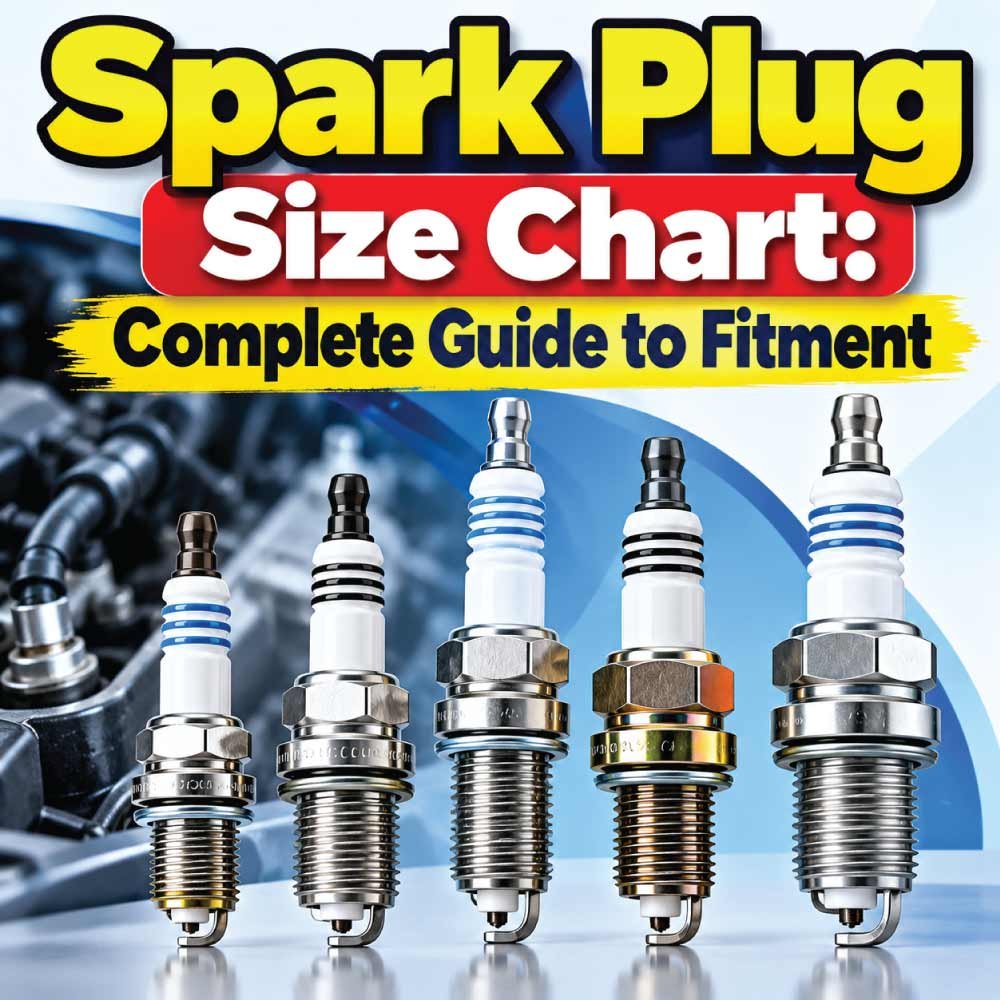
Spark plugs may look like simple components, but choosing the correct one involves more than matching the shape of an old plug. Thread diameter, thread reach, socket size, seat type, heat range, electrode design, and spark gap can all affect whether a spark plug is suitable for an engine.
A spark plug size chart makes these measurements easier to understand. However, physical dimensions should always be considered together with the engine’s required specifications. Two plugs can have the same thread diameter but differ in reach, hex size, or heat characteristics.
Whether you are replacing worn spark plugs, identifying an existing plug, choosing the correct socket, or learning how spark plug dimensions work, understanding these measurements can help you avoid common fitment mistakes.
What Is Spark Plug Size?
Spark plug size is not determined by one measurement. It is a combination of several physical and performance specifications.
The main dimensions include:
- Thread diameter
- Thread reach
- Hex or wrench size
- Seat type
- Overall plug length
- Electrode position
- Spark gap
There are also specifications that are not physical dimensions but are equally important when selecting a replacement, such as heat range and electrode material.
For example, two spark plugs may both use a 14 mm thread, yet one may require a different socket or have a different threaded length. They should not automatically be considered interchangeable.
Understanding each measurement separately makes spark plug identification much easier.
Why Spark Plug Dimensions Matter
A spark plug screws directly into the cylinder head, so its dimensions must correspond to the engine’s design.
The threads need to engage correctly without being too short or too long. The sealing surface must also match the cylinder head, while the firing end needs to sit in the intended position inside the combustion chamber.
Using an incorrectly sized plug can lead to problems such as:
- Poor sealing
- Thread damage
- Difficult installation
- Incorrect electrode position
- Potential interference with internal engine components
- Improper combustion characteristics
For this reason, never select a spark plug simply because it physically fits the opening.
Spark Plug Thread Diameter
Thread diameter refers to the approximate diameter of the threaded portion of the spark plug.
Common spark plug thread diameters include:
- 8 mm
- 10 mm
- 12 mm
- 14 mm
- 18 mm
The exact size depends on the engine and spark plug application.
The thread diameter needs to match the threaded hole in the cylinder head. A plug that is too large cannot be installed correctly, while a smaller plug cannot provide the required thread engagement.
How Thread Diameter Is Measured
A caliper can be used to measure the outside diameter of the threaded portion.
When measuring an old plug, clean away dirt and carbon deposits first. Measure across the outside of the threads rather than measuring the ceramic insulator or metal body.
A measurement that is close to a common size should still be verified against the engine specification before buying a replacement.
Spark Plug Thread Reach
Thread reach is the length of the threaded section that extends from the seating surface toward the firing end.
This measurement is especially important because plugs with the same thread diameter can have different reaches.
For example, several plugs may use a 14 mm thread but have different threaded lengths. The correct reach depends on the design of the cylinder head and combustion chamber.
If the reach is too short, the plug may not sit at the intended depth. If it is too long, the end of the plug may extend farther into the combustion chamber than designed.
How to Measure Thread Reach
To measure thread reach:
- Remove the plug from the engine.
- Clean the threaded portion.
- Identify the seating surface.
- Measure from the seating surface to the end of the threaded section.
- Record the measurement in millimeters.
Do not confuse thread reach with the total length of the spark plug.
Spark Plug Hex Size
The hex is the section of the spark plug that accepts a wrench or spark plug socket.
The hex size determines the socket size, not the thread diameter.
This distinction is important because a spark plug can have a 14 mm thread while requiring a considerably larger or smaller socket.
Common socket sizes encountered with spark plugs include:
| Hex Size | Matching Socket |
|---|---|
| 13 mm | 13 mm |
| 14 mm | 14 mm |
| 16 mm | 16 mm |
| 18 mm | 18 mm |
| 20.6–20.8 mm | Specialized spark plug socket |
| 21 mm | 21 mm |
| 25.4 mm | 25.4 mm |
The exact socket requirement depends on the individual spark plug design.
Why the Correct Socket Matters
A socket that fits poorly can damage the hex, especially if the plug is stuck or has been installed too tightly.
A proper spark plug socket usually has a mechanism that helps hold the plug while it is being removed or installed. Depending on the design, this may be a rubber insert or another retaining feature.
Spark Plug Seat Types
The seat is the portion of the spark plug that contacts the cylinder head and creates the intended seal.
Two common arrangements are gasket seats and taper seats.
Gasket Seat Spark Plugs
A gasket-seat plug uses a sealing washer between the plug and cylinder head.
The gasket is compressed when the plug is tightened, creating the required seal.
Some plugs use a separate-looking washer, while others have the sealing arrangement incorporated into the plug assembly.
Taper Seat Spark Plugs
A taper-seat spark plug uses a conical seating surface instead of a conventional flat gasket.
The shape of the plug and cylinder-head seat work together to create the seal.
Because these two systems are different, a gasket-seat plug should not automatically be substituted for a taper-seat plug simply because its thread dimensions appear similar.
Spark Plug Size Chart
The following chart provides a general dimensional reference for understanding common spark plug configurations.
| Thread Diameter | Example Reach Range | Common Hex Examples | Seat Type |
|---|---|---|---|
| 8 mm | Application-specific | Small hex designs | Application-specific |
| 10 mm | Application-specific | 14–16 mm | Gasket or taper |
| 12 mm | Various | 14–18 mm | Gasket or taper |
| 14 mm | Various | 16–21 mm | Gasket or taper |
| 18 mm | Various | 20–25 mm | Gasket or taper |
These are general reference categories rather than a vehicle-specific replacement chart. The correct dimensions must be confirmed for the particular engine.
How to Read Spark Plug Measurements
Spark plug specifications can sometimes look confusing because several dimensions may be written together.
A specification such as:
14 × 19 × 16 mm
can generally be understood as:
- 14 mm: thread diameter
- 19 mm: thread reach
- 16 mm: hex size
This type of notation is useful when comparing physical dimensions.
However, a complete spark plug specification may contain many additional details. Physical measurements alone cannot tell you whether the plug has the correct heat range, electrode arrangement, or spark gap.
Spark Plug Gap Explained
Spark plug gap is different from the physical size of the plug.
The gap is the distance between the center electrode and ground electrode. This is where the ignition system produces the spark.
Different engines and spark plug designs can require different gap specifications.
A gap that is too small or too large can affect ignition performance.
Possible symptoms of an unsuitable gap can include:
- Difficult starting
- Rough running
- Misfires
- Poor acceleration
- Inconsistent ignition
The correct gap should be based on the engine and plug specification rather than simply copying the gap from another spark plug.
Should You Adjust the Spark Plug Gap?
Some spark plugs are supplied with a predetermined gap, while others may require checking before installation.
If adjustment is permitted for the particular plug, use an appropriate spark plug gap tool and make small changes carefully.
Avoid applying excessive force to fine-wire or delicate electrodes because they can be damaged more easily than conventional electrode designs.
Also Read:
Spark Plug Heat Range
Heat range is another important specification that should not be confused with physical size.
The heat range describes how quickly heat is transferred away from the firing end of the spark plug.
A plug with the correct physical dimensions can still be unsuitable if its heat range does not match the engine’s requirements.
Heat range selection can be affected by factors such as:
- Engine design
- Compression
- Operating temperature
- Load
- Manufacturer specifications
- Modifications to the engine
For normal replacement, the safest approach is to follow the recommended spark plug specification for the engine rather than changing heat range without a specific reason.
Spark Plug Size and Electrode Design
Modern spark plugs are available with different electrode configurations and materials.
You may encounter:
- Standard nickel-alloy electrodes
- Fine-wire center electrodes
- Platinum electrodes
- Iridium electrodes
- Multiple-ground-electrode designs
Electrode material does not necessarily change the basic thread diameter or socket size.
However, it can change the construction of the firing end and the intended service characteristics of the plug.
When replacing a spark plug, match the specified plug type rather than assuming that any plug with identical physical dimensions will provide the same result.
Also Read:
How to Measure a Spark Plug
If you have an unidentified spark plug, you can measure several dimensions yourself.
A digital caliper is useful because it provides more precise measurements than a ruler.
Step 1: Clean the Plug
Remove dirt, oil, and loose deposits from the plug.
Cleaning makes it easier to identify the threads and seating surface.
Step 2: Measure the Thread Diameter
Measure across the outside of the threaded section.
Record the result in millimeters.
Step 3: Measure the Thread Reach
Measure from the seating surface to the end of the threaded portion.
Do not include the electrode or curved ground strap.
Step 4: Measure the Hex
Measure across the flat sides of the hex section.
This measurement corresponds to the socket size.
Step 5: Identify the Seat
Look at the lower portion of the plug and determine whether it uses a gasket-style or taper-style seating arrangement.
Step 6: Record the Part Number
If a part number is visible on the ceramic or metal portion, record it.
The part number can be much more useful for confirming an application than physical measurements alone.
Also Read:
Spark Plug Size Chart for Identification
When examining an unknown plug, organize the measurements before comparing it with replacement options.
| Measurement | What to Record | Why It Matters |
|---|---|---|
| Thread diameter | Millimeters | Must match cylinder head |
| Thread reach | Millimeters | Determines insertion depth |
| Hex size | Millimeters | Determines socket size |
| Seat type | Gasket or taper | Affects sealing |
| Electrode style | Visible design | Helps identify plug type |
| Part number | Marked code | Helps confirm exact application |
| Gap | Millimeters | Must match engine requirement |
This method reduces the chance of selecting a replacement based on appearance alone.
How to Choose the Correct Spark Plug
The most reliable selection process starts with the engine rather than the old plug’s appearance.
Check the Engine Information
Identify the:
- Vehicle
- Model
- Model year
- Engine size
- Engine configuration
Different engines within the same vehicle model can use different spark plugs.
Check the Recommended Part Number
Once the engine is identified, determine the specified spark plug part number.
Then compare its dimensions and specifications.
Confirm the Physical Dimensions
Check:
- Thread diameter
- Thread reach
- Hex size
- Seat type
Confirm the Performance Specifications
Then verify:
- Heat range
- Spark gap
- Electrode material
- Electrode design
- Terminal configuration
This two-stage process is much safer than selecting a plug from dimensions alone.
Common Spark Plug Sizing Mistakes
Spark plug replacement mistakes often happen because one dimension is treated as though it determines everything.
Mistake 1: Matching Only the Socket Size
A plug that uses the same socket can have completely different threads and reach.
Mistake 2: Matching Only Thread Diameter
A 14 mm plug is not automatically compatible with every engine that uses a 14 mm spark plug.
Reach, seat, heat range, and electrode configuration still matter.
Mistake 3: Ignoring Seat Type
A taper-seat plug and gasket-seat plug should not be treated as interchangeable.
Mistake 4: Assuming Physical Fit Means Correct Fit
A spark plug may screw into an opening and still be unsuitable for the engine.
Mistake 5: Ignoring Spark Gap
Even when the plug dimensions are correct, the gap still needs to meet the required specification.
Spark Plug Socket Size Chart
For tool selection, the hex dimension is the most useful measurement.
| Spark Plug Hex | Required Socket |
|---|---|
| 13 mm | 13 mm spark plug socket |
| 14 mm | 14 mm spark plug socket |
| 16 mm | 16 mm spark plug socket |
| 18 mm | 18 mm spark plug socket |
| 20.8 mm | 20.8 mm spark plug socket |
| 21 mm | 21 mm spark plug socket |
| 25.4 mm | 25.4 mm socket |
Always verify the actual plug specification before purchasing a socket because spark plug designs vary.
Signs That a Spark Plug May Be Incorrect
A newly installed spark plug should match the engine specification precisely.
If an incorrect plug has been installed, problems can potentially appear during installation or operation.
Watch for:
- The plug does not thread smoothly
- The socket does not fit correctly
- The sealing surface does not match
- The plug reaches an unusual depth
- The engine develops a misfire
- Starting becomes difficult
- Engine operation becomes irregular
If a spark plug does not install normally, do not force it. Remove it and verify the dimensions and application.
Spark Plug Size vs. Spark Plug Part Number
A size chart helps explain dimensions, but a part number usually provides a much more complete identification method.
A part number can represent multiple characteristics simultaneously, including the plug’s physical construction and intended application.
For that reason, use a size chart to understand and compare measurements, but use the manufacturer’s specified part number or application information when purchasing a replacement.
This distinction is particularly important when several plugs have similar thread dimensions.
Final Thoughts
A spark plug size chart is useful for understanding the measurements that determine physical fitment. Thread diameter, thread reach, hex size, and seat type are among the most important dimensions to check.
However, spark plug selection should never be based on one measurement alone. Heat range, electrode design, spark gap, and the specific engine application are also important.
If you are measuring an existing spark plug, record each dimension carefully and identify the part number whenever possible. When purchasing a replacement, compare the complete specification rather than choosing the plug that merely looks similar.
The right spark plug is the one that matches the engine’s required specifications in every important area—not simply the one that fits the socket or screws into the cylinder head.

Engineer Hassan is a Mechanical Engineer with 16+ years of hands-on experience in mechanical hardware, fasteners, and workshop tools. He focuses on size selection, thread identification, and measurement, helping users choose the correct components with accuracy and safety.