
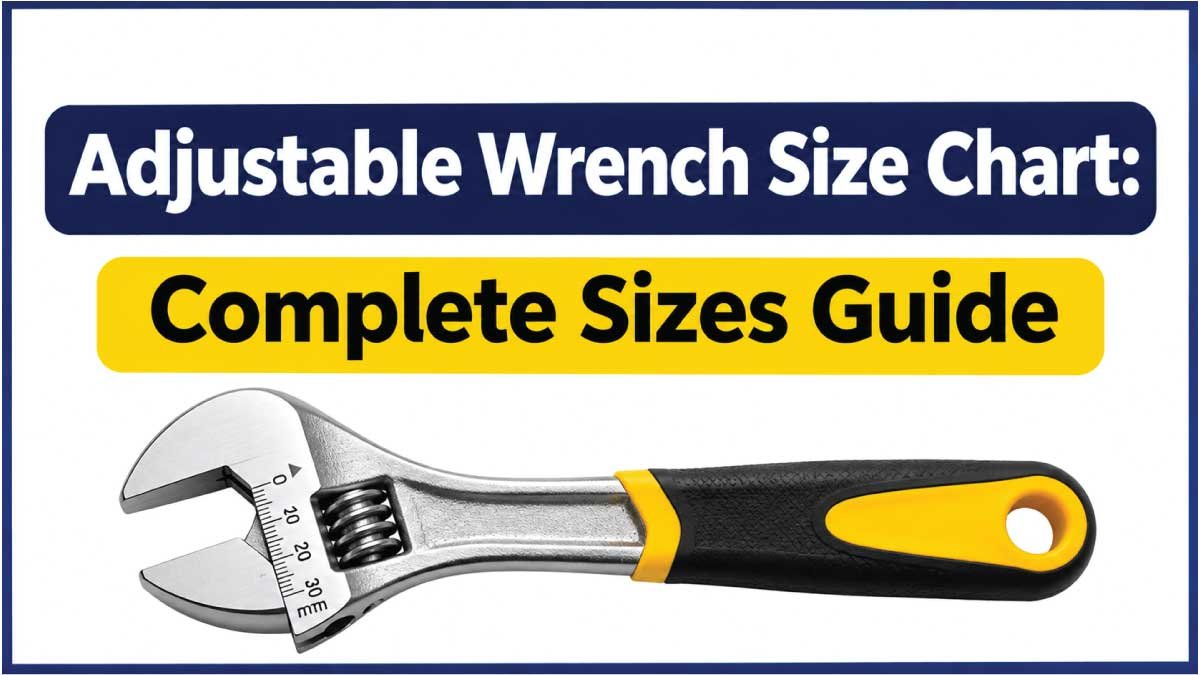
An adjustable wrench is one of the most useful hand tools for plumbing, mechanical repairs, automotive maintenance, and general DIY projects. Unlike a fixed-size spanner, an adjustable wrench has a movable jaw that allows it to fit different sizes of nuts, bolts, and other fasteners. This makes it a practical tool for jobs that require flexibility and convenience.
However, choosing the correct adjustable wrench size is important. A wrench that is too small may not open wide enough for the fastener, while an oversized wrench can be difficult to control in tight spaces. Understanding handle length, maximum jaw opening, and common applications helps you select the right tool for your work.
This adjustable wrench size chart explains common wrench sizes, jaw capacities, measurements in inches and millimeters, and suitable applications. It also covers wrench types, selection tips, proper usage, maintenance, and frequently asked questions.
Adjustable Wrench Size Chart
Adjustable wrenches are available in several sizes, commonly ranging from 4 inches to 24 inches. The size usually refers to the approximate overall length of the wrench, not the maximum width of the nut or bolt it can grip.
The following chart provides representative dimensions for common adjustable wrench sizes. Jaw openings can vary between manufacturers and models, so always check the product specifications before purchasing.
| Adjustable Wrench Size | Approximate Length (mm) | Typical Maximum Jaw Opening | Common Application |
|---|---|---|---|
| 4 inches | 100 mm | 13 mm | Small fasteners and electronics |
| 6 inches | 150 mm | 19 mm | Light household repairs |
| 8 inches | 200 mm | 24 mm | General DIY work |
| 10 inches | 250 mm | 30 mm | Plumbing and mechanical repairs |
| 12 inches | 300 mm | 35 mm | Larger nuts and bolts |
| 15 inches | 375 mm | 43 mm | Heavy-duty maintenance |
| 18 inches | 450 mm | 53 mm | Large fasteners |
| 24 inches | 600 mm | 62 mm | Industrial applications |
Important: These jaw openings are approximate examples, not universal specifications. Different manufacturers may offer different maximum openings for the same nominal wrench length. Always confirm the actual jaw capacity listed for the specific model.
What Do Adjustable Wrench Sizes Mean?
Adjustable wrench sizes generally describe the overall length of the tool. This measurement is taken from the end of the handle to the outer end of the wrench head.
For example:
- A 4-inch adjustable wrench is approximately 4 inches long.
- A 6-inch adjustable wrench is approximately 6 inches long.
- An 8-inch adjustable wrench is approximately 8 inches long.
- A 10-inch adjustable wrench is approximately 10 inches long.
- A 12-inch adjustable wrench is approximately 12 inches long.
- An 18-inch adjustable wrench is approximately 18 inches long.
The overall length affects leverage and handling. A longer wrench generally provides more leverage, while a shorter wrench is easier to carry and use in confined spaces.
However, overall length does not tell you the exact size of the fastener the wrench can grip. For that, you need to check its maximum jaw opening.
Adjustable Wrench Size in Inches and Millimeters
Adjustable wrenches are commonly sold using inch-based size labels, but metric measurements are useful when comparing tools and checking specifications.
| Wrench Size (Inches) | Approximate Length (mm) | Size Category |
|---|---|---|
| 4 inches | 100 mm | Extra small |
| 6 inches | 150 mm | Small |
| 8 inches | 200 mm | Medium |
| 10 inches | 250 mm | Medium |
| 12 inches | 300 mm | Large |
| 15 inches | 375 mm | Large |
| 18 inches | 450 mm | Extra large |
| 24 inches | 600 mm | Industrial |
These are rounded metric conversions of common nominal sizes. Actual tool lengths may differ slightly depending on the manufacturer.
Adjustable Wrench Jaw Opening Chart
The jaw opening is the distance between the two gripping surfaces when the movable jaw is adjusted to its widest position. It determines the maximum fastener width that the wrench can accommodate.
For an adjustable wrench, this is one of the most important specifications to consider.
| Wrench Size | Approximate Maximum Jaw Opening | Suitable Fastener Size Range |
|---|---|---|
| 4 inches | 13 mm | Small nuts and bolts |
| 6 inches | 19 mm | Small to medium fasteners |
| 8 inches | 24 mm | Medium fasteners |
| 10 inches | 30 mm | Medium to large fasteners |
| 12 inches | 35 mm | Large fasteners |
| 15 inches | 43 mm | Heavy-duty fasteners |
| 18 inches | 53 mm | Very large fasteners |
| 24 inches | 62 mm | Industrial-size fasteners |
The suitable fastener range depends on the actual jaw opening and the wrench’s design. A fastener should fit securely between the jaws without forcing the adjustment mechanism beyond its rated limit.
Adjustable Wrench Parts and Their Functions
Understanding the main parts of an adjustable wrench makes it easier to select, adjust, and maintain the tool.
1. Fixed Jaw
The fixed jaw is the stationary gripping section of the wrench head. It provides one side of the contact surface for holding a nut or bolt.
2. Movable Jaw
The movable jaw slides toward or away from the fixed jaw. This allows the wrench to fit fasteners of different widths.
3. Adjustment Worm
The adjustment worm is the small rotating mechanism that moves the movable jaw. Turning it changes the jaw opening.
4. Handle
The handle provides the gripping area and leverage needed to turn the fastener. Longer handles generally provide greater leverage but require more space.
5. Jaw Opening
Jaw opening refers to the distance between the gripping surfaces. The maximum jaw opening is the largest fastener width the wrench can accommodate.
6. Head
The head contains the fixed jaw, movable jaw, and adjustment mechanism. Its design determines the wrench’s jaw capacity and access to fasteners.
Different Types of Adjustable Wrenches
Adjustable wrenches come in several designs. Although they share the same basic purpose, their head shapes, jaw arrangements, and working features can differ.
1. Standard Adjustable Wrench
A standard adjustable wrench has one fixed jaw and one movable jaw controlled by an adjustment worm. It is widely used for general repairs, plumbing maintenance, and mechanical work.
It is suitable for many ordinary nuts and bolts when the correct jaw opening is selected.
2. Wide-Jaw Adjustable Wrench
A wide-jaw adjustable wrench is designed with a larger jaw opening relative to its overall length. This makes it useful when a standard wrench of the same length cannot accommodate a larger fastener.
It is particularly practical for plumbing fittings and maintenance tasks where a wider opening is needed without carrying a much longer wrench.
3. Slim-Jaw Adjustable Wrench
A slim-jaw adjustable wrench has a thinner head profile that helps it reach fasteners in restricted spaces. It can be useful around closely spaced pipes, fittings, and mechanical components.
Its jaw capacity depends on the specific model, so check the manufacturer’s specifications.
4. Insulated Adjustable Wrench
An insulated adjustable wrench has protective insulation around its handle and is intended for certain electrical maintenance tasks.
However, insulation alone does not make a tool safe for live electrical work. Only use a wrench specifically certified and rated for the intended electrical application, and follow appropriate electrical safety procedures.
5. Ratcheting Adjustable Wrench
A ratcheting adjustable wrench combines adjustable jaws with a ratcheting mechanism. It can allow repeated movement around a fastener without removing and repositioning the tool after every short turn.
This design can be useful in locations where handle movement is restricted. Not all models offer the same ratcheting range or capacity.
6. Combination Adjustable Wrench
Some adjustable wrench designs combine features intended for different repair tasks. These may include special jaw profiles or additional gripping features.
Before using a specialized design, review its intended applications and rated capacity rather than assuming it works like every standard adjustable wrench.
How to Choose the Right Adjustable Wrench Size
Selecting the correct adjustable wrench involves more than choosing a handle length. You should consider the fastener size, jaw opening, available working space, and required turning force.
1. Identify the Fastener Size
First, determine the width across the flats of the nut or bolt head. This is the distance between two opposite flat sides.
For example, if a hexagonal nut measures 17 mm across its flats, you need an adjustable wrench with a jaw opening that can accommodate at least 17 mm.
2. Check the Maximum Jaw Opening
Compare the fastener measurement with the wrench’s maximum jaw opening.
Do not assume that every 8-inch or 10-inch wrench has the same capacity. Manufacturers can use different head designs and jaw dimensions.
3. Choose a Suitable Handle Length
A shorter wrench is convenient for small fasteners and tight locations. A longer wrench can provide more leverage for larger fasteners, provided the tool is rated for the application.
For ordinary household repairs, 6-inch, 8-inch, and 10-inch adjustable wrenches are useful sizes to consider.
4. Consider Working Space
Check how much room is available around the fastener. A large wrench may not fit between pipes, inside cabinets, or around closely spaced mechanical components.
A compact wrench or a slim-jaw model may be more practical in these situations.
5. Consider the Fastener Condition
Worn, rounded, or damaged fasteners can be difficult to grip with an adjustable wrench. A correctly sized six-point socket or suitable fixed-size wrench may provide better contact.
Avoid using an adjustable wrench on severely damaged fasteners when a more appropriate tool is available.
6. Choose Quality Construction
Look for a wrench with strong jaws, a smooth adjustment mechanism, a comfortable handle, and clearly stated capacity specifications.
The movable jaw should adjust without excessive looseness. A poor-quality adjustment mechanism can make it difficult to maintain secure contact with the fastener.
Related Guide:
Common Adjustable Wrench Sizes for Different Jobs
Different repair tasks call for different wrench sizes. The following guide provides practical examples.
| Adjustable Wrench Size | Common Applications |
|---|---|
| 4 inches | Small fittings and compact mechanical work |
| 6 inches | Small household repairs |
| 8 inches | General DIY and maintenance |
| 10 inches | Plumbing and automotive maintenance |
| 12 inches | Larger nuts and mechanical fasteners |
| 15 inches | Heavy-duty repair work |
| 18 inches | Large industrial fasteners |
| 24 inches | Large equipment and industrial maintenance |
For most household toolkits, an 8-inch or 10-inch adjustable wrench offers a useful balance between size, jaw capacity, and handling. A 6-inch model is useful for smaller fasteners, while a 12-inch model can cover larger jobs.
The best combination depends on the types of repairs you regularly perform.
Related Guide:
How to Use an Adjustable Wrench Correctly
Using an adjustable wrench correctly helps prevent slipping, rounded fasteners, and unnecessary wear on the tool.
Step 1: Inspect the Wrench
Check the fixed jaw, movable jaw, adjustment worm, and handle. Do not use a wrench with cracked parts, badly worn jaws, or a damaged adjustment mechanism.
Step 2: Open the Jaws
Turn the adjustment worm until the jaws are wider than the fastener.
Step 3: Position the Wrench
Place the jaws around the nut or bolt head so that both gripping surfaces make proper contact with the flat sides.
Step 4: Adjust the Fit
Turn the adjustment worm until the jaws fit closely around the fastener. Minimize unnecessary clearance to reduce the chance of slipping or rounding the corners.
Step 5: Apply Force in the Correct Direction
Whenever practical, position the wrench so that the force is applied toward the fixed jaw. This helps reduce stress on the movable jaw and adjustment mechanism.
Step 6: Use Controlled Pressure
Apply steady pressure instead of sudden jerking movements. Do not use a pipe extension to increase leverage unless the manufacturer specifically permits it.
Step 7: Remove and Inspect
After completing the repair, remove the wrench and check the fastener for damage. Clean the tool before storing it.
Related Guide:
Adjustable Wrench vs. Combination Wrench
An adjustable wrench and a combination wrench are both used for turning nuts and bolts, but they have different designs and advantages.
| Feature | Adjustable Wrench | Combination Wrench |
|---|---|---|
| Jaw Design | One fixed and one movable jaw | Fixed-size open and box ends |
| Size Adjustment | Adjustable | Not adjustable |
| Flexibility | Fits multiple fastener sizes | Fits one nominal size |
| Fastener Contact | Depends on jaw adjustment | More precise fixed-size fit |
| Convenience | Useful for varied sizes | Useful for repeated specific sizes |
| Common Use | General repairs | Mechanical and automotive work |
An adjustable wrench is convenient when you need to work with different fastener sizes. A combination wrench is often preferable when you know the exact fastener size and need a secure fit.
Common Adjustable Wrench Sizing Mistakes
Choosing or using an adjustable wrench incorrectly can damage both the fastener and the tool. Avoid these common mistakes.
Confusing Handle Length with Jaw Opening
A 10-inch wrench does not have a 10-inch jaw opening. Its nominal size refers to its overall length. Check the maximum jaw capacity separately.
Choosing a Wrench with Insufficient Capacity
If the fastener is wider than the maximum jaw opening, the wrench cannot grip it correctly. Select a larger-capacity model instead of forcing the jaws.
Leaving Too Much Clearance
Loose jaw contact increases the possibility of slipping and rounding the fastener corners. Adjust the jaws closely around the nut or bolt.
Using the Wrong Side for Heavy Force
Applying heavy force in a way that overloads the movable jaw can increase the risk of damage. Position the wrench so that force is directed toward the fixed jaw whenever practical.
Using an Adjustable Wrench as a Hammer
An adjustable wrench is designed to turn fasteners, not to strike objects. Using it as a hammer can damage the head, handle, or adjustment mechanism.
Using Excessive Leverage
Adding a pipe extension or applying excessive force can overload the wrench. Use a properly rated tool for high-torque applications.
Ignoring Worn Fasteners
A rounded nut or bolt may not provide enough flat surface for a secure grip. A suitable socket or extractor may be a better choice.
Adjustable Wrench Maintenance Tips
Regular maintenance helps keep an adjustable wrench accurate, smooth, and reliable.
- Clean after use: Remove dirt, grease, and debris from the jaws and adjustment mechanism.
- Inspect the jaws: Check for cracks, deformation, or excessive wear.
- Check jaw movement: The movable jaw should slide smoothly without excessive looseness.
- Lubricate the adjustment worm: Apply suitable lubricant when recommended by the manufacturer.
- Store properly: Keep the wrench in a dry toolbox or storage area to prevent corrosion.
- Avoid overloading: Never exceed the tool’s intended capacity or use it as a substitute for a larger wrench.
- Replace damaged tools: Stop using a wrench with damaged jaws or a faulty adjustment mechanism.
A well-maintained adjustable wrench provides more reliable contact and makes everyday repair work easier.
Frequently Asked Questions About Adjustable Wrench Sizes
What size adjustable wrench is best for home use?
An 8-inch or 10-inch adjustable wrench is a practical choice for many household repairs. A 6-inch wrench is useful for smaller fasteners, while a 12-inch model provides a larger jaw capacity for bigger jobs.
What does an 8-inch adjustable wrench mean?
An 8-inch adjustable wrench has an overall nominal length of approximately 8 inches, or about 200 mm. Its maximum jaw opening is a separate measurement.
How wide does a 10-inch adjustable wrench open?
Many 10-inch adjustable wrenches have a maximum jaw opening around 25–30 mm, but the exact capacity depends on the manufacturer and model. Check the product specifications before buying.
What is the difference between adjustable wrench size and jaw opening?
Wrench size generally describes the overall tool length. Jaw opening describes the maximum distance between the gripping surfaces. Both measurements help determine whether a wrench is suitable for a particular fastener.
Can an adjustable wrench replace a complete wrench set?
An adjustable wrench can handle several fastener sizes, making it convenient for general repairs. However, it does not completely replace a fixed-size wrench set. Fixed-size combination wrenches and sockets often provide a more precise fit for regular mechanical and automotive work.
Is a larger adjustable wrench always better?
No. A larger wrench may provide more leverage and a wider jaw opening, but it can be difficult to use in confined spaces. Choose a size that matches the fastener and working conditions.
How do I measure an adjustable wrench jaw opening?
Open the jaws to their widest position and measure the distance between the two gripping surfaces. A suitable measuring tool, such as a ruler or caliper, can help determine the opening. Compare this measurement with the manufacturer’s stated maximum capacity.
Can I use an adjustable wrench on plumbing fittings?
Yes, an adjustable wrench can be used on many plumbing nuts and fittings when its jaw opening and design are suitable. For round pipes and threaded pipe connections that require strong gripping teeth, use an appropriate pipe wrench instead.
What is the most common adjustable wrench size?
The 8-inch and 10-inch adjustable wrenches are common general-purpose sizes. They provide a useful balance of handle length, jaw capacity, and portability for many repair tasks.
Conclusion
Choosing the correct adjustable wrench size helps make plumbing, mechanical, automotive, and household repairs easier. The overall wrench length determines its general handling and leverage, while the maximum jaw opening determines the largest fastener it can accommodate.
Small 4-inch and 6-inch models are useful for compact work, while 8-inch and 10-inch wrenches are practical general-purpose options. Larger 12-inch, 15-inch, and 18-inch models are suitable for bigger fasteners and more demanding maintenance tasks.
Use this adjustable wrench size chart as a reference when comparing tools. Always check the actual jaw opening, fastener dimensions, and manufacturer specifications before choosing a wrench. A properly sized tool provides a better fit, improves control, and helps prevent damage to fasteners.

Engineer Hassan is a Mechanical Engineer with 16+ years of hands-on experience in mechanical hardware, fasteners, and workshop tools. He focuses on size selection, thread identification, and measurement, helping users choose the correct components with accuracy and safety.