
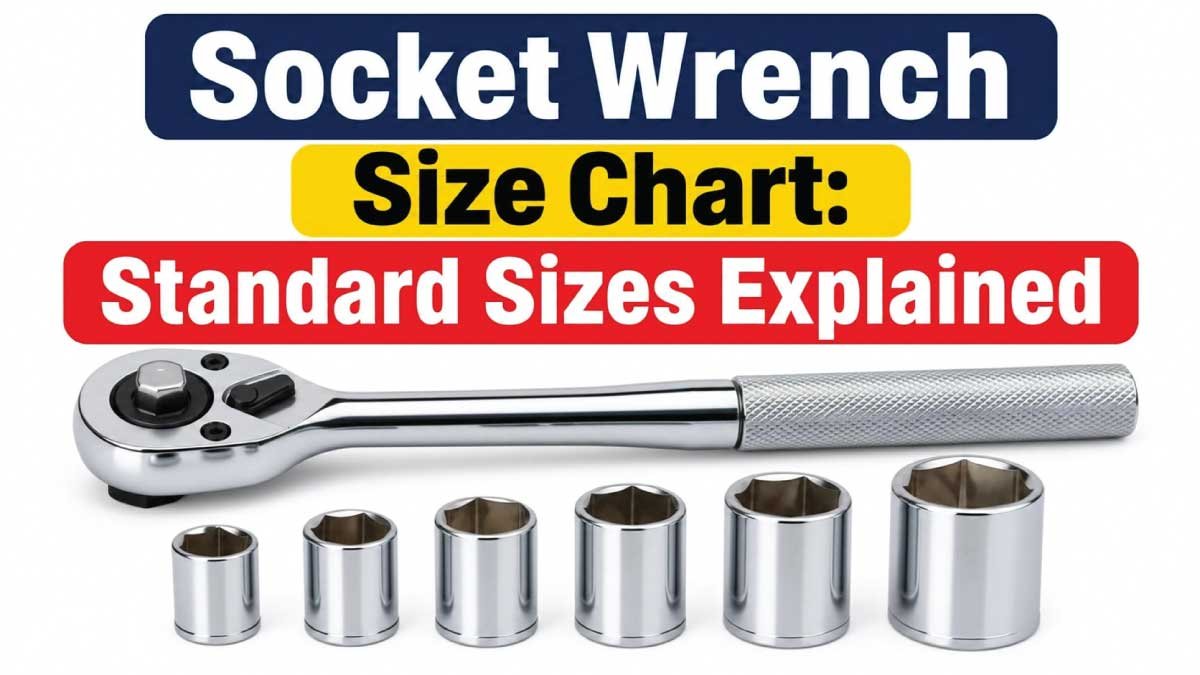
Choosing the correct socket size is essential for tightening and loosening bolts and nuts safely and efficiently. Whether you are performing automotive repairs, maintaining machinery, assembling equipment, or handling household projects, using the right socket wrench helps prevent damaged fasteners and makes mechanical work easier.
This socket wrench size chart covers common metric and SAE socket sizes, drive sizes, measurements, and practical applications. It also explains the differences between shallow and deep sockets, socket types, and how to choose the correct socket wrench for different jobs.
Understanding socket wrench measurements is particularly important because socket size and drive size are two different specifications. Socket size determines which fastener the socket fits, while drive size determines which ratchet or handle can connect to it.
What Is a Socket Wrench?
A socket wrench is a hand tool used to tighten or loosen threaded fasteners, such as bolts and nuts. It consists of a handle or drive tool that connects to a removable socket.
The socket fits over the fastener, while the handle provides the leverage needed to rotate it.
Unlike a fixed-size spanner, a socket wrench can work with many fastener sizes by changing the socket.
Common components of a socket wrench include:
- Socket: Fits over the bolt or nut.
- Square drive: Connects the socket to the handle or ratchet.
- Ratchet handle: Allows repeated rotation without removing the socket.
- Reversing switch: Changes the direction of rotation on compatible ratchets.
- Extension bar: Helps reach recessed or difficult-to-access fasteners.
- Universal joint: Allows angled access to certain fasteners.
Socket wrenches are widely used in automotive repair, construction, industrial maintenance, plumbing, and general mechanical work.
Socket Wrench Size Chart
Socket wrench sizes are commonly divided into two measurement systems: metric and SAE.
Metric sockets are measured in millimeters, while SAE sockets are measured in inches.
The following chart provides an overview of commonly used socket measurements.
Metric Socket Wrench Size Chart
Metric sockets are designed for fasteners with metric dimensions. They are commonly used in modern vehicles, machinery, equipment, and mechanical assemblies.
| Socket Size (mm) | Equivalent (inches) | Common Applications |
|---|---|---|
| 4 mm | 0.1575 in | Small mechanical assemblies |
| 5 mm | 0.1969 in | Electronics and small equipment |
| 6 mm | 0.2362 in | Small fasteners |
| 7 mm | 0.2756 in | Automotive components |
| 8 mm | 0.3150 in | General mechanical work |
| 9 mm | 0.3543 in | Equipment maintenance |
| 10 mm | 0.3937 in | Automotive repairs |
| 11 mm | 0.4331 in | Mechanical assemblies |
| 12 mm | 0.4724 in | Automotive maintenance |
| 13 mm | 0.5118 in | Vehicle and machinery work |
| 14 mm | 0.5512 in | Mechanical components |
| 15 mm | 0.5906 in | Automotive repairs |
| 16 mm | 0.6299 in | Machinery maintenance |
| 17 mm | 0.6693 in | Vehicle fasteners |
| 18 mm | 0.7087 in | Automotive applications |
| 19 mm | 0.7480 in | Wheel and suspension work |
| 20 mm | 0.7874 in | Mechanical assemblies |
| 21 mm | 0.8268 in | Automotive maintenance |
| 22 mm | 0.8661 in | Larger fasteners |
| 24 mm | 0.9449 in | Heavy mechanical work |
| 27 mm | 1.0630 in | Industrial equipment |
| 30 mm | 1.1811 in | Large machinery |
| 32 mm | 1.2598 in | Heavy-duty applications |
These are commonly available socket sizes, not a universal list of all metric fasteners. Always measure the fastener or consult the relevant equipment specifications before selecting a socket.
SAE Socket Wrench Size Chart
SAE sockets use fractional-inch measurements. They are commonly used with inch-based fasteners found in American vehicles, older machinery, and certain industrial applications.
| Socket Size (inches) | Decimal Measurement (inches) | Metric Equivalent |
|---|---|---|
| 1/4 in | 0.2500 | 6.35 mm |
| 5/16 in | 0.3125 | 7.94 mm |
| 3/8 in | 0.3750 | 9.53 mm |
| 7/16 in | 0.4375 | 11.11 mm |
| 1/2 in | 0.5000 | 12.70 mm |
| 9/16 in | 0.5625 | 14.29 mm |
| 5/8 in | 0.6250 | 15.88 mm |
| 11/16 in | 0.6875 | 17.46 mm |
| 3/4 in | 0.7500 | 19.05 mm |
| 13/16 in | 0.8125 | 20.64 mm |
| 7/8 in | 0.8750 | 22.23 mm |
| 15/16 in | 0.9375 | 23.81 mm |
| 1 in | 1.0000 | 25.40 mm |
| 1-1/16 in | 1.0625 | 26.99 mm |
| 1-1/8 in | 1.1250 | 28.58 mm |
| 1-1/4 in | 1.2500 | 31.75 mm |
| 1-1/2 in | 1.5000 | 38.10 mm |
SAE sockets should be used with fasteners designed for inch-based measurements. Although some SAE and metric sizes are close, they are not automatically interchangeable.
Socket Wrench Drive Size Chart
Drive size refers to the square connection between the socket and the ratchet or handle. It does not indicate the size of the bolt or nut.
Choosing the correct drive size ensures that the socket connects properly to the wrench.
The following chart compares common socket drive sizes and their typical applications.
| Drive Size | Measurement (mm) | Common Applications |
|---|---|---|
| 1/4 inch | 6.35 mm | Small fasteners and precision work |
| 3/8 inch | 9.53 mm | Automotive and general mechanical work |
| 1/2 inch | 12.70 mm | Larger automotive fasteners |
| 3/4 inch | 19.05 mm | Heavy vehicles and machinery |
| 1 inch | 25.40 mm | Industrial and heavy-duty equipment |
1/4-Inch Drive Socket Set
A 1/4-inch drive socket set is designed for smaller fasteners and applications requiring compact tools.
Common applications include:
- Electronics and small equipment.
- Bicycle maintenance.
- Automotive interior components.
- Small engine assemblies.
- Light mechanical repairs.
Its compact size makes it particularly useful in confined working areas.
3/8-Inch Drive Socket Set
A 3/8-inch drive socket set is a versatile choice for general automotive and mechanical maintenance.
Common applications include:
- Motorcycle repairs.
- Automotive engine components.
- Household machinery.
- General workshop maintenance.
- Medium-sized fasteners.
It provides a practical balance between accessibility and leverage.
1/2-Inch Drive Socket Set
A 1/2-inch drive socket set is commonly used for larger fasteners and automotive maintenance.
Common applications include:
- Wheel and suspension work.
- Automotive repairs.
- Larger engine components.
- Truck maintenance.
- Mechanical equipment.
It is a useful choice when working with larger sockets and fasteners that require a stronger drive connection.
3/4-Inch and 1-Inch Drive Socket Sets
These larger drive sizes are intended for heavy-duty applications.
Common applications include:
- Industrial machinery.
- Construction equipment.
- Heavy-duty vehicles.
- Agricultural machinery.
- Large mechanical assemblies.
They generally accommodate larger sockets and are designed for applications beyond ordinary automotive maintenance.
Types of Socket Wrenches
Socket wrenches are available in several designs. Each type offers specific advantages depending on the working environment and fastening requirements.
Standard Ratchet Socket Wrench
A ratchet socket wrench uses an internal mechanism that allows the user to turn a fastener without removing the socket after every handle movement.
Advantages:
- Quick fastening and loosening.
- Compatible with interchangeable sockets.
- Available in multiple drive sizes.
- Useful for repeated mechanical work.
Breaker Bar Socket Wrench
A breaker bar is a long, non-ratcheting handle designed to provide additional leverage when loosening tight fasteners.
Common applications include:
- Removing tight wheel nuts.
- Loosening rusted bolts.
- Automotive suspension work.
- Heavy mechanical maintenance.
A breaker bar should not be confused with a standard ratchet. Its design is intended for higher loosening loads.
Torque Wrench with Socket
A torque wrench is a precision tool used with compatible sockets to tighten fasteners to a specified torque.
It is particularly important in applications where the manufacturer specifies an exact tightening value.
Common applications include:
- Automotive wheel installation.
- Engine assembly.
- Mechanical equipment installation.
- Critical threaded connections.
Impact Socket Wrench
Impact sockets are designed for use with compatible powered impact tools.
They are generally made from materials and constructions intended to withstand repeated impact loading.
Common applications include:
- Automotive repair shops.
- Heavy-duty maintenance.
- Industrial fastening.
- Removing tight fasteners with impact tools.
Use impact-rated sockets with impact wrenches. Standard chrome sockets should not be substituted unless specifically approved for the application.
Related Guide:
Shallow vs Deep Socket Size Chart
Sockets are also classified according to their body depth.
Shallow and deep sockets may have the same opening size but are designed for different fastening situations.
| Feature | Shallow Socket | Deep Socket |
|---|---|---|
| Body length | Shorter | Longer |
| Main purpose | Accessible fasteners | Recessed or extended fasteners |
| Space requirement | Less vertical clearance | More vertical clearance |
| Common use | General automotive work | Long studs and recessed nuts |
| Accessibility | Suitable for ordinary access | Useful for deeper access |
When to Use a Shallow Socket
Shallow sockets are suitable when the fastener is easily accessible and does not have a long threaded stud extending through the nut.
They are particularly useful in confined spaces where a longer socket might not fit.
When to Use a Deep Socket
Deep sockets are useful when a nut is positioned on a long threaded stud or recessed fastening point.
They provide additional internal clearance, allowing the socket to reach the fastener without the stud preventing proper engagement.
Related Guide:
How to Measure Socket Wrench Size
Measuring a socket correctly helps ensure that it fits the fastener securely.
Follow these steps:
- Identify the fastener: Examine the bolt head or nut you need to remove or tighten.
- Measure across the flats: Use a caliper to measure the distance between two opposite flat sides of the hexagonal fastener.
- Identify the measurement system: Determine whether the fastener uses metric or SAE dimensions.
- Select the matching socket: Choose a socket with the corresponding internal measurement.
- Check the fit: Place the socket over the fastener and confirm that it fits securely without excessive movement.
- Check the drive connection: Ensure the socket’s square drive matches the ratchet or handle.
Do not measure across the corners of a hexagonal nut when determining its standard socket size. The correct measurement is across opposite flat surfaces.
How to Choose the Right Socket Wrench Set
Selecting a socket wrench set depends on the type of work, fastener measurements, and available tools.
1. Choose Metric or SAE Measurements
First, identify the measurement system used by your equipment.
A metric socket set is useful for metric fasteners, while an SAE set is designed for inch-based fasteners.
If you work on different types of equipment, owning both sets can reduce the need for improvised socket combinations.
2. Select the Appropriate Drive Size
Choose a drive size based on the fasteners and working conditions.
- 1/4-inch drive for small mechanical work.
- 3/8-inch drive for general maintenance.
- 1/2-inch drive for larger automotive fasteners.
- 3/4-inch drive for heavy-duty equipment.
- 1-inch drive for specialized industrial work.
3. Consider Socket Depth
A useful socket set should include both shallow and deep sockets if your work involves different fastener configurations.
Shallow sockets are convenient for ordinary access, while deep sockets help reach nuts on longer studs.
4. Check Socket Material
Common socket materials include chrome vanadium steel and chrome molybdenum steel.
- Chrome vanadium steel (Cr-V): Commonly used in standard hand-tool sockets.
- Chrome molybdenum steel (Cr-Mo): Commonly used in impact-rated sockets.
Always check the manufacturer’s intended application rather than selecting sockets based only on their material description.
5. Consider the Number of Pieces
Socket sets vary in the number of included pieces.
A practical set may contain:
- Metric or SAE sockets.
- Shallow and deep sockets.
- Ratchet handles.
- Extension bars.
- Universal joints.
- Socket adapters.
- Storage cases.
Choose a set based on the socket sizes you actually need rather than focusing only on the total number of pieces.
Related Guide:
Common Socket Wrench Mistakes to Avoid
Using an incorrect socket or applying excessive force can damage tools and fasteners.
Avoid these common mistakes:
- Using an incorrect socket size: Loose-fitting sockets can round off bolt heads and nuts.
- Mixing metric and SAE sockets: Similar measurements do not guarantee a secure fit.
- Using standard sockets with impact wrenches: Only use sockets rated for impact applications.
- Confusing drive size with socket size: These measurements serve different purposes.
- Using a ratchet as a breaker bar: Excessive force can damage the ratcheting mechanism.
- Using worn sockets: Damaged internal surfaces can cause slipping.
- Ignoring socket depth: A shallow socket may not fit over a long threaded stud.
- Over-tightening fasteners: Use a torque wrench when a specific tightening value is required.
Always inspect the socket and fastener before applying force.
Socket Wrench Maintenance and Storage Tips
Proper maintenance helps keep socket wrench sets in good working condition.
Follow these recommendations:
- Clean sockets after use to remove dirt, grease, and metal debris.
- Dry tools before storing them.
- Keep ratchet mechanisms lubricated according to manufacturer instructions.
- Inspect sockets for cracks, wear, or deformation.
- Store sockets in an organized case or rack.
- Keep metric and SAE sockets separated.
- Avoid using damaged extensions or adapters.
- Store tools in a dry environment to reduce corrosion.
- Replace damaged sockets instead of continuing to use them.
Regular inspection is particularly important for tools used frequently in automotive workshops and industrial maintenance environments.
Frequently Asked Questions (FAQs)
1. What are the most common socket wrench sizes?
Common metric socket sizes include 8 mm, 10 mm, 12 mm, 13 mm, 14 mm, 17 mm, and 19 mm. Common SAE sizes include 1/4 inch, 3/8 inch, 7/16 inch, 1/2 inch, 9/16 inch, and 3/4 inch.
2. What is the difference between socket size and drive size?
Socket size refers to the internal measurement across the flats of the fastener. Drive size refers to the square connection that attaches the socket to a ratchet or handle.
3. What size socket wrench is best for automotive work?
A 3/8-inch drive socket set is useful for many general automotive repairs. A 1/2-inch drive set is suitable for larger fasteners, while a 1/4-inch set helps with smaller components.
4. Are metric and SAE sockets interchangeable?
Not always. Some metric and SAE sizes are close in measurement, but small differences can result in an improper fit. Use the correct socket system whenever possible.
5. What is the difference between a deep socket and a regular socket?
A deep socket has a longer body that provides clearance for extended threaded studs and recessed fasteners. A regular shallow socket is shorter and useful for accessible fasteners.
6. What does a 3/8-inch drive socket mean?
A 3/8-inch drive socket has a square connection designed to fit a 3/8-inch drive ratchet or compatible handle. The socket’s actual fastener opening may be much larger or smaller.
7. Can I use an impact socket with a regular ratchet?
Impact sockets can generally be used with compatible manual drive tools, provided the connection and application are suitable. However, their primary design purpose is impact-tool use.
8. Which socket material is better, Cr-V or Cr-Mo?
Neither material is universally better. Chrome vanadium is common in standard hand sockets, while chrome molybdenum is frequently used in impact sockets. Select the material and construction according to the tool’s intended use.
9. How do I know which socket fits a bolt?
Measure the distance across the flat sides of the bolt head or nut using a caliper. Then choose a socket with the matching metric or SAE measurement and verify that it fits securely.
10. Do I need a torque wrench with a socket set?
A torque wrench is necessary when a fastening job requires a specified tightening torque. A standard ratchet is suitable for ordinary tightening and loosening but does not accurately measure applied torque.
Conclusion
Choosing the correct socket wrench size is essential for efficient and reliable fastening work. Understanding metric and SAE measurements, drive sizes, and socket depths helps you select the right tool for automotive repairs, machinery maintenance, and general mechanical applications.
Use the socket wrench size chart to identify the appropriate socket measurement and drive connection. Remember that socket size and drive size are different specifications, and both must match your requirements.
For the best results, use accurately fitting sockets, select the correct tool for the application, and follow manufacturer tightening specifications. Proper storage and regular maintenance will also help extend the life of your socket wrench set.

Engineer Hassan is a Mechanical Engineer with 16+ years of hands-on experience in mechanical hardware, fasteners, and workshop tools. He focuses on size selection, thread identification, and measurement, helping users choose the correct components with accuracy and safety.