
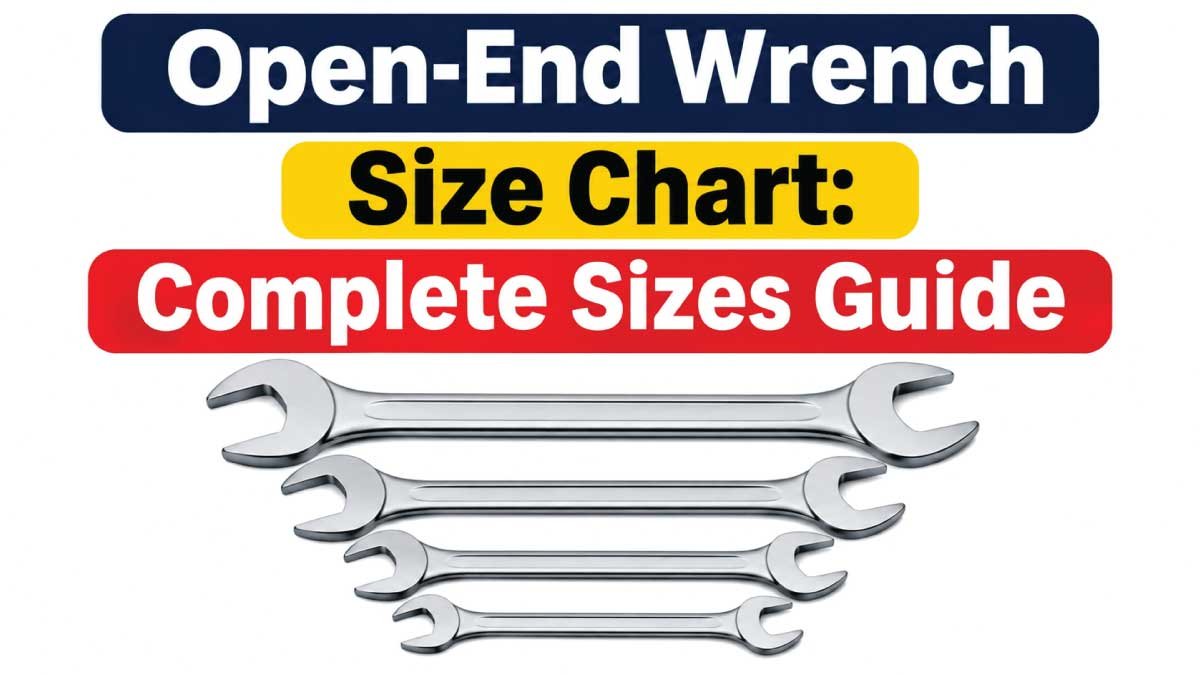
An open-end wrench is a commonly used hand tool for tightening and loosening nuts and bolts in automotive repairs, mechanical maintenance, plumbing, and general household projects. It has a U-shaped opening at each working end that fits around two opposite sides of a fastener. This design allows the wrench to approach a nut or bolt from the side, making it useful when a closed-end wrench cannot slide over the fastener.
Choosing the correct open-end wrench size is essential for getting a secure fit and preventing damage to fasteners. These wrenches are available in metric and SAE measurements, with different handle lengths, jaw openings, and head angles.
This open-end wrench size chart explains common metric and SAE sizes, measurement conversions, wrench types, and practical applications. You will also learn how to select the right wrench, understand its measurements, use it correctly, and avoid common sizing mistakes.
Open-End Wrench Size Chart
Open-end wrench sizes refer to the distance between the two inside gripping surfaces of the U-shaped opening. This measurement is designed to match the width across the flats of a compatible hexagonal nut or bolt head.
For example, a 10 mm open-end wrench is designed to fit a compatible fastener measuring 10 mm across its flats.
The following chart lists common metric open-end wrench sizes and their approximate SAE equivalents.
| Metric Wrench Size | Approximate SAE Equivalent | Common Applications |
|---|---|---|
| 6 mm | 1/4 inch | Small mechanical fasteners |
| 7 mm | 9/32 inch | Small equipment repairs |
| 8 mm | 5/16 inch | Light mechanical work |
| 9 mm | 11/32 inch | Small fittings |
| 10 mm | 3/8 inch | Automotive and general repairs |
| 11 mm | 7/16 inch | Mechanical maintenance |
| 12 mm | 15/32 inch | General workshop work |
| 13 mm | 1/2 inch | Automotive repairs |
| 14 mm | 9/16 inch | Medium mechanical fasteners |
| 15 mm | 19/32 inch | Vehicle maintenance |
| 16 mm | 5/8 inch | Machinery and equipment |
| 17 mm | 21/32 inch | Automotive applications |
| 18 mm | 11/16 inch | Mechanical equipment |
| 19 mm | 3/4 inch | Automotive and industrial work |
| 20 mm | 25/32 inch | General machinery |
| 21 mm | 13/16 inch | Larger mechanical fasteners |
| 22 mm | 7/8 inch | Automotive and industrial repairs |
| 24 mm | 15/16 inch | Large fasteners |
| 27 mm | 1-1/16 inches | Heavy-duty applications |
| 30 mm | 1-3/16 inches | Industrial machinery |
| 32 mm | 1-1/4 inches | Large mechanical fasteners |
Important: SAE equivalents are approximate dimensional comparisons, not recommendations for interchangeable use. A metric wrench and an SAE wrench with similar measurements may not fit a fastener equally well. Always use the exact size specified for the fastener.
SAE Open-End Wrench Size Chart
SAE open-end wrenches are measured in fractions of an inch. They are commonly used with inch-based fasteners found in American-made vehicles, older machinery, equipment, and mechanical systems.
The following chart includes common SAE wrench sizes and their approximate metric conversions.
| SAE Wrench Size | Decimal Equivalent (Inches) | Approximate Metric Equivalent |
|---|---|---|
| 1/4 inch | 0.250 | 6.35 mm |
| 5/16 inch | 0.3125 | 7.94 mm |
| 3/8 inch | 0.375 | 9.53 mm |
| 7/16 inch | 0.4375 | 11.11 mm |
| 1/2 inch | 0.500 | 12.70 mm |
| 9/16 inch | 0.5625 | 14.29 mm |
| 5/8 inch | 0.625 | 15.88 mm |
| 11/16 inch | 0.6875 | 17.46 mm |
| 3/4 inch | 0.750 | 19.05 mm |
| 13/16 inch | 0.8125 | 20.64 mm |
| 7/8 inch | 0.875 | 22.23 mm |
| 15/16 inch | 0.9375 | 23.81 mm |
| 1 inch | 1.000 | 25.40 mm |
| 1-1/16 inches | 1.0625 | 26.99 mm |
| 1-1/8 inches | 1.125 | 28.58 mm |
| 1-1/4 inches | 1.250 | 31.75 mm |
| 1-5/16 inches | 1.3125 | 33.34 mm |
| 1-3/8 inches | 1.375 | 34.93 mm |
| 1-1/2 inches | 1.500 | 38.10 mm |
SAE open-end wrenches are useful when working with fasteners manufactured to inch-based standards. A complete SAE wrench set can provide convenient coverage for common repair and maintenance tasks.
Metric Open-End Wrench Size Chart
Metric open-end wrenches are widely used in modern vehicles, industrial equipment, appliances, and general mechanical systems.
The following chart covers commonly available metric sizes and their approximate decimal-inch conversions.
| Metric Wrench Size | Decimal Equivalent (Inches) | Common Applications |
|---|---|---|
| 6 mm | 0.236 | Small equipment |
| 7 mm | 0.276 | Compact fasteners |
| 8 mm | 0.315 | Small automotive components |
| 9 mm | 0.354 | Mechanical fittings |
| 10 mm | 0.394 | Automotive repairs |
| 11 mm | 0.433 | General maintenance |
| 12 mm | 0.472 | Mechanical equipment |
| 13 mm | 0.512 | Vehicle fasteners |
| 14 mm | 0.551 | Medium fasteners |
| 15 mm | 0.591 | Automotive maintenance |
| 16 mm | 0.630 | Machinery |
| 17 mm | 0.669 | Automotive repairs |
| 18 mm | 0.709 | Mechanical equipment |
| 19 mm | 0.748 | Automotive and machinery |
| 20 mm | 0.787 | Larger fasteners |
| 21 mm | 0.827 | Heavy equipment |
| 22 mm | 0.866 | Industrial and automotive work |
| 24 mm | 0.945 | Large mechanical fasteners |
| 27 mm | 1.063 | Heavy-duty applications |
| 30 mm | 1.181 | Industrial machinery |
| 32 mm | 1.260 | Large equipment |
Not every wrench set contains every size. Smaller sets usually cover common fasteners, while professional and industrial sets often include a wider range.
Open-End Wrench Size in Inches and Millimeters
Open-end wrenches are available in both metric and inch-based measurements. Understanding the conversion between these systems helps when comparing tools and identifying fastener sizes.
One inch equals exactly 25.4 millimeters.
To convert inches into millimeters, multiply the inch measurement by 25.4. To convert millimeters into inches, divide the millimeter measurement by 25.4.
For example:
- 1/4 inch equals 6.35 mm.
- 5/16 inch equals 7.94 mm.
- 3/8 inch equals 9.525 mm.
- 1/2 inch equals 12.7 mm.
- 5/8 inch equals 15.875 mm.
- 3/4 inch equals 19.05 mm.
- 1 inch equals 25.4 mm.
The following table provides a quick conversion reference.
| SAE Measurement | Metric Equivalent |
|---|---|
| 1/4 inch | 6.35 mm |
| 5/16 inch | 7.94 mm |
| 3/8 inch | 9.53 mm |
| 7/16 inch | 11.11 mm |
| 1/2 inch | 12.70 mm |
| 9/16 inch | 14.29 mm |
| 5/8 inch | 15.88 mm |
| 11/16 inch | 17.46 mm |
| 3/4 inch | 19.05 mm |
| 13/16 inch | 20.64 mm |
| 7/8 inch | 22.23 mm |
| 15/16 inch | 23.81 mm |
| 1 inch | 25.40 mm |
These conversions are useful for understanding approximate size relationships. However, use the exact metric or SAE wrench size required by the fastener rather than relying on a close conversion.
What Do Open-End Wrench Sizes Mean?
An open-end wrench size describes the distance between the two inside gripping surfaces at the open end. This is also called the jaw opening.
For example, a 13 mm open-end wrench has a jaw opening designed for a compatible fastener measuring 13 mm across its flats.
The wrench size is different from its overall length. A 13 mm wrench may have a handle several inches long, but its opening remains 13 mm.
Three measurements are useful when comparing open-end wrenches:
1. Jaw Opening
The jaw opening is the distance between the inside gripping surfaces. It determines the fastener size the wrench can accommodate.
2. Overall Length
The overall length measures the distance from one end of the handle to the other. Longer wrenches generally provide more leverage, while shorter models are easier to use in confined spaces.
3. Head Thickness and Width
The head dimensions affect how easily the wrench fits around a fastener. Slim-head designs are useful when nearby components restrict access.
Different Types of Open-End Wrenches
Open-end wrenches are available in several designs. Each type offers different advantages depending on the fastener location, working clearance, and repair requirements.
1. Standard Open-End Wrench
A standard open-end wrench has a U-shaped opening at one or both ends. Its jaws fit around two opposite sides of a hexagonal nut or bolt head.
It is commonly used for general mechanical work, automotive maintenance, and household repairs.
2. Double Open-End Wrench
A double open-end wrench has an open jaw at both ends, usually in two different sizes.
For example, one end may be 10 mm and the other 12 mm. This allows users to work with two fastener sizes using a single tool.
3. Offset Open-End Wrench
An offset open-end wrench has angled ends that provide additional clearance around nearby components.
It is useful when a standard straight wrench cannot be positioned properly because of brackets, pipes, or surrounding equipment.
4. Thin-Head Open-End Wrench
A thin-head open-end wrench has slimmer jaws than a standard model. It can fit into narrow spaces where a thicker wrench head would be difficult to position.
This type is useful for certain fittings, closely spaced nuts, and specialized mechanical applications.
5. Flare Nut Wrench
A flare nut wrench, also called a line wrench, has a nearly closed head with a small opening that allows it to slide over a pipe or tube.
It provides more contact around the fastener than a standard open-end wrench while still allowing access to fittings connected to tubing.
It is commonly used on brake lines, fuel lines, and hydraulic fittings.
6. Ratcheting Open-End Wrench
Some specialized wrench designs combine open-end access with a ratcheting mechanism. These tools allow repeated movement without completely removing the wrench after each short turn.
Their exact operation and suitable applications depend on the model.
Related Guide:
Open-End Wrench vs. Box-End Wrench
Open-end and box-end wrenches are both used for turning nuts and bolts, but their head designs make them suitable for different situations.
| Feature | Open-End Wrench | Box-End Wrench |
|---|---|---|
| Head Design | U-shaped opening | Closed ring |
| Fastener Access | Can approach from the side | Must fit over the fastener |
| Contact | Grips two opposite sides | Surrounds the fastener |
| Grip Security | More sensitive to poor fit | Generally more secure |
| Repositioning | Easy to remove and reposition | Depends on point configuration |
| Common Use | Restricted side access | Tightening and loosening fasteners |
An open-end wrench is useful when a closed ring cannot be placed over the fastener. A box-end wrench is generally preferable when a secure grip is important and there is enough room to fit it over the nut or bolt.
Many combination wrenches include an open end on one side and a box end on the other.
Related Guide:
How to Choose the Right Open-End Wrench Size
Choosing the correct open-end wrench size helps prevent slipping, damaged fasteners, and unnecessary effort.
1. Identify the Fastener Size
First, determine the width across the flats of the nut or bolt head. This measurement tells you which wrench opening is required.
Use a caliper or suitable measuring tool if the fastener size is unknown.
2. Check the Measurement System
Identify whether the fastener uses metric or SAE measurements.
For example, a 13 mm fastener requires a compatible 13 mm wrench, while a 1/2-inch fastener requires a suitable 1/2-inch wrench.
3. Select the Exact Wrench Size
Choose a wrench that fits the fastener closely. A wrench that is too large can slip and damage the corners of the nut or bolt.
Avoid using a nearby size simply because it appears to fit.
4. Consider Handle Length
A longer handle provides more leverage, but it also needs more working space. Shorter wrenches are often easier to use in compact areas.
Choose a length that provides enough control without making the tool difficult to position.
5. Check Head Clearance
Consider whether nearby components restrict access. A slim-head or offset wrench may be more suitable when working around pipes, brackets, and engine components.
6. Consider the Job Requirements
For routine maintenance, a standard metric or SAE wrench set may be sufficient. Specialized fittings may require a flare nut wrench or another purpose-built tool.
Always select a wrench that matches the fastener and application.
Related Guide:
Common Open-End Wrench Sizes for Automotive Work
Open-end wrenches are commonly used in automotive maintenance because vehicles contain many nuts, bolts, and threaded fittings.
The exact sizes required vary according to the vehicle manufacturer, model, production year, and component.
| Metric Wrench Size | Common Automotive Applications |
|---|---|
| 8 mm | Small brackets and fittings |
| 10 mm | Battery-related hardware and small components |
| 12 mm | General vehicle fasteners |
| 13 mm | Brackets and mounting hardware |
| 14 mm | Engine and mechanical components |
| 15 mm | Selected mounting and suspension fasteners |
| 17 mm | Larger mechanical fasteners |
| 19 mm | Wheel-related and other mechanical applications |
| 21 mm | Larger automotive fasteners |
| 22 mm | Selected suspension and drivetrain components |
This is a general reference rather than a vehicle-specific guide. Consult the vehicle service manual to identify the correct wrench size and tightening torque for each component.
How to Use an Open-End Wrench Correctly
Correct technique helps improve fastener contact and reduces the risk of slipping.
Step 1: Inspect the Wrench
Check the jaws and handle for cracks, deformation, or excessive wear. Do not use a damaged wrench.
Step 2: Confirm the Fastener Size
Identify the exact metric or SAE size before selecting the tool.
Step 3: Position the Wrench
Place the open end around the fastener so that both jaws contact the opposite flat surfaces.
Step 4: Check the Fit
Make sure the wrench fits closely. If it moves excessively or slips, stop and confirm that you have selected the correct size.
Step 5: Apply Controlled Force
Turn the wrench smoothly in the required direction. Avoid sudden jerking movements or excessive force.
Step 6: Reposition When Necessary
If there is not enough room for a complete turn, remove the wrench and reposition it for the next movement.
Step 7: Use a Torque Wrench When Required
When a fastener has a specified tightening torque, use a suitable calibrated torque wrench for final tightening. A standard open-end wrench does not measure torque.
Common Open-End Wrench Sizing Mistakes
Using the wrong wrench size or applying incorrect technique can damage fasteners and make repairs more difficult.
Choosing a Wrench That Is Too Large
An oversized opening may slip around the fastener and round its corners. Always choose the exact size.
Confusing Metric and SAE Measurements
Some metric and SAE sizes are close in dimension, but they are not necessarily interchangeable. Use the measurement system specified for the fastener.
Ignoring Jaw Condition
Worn or distorted jaws may not grip the fastener properly. Replace damaged tools instead of continuing to use them.
Using an Open-End Wrench for Excessive Force
Open-end wrenches contact only two opposite sides of a fastener. They may be more likely to slip under excessive force, especially when the fit is poor.
For demanding applications, use a suitable box-end wrench or socket when access allows.
Using the Wrong Wrench Profile
A standard wrench may not fit around a fastener located close to another component. An offset or thin-head model may provide better clearance.
Using a Wrench as a Hammer
An open-end wrench is designed for turning fasteners, not striking objects. Using it as a hammer can damage the tool and create a safety hazard.
Ignoring Torque Specifications
Some mechanical and automotive fasteners require precise tightening torque. Use a calibrated torque wrench when the service specifications require it.
Open-End Wrench Maintenance Tips
Proper maintenance helps keep open-end wrenches in good working condition and extends their service life.
- Clean after use: Remove oil, grease, dirt, and debris from the jaws and handle.
- Inspect the jaws: Check for spreading, cracks, deformation, and excessive wear.
- Prevent corrosion: Dry the tool before storing it in a toolbox.
- Organize by size: Keep metric and SAE wrenches separate and clearly identified.
- Avoid overloading: Do not exceed the tool’s intended application or use an extension unless the manufacturer permits it.
- Store properly: Use a wrench rack or organized tool drawer to prevent damage and make sizes easy to find.
- Replace damaged tools: Stop using wrenches with worn or distorted gripping surfaces.
Regular inspection is especially important for tools used frequently in professional workshops.
Frequently Asked Questions About Open-End Wrench Sizes
What does an open-end wrench size mean?
An open-end wrench size refers to the distance between the inside gripping surfaces of the jaws. It is designed to match the width across the flats of a compatible nut or bolt head.
What are the most common metric open-end wrench sizes?
Common metric sizes include 8 mm, 10 mm, 12 mm, 13 mm, 14 mm, 15 mm, 17 mm, 19 mm, 21 mm, and 22 mm. The sizes needed depend on the equipment or vehicle being serviced.
What are the most common SAE open-end wrench sizes?
Common SAE sizes include 1/4 inch, 5/16 inch, 3/8 inch, 7/16 inch, 1/2 inch, 9/16 inch, 5/8 inch, 11/16 inch, 3/4 inch, and 7/8 inch.
What size open-end wrench do I need for a 10 mm nut?
A 10 mm open-end wrench is designed for a compatible 10 mm hex nut. Make sure the measurement refers to the width across the flats.
Can I use a 1/2-inch wrench instead of a 13 mm wrench?
A 1/2-inch opening equals 12.7 mm, which is close to 13 mm but not identical. It may be too small or provide an unsuitable fit. Use the exact size specified for the fastener.
Is an open-end wrench better than a box-end wrench?
Neither is always better. An open-end wrench can approach a fastener from the side, making it useful when a closed ring cannot fit over it. A box-end wrench generally provides more secure contact when there is enough clearance.
What is a flare nut wrench used for?
A flare nut wrench is used on fittings connected to tubing, such as brake lines and hydraulic lines. Its nearly closed head provides more contact around the fastener than a standard open-end wrench.
Can an open-end wrench be used for tightening bolts?
Yes. It can tighten and loosen compatible nuts and bolts. However, use a calibrated torque wrench when the fastener requires a specific tightening torque.
What is the difference between a double open-end wrench and a combination wrench?
A double open-end wrench has an open jaw at both ends, usually in two different sizes. A combination wrench has an open end on one side and a closed box end on the other.
Conclusion
Choosing the correct open-end wrench size is important for safe and effective mechanical work. The jaw opening must match the fastener’s width across the flats, while the handle length and head design should suit the available working space.
Metric sizes such as 8 mm, 10 mm, 12 mm, 13 mm, 14 mm, 17 mm, and 19 mm are common in many modern mechanical applications. SAE sizes such as 1/4 inch, 3/8 inch, 7/16 inch, 1/2 inch, 9/16 inch, and 3/4 inch are useful for inch-based fasteners.
Use this open-end wrench size chart as a reference when selecting tools for automotive repairs, machinery maintenance, and household projects. Always match the exact fastener size, check the wrench condition, and choose a suitable wrench design for the job.

Engineer Hassan is a Mechanical Engineer with 16+ years of hands-on experience in mechanical hardware, fasteners, and workshop tools. He focuses on size selection, thread identification, and measurement, helping users choose the correct components with accuracy and safety.