
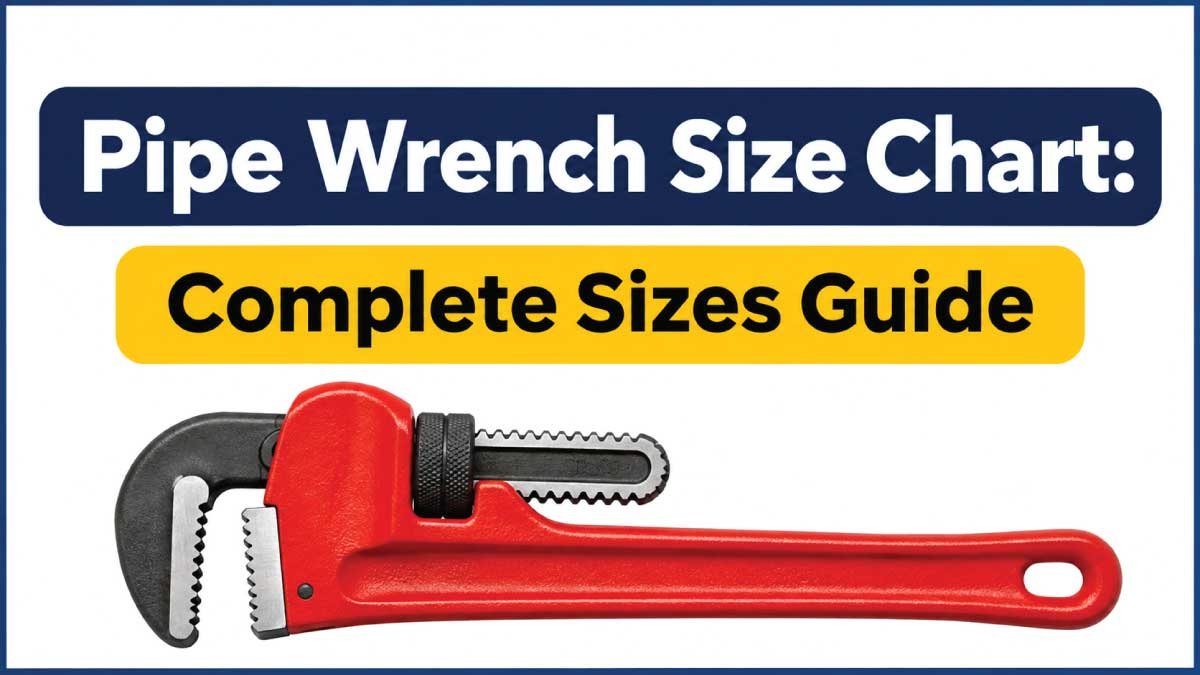
A pipe wrench is an essential tool for plumbers, mechanics, maintenance workers, and DIY users who work with threaded pipes and fittings. Choosing the correct pipe wrench size makes it easier to grip, tighten, loosen, and remove pipes without applying unnecessary force. However, pipe wrench sizing can be confusing because the number printed on the wrench usually refers to its handle length, not the diameter of the pipe it can grip.
This pipe wrench size chart explains common wrench sizes, pipe capacities, measurements, and practical applications. You will also learn how to select the right wrench, understand different pipe wrench types, and use the tool safely for plumbing and mechanical work.
Pipe Wrench Size Chart
Pipe wrenches are available in several sizes, ranging from compact 6-inch models to large 60-inch tools. Each size is designed for a particular range of pipe diameters and working conditions.
The following chart shows commonly available heavy-duty straight pipe wrench sizes and their approximate maximum pipe capacities. Actual capacity and recommended working range can vary by manufacturer and wrench design.
| Pipe Wrench Size | Handle Length (mm) | Maximum Pipe Capacity | Common Application |
|---|---|---|---|
| 6 inches | 150 mm | 3/4 inch | Small plumbing fittings |
| 8 inches | 200 mm | 1 inch | Light plumbing work |
| 10 inches | 250 mm | 1-1/2 inches | Household pipe connections |
| 12 inches | 300 mm | 2 inches | General plumbing work |
| 14 inches | 350 mm | 2 inches | Medium pipe fittings |
| 18 inches | 450 mm | 2-1/2 inches | Larger plumbing connections |
| 24 inches | 600 mm | 3 inches | Heavy-duty pipe work |
| 36 inches | 900 mm | 5 inches | Industrial pipe systems |
| 48 inches | 1,200 mm | 6 inches | Large-diameter pipe work |
| 60 inches | 1,500 mm | 8 inches | Heavy industrial applications |
Important: The maximum pipe capacity is not the same as the wrench’s handle length. For example, a 14-inch pipe wrench has a handle approximately 14 inches long, but its maximum pipe capacity may be around 2 inches. These figures are representative of a common heavy-duty straight pipe wrench range, not universal specifications. Always check the manufacturer’s capacity chart before purchasing or using a wrench.
What Do Pipe Wrench Sizes Mean?
Pipe wrench sizes generally describe the nominal length of the handle. This measurement helps users understand the tool’s overall size and the leverage it can provide.
A longer pipe wrench usually provides more leverage, making it useful for larger or tighter pipe connections. However, a longer handle does not automatically mean the wrench can grip every larger pipe. Jaw opening and manufacturer-rated pipe capacity determine whether the wrench can fit around a particular pipe.
For example:
- A 6-inch pipe wrench has a handle approximately 6 inches long.
- A 10-inch pipe wrench has a handle approximately 10 inches long.
- A 14-inch pipe wrench has a handle approximately 14 inches long.
- A 24-inch pipe wrench has a handle approximately 24 inches long.
- A 36-inch pipe wrench has a handle approximately 36 inches long.
The size printed on the tool should not be confused with the pipe diameter. Always consider handle length, jaw opening, and maximum pipe capacity separately.
Pipe Wrench Size in Inches and Millimeters
Pipe wrenches are commonly labeled in inches, especially in the United States. Metric measurements are also useful when comparing tools from different manufacturers or working with metric product specifications.
| Pipe Wrench Size (Inches) | Approximate Length (mm) | Size Category |
|---|---|---|
| 6 inches | 150 mm | Extra small |
| 8 inches | 200 mm | Small |
| 10 inches | 250 mm | Small |
| 12 inches | 300 mm | Medium |
| 14 inches | 350 mm | Medium |
| 18 inches | 450 mm | Medium-large |
| 24 inches | 600 mm | Large |
| 36 inches | 900 mm | Extra large |
| 48 inches | 1,200 mm | Industrial |
| 60 inches | 1,500 mm | Heavy industrial |
These metric values are rounded nominal handle lengths. They are useful for comparing tools, but the manufacturer’s listed dimensions should be used when exact measurements are required.
Pipe Wrench Size and Pipe Capacity
Pipe capacity describes the largest pipe size a wrench is designed to grip. It is one of the most important specifications to check when selecting a pipe wrench.
A wrench may have a long handle but still have a jaw opening that is too small for a particular pipe. Similarly, choosing a wrench with a capacity much larger than necessary may make a small plumbing job awkward.
The following chart provides common manufacturer-style maximum capacities for straight pipe wrenches.
| Wrench Handle Size | Approximate Maximum Pipe Capacity | Typical Work |
|---|---|---|
| 6 inches | 3/4 inch | Small fittings |
| 8 inches | 1 inch | Small water pipes |
| 10 inches | 1-1/2 inches | Household plumbing |
| 12 inches | 2 inches | Water supply connections |
| 14 inches | 2 inches | Medium plumbing pipes |
| 18 inches | 2-1/2 inches | Larger pipe fittings |
| 24 inches | 3 inches | Commercial plumbing |
| 36 inches | 5 inches | Industrial pipe work |
| 48 inches | 6 inches | Large pipe connections |
| 60 inches | 8 inches | Heavy industrial systems |
Maximum capacity does not mean that every pipe within that limit will be equally easy to work with. The pipe material, surface condition, fitting shape, available clearance, and wrench design all affect performance.
Understanding Nominal Pipe Size and Actual Pipe Diameter
One important detail when choosing a pipe wrench is the difference between nominal pipe size and actual outside diameter.
Nominal Pipe Size (NPS) is a standardized pipe identification system. It does not always represent the pipe’s actual outside diameter. For example, a nominal 1-inch steel pipe has an outside diameter of approximately 1.315 inches, not exactly 1 inch.
This difference matters because a pipe wrench grips the outside surface of the pipe.
Here are some common nominal pipe sizes and their approximate outside diameters for standard NPS steel pipe:
| Nominal Pipe Size | Actual Outside Diameter |
|---|---|
| 1/2 inch | 0.840 inch |
| 3/4 inch | 1.050 inches |
| 1 inch | 1.315 inches |
| 1-1/4 inches | 1.660 inches |
| 1-1/2 inches | 1.900 inches |
| 2 inches | 2.375 inches |
| 2-1/2 inches | 2.875 inches |
| 3 inches | 3.500 inches |
| 4 inches | 4.500 inches |
| 6 inches | 6.625 inches |
These dimensions apply to standard NPS steel pipe. Other pipe systems, including copper, PVC, and metric plumbing systems, can have different outside diameters.
Before selecting a wrench, identify the pipe system and measure its outside diameter when necessary. Then compare the measurement with the wrench manufacturer’s stated jaw capacity.
Different Types of Pipe Wrenches
Pipe wrenches come in several designs. Each type is intended for particular working conditions, pipe materials, and access requirements.
1. Straight Pipe Wrench
A straight pipe wrench is the traditional design used for general plumbing and pipe installation work. It has a straight handle and an adjustable jaw that grips round pipes and threaded fittings.
Straight pipe wrenches are available in small, medium, and large sizes. They are commonly used for tightening and loosening threaded steel pipes, removing pipe sections, and installing plumbing connections.
2. Offset Pipe Wrench
An offset pipe wrench has a jaw arrangement designed to improve access in restricted spaces. Its head geometry makes it easier to position the wrench around pipes located near walls, ceilings, or other obstacles.
This type is useful when a standard straight wrench cannot be positioned comfortably. It is often used in maintenance and industrial plumbing work.
3. End Pipe Wrench
An end pipe wrench is designed for working in tight locations where a conventional wrench may not fit easily. Its head arrangement allows the user to approach a pipe from an angle that can be difficult to reach with a straight model.
It is useful for pipe connections close to walls, parallel pipes, and other restricted installations.
4. Strap Wrench
A strap wrench uses a flexible strap instead of traditional toothed metal jaws. The strap wraps around the pipe or fitting and provides gripping force without the same aggressive tooth marks produced by a conventional pipe wrench.
It is suitable for certain plastic, polished, or finished surfaces where scratching or crushing must be avoided. However, its rated capacity and application limits should always be checked.
5. Chain Pipe Wrench
A chain pipe wrench uses a strong chain to grip large pipes. The chain wraps around the workpiece and connects to the wrench body to provide a secure hold.
This design is commonly used in industrial maintenance, large-diameter piping, and heavy mechanical work. Chain pipe wrenches are available in different capacities depending on the model.
6. Aluminum Pipe Wrench
An aluminum pipe wrench performs many of the same functions as a traditional heavy-duty pipe wrench but uses a lighter body. Its reduced weight makes it easier to carry and handle, especially during overhead work or when working for extended periods.
Aluminum models are available in several sizes and designs. Always check the rated capacity and manufacturer instructions before use.
Related Guide:
How to Choose the Right Pipe Wrench Size
Choosing the correct pipe wrench requires more than looking at the handle length. You should consider pipe diameter, working space, material, and the amount of leverage required.
1. Identify the Pipe Diameter
Start by identifying the pipe size. Check the pipe markings or determine its nominal size from the system specifications.
If the pipe size is unknown, measure its outside diameter with a suitable measuring tool. Remember that nominal pipe size and actual outside diameter are not necessarily identical.
2. Check the Maximum Jaw Capacity
Compare the pipe’s outside diameter and the fitting dimensions with the wrench’s rated capacity.
The jaw must open far enough to fit around the workpiece while allowing the gripping teeth to engage properly. Never force a wrench onto a pipe that exceeds its rated capacity.
3. Consider the Required Handle Length
A longer handle generally provides more leverage, but it also requires more working space and can increase the force applied to the pipe.
For small plumbing connections, a compact wrench may offer better control. Larger wrenches are more appropriate for heavy-duty applications when the pipe and fittings can safely withstand the applied force.
4. Consider the Working Space
Check the available clearance around the pipe. A large straight wrench may be difficult to position in a narrow cabinet or behind plumbing equipment.
An offset or end pipe wrench may be more practical in restricted locations. A compact wrench can also be easier to control around small fittings.
5. Match the Wrench to the Pipe Material
Traditional toothed pipe wrenches are intended primarily for gripping suitable round pipe and threaded fittings. Their teeth bite into the surface to create a secure grip.
This can damage soft, thin-walled, decorative, or finished materials. For plastic or polished fittings, consider a suitable strap wrench or another tool specifically recommended for the material.
6. Consider the Job Requirements
A plumber who regularly works with different pipe diameters may need several wrench sizes. A homeowner performing occasional repairs may only need a smaller general-purpose model.
Choose the tool according to the actual work rather than purchasing the largest available wrench.
Related Guide:
Common Pipe Wrench Sizes for Plumbing Work
Different plumbing tasks require different wrench sizes. The following guide provides practical examples, but the correct choice still depends on the manufacturer’s capacity specifications and the dimensions of the pipe or fitting.
| Pipe Wrench Size | Common Plumbing Applications |
|---|---|
| 6 inches | Small fittings and restricted spaces |
| 8 inches | Light plumbing connections |
| 10 inches | Small household pipe connections |
| 12 inches | General water pipe work |
| 14 inches | Medium plumbing fittings |
| 18 inches | Larger threaded connections |
| 24 inches | Commercial plumbing systems |
| 36 inches | Large pipe installations |
| 48 inches | Industrial pipe maintenance |
| 60 inches | Heavy-duty industrial work |
For common household repairs, 10-inch, 12-inch, and 14-inch pipe wrenches are useful sizes to consider. Larger models are generally intended for bigger pipe systems and more demanding work.
How to Use a Pipe Wrench Correctly
Using a pipe wrench properly improves grip, reduces slipping, and helps protect the tool and workpiece.
Step 1: Inspect the Wrench
Before starting, examine the handle, adjustment nut, hook jaw, heel jaw, and teeth. Do not use a wrench with cracked components, damaged teeth, or a loose jaw assembly.
Step 2: Position the Wrench
Place the wrench around the pipe or suitable fitting. Adjust the jaw until it fits securely. The hook jaw should engage the pipe while maintaining the correct gripping arrangement.
Step 3: Maintain Proper Jaw Contact
A conventional pipe wrench needs the correct relationship between the hook jaw, heel jaw, and workpiece. Follow the manufacturer’s setup instructions and maintain the required clearance between the hook jaw shank and the pipe. This allows both gripping points to work effectively.
Step 4: Apply Controlled Pressure
Apply steady force in the appropriate direction. Avoid sudden jerking movements, excessive force, or using an extension pipe to increase leverage unless the manufacturer specifically permits it.
Step 5: Use a Second Wrench When Needed
When loosening or tightening threaded connections, a second wrench can be used to hold the adjoining fitting or pipe. This helps prevent unwanted movement and reduces stress on connected plumbing components.
Step 6: Release and Inspect
After completing the task, remove the wrench carefully. Inspect the pipe and fitting for damage, deformation, or leaks before returning the system to service.
Related Guide:
Pipe Wrench vs. Adjustable Wrench
A pipe wrench and an adjustable wrench may look similar because both have adjustable jaws. However, they are designed for different purposes.
| Feature | Pipe Wrench | Adjustable Wrench |
|---|---|---|
| Jaw Design | Toothed gripping jaws | Smooth parallel jaws |
| Main Purpose | Round pipes and threaded fittings | Nuts and bolts |
| Grip Method | Teeth bite into the workpiece | Jaws grip flat surfaces |
| Surface Protection | Can leave tooth marks | Generally less damaging |
| Common Applications | Plumbing and pipe work | Mechanical and general repairs |
| Suitable Workpieces | Appropriate round pipe | Hexagonal fasteners and flats |
A pipe wrench should not be used as a substitute for an adjustable wrench on ordinary nuts and bolts. Its teeth can damage the flat surfaces and round off the corners of fasteners.
Likewise, a smooth-jaw adjustable wrench is not a direct replacement for a pipe wrench when substantial gripping force is required on suitable round pipe.
Common Pipe Wrench Sizing Mistakes
Selecting the wrong pipe wrench can make a repair more difficult and may damage the pipe or fitting. Avoid these common mistakes.
Choosing a Wrench Based Only on Handle Length
A 24-inch wrench is not designed for a 24-inch pipe. Its handle length and pipe capacity are two different specifications. Always check the rated capacity.
Ignoring Actual Pipe Diameter
Nominal pipe size does not always equal outside diameter. This is particularly important when comparing different pipe materials and plumbing systems.
Using a Wrench That Is Too Small
A wrench with insufficient jaw capacity may not fit correctly around the workpiece. Forcing it into position can damage the jaws or cause slipping.
Using Excessive Leverage
A longer handle can increase the applied force. Excessive force may damage threads, deform thin-walled pipe, or break a fitting.
Using Toothed Jaws on Finished Surfaces
Traditional pipe wrench teeth can leave marks or damage softer materials. Use a suitable alternative when surface protection is important.
Ignoring Manufacturer Specifications
Pipe wrench capacity and suggested working ranges can vary between manufacturers and models. Do not assume that two wrenches with the same handle length have identical jaw openings or pipe capacities.
Pipe Wrench Maintenance Tips
Regular maintenance helps keep a pipe wrench working properly and extends its service life.
- Clean the jaws: Remove dirt, grease, rust, and debris from the teeth after use.
- Inspect the teeth: Check the hook and heel jaws for excessive wear, chipping, or damage.
- Check the adjustment nut: Make sure the jaw moves smoothly and the adjustment mechanism is not damaged.
- Lubricate moving parts: Apply suitable lubricant to the adjustment mechanism when recommended by the manufacturer.
- Keep the wrench dry: Store the tool in a dry location to reduce corrosion.
- Replace worn jaws: Use approved replacement parts when the gripping teeth become excessively worn.
- Avoid improper use: Do not use the wrench as a hammer, pry bar, or substitute for another tool.
Before every important job, inspect the wrench to confirm that its jaws and adjustment mechanism are in safe working condition.
Frequently Asked Questions About Pipe Wrench Sizes
What size pipe wrench is best for home plumbing?
A 10-inch, 12-inch, or 14-inch pipe wrench is often useful for common household plumbing tasks. The correct size depends on the pipe diameter, fitting dimensions, and available working space.
What size pipe can a 12-inch pipe wrench handle?
A common heavy-duty 12-inch straight pipe wrench has a maximum rated pipe capacity of approximately 2 inches. Its suggested working range may be smaller, depending on the manufacturer.
What size pipe wrench do I need for a 1-inch pipe?
A 10-inch or 12-inch pipe wrench may be suitable for many 1-inch nominal steel pipe applications. However, you should check the actual outside diameter and the wrench’s rated capacity before use.
What does a 14-inch pipe wrench mean?
A 14-inch pipe wrench generally refers to a tool with a nominal handle length of approximately 14 inches. It does not mean the wrench is designed to grip a 14-inch-diameter pipe.
What is the largest common pipe wrench size?
Heavy-duty straight pipe wrenches are available in sizes up to 60 inches in some product ranges. These large tools can have maximum rated pipe capacities of approximately 8 inches, depending on the model.
Can I use a pipe wrench on PVC pipe?
A traditional toothed pipe wrench is generally not recommended for PVC pipe because its teeth can damage or crush the material. Use a suitable strap wrench or another tool approved for the particular PVC fitting and application.
Are pipe wrench sizes universal?
No. Handle lengths and general size labels are widely used, but jaw openings, maximum capacities, and suggested working ranges can differ between manufacturers and wrench designs.
What is the difference between pipe wrench size and jaw capacity?
Pipe wrench size usually refers to the nominal handle length. Jaw capacity describes the maximum pipe or fitting size the wrench is designed to grip. Both measurements are important when selecting a tool.
Should I use a larger pipe wrench for more leverage?
A larger wrench can provide more leverage, but excessive force may damage pipes, fittings, or threads. Select a wrench that is appropriate for the pipe and job, and apply controlled pressure.
Conclusion
Choosing the correct pipe wrench size is important for safe and effective plumbing and mechanical work. The size printed on a pipe wrench generally refers to its handle length, while its jaw capacity determines the maximum pipe diameter it can grip.
Small 6-inch to 10-inch wrenches are useful for compact fittings and light plumbing tasks. Medium 12-inch to 18-inch models cover many general plumbing applications, while 24-inch and larger wrenches are commonly used for heavy-duty and industrial pipe work.
Use this pipe wrench size chart as a starting point, but always check the manufacturer’s specifications before selecting a tool. Consider the actual pipe diameter, jaw capacity, working clearance, and material to choose a wrench that provides a secure grip without unnecessary damage.

Engineer Hassan is a Mechanical Engineer with 16+ years of hands-on experience in mechanical hardware, fasteners, and workshop tools. He focuses on size selection, thread identification, and measurement, helping users choose the correct components with accuracy and safety.