
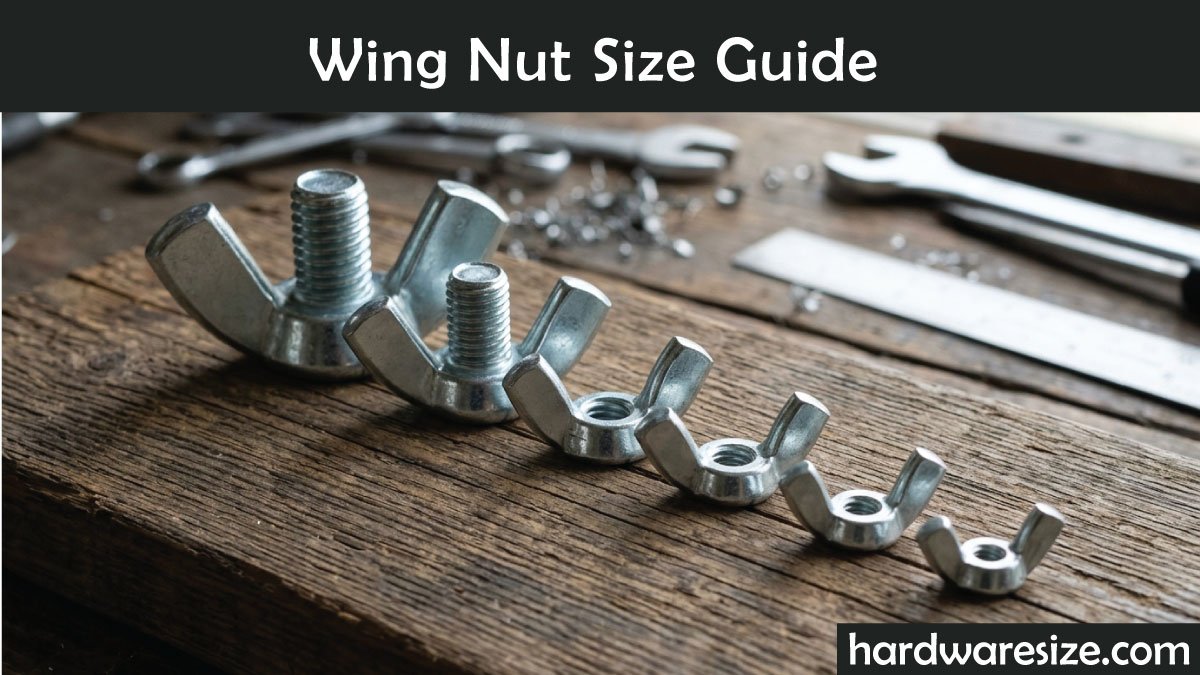
Wing nuts have been one of the most accessible fastening remedies both at home and in industries. They have a unique wing shape which means that they can be loosened and tightened without the need of a single wrench or spanner.
When putting together furniture, using machinery, temporary fittings, etc, it is important to know the sizes, dimensions and standards of wing nuts to select the right fastener.
This detailed guide explains wing nut sizing, thread types, common standards, materials, and how to read a wing nut size chart correctly.
What Is a Wing Nut?
A wing nut is a kind of nut that has two pieces of flat protrusions (wings) at different sides of it. These wings give leverage and one can tighten or loosen the nut without the help of fingers only. Where the adjustments or removal should be done frequently, wing nuts are utilized.
Common Uses of Wing Nuts
-
Furniture assembly
-
Electrical enclosures
-
Automotive components
-
Industrial machinery
-
Clamps and fixtures
-
Temporary installations
Because they are hand-tightened, wing nuts are ideal for low-to-moderate load applications.
Why Wing Nut Size Matters
It is critical to choose a wing nut based on the right size to ensure the safety, performance, and long life connections.
The wrong size may lead to loose and/or unstable fasteners, stripped threads, and tightening (or loosening) problems and even broken bolts or studs.
Correct sizing gives increased confidence in engagement, ease of functioning and increases nut and bolt life.
-
Loose or unstable connections
-
Stripped threads
-
Difficulty tightening or loosening
-
Damage to bolts or studs
Correct sizing improves reliability and extends the life of both the nut and the bolt.
How Wing Nut Sizes Are Measured
The sizing of the Wing nuts is limited to thread size, rather than wing width. Precise measurement is guaranteed to be compatible with bolts or threaded rods.
The dimensions of interest are thread diameter, thread pitch (metric) or threads per inch (imperial), nut thickness (height) and wing span (total width).
These can be meticulously measured to assure the easy assembly and the secure fastening in any use.
Key Measurements Include:
- Thread diameter
- Thread pitch (metric) or threads per inch (TPI) (imperial)
- Nut thickness (height)
- Wing span (overall width)
Let’s break these down in simple terms.
Understanding Thread Sizes
Thread sizes determine the proper fit and secure fastening of wing nuts. It uses metric and imperial systems that have certain criteria..
Understand thread diameter, pitch, and the difference between UNC/UNF and ISO metric threads is critical for proper selection.
This knowledge eliminates cross-threading and provides mechanical reliability and enhances safety in general in assemblies.
Metric Thread Sizes
Metric wing nuts follow the ISO metric thread system and are marked with the letter “M” plus the nominal thread diameter in millimeters.
For example, an M6 wing nut has a 6 mm diameter. Thread pitch, measured in millimeters, specifies the distance between threads.
Fitting the right pitch is essential towards tightening and stable fastening.
Example:
- M6 wing nut → 6 mm thread diameter
Metric threads are further defined by their thread pitch, which is the distance between threads measured in millimeters.
Example:
- M6 × 1.0 → 1.0 mm distance between threads
Imperial (UNC/UNF) Thread Sizes
Imperial wing nuts use inch-based measurements and are common in the USA and also older machinery. Sizes are determine by nominal bolt diameter in inches and threads per inch (TPI).
For example, a 1/4″-20 wing nut has a 1/4 inch diameter and 20 threads per inch. Correct selection prevents thread stripping and ensures secure assembly.
- Nominal bolt diameter (in inches)
- Threads per inch (TPI)
Example:
- 1/4″-20 → 1/4 inch diameter, 20 threads per inch
Standard Wing Nut Size Chart (Metric)
Metric wing nuts follow standardized ISO dimensions to ensure consistency. The chart provides approximate thread diameters, thicknesses, and wing spans for common sizes.
Whereas there are minimal differences between manufacturers. This source can be used to choose the right size fast to get a proper fit, easy installation, and dependable performance in the industrial, mechanical, or home environment.
| Thread Size | Thread Pitch (mm) | Nut Height (mm) | Wing Span (mm) |
|---|---|---|---|
| M3 | 0.5 | 6 | 12 |
| M4 | 0.7 | 8 | 16 |
| M5 | 0.8 | 10 | 20 |
| M6 | 1.0 | 12 | 24 |
| M8 | 1.25 | 15 | 32 |
| M10 | 1.5 | 18 | 40 |
| M12 | 1.75 | 22 | 50 |
This chart helps you quickly identify the right wing nut for your bolt size.
Standard Wing Nut Size Chart (Imperial)
Imperial wing nuts follow ANSI and ASME standards, ensuring consistency across applications. Common sizes include #10-24, 1/4″-20, and 1/2″-13, with varying nut heights and wing spans.
Always confirm thread compatibility before installation to prevent stripped threads, loose connections, or improper fastening in mechanical and industrial projects.
| Thread Size | Threads Per Inch (TPI) | Nut Height (in) | Wing Span (in) |
|---|---|---|---|
| #10-24 | 24 | 0.31 | 0.75 |
| 1/4″-20 | 20 | 0.38 | 0.94 |
| 5/16″-18 | 18 | 0.44 | 1.12 |
| 3/8″-16 | 16 | 0.50 | 1.31 |
| 1/2″-13 | 13 | 0.63 | 1.75 |
Always verify thread compatibility before installation.
Wing Nut Standards Explained
Wing nuts are produced to the accepted international standards to ensure that they are interchangeable and that they fit.
Dimensions and thread specifications of both metric and imperial fasteners are defined in DIN, ISO, ANSI and ASME.
When the correct standard is chosen, then reliability becomes assured particularly when the application under consideration is industrial, export or high precision where conformity is highly essential.
Common Wing Nut Standards
-
DIN 315 – Metric wing nuts widely used in Europe and Asia
-
ISO 4032 – International metric nut standards
-
ASME B18.17 – American standard for wing nuts
-
ANSI – Covers imperial thread specifications
When purchasing wing nuts for industrial or export use, matching the correct standard is crucial.
Types of Wing Nuts
Wing nuts are available in various designs to fit a particular application. Type A has smooth and rounded wings that can be easily tightened by the hand.
Type B has straight and flat wings with greater torque and heavy-duty types have heavier weight bodies and wings with larger bolts. The choice of the type guarantees convenience and mechanical durability.
1. Type A (Rounded Wings)
- Smooth, rounded wings
- Easy hand grip
- Common in light-duty applications
2. Type B (Rectangular Wings)
- Flat, straight wings
- Higher torque than Type A
- Used in industrial settings
3. Heavy-Duty Wing Nuts
- Thicker body and wings
- Designed for higher loads
- Often used with large bolts
Wing Nut Materials and Their Impact on Size
Thread size does not change but the material affects the durability, resistance to corrosion and suitability of application.
The most common materials are carbon steel, which is strong, stainless steel, which is used outdoors, brass, which is lightweight, and non-conductive and is made with plastic or nylon.
It is corrosion resistant and attractive. The choice of materials has some slight influence on the total nut sizes.
Common Materials
-
Carbon steel – Strong and cost-effective
-
Stainless steel – Corrosion-resistant, ideal for outdoor use
-
Brass – Non-sparking, decorative, corrosion-resistant
-
Plastic/Nylon – Lightweight, electrical insulation
Material selection does not change the thread size but may slightly affect overall dimensions.
How to Measure a Wing Nut Correctly
Wing nut measurement should be correct, otherwise it may cross thread. Measure internal thread diameter, measure thread pitch, measure nut height and wing tip-tip wing span.
It is important to match these dimensions to a size chart to be sure that the right wing nut is chosen to be applied.
Step-by-Step Guide
-
Measure the internal thread diameter using a caliper
-
Determine the thread pitch with a thread gauge
-
Measure the nut height from top to bottom
-
Measure the wing span from tip to tip
Matching these values with a wing nut size chart helps identify the exact size.
Metric vs Imperial Wing Nuts
Understand whether fasteners are metric or imperial prevents cross-threading and damage. Thread pitch is used to measure the metric nuts in millimeters, and inches and threads per inch (TPI) are used to measure imperial nuts.
Standards and regions vary and there is always a need to ensure that the type of fastener is checked before installing to ensure that there is proper engagement and mechanical integrity.
| Feature | Metric | Imperial |
|---|---|---|
| Measurement | Millimeters | Inches |
| Thread Definition | Pitch (mm) | TPI |
| Common Regions | Europe, Asia | USA |
| Standards | DIN, ISO | ANSI, ASME |
Never force a metric wing nut onto an imperial bolt (or vice versa), as thread damage is likely.
👉 Nut Size Chart is your ultimate guide to types, materials, and applications of nuts. Learn how to pick the right nut for any project, understand different sizes and grades, and ensure secure, reliable connections. Ideal for DIYers, engineers, and professionals, this post makes choosing nuts simple and accurate. Read the full guide for expert tips!
Common Applications by Wing Nut Size
The size of Wing nuts are applicable in various purposes. The M3-M4 size is used to accommodate electronics and light fixtures, M5-M6 is used to accommodate furniture and light machinery,
M8-M10 are used to accommodate automotive and mechanical assemblies, and M12+ are used to accommodate heavy-duty industry work.
Proper sizing will guarantee safety, ease of assembly and optimum performance.
-
M3–M4: Electronics, small fixtures
-
M5–M6: Furniture, light machinery
-
M8–M10: Automotive and mechanical assemblies
-
M12 and above: Heavy-duty industrial use
Choosing the correct size ensures safe and efficient operation.
Advantages of Using Wing Nuts
Wing nuts can be installed and adjusted very easily and reused, tool free. They would be perfect in cases where the assembling and disassembling must be done many times.
They are, however, not suggested in applications that have high vibration or heavy loads unless accompanied with locking solutions.
It is conveniently used to the maximum without sacrificing safety.
- Tool-free installation
- Quick assembly and removal
- Reusable fastener
- Ideal for frequent adjustments
However, wing nuts are not recommended for high-vibration or heavy-load applications unless combined with locking solutions.
Common Mistakes to Avoid
Safety precaution prevents the error of fastening. Some of the mistakes that usually occur are the wrong thread standard,
Hand tightening, lack of consideration of the suitability of the material, or the belief that wing span is the measure of size.
The thread diameter and thread pitch should always be used to ensure that you are choosing the right wing nuts so that you are not dealing with stripped threads nor do you have loose or unstable connections.
- Using the wrong thread standard
- Over-tightening by hand
- Ignoring material compatibility
- Assuming wing span determines size
Always rely on thread size, not appearance.
Final Thoughts
The selection of the fasteners is easy and precise with the knowledge of the wing nut size chart, dimensions, thread sizes, and standards.
Whether it is a DIY project that you are working on or an assembly in an industry, having the right wing nut will enhance safety, durability and performance.
Once you know how to read a size chart and ended up with the correct thread standard, you will be able to have the correct wing nut to use each time.
When you frequently deal with fasteners, it is better to have a wing nut size chart to help you save time, eliminate the chances of errors, and create the result of the work on a professional level.
👉 Heavy Hex Nut Guide explains everything about definition, dimensions, sizes, and materials of heavy hex nuts. Learn how to select the right nut for high-strength applications, ensure proper fit, and understand material differences for durability. This post is perfect for engineers, builders, and DIY enthusiasts. Read the full guide for complete insights!

Engineer Hassan is a Mechanical Engineer with 16+ years of hands-on experience in mechanical hardware, fasteners, and workshop tools. He focuses on size selection, thread identification, and measurement, helping users choose the correct components with accuracy and safety.