
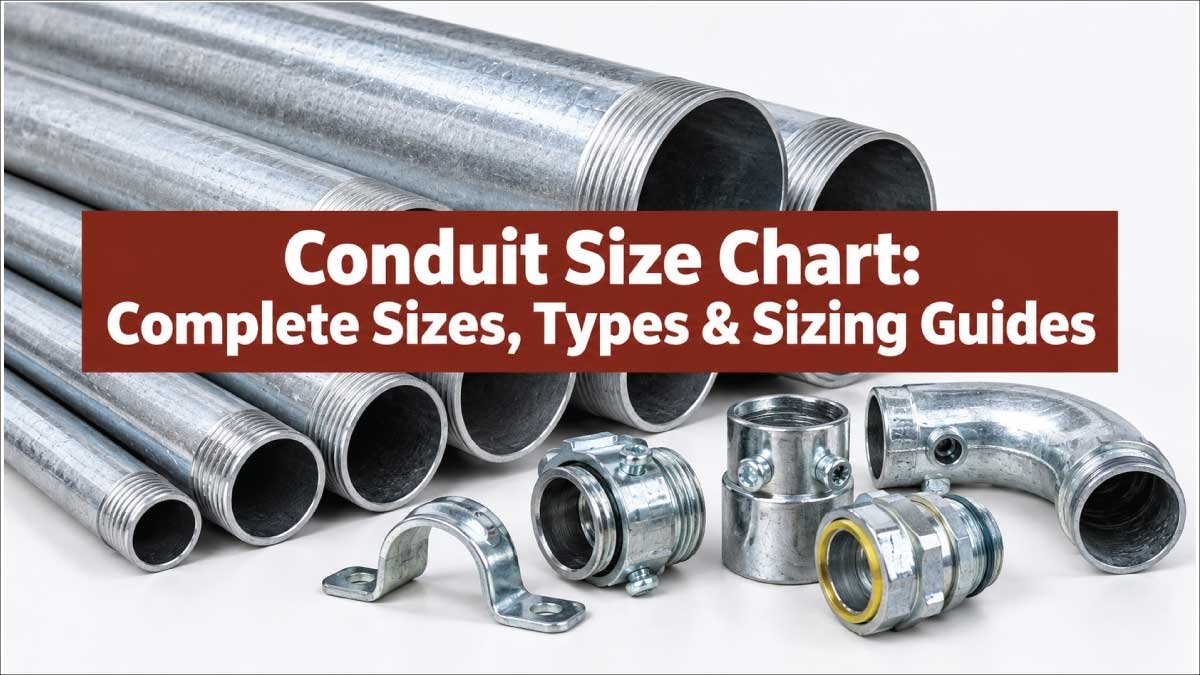
Choosing the correct electrical conduit size is important for protecting conductors, maintaining safe installations, and making future maintenance easier. A conduit that is too small can make wire pulling difficult, while an unnecessarily large conduit can increase material cost and take up more installation space.
This conduit size chart explains common conduit trade sizes, major conduit types, inside and outside diameter considerations, conduit fill, wire capacity, measurement methods, and practical sizing factors. Whether you are working with EMT, rigid metal conduit, IMC, PVC, or flexible conduit, understanding how conduit sizing works helps you select an appropriate raceway for the application.
What Is Electrical Conduit?
Electrical conduit is a protective raceway used to route and protect insulated electrical conductors. It can be made from materials such as galvanized steel, aluminum, PVC, or flexible metallic and nonmetallic materials.
Conduit protects wiring from mechanical damage, moisture, chemicals, sunlight, and other environmental conditions depending on the conduit type and installation method.
Common applications include:
- Residential electrical wiring
- Commercial buildings
- Industrial control systems
- Motor circuits
- Outdoor electrical installations
- Underground wiring systems
- Data and communication installations
- Machinery and equipment wiring
Conduit is identified primarily by trade size, rather than simply by measuring its outside diameter.
Trade Size vs. Actual Diameter
One of the most important points to understand is that conduit trade size does not necessarily equal its measured inside or outside diameter.
For example, a conduit identified as 1-inch trade size does not simply have a 1-inch outside diameter. Its actual dimensions depend on the conduit type and wall thickness.
The trade size is therefore used as the common identification system, while actual dimensions are used when calculating physical clearance, conduit fill, bending space, and installation requirements.
Conduit Size Chart
The following chart provides a practical overview of commonly encountered conduit trade sizes. Exact internal and external dimensions can vary according to conduit type, wall thickness, manufacturing requirements, and applicable standards.
| Trade Size | Approx. Nominal Metric Reference | Common Uses |
|---|---|---|
| 1/2 in. | 16 mm class | Small branch circuits and control wiring |
| 3/4 in. | 20 mm class | Branch circuits and general wiring |
| 1 in. | 25 mm class | Larger branch circuits |
| 1-1/4 in. | 32 mm class | Multiple conductors and feeders |
| 1-1/2 in. | 40 mm class | Feeders and larger cable groups |
| 2 in. | 50 mm class | Larger feeders and commercial wiring |
| 2-1/2 in. | 63 mm class | Large conductors and feeders |
| 3 in. | 75 mm class | Large cable installations |
| 3-1/2 in. | 90 mm class | High-capacity raceways |
| 4 in. | 100 mm class | Large feeders and major distribution wiring |
| 5 in. | 125 mm class | Large commercial and industrial installations |
| 6 in. | 150 mm class | Large cable groups and distribution systems |
The metric references in this chart are nominal classes, not direct conversions of the actual conduit diameter. Metric and inch-based conduit systems should not be treated as automatically interchangeable.
Common Conduit Sizes and Where They Are Used
Different trade sizes are suitable for different wiring arrangements. The correct choice depends on the number, size, and type of conductors rather than simply the circuit voltage.
1/2-Inch Conduit
1/2-inch conduit is one of the smaller commonly used trade sizes. It is frequently associated with smaller branch circuits, control wiring, and installations containing a limited number of appropriately sized conductors.
The actual allowable conductor capacity must be determined using the applicable conduit-fill rules rather than assuming that every small wire will fit.
3/4-Inch Conduit
3/4-inch conduit provides more internal space than 1/2-inch conduit and is useful where additional conductors or larger conductors are required.
It is also sometimes selected to make wire pulling easier when the installation conditions justify additional space.
1-Inch Conduit
1-inch conduit is commonly encountered in commercial, industrial, and larger residential installations. It can accommodate substantially more conductor area than smaller raceways, but its capacity still depends on conductor dimensions and conduit type.
1-1/4-Inch to 2-Inch Conduit
These sizes are commonly considered when circuits require larger conductors, multiple conductors, feeder wiring, or more physical room for installation.
Larger conduit can also be useful where long pulling distances or multiple bends make installation more demanding.
2-1/2-Inch and Larger Conduit
Large conduit sizes are typically associated with substantial feeders, distribution systems, industrial equipment, and installations containing many or large conductors.
At these sizes, installation planning becomes increasingly important because conduit weight, bending requirements, pulling tension, support, and available space can all affect the design.
Types of Electrical Conduit
Conduit size alone does not determine whether a raceway is suitable. The conduit material and construction also affect its dimensions, installation method, durability, and permitted applications.
EMT Conduit
Electrical Metallic Tubing, commonly called EMT, is a thin-wall metallic raceway used extensively for electrical installations.
Typical characteristics include:
- Lightweight construction
- Easy field bending
- Metallic protection
- Availability in many trade sizes
- Frequent use in commercial and industrial wiring
EMT is generally easier to bend than heavier rigid metallic raceways, making it practical for installations with multiple changes in direction.
Rigid Metal Conduit
Rigid metal conduit has a heavier wall construction than EMT and provides strong mechanical protection.
It may be used where increased physical protection or particular environmental characteristics are required.
Rigid metallic conduit is available in multiple materials and finishes, so the exact dimensions and characteristics should be checked against the selected product.
IMC Conduit
Intermediate Metal Conduit is a metallic raceway that provides substantial mechanical protection while generally being lighter than traditional heavy rigid conduit.
It is commonly used in commercial and industrial electrical systems where a strong metallic raceway is required.
PVC Conduit
PVC electrical conduit is a nonmetallic raceway commonly used in locations where corrosion resistance, lightweight construction, or underground applications are important.
PVC conduit is available in different schedules and product types. Consequently, the actual internal diameter can differ between products with the same nominal trade size.
Flexible Metal Conduit
Flexible metal conduit can bend around obstacles and equipment connections without requiring rigid elbows for every change in direction.
It is particularly useful for:
- Equipment connections
- Motors
- Fixtures
- Areas requiring flexibility
- Short connection sections
Liquidtight Flexible Conduit
Liquidtight flexible conduit is designed for applications where flexibility is required together with protection against moisture or liquid exposure.
It is commonly associated with motors, outdoor equipment, pumps, machinery, and other locations where environmental conditions require additional protection.
EMT Conduit Size Chart
EMT is one of the most recognizable metallic conduit types, but its actual dimensions should not be confused with its trade-size designation.
A simplified trade-size chart is shown below.
| EMT Trade Size | Common Nominal Reference | Typical Application |
|---|---|---|
| 1/2 in. | Small raceway | Branch and control wiring |
| 3/4 in. | Small raceway | General branch circuits |
| 1 in. | Medium raceway | Multiple conductors |
| 1-1/4 in. | Medium-large raceway | Feeders and larger wiring |
| 1-1/2 in. | Large raceway | Larger conductor groups |
| 2 in. | Large raceway | Feeders and commercial systems |
| 2-1/2 in. | Extra-large raceway | Large conductor installations |
| 3 in. | Extra-large raceway | Distribution systems |
| 4 in. | Large-capacity raceway | Major feeders and distribution |
For exact EMT inside diameter, outside diameter, and wall thickness, use the dimensional information for the specific product being installed.
PVC Conduit Size Chart
PVC conduit is available in different schedules and configurations, so two conduits with the same trade size can have different wall thicknesses and internal dimensions.
| Trade Size | Nominal Metric Class | Typical Application |
|---|---|---|
| 1/2 in. | 16 mm class | Small wiring |
| 3/4 in. | 20 mm class | Branch circuits |
| 1 in. | 25 mm class | General wiring |
| 1-1/4 in. | 32 mm class | Larger conductor groups |
| 1-1/2 in. | 40 mm class | Feeders |
| 2 in. | 50 mm class | Larger feeders |
| 2-1/2 in. | 63 mm class | Large cable groups |
| 3 in. | 75 mm class | Distribution wiring |
| 4 in. | 100 mm class | Large installations |
| 6 in. | 150 mm class | High-capacity raceways |
Always identify the PVC schedule or product specification before using an inside-diameter value for calculations.
How Conduit Size Is Determined
Selecting conduit size involves more than counting wires. The primary factors include conductor dimensions, number of conductors, conduit type, available interior area, installation conditions, and applicable electrical requirements.
Conduit Fill
Conduit fill describes how much of the usable internal raceway area is occupied by conductors.
A larger number of wires does not automatically mean that the next trade size should be selected. The cross-sectional area of the individual conductors is also important.
For example, ten relatively small conductors may require less internal area than a smaller number of large conductors.
Number of Conductors
The conductor count is one of the first pieces of information needed when selecting conduit.
Consider:
- Number of current-carrying conductors
- Grounding conductors
- Neutral conductors
- Control wires
- Communication conductors where applicable
- Future wiring requirements
The applicable electrical rules determine which conductors must be included in particular calculations.
Conductor Size
Wire gauge or conductor cross-sectional area has a direct effect on required raceway space.
A conduit selected for small control conductors may be completely unsuitable for the same number of large power conductors.
This is why a conduit size chart should be used as a starting point rather than as a substitute for an actual fill calculation.
How to Measure Conduit Size
Measuring an existing conduit can be useful when the original labeling is unavailable, but measuring the outside diameter alone may not reveal its trade size.
Step 1: Identify the Conduit Type
First determine whether the raceway is:
- EMT
- IMC
- Rigid metal conduit
- PVC
- Flexible metal conduit
- Liquidtight flexible conduit
- Another approved raceway type
The same nominal trade size can have different dimensions depending on the product type.
Step 2: Measure the Outside Diameter
A caliper can provide a more precise outside-diameter measurement than a standard tape measure.
For flexible conduit, measurement can be less straightforward because the surface and construction can vary.
Step 3: Check Wall Thickness
If the inside diameter is needed, wall thickness becomes important.
For a round conduit, the relationship can be expressed conceptually as:
Inside Diameter = Outside Diameter − 2 × Wall Thickness
Do not assume wall thickness from the trade size. Use the manufacturer’s dimensional specification when accuracy matters.
Step 4: Check Markings
Many conduits have markings that identify their type, size, material, or manufacturer information.
These markings are often more useful than trying to identify a conduit solely from a physical measurement.
Conduit Fill and Wire Capacity
One of the most common conduit-sizing mistakes is choosing a raceway based only on the number of wires.
A proper capacity calculation considers the actual dimensions of the conductors and the usable internal area of the raceway.
For a group of conductors, the total conductor area can be represented as:
Total Conductor Area = Area of Conductor 1 + Area of Conductor 2 + …
The result is then compared with the permitted conduit-fill area for the particular installation.
Why Fill Percentage Matters
Electrical installation rules commonly establish maximum allowable fill percentages based on the number and arrangement of conductors.
The permitted percentage is not necessarily the same for every situation.
Therefore, do not apply one generic fill percentage to every conduit installation. The applicable code, conductor configuration, and raceway type need to be considered.
Leave Practical Working Space
A conduit that technically meets a fill requirement may still be inconvenient to install if the run is long or contains many bends.
Additional internal space can make:
- Wire pulling easier
- Conductor replacement easier
- Maintenance simpler
- Future modifications more practical
- Bends less difficult to manage
However, oversizing should also be avoided when physical space, cost, or installation requirements make it unnecessary.
Also Read:
Conduit Size for Common Wiring Applications
There is no universal conduit size for a circuit simply because it has a particular voltage or breaker rating.
Two circuits with the same voltage can require different raceway sizes because their conductor sizes and quantities differ.
Branch Circuits
Smaller branch circuits often use smaller raceways, but the actual selection depends on conductor size and quantity.
Feeders
Feeder circuits frequently require larger conduit because they use larger conductors or multiple conductors.
Motor Circuits
Motor installations can require special attention to conductor quantity, conductor size, equipment connections, bending space, and environmental conditions.
Flexible or liquidtight sections may also be used near motors where vibration or movement is present.
Control Wiring
Control systems may use numerous smaller conductors. Although each individual wire may occupy little space, a high conductor count can make a larger raceway practical.
Underground Wiring
Underground installations may use PVC or other suitable raceways depending on the environment and applicable requirements.
The raceway must be appropriate for burial conditions, physical protection, moisture exposure, and the complete installation method.
Also Read:
Conduit Size vs. Wire Size
Conduit size and wire size are related, but they are not the same measurement.
Wire size describes the electrical conductor itself, commonly using AWG in some systems or millimeter-based cross-sectional area in others.
Conduit size identifies the raceway used to protect and route those conductors.
For example, a 12 AWG conductor does not mean that a 12-inch or 12-unit conduit is required. The wire designation and conduit trade size use completely different systems.
When selecting a raceway, evaluate both:
- Conductor gauge or cross-sectional area
- Number of conductors
- Conduit internal area
- Raceway type
- Installation requirements
Conduit Types Comparison
The best conduit type depends on the environment and installation requirements rather than size alone.
| Conduit Type | Material | Main Characteristic | Common Applications |
|---|---|---|---|
| EMT | Metal | Lightweight and bendable | Commercial wiring |
| IMC | Metal | Strong mechanical protection | Commercial and industrial |
| Rigid Metal | Metal | Heavy-duty protection | Demanding installations |
| PVC | Nonmetal | Corrosion resistant | Underground and corrosive areas |
| Flexible Metal | Metal | Flexible installation | Equipment connections |
| Liquidtight Flexible | Metal or nonmetal | Flexible and moisture resistant | Motors and wet locations |
The specific approval and suitability of each raceway depend on the product and installation conditions.
Also Read:
Factors to Consider When Choosing Conduit Size
Before purchasing conduit, evaluate the complete installation rather than selecting a size from a single chart.
Conductor Count
Count the conductors that will occupy the raceway and identify their dimensions.
Conductor Diameter
Two wires with the same general electrical purpose can have different physical dimensions depending on insulation type and construction.
Conduit Length
Long runs can make wire pulling more difficult. A larger raceway may provide additional working room where permitted and practical.
Number of Bends
Multiple bends increase pulling difficulty. The route should be planned so that the conduit can be installed and conductors pulled without exceeding applicable limitations.
Environment
Consider whether the conduit will be exposed to:
- Water
- Moisture
- Chemicals
- Sunlight
- Corrosive substances
- Mechanical impact
- Temperature extremes
- Underground conditions
Future Expansion
If additional wiring is reasonably expected, the installation may benefit from planning additional capacity where permitted by the applicable requirements.
Common Conduit Sizing Mistakes
Correct conduit sizing is not only about selecting a large enough raceway. Several common mistakes can create installation problems.
Using Outside Diameter as the Available Space
The outside diameter does not represent the usable conductor area. Wall thickness reduces the interior space.
Assuming Trade Size Equals Actual Diameter
A conduit trade designation is a standardized identification rather than a simple statement of its measured diameter.
Ignoring Insulation Thickness
Conductors with different insulation types can have different outside diameters even when the conductor itself has the same electrical size.
Mixing Conduit Types Without Checking Dimensions
A 1-inch EMT, PVC, and rigid metal conduit should not automatically be assumed to have identical internal dimensions.
Choosing the Smallest Possible Raceway
Minimum-size selection may satisfy a basic calculation but can make installation unnecessarily difficult.
Using a Generic Wire-Capacity Chart
Generic charts can be misleading when they do not account for the specific conductor construction, insulation, raceway type, and applicable installation requirements.
How to Choose the Correct Conduit Size
A practical conduit-sizing process can be summarized in several steps.
Identify the circuit or wiring application.
Determine the conductor type and electrical size.
Determine the number of conductors.
Find the actual outside dimensions of the conductors.
Identify the conduit type and trade size.
Determine the usable internal raceway area.
Apply the appropriate conduit-fill requirements.
Consider bends, pulling distance, and installation conditions.
Check temperature, moisture, corrosion, and physical-protection requirements.
Verify the final selection against the applicable electrical requirements and manufacturer specifications.
This process is more reliable than choosing conduit based solely on a rule of thumb.
Frequently Asked Questions About Conduit Sizes
What is the most common conduit size?
There is no single conduit size that is appropriate for every installation. 1/2-inch and 3/4-inch trade sizes are common in smaller wiring applications, while larger commercial and industrial systems frequently use larger sizes.
The appropriate size depends on the conductors and installation.
Is 1-inch conduit actually 1 inch in diameter?
Not necessarily. A conduit’s trade size is not always its measured inside or outside diameter. Actual dimensions vary by conduit type and construction.
What is the difference between EMT and PVC conduit sizes?
Both can use similar trade-size designations, but their actual dimensions and wall construction can differ. PVC dimensions can also vary according to schedule and product type.
How many wires can fit in conduit?
The answer depends on the physical dimensions of the conductors, number of conductors, conduit type, and applicable fill requirements.
A wire-count-only answer is not reliable for every installation.
Can larger conduit always hold more wires?
Generally, a larger internal raceway provides more available area, but conductor arrangement, fill requirements, installation conditions, and the permitted use of the raceway still need to be considered.
Should I use larger conduit than the minimum size?
Additional space can make wire pulling and future maintenance easier, but conduit should still be selected according to the actual installation requirements, available space, cost, and applicable rules.
Does conduit size depend on breaker size?
Not directly. Breaker rating influences conductor selection, but conduit sizing primarily depends on the physical characteristics and quantity of the conductors and the raceway requirements.
Does wire gauge determine conduit size?
Wire gauge is an important factor, but it is only one part of the calculation. The number of conductors and their actual outside dimensions are also important.
Conduit Sizing Quick Reference
For quick planning, the following points provide a useful summary:
| Requirement | What to Check |
|---|---|
| Conduit identification | Trade size and conduit type |
| Wire quantity | Number of conductors |
| Wire dimensions | Actual outside diameter |
| Internal capacity | Usable raceway area |
| Fill | Applicable maximum fill requirement |
| Installation route | Length and number of bends |
| Environment | Wet, dry, corrosive, outdoor, underground |
| Mechanical protection | Required level of physical protection |
| Future wiring | Possible expansion requirements |
| Final verification | Applicable code and manufacturer data |
Key Takeaways
A conduit size chart is useful for identifying common trade sizes, but selecting the correct raceway requires more than matching a wire count to a conduit number.
Remember these important points:
Conduit trade size is not necessarily its actual diameter.
EMT, PVC, IMC, rigid metal, and flexible conduits can have different dimensions.
Conduit fill depends on conductor dimensions and quantity.
Wire gauge alone does not determine conduit size.
Long runs and multiple bends can make installation more difficult.
Environmental conditions influence conduit-type selection.
Actual manufacturer dimensions should be used when precise calculations are required.
Applicable electrical requirements should always be checked before final installation.
The right conduit size provides sufficient room for the conductors while remaining suitable for the physical environment and installation method. Use the trade-size chart as a starting point, then verify conductor dimensions, fill, conduit construction, routing, and applicable requirements before choosing the final raceway.
Conclusion
Understanding conduit sizing makes electrical installation planning much easier. Common trade sizes range from small branch-circuit raceways to large raceways used for feeders and distribution systems, while EMT, PVC, IMC, rigid, and flexible conduit each have different characteristics.
For accurate selection, focus on conduit type, trade size, conductor count, conductor dimensions, conduit fill, routing, and environmental conditions rather than relying on a simple wire-count rule. When exact dimensions or compliance are important, verify the selected product and applicable electrical requirements before installation.

Engineer Hassan is a Mechanical Engineer with 16+ years of hands-on experience in mechanical hardware, fasteners, and workshop tools. He focuses on size selection, thread identification, and measurement, helping users choose the correct components with accuracy and safety.