
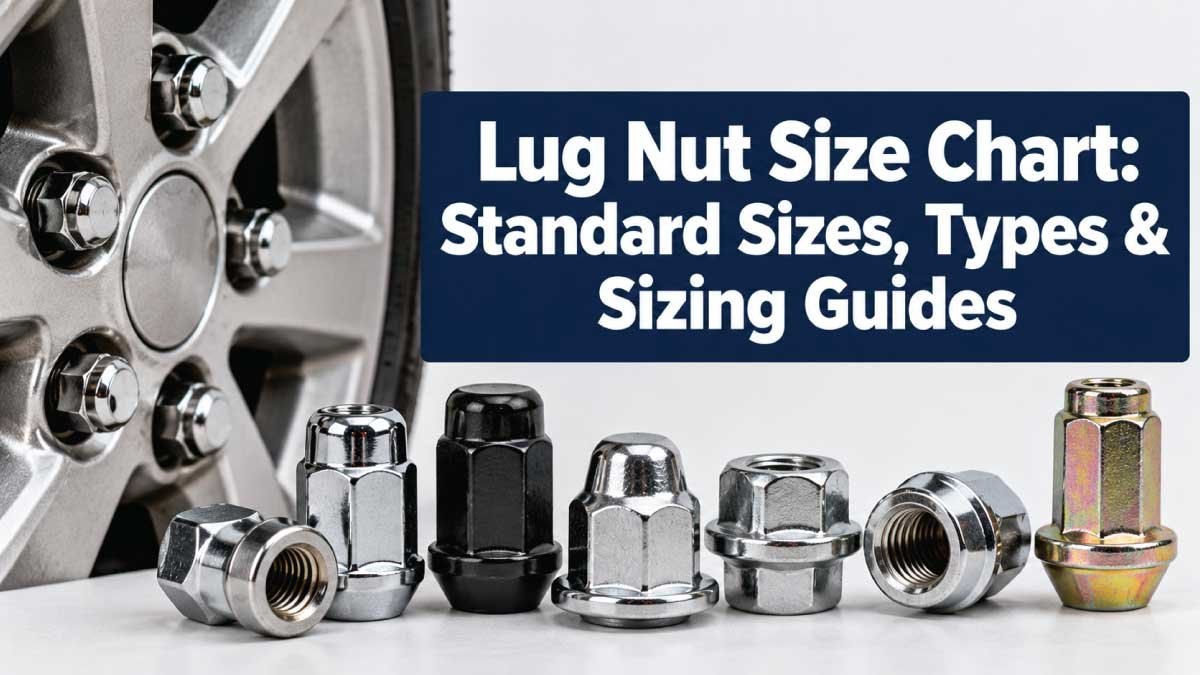
Finding the correct lug nut can be confusing because lug nut size is not determined by a single measurement. A lug nut has several important dimensions, including thread diameter, thread pitch, hex size, seat style, overall length, and sometimes special features such as a locking pattern or extended shank.
This lug nut size chart explains common metric and SAE thread sizes, typical hex sizes, major lug nut types, seat designs, and practical measuring methods. Whether you are replacing a damaged lug nut, changing wheels, or trying to identify an unknown fastener, understanding these dimensions helps you avoid an incorrect fit.
What Is a Lug Nut?
A lug nut is a threaded fastener used to secure a vehicle wheel to its wheel studs. The nut threads onto the wheel stud and clamps the wheel against the vehicle’s hub or mounting surface.
Although lug nuts may look similar, their designs can differ substantially. Two nuts may have the same thread diameter but use different seat profiles, hex sizes, or lengths.
The most important characteristics include:
Thread diameter – The approximate outside diameter of the mating wheel stud.
Thread pitch – The distance between threads in metric systems or threads per inch in SAE systems.
Hex size – The dimension across the flats of the nut, which determines the required socket or wrench size.
Seat type – The surface that contacts the wheel.
Overall length – Important for certain wheel and stud combinations.
Material and finish – Affect durability, corrosion resistance, and appearance.
The correct lug nut must match the wheel stud and wheel design, not simply the socket available in your toolbox.
Lug Nut Size Chart
The following chart provides commonly encountered automotive lug nut thread sizes. It is a general identification guide rather than a vehicle-specific fitment chart.
| Common Thread Size | Thread System | Typical Applications | Notes |
|---|---|---|---|
| M10 × 1.25 | Metric | Some compact vehicles | Vehicle-specific |
| M12 × 1.25 | Metric | Many passenger vehicles | Common fine pitch |
| M12 × 1.5 | Metric | Passenger cars and light vehicles | Very common |
| M12 × 1.75 | Metric | Selected applications | Verify vehicle specification |
| M14 × 1.5 | Metric | Larger cars, SUVs, trucks | Common larger metric size |
| M14 × 2.0 | Metric | Selected truck applications | Must be verified |
| 1/2-20 | SAE | Many older and some current vehicles | 20 threads/in |
| 7/16-20 | SAE | Smaller or older applications | 20 threads/in |
| 9/16-18 | SAE | Larger vehicle applications | 18 threads/in |
| 5/8-18 | SAE | Heavy-duty applications | 18 threads/in |
Important: Thread size alone does not establish complete lug nut compatibility. The seat style and other dimensions must also match the wheel.
Understanding Lug Nut Thread Size
The thread specification is one of the most important parts of a lug nut’s size.
For metric lug nuts, a specification such as M12 × 1.5 means the nominal thread diameter is approximately 12 mm and the thread pitch is 1.5 mm.
For an SAE lug nut such as 1/2-20, the first number represents the nominal diameter in inches and 20 indicates 20 threads per inch.
Metric Lug Nut Sizes
Metric lug nuts are normally identified using the diameter and pitch format:
M12 × 1.5
Here:
- M indicates a metric thread.
- 12 is the nominal diameter in millimeters.
- 1.5 is the thread pitch in millimeters.
Common metric lug nut threads include M10, M12, and M14 sizes, but the exact pitch is equally important.
An M12 × 1.25 lug nut should not be treated as interchangeable with an M12 × 1.5 lug nut. Both have the same nominal diameter, but their threads are different.
SAE Lug Nut Sizes
SAE lug nuts use inches and threads per inch.
For example:
1/2-20
means a nominal diameter of 1/2 inch with 20 threads per inch.
Common SAE wheel stud threads include 7/16-20, 1/2-20, 9/16-18, and 5/8-18 in appropriate vehicle applications.
Never select an SAE lug nut simply because its diameter appears close to a metric size.
Lug Nut Hex Size Chart
The hex size is the measurement across the flat sides of the lug nut. It determines which socket is needed to install or remove the nut.
Hex size is separate from thread size. For example, two lug nuts could have the same M12 × 1.5 thread while having different external hex dimensions.
Common automotive hex sizes include 17 mm, 19 mm, 21 mm, 22 mm, and 13/16 inch, among others.
| Hex Size | Measurement System | Common Use |
|---|---|---|
| 17 mm | Metric | Compact and standard automotive applications |
| 19 mm | Metric | Common passenger vehicle lug nuts |
| 21 mm | Metric | Common automotive applications |
| 22 mm | Metric | Selected larger applications |
| 13/16 in | SAE | Some SAE lug nuts |
| 7/8 in | SAE | Larger SAE applications |
| 15/16 in | SAE | Selected heavy-duty applications |
These are common socket sizes, not universal fitment specifications. The same thread specification can be manufactured with different hex dimensions.
Thread Size vs. Socket Size
This distinction is especially important when searching for replacement lug nuts.
A 21 mm lug nut usually refers to the nut’s hex/socket size, not its thread specification.
For example, saying “I need a 21 mm lug nut” does not provide enough information to identify the correct replacement. You would still need to know the thread and seat configuration.
Lug Nut Seat Types
The seat is the portion of the lug nut that contacts the wheel. Seat compatibility is critical because the wrong seat can prevent the wheel from being clamped correctly.
The three common seat styles are:
- Conical seat
- Ball or spherical seat
- Flat or mag seat
Other specialized designs are also available for particular wheels.
Conical Seat Lug Nuts
A conical lug nut, often called a tapered seat lug nut, uses a cone-shaped contact surface.
A common cone angle is 60 degrees, although the exact design should always be confirmed for the wheel.
Conical seats are widely used with many aftermarket and original-equipment wheel designs.
The nut centers itself against the tapered wheel hole as it is tightened.
Ball Seat Lug Nuts
Ball seat lug nuts use a rounded or spherical contact surface instead of a straight cone.
They are designed for wheels manufactured with a matching spherical seat.
A ball-seat nut should not automatically be substituted with a conical nut. Although the threads may fit, the contact geometry can be wrong.
Flat Seat Lug Nuts
Flat-seat lug nuts use a flat washer-like contact arrangement. Some designs incorporate a captive washer.
These are often associated with particular wheel designs where the wheel’s mounting surface requires a flat clamping interface.
Mag Seat Lug Nuts
Mag-style lug nuts generally have a longer cylindrical shank that extends into the wheel hole, along with a flat seating surface.
The shank length is an important specification. A replacement that is too long or too short may not work correctly with the wheel.
Lug Nut Types and Their Uses
Lug nuts are available in several designs because wheels and vehicle mounting systems differ.
Open-End Lug Nuts
Open-end lug nuts have an opening through the top rather than a closed cap.
They can be useful where the wheel stud extends farther than the nut depth or where a specialized wheel configuration requires additional clearance.
Acorn Lug Nuts
Acorn lug nuts have a closed, rounded or tapered top. They are commonly used with wheels that require a conventional closed-end appearance.
Their shape can also help protect exposed threads from dirt and corrosion.
Bulge Acorn Lug Nuts
Bulge acorn lug nuts have a larger seating surface than standard conical acorn nuts.
The additional contact area may be required for particular wheel designs with larger mounting holes.
The wheel manufacturer should determine whether this design is appropriate.
Spline Drive Lug Nuts
Spline drive nuts use a specially shaped external pattern that requires a matching key or socket.
They are frequently used where a smaller external profile or specialized installation system is needed.
Locking Lug Nuts
Locking lug nuts use a unique key pattern to make removal more difficult without the matching key.
A vehicle may use one locking nut per wheel or another arrangement depending on the owner’s preference.
When replacing locking nuts, retain the key in a safe location.
How to Measure Lug Nut Size
If you have an unknown lug nut, several measurements can help identify it. Measuring the nut alone, however, may not reveal whether its seat matches the wheel.
Step 1: Measure the Thread Diameter
Use a caliper to measure the approximate outside diameter of the threaded portion.
For a metric lug nut, a reading near 12 mm suggests an M12 thread, while a measurement near 14 mm may indicate an M14 thread.
Because worn or damaged threads can produce misleading measurements, compare the result with the vehicle or wheel specification whenever possible.
Step 2: Determine the Thread Pitch
Thread pitch is essential.
For metric threads, measure the distance from one thread crest to the next. A thread pitch gauge makes this much easier.
For SAE threads, determine the number of threads per inch.
For example:
- M12 × 1.25 = 1.25 mm pitch
- M12 × 1.5 = 1.5 mm pitch
- 1/2-20 = 20 threads per inch
- 9/16-18 = 18 threads per inch
Do not force a nut onto a stud when the threads do not match.
Step 3: Measure the Hex
Place a caliper across two opposite flat sides of the lug nut.
This gives the hex size, which corresponds to the socket size.
For example, a measurement close to 19 mm indicates a 19 mm hex.
Step 4: Identify the Seat
Look at the underside of the lug nut and the wheel’s lug hole.
Determine whether the nut uses:
- Conical seating
- Spherical or ball seating
- Flat seating
- Mag-style seating
- Another specialized configuration
The nut and wheel seat must be compatible.
Step 5: Measure Overall Length and Shank
For extended or specialized lug nuts, measure the total length and any shank length.
This is especially important for mag-style nuts, deep wheels, and applications where the wheel stud extends significantly through the wheel.
Also Read:
How to Choose the Correct Lug Nut
Selecting the right lug nut requires more than matching the thread diameter.
Check these specifications together:
| Specification | What to Check | Why It Matters |
|---|---|---|
| Thread diameter | M10, M12, M14, 1/2 in, etc. | Must fit the wheel stud |
| Thread pitch | Metric pitch or SAE TPI | Prevents thread mismatch |
| Seat type | Cone, ball, flat, mag | Must match wheel geometry |
| Hex size | Socket measurement | Determines installation tool |
| Overall length | Total nut length | Important for clearance |
| Shank | Length and diameter where applicable | Must suit wheel design |
| Material | Steel or specified construction | Must meet application requirements |
| Finish | Chrome, black, zinc, etc. | Corrosion and appearance considerations |
If replacing an original lug nut, the safest approach is to identify the vehicle, wheel type, and original specifications rather than selecting a nut based only on appearance.
Common Lug Nut Sizes by Vehicle Category
Vehicle category can provide a starting point, but it should never replace exact fitment information.
| Vehicle Category | Common Thread Examples | Typical Considerations |
|---|---|---|
| Compact cars | M12 × 1.25, M12 × 1.5 | Compact wheel and stud designs |
| Passenger cars | M12 × 1.5, 1/2-20 | Varies significantly by manufacturer |
| SUVs | M12 × 1.5, M14 × 1.5 | Larger wheel and load requirements may apply |
| Pickup trucks | M14 × 1.5, 9/16-18, 5/8-18 | Application-specific |
| Older vehicles | 7/16-20, 1/2-20, 9/16-18 | SAE threads may be encountered |
| Heavy-duty vehicles | Larger metric or SAE threads | Exact specification is essential |
This table illustrates common patterns rather than providing universal vehicle fitment.
Why Lug Nut Seat Type Matters
Thread compatibility alone does not guarantee a safe wheel installation.
The seat transfers the clamping force from the lug nut to the wheel. If the contact geometry is incorrect, the nut may not seat properly.
For example, a conical nut installed into a wheel designed for a spherical seat can contact the wheel differently from the intended design.
Potential problems include:
- Incorrect seating
- Reduced contact area
- Wheel damage
- Difficulty maintaining proper clamping
- Loosening concerns
- Difficulty removing the nut later
Always match the lug nut seat to the wheel seat.
Also Read:
Lug Nut Torque and Installation
Correct installation is just as important as selecting the correct size.
The required lug nut torque is vehicle-specific and should be taken from the vehicle or wheel manufacturer’s specifications.
Do not assume that every lug nut should be tightened to the same torque value.
Recommended Installation Practices
Before installation:
- Inspect wheel studs for damaged or contaminated threads.
- Check lug nuts for cracks, deformation, or damaged threads.
- Ensure the wheel mounting surfaces are clean and properly seated.
- Start lug nuts by hand to avoid cross-threading.
- Tighten nuts in the recommended sequence.
- Use a calibrated torque wrench for final tightening.
- Follow the vehicle or wheel manufacturer’s torque specification.
Avoid using an impact wrench as a substitute for controlled final torque.
Common Lug Nut Problems
Incorrect sizing or poor installation can create several problems.
Cross-Threading
Cross-threading occurs when the nut does not start straight on the stud.
The nut should rotate smoothly by hand during initial installation. If significant resistance appears immediately, stop and inspect the threads.
Wrong Thread Pitch
An M12 × 1.25 and M12 × 1.5 nut can appear nearly identical because both have a 12 mm nominal diameter.
Their different pitches, however, mean they are not interchangeable.
Wrong Seat
A correctly threaded lug nut can still be unsuitable if its seat does not match the wheel.
This is one of the most commonly overlooked dimensions when selecting aftermarket lug nuts.
Incorrect Socket Size
Using a socket that is too large can damage the external hex. A socket that does not fully engage the flats can also make removal difficult.
For decorative or thin-wall lug nuts, use an appropriately sized socket designed for the application.
Swollen Lug Nuts
Some capped lug nuts can develop dimensional changes or swelling when the outer cap or construction deteriorates.
A nut that no longer accepts the correct socket properly should be inspected and replaced rather than forced.
Also Read:
Lug Nut Size vs. Wheel Stud Size
A common misconception is that wheel diameter determines lug nut size.
It does not.
A vehicle with a large wheel can use a relatively smaller stud, while another vehicle with a smaller wheel may use a larger stud.
Lug nut selection is primarily related to the wheel stud thread and wheel mounting design.
Wheel diameter, bolt pattern, center bore, offset, and lug-hole design are separate wheel specifications.
Lug Nut vs. Wheel Bolt
Lug nuts and wheel bolts perform similar wheel-retention functions but are used in different mounting systems.
A conventional wheel-stud system has:
Wheel stud → wheel → lug nut
A wheel-bolt system typically has:
Wheel → wheel bolt → hub
This difference matters when replacing fasteners. A lug nut cannot simply replace a wheel bolt because the underlying mounting system is different.
Tips for Buying Replacement Lug Nuts
When purchasing replacement lug nuts, avoid using only a generic description such as “21 mm lug nuts.”
Instead, confirm the complete specification.
Check These Details
- Thread diameter
- Thread pitch
- Seat style
- Seat angle where applicable
- Hex size
- Overall length
- Shank dimensions where applicable
- Closed-end or open-end design
- Wheel manufacturer requirements
- Vehicle manufacturer’s requirements
- Required torque specification
If the vehicle has aftermarket wheels, use the wheel manufacturer’s lug nut requirements as an important reference because the wheel’s lug-hole geometry may differ from the original wheels.
Frequently Asked Questions
How do I know what size lug nuts I need?
Identify the wheel stud’s thread diameter and pitch, then determine the wheel’s required seat type. Confirm the required hex size, nut length, and other dimensions before purchasing.
Is a 21 mm lug nut the same as an M12 lug nut?
No. 21 mm normally describes the external hex size across the flats, while M12 describes the nominal metric thread diameter. They refer to different dimensions.
Are all M12 lug nuts interchangeable?
No. M12 only identifies the nominal thread diameter. The pitch, such as M12 × 1.25 or M12 × 1.5, must also match. The seat and other dimensions must be compatible as well.
Can I use a different lug nut seat if the threads fit?
Generally, you should not assume that a different seat is acceptable. The lug nut seat should match the wheel’s intended seating geometry.
What socket size do I need for lug nuts?
The socket size depends on the lug nut’s external hex. Common automotive sizes include 17 mm, 19 mm, and 21 mm, but the correct size varies by application.
Do aftermarket wheels use different lug nuts?
They can. Aftermarket wheels may use different seat styles, shank dimensions, or other requirements from the vehicle’s original wheels. Always verify the wheel manufacturer’s specifications.
Can I determine thread pitch by looking at the lug nut?
Visual inspection can provide clues, but it is not a reliable identification method. A thread pitch gauge, caliper, matching stud, or verified vehicle specification provides better identification.
Should lug nuts be tightened with an impact wrench?
An impact wrench can be useful for initial installation when used appropriately, but final tightening should follow the manufacturer’s specified procedure and torque using a suitable torque wrench.
Lug Nut Identification Checklist
If you are standing beside a vehicle with an unknown lug nut, use this simple checklist:
Identify the wheel and vehicle application.
Determine whether the system uses studs and nuts or wheel bolts.
Measure or identify the thread diameter.
Determine the thread pitch.
Measure the external hex.
Inspect the lug nut seat.
Check overall length and shank dimensions if applicable.
Confirm compatibility with the wheel.
Check the required torque specification.
Inspect the fastener before installation.
This approach is much more reliable than matching a lug nut solely by its appearance or socket size.
Final Takeaway
A lug nut’s size involves several dimensions, not just the number printed on a socket. The most important specifications are thread diameter, thread pitch, hex size, seat type, and overall dimensions.
Common thread examples include M12 × 1.25, M12 × 1.5, M14 × 1.5, 1/2-20, and 9/16-18, but these should be treated as identification examples rather than universal vehicle specifications.
When using a lug nut size chart, first identify the thread, then confirm the wheel’s seat design and remaining dimensions. For a replacement, vehicle and wheel specifications should take priority over assumptions based on appearance. Correct fitment and proper installation are essential for maintaining the intended wheel clamping system.

Engineer Hassan is a Mechanical Engineer with 16+ years of hands-on experience in mechanical hardware, fasteners, and workshop tools. He focuses on size selection, thread identification, and measurement, helping users choose the correct components with accuracy and safety.