
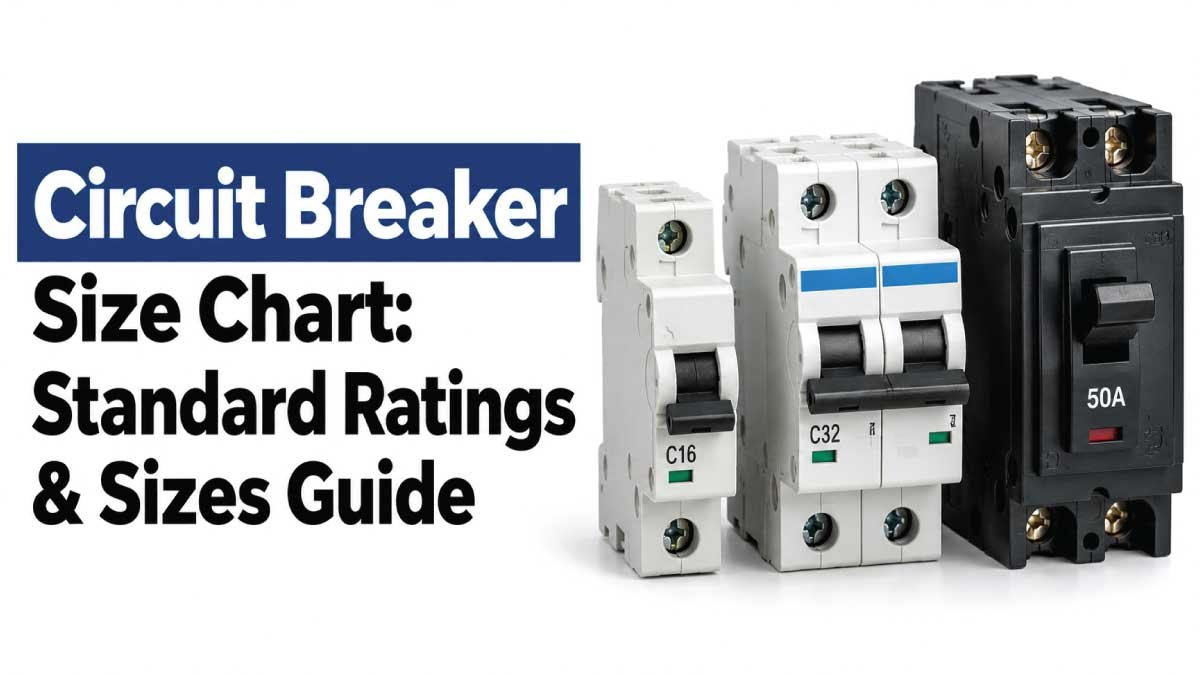
Choosing the correct circuit breaker requires more than matching a number on a panel. The breaker rating, number of poles, voltage, conductor size, circuit load, interrupting rating, and installation conditions all need to work together. An incorrectly sized breaker can cause nuisance tripping or fail to provide the intended protection for the circuit.
This circuit breaker size chart explains common breaker ratings, breaker types, pole configurations, sizing principles, and practical selection factors. It also explains how breaker size relates to wire size and why the largest available breaker is not automatically the correct choice.
What Is a Circuit Breaker?
A circuit breaker is a protective switching device designed to interrupt electrical current when a circuit experiences an abnormal condition, such as an overload or short circuit. Once the fault is cleared, many breakers can be reset rather than replaced.
The breaker works as part of a complete electrical protection system. Its rating must be compatible with the circuit conductors, equipment, voltage, and installation requirements.
A breaker generally has several important specifications:
Current rating: The maximum rated current under specified conditions.
Voltage rating: The maximum system voltage for which the breaker is suitable.
Number of poles: Determines how many conductors or circuit legs the breaker switches.
Interrupting rating: The fault current the breaker can safely interrupt under specified conditions.
Trip characteristics: Determine how the breaker responds to overloads and short circuits.
Terminal capacity: Defines the conductor sizes and types that can be connected.
The current rating is commonly expressed in amperes (A). Common residential and light-commercial ratings include 15 A, 20 A, 25 A, 30 A, 40 A, 50 A, and 60 A, although larger ratings are widely used in distribution and industrial applications.
Circuit Breaker Size Chart
The following chart shows common breaker current ratings and typical application categories. These are general rating references rather than instructions to install a particular breaker on a specific circuit.
| Breaker Rating | Typical Circuit Category | Common Application Examples |
|---|---|---|
| 10 A | Light-duty | Specialized lighting and control circuits |
| 15 A | General light-duty | Lighting and general-purpose circuits |
| 20 A | General-purpose | Receptacles and small appliances |
| 25 A | Medium-duty | Dedicated equipment circuits |
| 30 A | Medium-duty | Larger appliances and equipment |
| 40 A | Heavy-duty | Heating and larger equipment |
| 50 A | Heavy-duty | Large appliances and equipment |
| 60 A | High-current | Equipment and feeder applications |
| 70–100 A | Distribution | Feeders and larger equipment |
| 110–200 A | High-current distribution | Main and feeder applications |
| 225 A+ | Commercial/industrial | Large feeders and distribution systems |
The application column is intentionally general because the appropriate breaker depends on the actual equipment, conductor ampacity, load calculation, voltage, and applicable electrical requirements.
A 20 A breaker, for example, does not mean every circuit using 20 A protection can be wired identically. The conductor, insulation rating, termination requirements, ambient conditions, installation method, and equipment specifications all matter.
Common Circuit Breaker Ratings
15 Amp Breaker
A 15 A breaker is commonly associated with general-purpose branch circuits and lighting applications in systems where that rating is permitted.
It is intended to protect a circuit against excessive current. The actual wire size and installation method must be selected according to the applicable electrical requirements rather than simply assuming a particular conductor from the breaker number.
20 Amp Breaker
The 20 A breaker is one of the most commonly encountered branch-circuit ratings. It is frequently used for general-purpose receptacle circuits and dedicated equipment circuits.
Whether a particular conductor can be protected by a 20 A breaker depends on its permitted ampacity and the applicable rules for the installation.
30 Amp Breaker
A 30 A breaker is commonly found on dedicated circuits serving equipment that requires more current than ordinary general-purpose circuits.
Examples can include certain appliances, motors, and other dedicated loads. The equipment nameplate and circuit requirements should be checked before selecting the breaker.
40 Amp and 50 Amp Breakers
These ratings are often encountered on larger electrical loads, including certain heating equipment, cooking appliances, and other high-current applications.
The breaker should not be selected simply from the appliance’s maximum apparent current. The complete load calculation, equipment instructions, conductor ampacity, and applicable electrical requirements must be considered.
60 Amp and Larger Breakers
Breakers rated 60 A and above are commonly used for larger equipment, feeders, subpanels, and distribution circuits.
At these ratings, conductor selection, termination temperature ratings, voltage drop, installation conditions, available fault current, and equipment compatibility become particularly important.
Types of Circuit Breakers
Circuit breakers are available in several designs. Their physical size alone does not determine whether a breaker is suitable for an application.
Single-Pole Breaker
A single-pole breaker typically occupies one breaker position in compatible panel equipment and is used for many single-phase branch circuits.
Its voltage capability depends on the specific breaker and electrical system. A single-pole breaker should only be installed where the panelboard and circuit configuration permit it.
Double-Pole Breaker
A double-pole breaker operates two poles together and is commonly used for circuits requiring two connected circuit legs.
It may be used for larger loads or equipment requiring a higher line-to-line voltage, depending on the electrical system and breaker design.
Three-Pole Breaker
Three-pole breakers are widely used in three-phase systems. They are common in commercial and industrial distribution and motor applications.
The breaker must match the panelboard, system voltage, phase configuration, and equipment requirements.
GFCI Circuit Breaker
A ground-fault circuit-interrupter breaker provides protection against certain ground-fault conditions in addition to overcurrent protection.
The exact requirements for GFCI protection depend on the location, equipment, circuit, and applicable electrical code.
AFCI Circuit Breaker
An arc-fault circuit-interrupter breaker is designed to detect certain hazardous arcing conditions. AFCI requirements depend on the circuit location and installation.
AFCI and GFCI functions may also be combined in certain breaker designs.
Molded-Case Circuit Breaker
Molded-case circuit breakers are commonly used for higher-current branch circuits, feeders, and distribution applications.
They are available with different frame sizes, trip ratings, accessories, and interrupting capacities.
How Circuit Breaker Size Relates to Wire Size
One of the most important concepts in breaker selection is the relationship between the breaker rating and conductor ampacity.
The breaker is intended to protect the circuit conductors from excessive current. Therefore, the conductor cannot simply be selected because it physically fits the breaker terminal.
A simplified selection process looks like this:
Load → Required circuit capacity → Conductor ampacity → Breaker rating → Equipment compatibility
The exact process is more complicated because electrical codes contain exceptions, adjustment factors, correction factors, equipment limitations, and special rules.
Why Wire Size Matters
A conductor carrying excessive current can heat up. The purpose of overcurrent protection is to limit current to a level appropriate for the circuit and its components under the applicable requirements.
When changing from a smaller breaker to a larger breaker, you cannot assume that the existing wire is automatically suitable.
For example, replacing a 15 A breaker with a 30 A breaker simply to stop nuisance tripping can create a serious protection problem if the circuit conductors are not permitted to operate with that protection.
Breaker and Wire Size Reference
The following is a general reference, not a universal installation chart. Actual permitted combinations depend on the governing electrical standard, conductor material, insulation, installation method, temperature, terminals, and other factors.
| Breaker Rating | Conductor Consideration | Typical Use Category |
|---|---|---|
| 15 A | Must have permitted ampacity for the installation | General branch circuits |
| 20 A | Must have permitted ampacity for the installation | Receptacles/equipment |
| 30 A | Larger conductor generally required than a 15 A circuit | Dedicated loads |
| 40 A | Conductor selected from calculated ampacity | Larger equipment |
| 50 A | Conductor selected from calculated ampacity | High-current equipment |
| 60 A | Conductor selected from calculated ampacity | Equipment/feeders |
| 70 A+ | Engineering/code-based selection becomes increasingly important | Feeders/distribution |
This approach is safer than treating a simple amp-to-wire-size chart as universally applicable.
How to Choose the Correct Circuit Breaker Size
Selecting a breaker begins with the circuit load rather than the breaker itself.
1. Determine the Circuit Load
Identify what the circuit supplies and determine the required current based on the equipment specifications and applicable load calculation.
For equipment with a known voltage and power rating, basic electrical relationships can provide an initial understanding of current demand.
For a simple single-phase load:
Current = Power ÷ Voltage
For example, a 2,400 W load operating at 120 V has a calculated current of:
2,400 ÷ 120 = 20 A
However, this calculation alone does not automatically mean that a 20 A breaker is appropriate. Continuous loads, starting current, conductor requirements, equipment instructions, and applicable electrical rules must also be considered.
2. Consider Continuous Loads
A load that operates continuously may require additional capacity under applicable electrical requirements.
This is particularly important for equipment that operates for extended periods, such as certain heaters, lighting systems, and commercial equipment.
The circuit should be designed using the required calculation method rather than selecting a breaker based solely on the equipment’s ordinary operating current.
3. Check the Conductor Ampacity
The conductor must have the appropriate permitted ampacity for the installation.
Factors can include:
- Conductor material
- Conductor size
- Insulation type
- Ambient temperature
- Number of current-carrying conductors
- Installation method
- Terminal temperature limitations
- Raceway or cable configuration
4. Check the Voltage
The breaker must be suitable for the system voltage.
A breaker marked for a particular voltage cannot automatically be assumed suitable for every electrical system. Voltage ratings, pole configurations, and system characteristics must match.
5. Check the Panel Compatibility
Circuit breakers are not universally interchangeable.
The breaker must be specifically compatible with the panelboard or equipment in which it will be installed. Physical fit alone is not enough.
Important considerations include:
- Manufacturer compatibility
- Panel series
- Breaker type
- Bus connection
- Voltage rating
- Pole configuration
- Mounting arrangement
6. Check the Interrupting Rating
The interrupting rating, sometimes expressed as an ampere interrupting capacity, indicates the fault current the breaker is designed to interrupt under specified conditions.
The available fault current at the installation must not exceed the applicable interrupting capability of the protective device.
This becomes especially important in larger electrical systems and installations located near substantial electrical sources.
Also Read:
Breaker Size and Electrical Load
A breaker should not normally be selected by multiplying the number of appliances connected to a circuit without performing an appropriate load assessment.
Different loads have different characteristics.
Resistive Loads
Heating elements and some other resistive devices have relatively predictable current characteristics.
Examples include certain heaters and electric heating elements.
Motor Loads
Motors can draw substantially higher current during starting than during normal operation. This starting behavior affects circuit and protection selection.
Motor circuits often require specific rules for conductor sizing and overcurrent protection.
Electronic Loads
Modern electronic equipment can have switching power supplies and other characteristics that may affect current behavior and protection requirements.
The equipment manufacturer’s instructions should be considered when designing the circuit.
Also Read:
Circuit Breaker Pole Size and Configuration
The term breaker size can refer to current rating, physical dimensions, or number of poles. These are different characteristics.
| Configuration | General Description | Common Application |
|---|---|---|
| 1-pole | One pole | Many branch circuits |
| 2-pole | Two connected poles | Larger loads and certain multi-wire systems |
| 3-pole | Three connected poles | Three-phase systems |
| 4-pole | Four switching poles in suitable equipment | Specialized distribution systems |
A breaker with a higher ampere rating is not necessarily physically larger. Conversely, two breakers with similar current ratings may have completely different physical and electrical specifications.
Always identify the current rating, poles, voltage rating, breaker family, and interrupting rating separately.
Standard Circuit Breaker Size Chart by Application
The following chart provides broad application categories rather than fixed installation instructions.
| Breaker Rating | General Application | Load Examples |
|---|---|---|
| 15 A | Light-duty branch circuit | Lighting, general loads |
| 20 A | General branch circuit | Receptacles, small equipment |
| 30 A | Dedicated branch circuit | Larger appliances, equipment |
| 40 A | High-current branch circuit | Heating, equipment |
| 50 A | High-current branch circuit | Cooking, equipment |
| 60 A | Equipment/feeder | Larger equipment |
| 70–100 A | Feeder/distribution | Subpanels, equipment |
| 110–200 A | Main/feeder | Larger distribution |
| 225 A+ | Commercial/industrial | Large distribution systems |
Actual applications vary considerably, so this chart should be used to understand rating categories rather than as a substitute for circuit design.
Also Read:
Common Circuit Breaker Sizes for Residential Panels
Residential electrical panels commonly contain a mixture of breaker ratings. Smaller ratings are often used for general branch circuits, while larger ratings may serve dedicated equipment or feeders.
A typical panel may contain:
- 15 A branch breakers
- 20 A branch breakers
- 30 A dedicated-load breakers
- 40 A equipment breakers
- 50 A high-current breakers
- Larger feeder or main protection where required
The exact combination depends on the building, electrical service, equipment, regional requirements, and circuit design.
A residential panel should never be modified merely to accommodate a larger breaker without confirming that the panel, conductors, equipment, and circuit design support the change.
How to Read a Circuit Breaker Label
The label on a breaker contains valuable information that helps identify its intended application.
Look for:
Ampere rating
Voltage rating
Number of poles
AC or DC designation, where applicable
Interrupting rating
Breaker type or catalog identification
Certification markings
Manufacturer information
The panelboard itself also has a label. It may identify compatible breaker families, voltage limitations, bus ratings, and other important information.
Never assume two breakers are interchangeable simply because they have the same ampere rating and appear similar.
Common Circuit Breaker Sizing Mistakes
Incorrect breaker selection often comes from focusing on only one specification.
Using a Larger Breaker to Stop Tripping
Frequent tripping can indicate an overloaded circuit, faulty equipment, wiring problems, or another issue.
Installing a larger breaker without investigating the cause can remove the protection intended for the existing conductors.
Ignoring Continuous Loads
Treating continuous operation like an occasional load can result in an incorrectly designed circuit.
The appropriate load calculation should account for continuous-load requirements where applicable.
Choosing by Physical Fit
A breaker that physically fits into a panel is not automatically approved or suitable for that panel.
Electrical and mechanical compatibility both matter.
Ignoring Interrupting Capacity
The breaker must have an appropriate interrupting rating for the available fault current.
This specification becomes particularly important in high-current distribution systems.
Mixing Breaker Families
Different breaker designs may look nearly identical while having different electrical or mechanical characteristics.
Use only breakers identified as compatible with the specific panel or equipment.
Relying on a Simple Wire Chart
A basic wire-size table cannot account for every installation condition.
Temperature, conductor material, installation method, terminal limitations, conductor grouping, and applicable exceptions can affect the final selection.
Circuit Breaker vs Fuse
Both circuit breakers and fuses provide overcurrent protection, but they operate differently.
| Feature | Circuit Breaker | Fuse |
|---|---|---|
| Resettable | Generally yes | No; normally replaced after operation |
| Switching function | Available on many designs | Depends on system/design |
| Fault interruption | Designed for specified fault levels | Designed for specified fault levels |
| Maintenance | Can often be reset | Requires replacement after operation |
| Applications | Residential, commercial, industrial | Residential, commercial, industrial |
Neither device should be selected based only on convenience. The protection method must suit the equipment, circuit, fault characteristics, and applicable requirements.
When Should a Circuit Breaker Be Replaced?
A breaker may require investigation or replacement when it shows signs of damage or does not operate normally.
Potential warning signs include:
- Visible physical damage
- Burning or discoloration
- Unusual heat
- Persistent nuisance tripping
- Mechanical difficulty when switching
- Repeated failure to reset
- Evidence of arcing
- A breaker that does not remain engaged
A breaker that trips repeatedly should not simply be replaced with a higher-rated model. The underlying circuit condition should be identified first.
For electrical panels and energized equipment, inspection and repair should be performed by a qualified person following the applicable safety procedures.
Frequently Asked Questions About Circuit Breaker Sizes
What is the most common circuit breaker size?
15 A and 20 A breakers are common branch-circuit ratings, while 30 A, 40 A, 50 A, and larger breakers are used for higher-current or dedicated applications. The appropriate rating depends on the circuit design.
Can I replace a 15 A breaker with a 20 A breaker?
Not simply because the 15 A breaker trips. The circuit conductors, equipment, panel, load calculation, and applicable requirements must permit the change. A larger breaker can provide inadequate overcurrent protection if the circuit is not designed for it.
Does a bigger breaker mean more power?
A higher-rated breaker permits a circuit to carry a higher current before the breaker operates under overload conditions, but it does not automatically make the equipment capable of using more power.
The entire circuit must be designed for the intended load.
How do I know what size breaker I need?
Determine the load, calculate the required circuit capacity, verify conductor ampacity, check voltage and pole requirements, confirm panel compatibility, and verify the interrupting rating and applicable installation requirements.
What does a 20 A breaker mean?
A 20 A breaker has a nominal current rating of 20 amperes under its specified operating conditions. It is commonly used on branch circuits, but the exact application depends on the circuit design and applicable requirements.
Can two breakers with the same amp rating be interchangeable?
No. Breakers with the same current rating may have different voltage ratings, pole arrangements, physical configurations, interrupting capacities, and panel compatibility requirements.
What happens if a breaker is too small?
An undersized breaker may trip during normal operation if the connected load exceeds its rating. Frequent tripping can indicate that the circuit needs investigation rather than simply replacing the breaker.
What happens if a breaker is too large?
An oversized breaker can allow excessive current through conductors or equipment that are not designed for that level of protection. This can defeat the intended overcurrent protection of the circuit.
Practical Tips for Selecting Circuit Breaker Sizes
Before selecting or replacing a breaker, work through the following checklist:
- Identify the actual circuit load.
- Check equipment nameplate information.
- Determine the required voltage and phase configuration.
- Verify the conductor ampacity.
- Consider continuous and special loads.
- Check the panelboard’s approved breaker types.
- Verify the breaker pole configuration.
- Confirm the required interrupting rating.
- Follow applicable electrical codes and installation requirements.
- Check manufacturer documentation for equipment-specific requirements.
- Investigate nuisance tripping instead of automatically increasing breaker size.
- Have uncertain or high-risk electrical work evaluated by a qualified electrician.
These steps help prevent the common mistake of treating breaker selection as a simple ampere-number comparison.
Final Takeaway
A circuit breaker size chart is useful for understanding common ratings, but the correct breaker cannot be selected from amperage alone. Current rating, conductor ampacity, voltage, poles, panel compatibility, load characteristics, interrupting rating, and installation conditions all contribute to the final selection.
The most important principle is that the breaker, wiring, equipment, and electrical system must be designed to work together. If an existing breaker trips repeatedly, investigate the cause instead of automatically installing a larger rating. For installations where the correct rating is uncertain, use the applicable electrical requirements and qualified professional guidance before making changes.

Engineer Hassan is a Mechanical Engineer with 16+ years of hands-on experience in mechanical hardware, fasteners, and workshop tools. He focuses on size selection, thread identification, and measurement, helping users choose the correct components with accuracy and safety.