
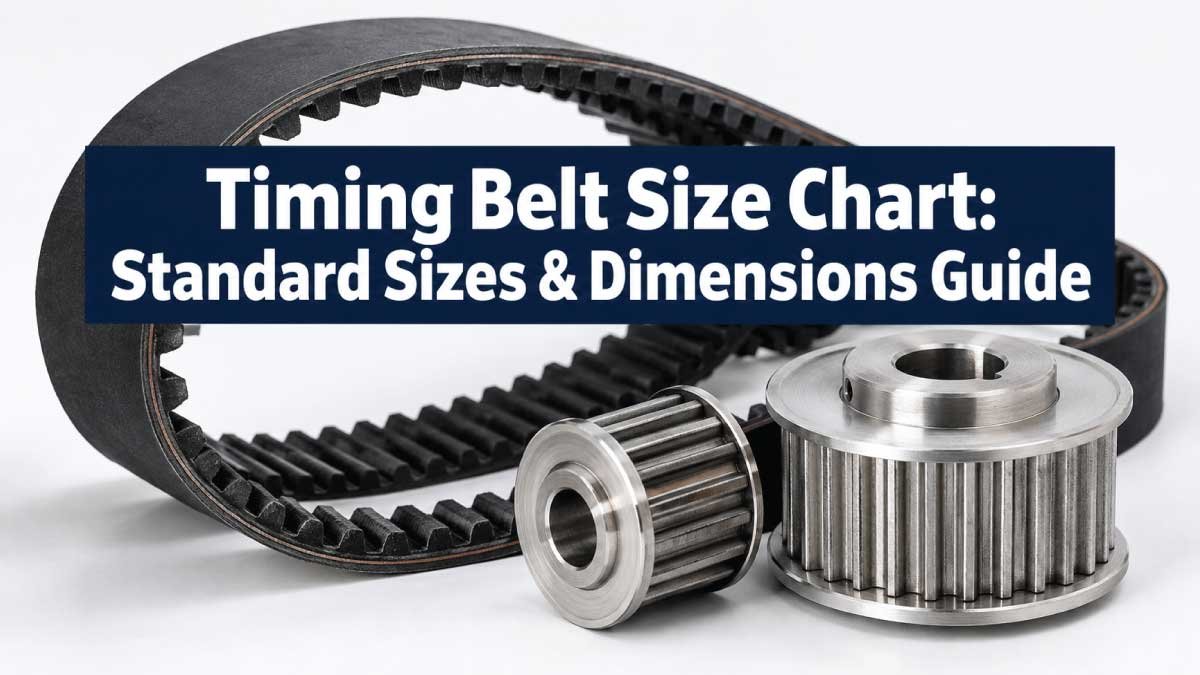
Choosing the correct timing belt requires more than matching a belt by its overall length. A timing belt must have the correct pitch, tooth profile, tooth count, belt length, width, and pulley compatibility for the drive to operate properly. Even belts with similar dimensions may not interchange if their tooth geometry differs.
This timing belt size chart explains the main dimensions used to identify synchronous belts, including metric and imperial profiles, pitch, tooth count, pitch length, width, and pulley requirements. It also covers how to measure an existing belt, how to select a replacement, common timing belt types, and mistakes to avoid.
Timing Belt Size Chart
A timing belt is a toothed, flexible drive belt designed to engage matching grooves on a pulley. Unlike a conventional V-belt, it transmits motion through positive tooth engagement, which helps maintain synchronization between rotating components.
The most important dimensions are the tooth pitch, number of teeth, pitch length, and belt width. The belt profile must also match the pulley.
The chart below shows commonly encountered timing belt profiles and their nominal pitches. These values identify the belt family rather than specifying one complete replacement belt.
| Belt Profile | Nominal Pitch | Common Identification | Typical Use |
|---|---|---|---|
| XL | 1/5 in | 0.200 in | Light-duty drives |
| L | 3/8 in | 0.375 in | General industrial drives |
| H | 1/2 in | 0.500 in | Higher-load drives |
| XH | 7/8 in | 0.875 in | Heavy-duty drives |
| XXH | 1-1/4 in | 1.250 in | Very heavy-duty applications |
| MXL | 2.032 mm | 0.080 in | Small precision drives |
| T2.5 | 2.5 mm | 2.5 mm pitch | Compact metric drives |
| T5 | 5 mm | 5 mm pitch | Light/medium drives |
| T10 | 10 mm | 10 mm pitch | Industrial drives |
| T20 | 20 mm | 20 mm pitch | Larger industrial drives |
| HTD 3M | 3 mm | 3 mm pitch | Compact synchronous drives |
| HTD 5M | 5 mm | 5 mm pitch | General-purpose drives |
| HTD 8M | 8 mm | 8 mm pitch | Higher-load drives |
| HTD 14M | 14 mm | 14 mm pitch | Heavy-duty drives |
| HTD 20M | 20 mm | 20 mm pitch | Large industrial drives |
The pitch value is not the same as belt width. For example, an 8M belt has an 8 mm tooth pitch, while its width may be selected separately according to the application.
What Do Timing Belt Sizes Mean?
Timing belt markings can initially look confusing because several dimensions are represented in a single designation.
A typical belt identification may contain information corresponding to:
Belt profile
Tooth pitch
Number of teeth or pitch length
Belt width
Construction or material
Manufacturer-specific designation
For example, a metric synchronous belt designation may indicate an 8 mm pitch, a particular tooth count, and a specified width.
Understanding these dimensions makes it much easier to compare an existing belt with a replacement.
Timing Belt Pitch
Pitch is the distance from the corresponding point of one tooth to the same point on the next tooth, measured along the belt’s pitch line.
Common metric pitches include:
- 2 mm
- 2.5 mm
- 3 mm
- 5 mm
- 8 mm
- 10 mm
- 14 mm
- 20 mm
The exact pitch series depends on the belt profile.
Timing Belt Tooth Count
The tooth count is the total number of teeth around the belt.
It is directly related to pitch length:
Pitch Length = Tooth Count × Pitch
For example, a hypothetical belt with 100 teeth and a 5 mm pitch has a pitch length of:
100 × 5 mm = 500 mm
This calculation is useful when identifying belts, although the manufacturer’s designation and actual belt construction should be checked before ordering.
Timing Belt Width
Width determines how much tooth area is available to transmit load.
Common widths vary significantly by profile and manufacturer. A wider belt generally provides greater load-carrying capability, but width alone cannot determine whether a belt is suitable.
The belt must still match:
- Tooth profile
- Pitch
- Pulley geometry
- Pitch diameter
- Tooth count
- Operating conditions
Common Timing Belt Types and Profiles
Different timing belt profiles have different tooth geometries. This is one of the most important reasons that belts with apparently similar dimensions should not automatically be substituted for one another.
Trapezoidal Timing Belts
Trapezoidal-tooth belts use a tooth shape that has traditionally been common in synchronous belt systems.
Examples include:
- XL
- L
- H
- XH
- XXH
- T-series belts
These belts are found in various machinery, automation systems, office equipment, and industrial drives.
HTD Timing Belts
HTD stands for High Torque Drive. These belts use a rounded tooth profile designed for positive engagement and torque transmission.
Common HTD pitches include:
- 3M
- 5M
- 8M
- 14M
- 20M
The number indicates the nominal pitch in millimeters.
GT Timing Belts
GT-style profiles use specially designed tooth geometry intended to provide accurate engagement and improved drive characteristics in suitable applications.
They are commonly associated with:
- Motion-control equipment
- Robotics
- Automation
- Precision mechanisms
- Machinery
GT and HTD belts should not be treated as interchangeable simply because their pitches appear similar.
Metric vs. Imperial Timing Belt Sizes
Timing belts are available in both metric and inch-based systems.
Metric belts are commonly identified using designations such as T5, T10, HTD 5M, HTD 8M, or similar profile markings.
Imperial belts may use profiles such as:
- MXL
- XL
- L
- H
- XH
- XXH
The pitch system is one of the easiest ways to distinguish these families.
| System | Example Profile | Pitch Identification |
|---|---|---|
| Metric | T5 | 5 mm |
| Metric | T10 | 10 mm |
| Metric | HTD 5M | 5 mm |
| Metric | HTD 8M | 8 mm |
| Imperial | XL | 0.200 in |
| Imperial | L | 0.375 in |
| Imperial | H | 0.500 in |
| Imperial | XH | 0.875 in |
| Imperial | XXH | 1.250 in |
Do not convert an imperial belt into a metric equivalent simply by finding a numerically similar pitch. Tooth geometry and pulley compatibility matter just as much as pitch.
How to Read a Timing Belt Size
The exact marking format differs between manufacturers, but the basic information can often be separated into several parts.
Suppose a belt identification indicates a particular 5 mm pitch, a specific tooth count, and a certain width.
The important information is:
- Profile — identifies the tooth geometry.
- Pitch — establishes tooth spacing.
- Tooth count — identifies the belt’s pitch length.
- Width — identifies the belt’s axial width.
- Construction — may identify material, reinforcement, or manufacturer-specific characteristics.
When replacing a belt, it is better to identify all of these characteristics instead of ordering based only on the outside circumference.
Timing Belt Dimensions You Need to Check
A proper timing belt size comparison involves several measurements.
Pitch
Pitch is the spacing between corresponding points of adjacent teeth.
Pitch Length
Pitch length is the effective length measured along the belt’s pitch line.
For a standard toothed belt:
Pitch Length = Pitch × Number of Teeth
Outside Length
The outside circumference is measured around the outer surface of the belt. It should not automatically be treated as the belt’s pitch length because the pitch line is located within the belt structure.
Belt Width
Measure across the belt from one side edge to the other.
Tooth Height
Tooth height varies according to the specific profile. It is useful when distinguishing profiles, but it should be compared against manufacturer specifications rather than used alone for identification.
Tooth Shape
Tooth geometry is critical. Two belts can have the same pitch but different tooth profiles and still require different pulleys.
How to Measure a Timing Belt
If the original belt marking is unreadable or unavailable, careful measurement can help identify the belt.
Step 1: Remove the Belt
If possible, remove the belt from the drive before measuring it. This allows you to inspect the teeth and measure the belt without pulley tension affecting the result.
If the belt is damaged, photograph or record its original routing before removal.
Step 2: Count the Teeth
Count every tooth around the complete belt.
A simple way to reduce counting errors is to mark the starting tooth and proceed around the belt systematically.
The tooth count is particularly useful because it can be combined with pitch to determine pitch length.
Step 3: Measure the Belt Width
Use a ruler or caliper to measure the width across the belt.
Avoid measuring a damaged or distorted edge if possible.
Step 4: Determine the Pitch
Measure the distance between corresponding points of several consecutive teeth rather than relying on one tooth spacing.
For example, measuring across 10 tooth pitches and dividing the result by 10 can reduce measurement error.
Step 5: Inspect the Tooth Profile
Look carefully at the tooth shape.
Determine whether the teeth appear:
- Trapezoidal
- Rounded
- Metric T-profile
- Another manufacturer-specific profile
Profile identification is essential because the matching pulley must have compatible grooves.
Step 6: Record Any Markings
Look for printed or molded information on the belt.
Record everything that remains legible, including:
- Numbers
- Letters
- Profile designation
- Manufacturer marking
- Width information
- Part number
A partial marking can often provide valuable identification information.
Also Read:
How to Calculate Timing Belt Length
Timing belt length can be approached in two different ways: from the belt itself or from the drive geometry.
For an existing belt, the most straightforward method is:
Pitch Length = Pitch × Number of Teeth
For example, if a belt has 120 teeth and a 5 mm pitch:
120 × 5 = 600 mm pitch length
For an installed two-pulley system, belt length depends on pulley diameters and center distance. A commonly used approximation for a standard open two-pulley arrangement is:
L ≈ 2C + π(D + d)/2 + (D − d)²/(4C)
where:
- L = approximate pitch length
- C = center distance
- D = larger pulley pitch diameter
- d = smaller pulley pitch diameter
The result should be treated as a sizing calculation rather than a substitute for the manufacturer’s belt selection method.
Timing Belt Pulley Size and Compatibility
A timing belt and pulley function as a matched system.
The pulley must have compatible:
- Tooth profile
- Pitch
- Tooth spacing
- Number of teeth
- Width
- Flange or guide arrangement where applicable
Pulley Tooth Count
Pulley tooth count affects the effective drive ratio.
For a two-pulley system:
Speed Ratio = Driven Pulley Teeth ÷ Driving Pulley Teeth
For example, a 20-tooth driving pulley and a 40-tooth driven pulley produce a nominal 2:1 speed relationship, assuming no other transmission elements affect the system.
Minimum Pulley Teeth
Every timing belt profile has recommended pulley tooth-count limits. Using a pulley with too few teeth can increase tooth loading and bending stress.
Therefore, pulley selection should follow the belt manufacturer’s recommendations rather than selecting the smallest physically possible pulley.
Also Read:
How to Choose the Correct Timing Belt Size
Selecting a timing belt involves more than matching its length.
1. Identify the Profile
Start with the tooth profile and pitch.
A 5 mm-pitch belt is not automatically interchangeable with every other 5 mm-pitch belt.
2. Determine the Required Length
Use the existing belt’s tooth count and pitch when available.
If designing a new drive, calculate the required pitch length based on pulley sizes and center distance.
3. Select the Width
Choose the width based on transmitted power, torque, speed, service conditions, and manufacturer recommendations.
A belt that is too narrow may not carry the required load, while an unnecessarily wide belt may create clearance or compatibility issues.
4. Check Pulley Compatibility
The belt and pulley must have matching geometry.
Confirm the pulley:
- Pitch
- Tooth profile
- Tooth count
- Width
- Bore
- Flange arrangement
5. Consider Operating Conditions
Temperature, contamination, moisture, chemicals, speed, and tension can affect belt selection.
For demanding machinery, use the belt manufacturer’s selection procedure rather than choosing solely from physical dimensions.
Also Read:
Timing Belt Size by Application
Timing belts are used in many different mechanical systems, and the appropriate profile depends heavily on the application.
Common applications include:
- Automotive engine timing systems
- Industrial machinery
- Conveyors
- Packaging equipment
- CNC machinery
- Robotics
- Printing equipment
- Automation systems
- Pumps and compressors
- Motion-control equipment
- Textile machinery
- Office and laboratory equipment
Automotive timing belts are a particularly specialized category. Their dimensions, tooth profiles, construction, tension requirements, and replacement intervals are determined by the specific engine and belt system.
An industrial synchronous belt should not be selected as an automotive replacement merely because its dimensions appear similar.
Timing Belt vs. Serpentine Belt
Timing belts and serpentine belts perform very different functions.
| Feature | Timing Belt | Serpentine Belt |
|---|---|---|
| Tooth Type | Toothed | Usually ribbed |
| Drive Method | Positive engagement | Friction |
| Primary Function | Synchronization or precise motion | Accessory drive |
| Matching Pulley | Toothed pulley | Ribbed pulley |
| Typical Applications | Timing and motion control | Alternators, pumps, compressors |
| Slip Control | Designed to prevent tooth-to-pulley slip | Relies on belt tension and friction |
The two belt types should never be treated as interchangeable.
Timing Belt Width and Load Capacity
Width is an important part of timing belt selection because it influences the amount of tooth area available for load transmission.
However, wider does not automatically mean better.
The correct width depends on factors such as:
- Torque
- Rotational speed
- Number of teeth in engagement
- Pulley size
- Center distance
- Operating temperature
- Duty cycle
- Shock loading
- Required service life
A proper engineering selection considers these factors together.
For a replacement, the original manufacturer’s specified width is usually the safest starting point unless the drive has been redesigned.
Common Timing Belt Problems
Incorrect sizing or installation can cause several problems.
Tooth Jumping
Tooth jumping occurs when the belt teeth disengage from the pulley grooves.
Possible causes include:
- Incorrect belt tension
- Excessive load
- Incorrect pulley geometry
- Insufficient pulley tooth engagement
- Worn components
Premature Tooth Wear
Rapid tooth wear may result from:
- Misalignment
- Incorrect tension
- Contamination
- Incompatible pulley profile
- Excessive loading
Belt Edge Wear
Wear along one or both edges can indicate:
- Pulley misalignment
- Incorrect tracking
- Damaged pulley flanges
- Improper installation
Cracking or Deterioration
Belt material can deteriorate because of unsuitable temperature, chemicals, aging, or environmental exposure.
The correct replacement should match the application and operating environment.
Timing Belt Tension and Installation Tips
Correct installation is just as important as selecting the correct belt.
Before installation:
- Inspect the pulleys for damage.
- Remove debris from pulley grooves.
- Check pulley alignment.
- Confirm that the belt profile matches the pulleys.
- Verify the belt width and pitch.
- Follow the manufacturer’s tension procedure.
Avoid forcing a belt over a pulley by prying against the belt with a screwdriver or similar tool. This can damage the reinforcement and teeth.
After installation, rotate the drive manually when appropriate and verify that the belt tracks correctly before operating the machinery.
Common Timing Belt Sizing Mistakes
Several mistakes can result in an incorrect replacement.
Using Outside Length as Pitch Length
The outside circumference and pitch length are different measurements. Always identify which dimension a specification refers to.
Matching Only the Width
Two belts can have the same width but completely different pitches and profiles.
Matching Only the Pitch
The same pitch does not guarantee compatible tooth geometry.
Ignoring Tooth Count
Tooth count determines the pitch length and can affect the drive ratio and center distance.
Ignoring the Pulley
A belt should always be considered together with its mating pulley system.
Assuming Similar-Looking Belts Are Interchangeable
Visual similarity is not sufficient for a reliable replacement. Profile geometry, material, reinforcement, and dimensional tolerances can differ.
Timing Belt Selection Checklist
Before ordering a replacement timing belt, record the following information:
Belt profile
Pitch
Tooth count
Pitch length
Belt width
Tooth shape
Pulley tooth count
Pulley profile
Application
Operating speed
Torque or power requirement
Temperature
Environmental conditions
Original part number, if available
For an existing machine, comparing the measured belt with the equipment manufacturer’s specification provides greater confidence than relying on measurements alone.
Frequently Asked Questions About Timing Belt Sizes
Are all timing belts the same size?
No. Timing belts differ in pitch, tooth profile, length, width, tooth count, construction, and reinforcement. Belts must be selected according to the specific drive system.
How do I know what size timing belt I need?
Identify the original belt marking if possible. Otherwise, determine the profile, pitch, tooth count, pitch length, and width, then verify compatibility with the pulley.
What is the most important timing belt dimension?
There is no single dimension that works independently. Profile and pitch establish tooth compatibility, while tooth count, length, and width determine other important aspects of fit and performance.
Can I use a belt with the same pitch but a different profile?
Generally, you should not assume so. Different profiles can have different tooth geometries and require corresponding pulley designs.
How is timing belt length calculated?
For a toothed belt, pitch length can be calculated as:
Pitch Length = Pitch × Tooth Count
For a new two-pulley design, belt length can also be estimated from pulley pitch diameters and center distance.
Does a wider timing belt last longer?
Not necessarily. Belt life depends on the complete drive design, including load, speed, alignment, tension, pulley size, temperature, and belt construction.
What happens if a timing belt is too loose?
Insufficient tension can contribute to tooth jumping, poor tracking, vibration, and unreliable power transmission. The manufacturer’s specified tension method should be followed.
What happens if a timing belt is too tight?
Excessive tension can increase loads on the belt, shafts, bearings, and pulleys. It can also reduce service life.
Can timing belt sizes be converted between metric and imperial systems?
Not reliably by simple numerical conversion. The profile, pitch, and pulley geometry must all be compatible.
Final Takeaway
A timing belt size is defined by much more than its overall length. The key identification points are tooth profile, pitch, tooth count, pitch length, and width, together with the matching pulley geometry.
Use a timing belt size chart to narrow down the correct belt family, but verify the complete specification before purchasing a replacement. For critical machinery, automotive systems, and high-load applications, the manufacturer’s belt and pulley specifications should take priority over measurements alone.
When measuring an existing belt, count the teeth, determine the pitch, measure the width, inspect the tooth profile, and record every available marking. These details provide a much more reliable basis for selecting the correct timing belt.

Engineer Hassan is a Mechanical Engineer with 16+ years of hands-on experience in mechanical hardware, fasteners, and workshop tools. He focuses on size selection, thread identification, and measurement, helping users choose the correct components with accuracy and safety.