
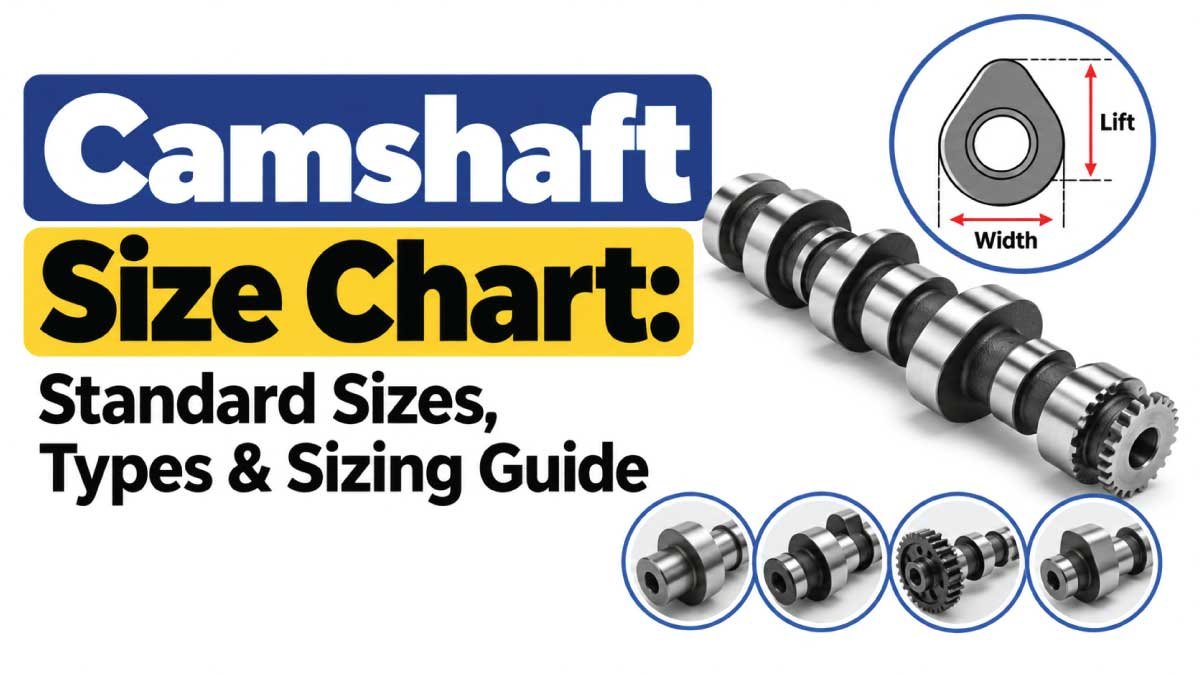
A camshaft is one of the most important components in a four-stroke engine because it controls when the intake and exhaust valves open and close. Choosing the correct camshaft requires more than checking its overall length. Camshaft diameter, lobe lift, duration, journal dimensions, lobe separation, base circle, and timing position can all affect compatibility and engine performance.
This camshaft size chart explains the main dimensions, common camshaft types, important specifications, and practical sizing considerations. Because camshaft dimensions vary considerably between engines and manufacturers, the tables below are intended as a guide to the measurements you should compare rather than a universal fitment chart.
Whether you are replacing a worn camshaft, rebuilding an engine, selecting a performance cam, or identifying an unknown component, understanding these measurements can help you avoid choosing a camshaft that looks similar but does not actually fit or operate correctly.
What Is a Camshaft?
A camshaft is a rotating engine component with specially shaped cam lobes that control valve movement. As the camshaft rotates, each lobe pushes against a follower, lifter, rocker arm, or another valve-train component to open a valve.
In a typical four-stroke engine, the camshaft works with the crankshaft to coordinate:
- Intake valve opening
- Intake valve closing
- Exhaust valve opening
- Exhaust valve closing
- Valve lift
- Valve timing
- The relationship between intake and exhaust events
The camshaft normally rotates at half the crankshaft speed in a conventional four-stroke engine. This allows each valve event to occur at the appropriate point during the intake, compression, power, and exhaust strokes.
Camshaft design differs substantially between engines. An overhead-valve engine, single-overhead-cam engine, and double-overhead-cam engine can use completely different camshaft arrangements and dimensions.
Camshaft Size Chart
There is no single standard camshaft size that fits all engines. The correct dimensions depend on the engine’s cylinder head, block, valve train, bearing arrangement, timing system, and manufacturer specifications.
The following chart shows the principal dimensions commonly checked when identifying or selecting a camshaft.
| Camshaft Specification | Typical Measurement Unit | What It Describes |
|---|---|---|
| Camshaft diameter | mm or in | Diameter of the main shaft or relevant journal |
| Journal diameter | mm or in | Diameter of each bearing journal |
| Overall length | mm or in | Total end-to-end camshaft length |
| Lobe lift | mm or in | Height of the cam lobe’s lifting action |
| Base circle diameter | mm or in | Diameter across the non-lobe portion of the cam |
| Duration | Crankshaft degrees | Length of time a valve remains open at a specified lift |
| Lobe separation angle | Degrees | Angular relationship between intake and exhaust lobe centers |
| Journal width | mm or in | Width of an individual bearing journal |
| Nose width | mm or in | Width across the lobe nose |
| Cam gear diameter | mm or in | Diameter of the timing gear where applicable |
| Cam nose/thread dimensions | mm or in | Front-end attachment dimensions |
| Keyway dimensions | mm or in | Dimensions used for timing-component location |
These measurements should be compared with the engine manufacturer’s specifications or the camshaft manufacturer’s application data before installation.
Camshaft Dimensions Explained
Understanding the terminology is essential because two camshafts can have similar overall dimensions but very different valve-control characteristics.
Camshaft Diameter
Camshaft diameter refers to the diameter of the shaft or, depending on the design, the relevant journal diameter. It is particularly important where the camshaft is supported directly by bearings.
A replacement camshaft must have compatible journal dimensions. An incorrect journal diameter can prevent proper installation or cause excessive clearance.
Overall Camshaft Length
Overall length is measured from one end of the camshaft to the other. This dimension can help identify a camshaft, but it should never be used alone for selection.
Two camshafts may have the same overall length while using different:
- Journal positions
- Lobe locations
- Gear arrangements
- Thrust arrangements
- Timing components
- Valve-event specifications
Journal Diameter and Width
Camshaft journals provide the bearing surfaces that support the rotating shaft. Both journal diameter and journal width can matter during engine assembly.
Bearing clearance is also critical. Simply matching the nominal diameter does not guarantee correct fitment because the actual clearance between the journal and bearing must fall within the applicable specification.
Base Circle Diameter
The base circle is the portion of the cam profile where the follower experiences the minimum lift. Base-circle size affects valve-train geometry and available adjustment.
When comparing performance camshafts, base-circle diameter should be considered alongside lobe lift and valve-train components rather than treated as an independent measurement.
Camshaft Lobe Size and Profile
The cam lobe is the feature that converts rotational movement into valve movement. Its profile determines how quickly the valve opens, how far it opens, how long it stays open, and how it closes.
Several specifications describe the lobe profile.
Lobe Lift
Lobe lift is the amount of movement produced directly by the cam lobe. The actual valve lift can be greater because many valve trains use rocker arms or other mechanical leverage.
For example, in a rocker-arm system, valve lift is influenced by the rocker ratio as well as cam lobe lift.
A useful relationship is:
Valve lift ≈ Cam lobe lift × Rocker ratio
This is a simplified relationship and does not account for real-world valve-train losses or geometry.
Valve Lift
Valve lift describes how far the valve moves away from its seat.
Higher valve lift can change airflow characteristics, but increasing lift is not automatically beneficial. The cylinder head, valve springs, retainers, rocker system, piston clearance, and other components must all be capable of accommodating the selected lift.
Duration
Camshaft duration describes how long a valve remains open according to a defined measurement method. Duration is commonly expressed in crankshaft degrees.
Because different manufacturers can use different checking points, duration figures should always be compared using the same measurement convention.
Lobe Separation Angle
Lobe separation angle, often abbreviated LSA, describes the angular relationship between the intake and exhaust lobe centerlines.
It influences valve overlap and the overall character of the engine. However, LSA should not be considered in isolation because actual valve timing also depends on camshaft installation and other specifications.
Common Types of Camshafts
Camshafts can be classified according to their engine location, construction, valve-train arrangement, and intended use.
Overhead Valve Camshaft
An overhead-valve engine generally positions the camshaft in the engine block. Pushrods and rocker arms transfer camshaft movement to the valves located in the cylinder head.
These camshafts are often associated with compact engine blocks and traditional pushrod valve trains.
Single Overhead Camshaft
A SOHC engine uses one camshaft in the cylinder head for each cylinder bank or head arrangement.
The camshaft may operate intake and exhaust valves directly or through rocker arms or followers.
Double Overhead Camshaft
A DOHC engine uses two camshafts for a cylinder head arrangement. One camshaft commonly controls the intake valves while the other controls the exhaust valves.
DOHC systems allow considerable flexibility in valve timing and are common in modern multi-valve engines.
Performance Camshaft
A performance camshaft is designed around a particular operating objective rather than simply being a larger version of a standard camshaft.
Its specifications may differ in:
- Lift
- Duration
- Lobe separation
- Valve timing
- Ramp design
- Operating range
The correct performance camshaft must match the complete engine combination.
Camshaft Size Chart by Application
The following comparison provides a practical way to think about camshaft selection. It is not a universal dimensional fitment chart because engine-specific dimensions vary.
| Camshaft Application | Primary Selection Consideration | Typical Objective |
|---|---|---|
| Stock replacement | Original specifications and fitment | Restore factory operation |
| Street performance | Moderate lift and duration | Improve usable performance |
| High-performance street | Valve-train compatibility | Higher operating capability |
| Racing | Complete engine combination | Maximum application-specific performance |
| Heavy-duty use | Durability and operating conditions | Reliable continuous operation |
| Engine restoration | Original profile and dimensions | Preserve intended configuration |
For a replacement camshaft, matching the original application is usually more important than selecting a camshaft solely because it has greater lift or duration.
How to Measure a Camshaft
Accurate measurement is useful when identifying an unknown camshaft or checking a component before installation.
Measure Overall Length
Use a suitable precision measuring tool to determine the distance from the extreme end of the camshaft to the opposite end.
Record the measurement consistently and note whether any removable timing component has been included in the measurement.
Measure Journal Diameter
Measure each bearing journal separately because wear or manufacturing differences can affect individual measurements.
A micrometer is generally more suitable than a basic ruler for precision journal measurements.
Check for:
- Diameter
- Out-of-round condition
- Taper
- Surface damage
- Scoring
- Excessive wear
Measure Lobe Height
To determine the approximate lobe lift from the cam itself, measure the lobe from the base circle to the highest point of the nose.
A basic geometric comparison can be made by considering the maximum lobe dimension and base-circle dimension, although exact manufacturer checking procedures may differ.
Measure Journal Position
For camshaft identification, record the location of each journal and lobe along the shaft. The distance between features can be just as important as their individual dimensions.
This is especially useful when two camshafts have similar overall lengths.
Also Read:
How to Choose the Correct Camshaft Size
Choosing a camshaft should begin with compatibility, followed by performance requirements.
Confirm Engine Application
Start with the exact:
- Engine manufacturer
- Engine family
- Model or designation
- Displacement
- Model year where relevant
- Cylinder-head configuration
- Valve-train arrangement
An engine family can sometimes have multiple camshaft specifications, so a general engine name may not be enough.
Check Physical Dimensions
Compare the replacement camshaft against the required specifications.
Important measurements include:
- Journal diameter
- Journal width
- Overall length
- Lobe positions
- Gear or sprocket arrangement
- Thrust-control arrangement
- Front-end dimensions
- Keyway or locating features
Check Valve-Train Compatibility
The camshaft must work with the rest of the valve train.
Check compatibility with:
- Lifters or followers
- Rocker arms
- Pushrods
- Valve springs
- Retainers
- Valves
- Timing components
- Cylinder-head geometry
A camshaft that physically fits the engine may still be unsuitable if the valve train cannot accommodate its profile.
Also Read:
Stock vs Performance Camshaft Sizing
The phrase “larger camshaft” can be misleading. A camshaft is not selected simply by its physical diameter or overall size.
Performance is more closely related to the cam profile and valve timing than to the external dimensions of the shaft.
| Feature | Stock-Oriented Camshaft | Performance-Oriented Camshaft |
|---|---|---|
| Valve timing | Designed for factory operating conditions | Tuned for a specific operating objective |
| Lift | Application-specific | May be increased |
| Duration | Usually optimized for broad usability | May be increased depending on application |
| Operating range | Often broad | Can be shifted toward a selected range |
| Valve-train demands | Generally based on factory components | May require upgraded components |
| Compatibility | Usually direct replacement when correctly specified | Requires careful system matching |
A performance camshaft can require changes elsewhere in the engine. Therefore, selecting the camshaft should be treated as a complete valve-train and engine-combination decision.
Also Read:
Camshaft Timing and Sizing
Camshaft dimensions and camshaft timing are closely related but are not the same thing.
The camshaft must be installed in the correct angular relationship with the crankshaft. Timing components such as gears, chains, belts, sprockets, keys, and locating features establish this relationship.
Incorrect camshaft timing can cause:
- Poor engine operation
- Incorrect valve events
- Reduced performance
- Starting problems
- Valve-to-piston interference in some engines
- Potential component damage
For this reason, timing should be checked according to the engine or camshaft manufacturer’s specified procedure.
When degreeing a performance camshaft, a degree wheel and appropriate measurement equipment may be used to verify actual valve timing rather than relying only on timing marks.
Factors That Affect Camshaft Selection
The correct camshaft depends on more than dimensions.
Engine Displacement
Engine displacement affects how a cam profile interacts with the engine’s airflow requirements. A camshaft designed for one engine configuration may not produce the same results in another.
Cylinder Head Flow
Cylinder-head design influences how effectively the engine can use a particular camshaft profile. Valve lift and duration should be considered together with the head’s flow characteristics.
Compression Ratio
Compression ratio and camshaft timing interact. Changing duration and valve-closing events can alter the engine’s effective operating characteristics.
Intake and Exhaust System
The intake manifold, throttle system, exhaust manifold, headers, and exhaust system can all influence whether a particular camshaft profile is appropriate.
Operating RPM
Consider where the engine is expected to operate most often.
A camshaft intended for low-speed drivability may have substantially different specifications from one designed around high engine speeds.
Vehicle or Equipment Use
The correct choice also depends on the application:
- Daily driving
- Towing
- Off-road operation
- Track use
- Competition
- Restoration
- Industrial or utility operation
The intended use should guide the camshaft profile rather than choosing specifications based only on maximum numbers.
Common Camshaft Sizing Mistakes
Incorrect camshaft selection often occurs because one measurement is treated as the entire specification.
Common mistakes include:
- Choosing a camshaft based only on overall length
- Assuming similar-looking camshafts are interchangeable
- Comparing duration figures measured at different checking points
- Ignoring journal dimensions
- Forgetting valve-to-piston clearance
- Ignoring valve-spring requirements
- Failing to verify timing-component compatibility
- Selecting excessive lift without checking valve-train geometry
- Mixing incompatible lifters or followers
- Installing a camshaft without checking lubrication requirements
- Assuming a performance cam will work with every factory component
A proper camshaft selection process checks the entire system, not just the shaft itself.
Camshaft Inspection Before Installation
Even a correctly specified camshaft should be inspected before installation.
Look for:
- Scratches or scoring on journals
- Damaged lobe surfaces
- Rust or corrosion
- Burrs around keyways
- Damaged threads
- Worn gear teeth
- Incorrect or damaged locating features
- Signs of overheating
- Abnormal surface wear
The bearing surfaces and lobes should have the condition and finish expected for the particular camshaft design.
If a used camshaft is being reused, inspect the associated lifters or followers as well. Cam and follower wear patterns are related, and replacing one component without evaluating the other can create problems.
Camshaft Size Chart: Key Specifications to Record
If you are identifying a camshaft for replacement or comparison, creating a measurement record can make the process easier.
| Measurement | Record |
|---|---|
| Overall length | Actual measured value |
| Main journal diameter | Actual measured value |
| Journal width | Actual measured value |
| Base circle diameter | Actual measured value |
| Lobe height | Actual measured value |
| Lobe positions | Measured locations |
| Front-end dimensions | Actual measured value |
| Keyway dimensions | Actual measured value |
| Timing gear/sprocket details | Configuration |
| Part identification | Marking or casting information |
This information can be combined with the engine identification and manufacturer’s specifications to narrow down the correct replacement.
Frequently Asked Questions About Camshaft Sizes
Are camshafts a standard size?
No. Camshaft dimensions are engine-specific. Journal diameter, overall length, lobe arrangement, timing features, and valve-event specifications can differ substantially between engines.
How do I know what size camshaft I need?
Identify the exact engine application first, then compare the required camshaft dimensions and specifications. For a performance application, also consider valve-train components, engine displacement, cylinder-head characteristics, compression, intake and exhaust systems, and intended operating range.
Does a bigger camshaft make more power?
Not necessarily. A camshaft’s physical size does not determine performance by itself. Lift, duration, timing, lobe separation, and the rest of the engine combination are more relevant to how the engine operates.
What is camshaft lift?
Camshaft lift is the amount of movement produced by the cam lobe. The resulting valve lift can depend on the valve-train design and rocker ratio.
What is camshaft duration?
Duration describes how long a valve remains open according to a defined measurement point. Because measurement conventions can differ, duration specifications should be compared using the same standard.
Can I use a performance camshaft with stock components?
It depends on the specific camshaft and engine. Some performance profiles may work with existing components, while others can require different valve springs, retainers, lifters, pushrods, rocker arms, or other parts.
Why is camshaft timing important?
Camshaft timing determines when the intake and exhaust valves operate relative to piston movement. Incorrect timing can affect engine operation and, in some engines, create a risk of valve-to-piston contact.
Can I identify a camshaft by measuring its length?
Length alone is usually insufficient. Identification should also consider journal dimensions, lobe locations, lobe characteristics, timing features, gear or sprocket configuration, and any identifying markings.
Final Camshaft Sizing Tips
Before purchasing or installing a camshaft, use this checklist:
- Identify the exact engine application.
- Compare all relevant journal dimensions.
- Verify overall length and lobe locations.
- Check lift, duration, and lobe separation where applicable.
- Confirm compatibility with lifters, followers, rockers, springs, and pushrods.
- Check timing gear, chain, belt, sprocket, and locating features.
- Verify valve-to-piston and valve-train clearances where required.
- Consider the engine’s intended RPM and operating conditions.
- Use matching measurement conventions when comparing specifications.
- Confirm final specifications using the appropriate manufacturer documentation.
Conclusion
A camshaft size chart is useful for organizing the measurements and specifications needed to identify or select a camshaft, but there is no universal camshaft size that fits every engine. The most important considerations include journal dimensions, overall length, lobe locations, lift, duration, base circle, timing features, and valve-train compatibility.
For a standard replacement, prioritize exact application and dimensional compatibility. For a performance build, consider the camshaft as part of the complete engine combination rather than selecting it from one specification alone.
Accurate measurement and careful comparison with the applicable engine or camshaft manufacturer’s specifications are the safest ways to confirm that the selected camshaft will fit and operate correctly.

Engineer Hassan is a Mechanical Engineer with 16+ years of hands-on experience in mechanical hardware, fasteners, and workshop tools. He focuses on size selection, thread identification, and measurement, helping users choose the correct components with accuracy and safety.