
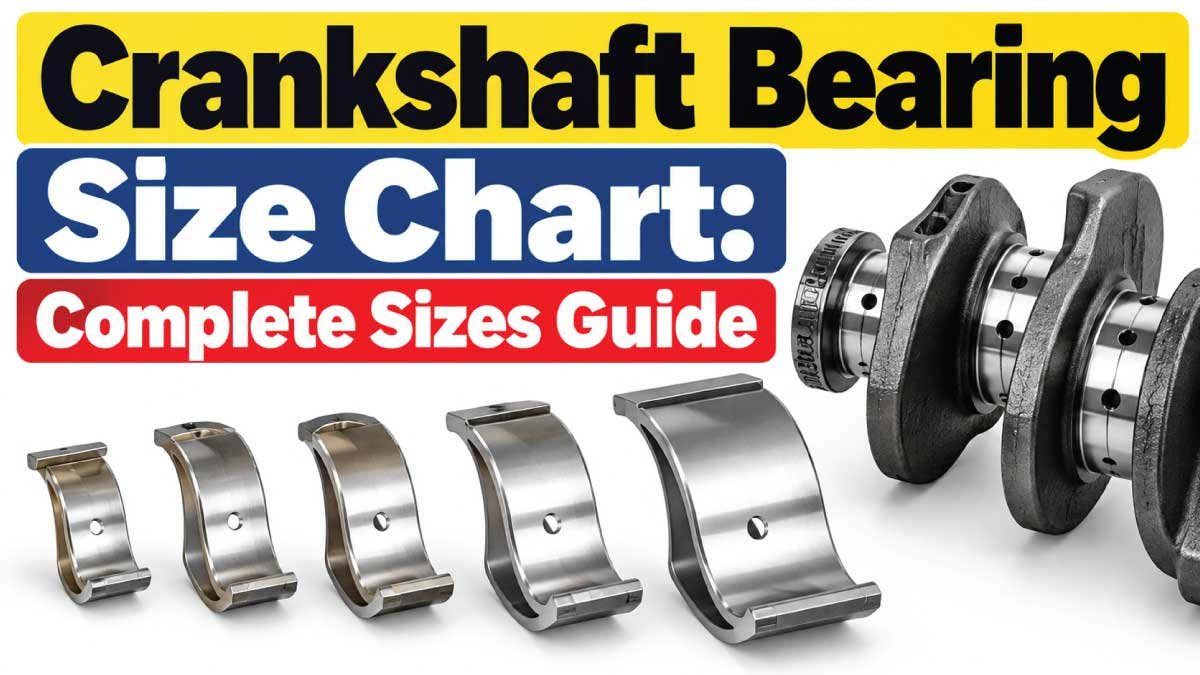
Choosing the correct crankshaft bearing is essential for maintaining proper oil clearance, supporting the crankshaft, and preventing premature engine wear. Unlike simple hardware bearings, engine crankshaft bearings are not selected by outside diameter alone. Their dimensions must match the crankshaft journals, connecting rods or main bearing bores, block specifications, and required bearing clearance.
A crankshaft bearing size chart is useful for understanding the terminology used for standard, undersize, and oversize bearings, but exact dimensions are engine-specific. A bearing that fits one engine may be completely unsuitable for another, even when the nominal journal diameter appears similar.
This guide explains crankshaft bearing sizes, dimensions, bearing types, measurement methods, clearance, undersize markings, common problems, and practical selection steps. It also explains why manufacturer specifications and measured engine components should always take priority over a generic chart.
What Is a Crankshaft Bearing?
A crankshaft bearing is a precision engine component that supports the crankshaft while allowing it to rotate on a controlled film of lubricating oil. Most automotive and industrial engines use plain bearings, rather than rolling-element bearings, for their main crankshaft supports and connecting-rod journals.
Crankshaft bearings are generally thin, replaceable shells installed into machined bearing locations. They have carefully controlled thickness and a specialized surface designed to operate under high loads.
The bearing works together with:
- Crankshaft main journals
- Connecting-rod journals
- Engine block main bearing bores
- Connecting rods
- Bearing caps
- Lubrication passages
- Engine oil
- Thrust-control surfaces
The bearing does not normally contact the rotating crankshaft directly during proper operation. Instead, engine oil forms a hydrodynamic film between the bearing surface and journal.
Because the clearance is critical, bearing selection is a dimensional matching process, not simply a matter of finding a bearing with the same nominal size.
Crankshaft Bearing Size Chart
There is no universal numerical crankshaft bearing size chart that applies to every engine. Main and rod bearing dimensions differ substantially between manufacturers, engine families, generations, and applications.
A useful general chart is therefore based on the terminology used to identify bearing sizes.
| Bearing Size Type | Meaning | Typical Use | Important Consideration |
|---|---|---|---|
| Standard | Designed for a crankshaft at its specified standard journal dimension | Original or correctly machined crankshaft | Verify journal diameter and clearance |
| Undersize | Bearing with additional effective thickness for a reduced journal | Reground crankshaft | Must match the actual journal undersize |
| Main Bearing | Supports crankshaft main journals | Engine block main bearing locations | Match block and crankshaft specifications |
| Rod Bearing | Supports connecting-rod journals | Connecting rods | Match rod bore and crankshaft journal |
| Thrust Bearing | Controls crankshaft axial movement | Engine thrust location | Verify thrust design and dimensions |
| Selective/Grade Bearing | Precisely controlled production size | Engines using graded bearing selection | Follow manufacturer grading system |
The terms standard, 0.25 mm undersize, 0.50 mm undersize, and similar markings are commonly encountered in replacement bearing catalogs. However, the correct oversize or undersize specification must come from the engine’s service information and actual measurements.
Understanding Crankshaft Bearing Dimensions
Several measurements determine whether a crankshaft bearing is suitable. Looking at only one dimension can lead to an incorrect fit.
Inside Diameter
The assembled bearing’s inside diameter corresponds to the crankshaft journal when the bearing shells are correctly installed and the specified clearance is present.
It is important to understand that an individual bearing shell is not necessarily measured as though it were a finished circular tube. The shell geometry, crush, housing fit, and assembly conditions all influence the final assembled dimension.
Outside Diameter
The outside dimension relates to the engine block or connecting-rod bearing housing.
For a main bearing, the bearing shell must properly locate within the machined main bearing bore. For a rod bearing, it must fit correctly into the connecting-rod and cap assembly.
Bearing Thickness
Bearing thickness is particularly important when determining whether a bearing is standard or intended for a reground crankshaft.
A thicker bearing can compensate for a crankshaft journal that has been intentionally reduced by machining. The correct relationship must be established from the manufacturer’s specifications.
Bearing Width
Bearing width describes how much of the journal or bearing housing is covered axially.
Width is important because excessive or insufficient bearing width can affect fit, oil control, crankshaft movement, and thrust behavior.
Types of Crankshaft Bearings
Different engine locations require different bearing designs. They should not be treated as interchangeable.
Main Crankshaft Bearings
Main bearings support the crankshaft at the engine block’s main bearing locations. The number of main bearings varies by engine design.
Main bearings are subjected to substantial loads generated by combustion forces and crankshaft rotation. Correct oil clearance and housing alignment are therefore essential.
Many main bearing sets contain upper and lower shells with different features, such as oil holes or grooves.
Connecting-Rod Bearings
Rod bearings fit between the connecting rod and its cap around the crankshaft rod journal.
They experience rapidly changing loads as the piston moves through the engine cycle. The bearing must maintain the correct relationship between journal diameter, rod bore, shell thickness, and oil clearance.
Thrust Bearings
A thrust bearing controls crankshaft end play, also called axial movement.
Depending on the engine design, thrust surfaces may be integrated into a main bearing or supplied as separate components. The exact location and design vary considerably.
A thrust bearing should never be selected solely by outer dimensions because its axial-control function is equally important.
Standard, Undersize, and Selective Bearings
One of the most important concepts in crankshaft bearing sizing is the distinction between nominal and actual dimensions.
Standard Bearings
A standard bearing is intended for a crankshaft journal that remains at its specified standard dimension.
If an engine is being rebuilt and the crankshaft journals are within the manufacturer’s permitted standard specifications, standard bearings may be appropriate.
However, the word “standard” does not mean every standard bearing has the same dimensions. Standard size is specific to the engine application.
Undersize Bearings
An undersize bearing is generally used when a crankshaft journal has been machined to a smaller diameter.
For example, a crankshaft may be reground to a manufacturer’s specified undersize dimension after removing journal damage. The bearing thickness is then selected to restore the required oil clearance.
Common markings may include values such as:
- 0.25 mm undersize
- 0.50 mm undersize
- 0.75 mm undersize
These values are not universal repair instructions. The permitted crankshaft machining steps depend on the particular engine and bearing manufacturer.
Selective or Graded Bearings
Some engines use bearing grades or selective sizing systems. Instead of relying exclusively on a simple standard/undersize designation, the manufacturer may use markings on the crankshaft, block, rods, or original bearings.
When an engine uses selective bearings, the manufacturer’s identification system should be followed precisely.
How Crankshaft Bearing Size Is Determined
Correct bearing sizing normally begins with the engine specifications and continues with dimensional inspection.
The basic process includes:
- Identify the exact engine application.
- Determine the specified main and rod journal dimensions.
- Inspect the crankshaft for wear or damage.
- Measure each relevant journal.
- Check the bearing housing dimensions.
- Determine the required bearing thickness.
- Install the selected bearings correctly.
- Measure the assembled oil clearance.
- Verify crankshaft end play where applicable.
- Confirm all results against the applicable service specifications.
This approach is more reliable than selecting a bearing based only on a vehicle model or a visual comparison.
How to Measure a Crankshaft Journal
Accurate journal measurement is one of the most important parts of bearing selection.
Measure Journal Diameter
A suitable precision micrometer is normally used to measure crankshaft journals.
Take measurements at multiple positions rather than measuring a single point. This helps identify:
- Taper
- Out-of-round condition
- Wear
- Scoring
- Uneven machining
- Differences between journals
A journal can look smooth while still being outside the permitted dimensional range.
Check for Taper
Taper occurs when the diameter differs from one end of the journal to the other.
Compare measurements taken at different axial positions. If the results are outside the manufacturer’s tolerance, replacing bearings alone may not correct the problem.
Check for Out-of-Round Condition
Measure the journal at different rotational positions.
A significant difference between measurements indicates an out-of-round condition. This can affect the oil film and produce uneven bearing loading.
How to Check Crankshaft Bearing Clearance
Bearing clearance is the space between the crankshaft journal and the bearing surface after assembly.
This clearance allows the correct oil film to form while giving the crankshaft room to rotate without binding.
Using Precision Measurement
One approach is to measure the assembled bearing inside diameter with appropriate precision equipment and compare it with the corresponding journal measurement.
The difference between the relevant dimensions represents the operating clearance.
This method requires suitable equipment and careful control of measurement conditions.
Using Plastigage
Plastigage is another commonly used inspection method for checking bearing clearance during engine assembly.
The material is placed across the journal, the bearing cap is installed and torqued according to the specified procedure, and the resulting compressed strip is compared with its measurement scale.
Plastigage can be useful as an assembly check, but it does not replace proper dimensional inspection when detailed crankshaft measurements are required.
Also Read:
Why Bearing Clearance Matters
Correct clearance is fundamental to crankshaft bearing performance.
Clearance Too Tight
Insufficient clearance can restrict the oil film and increase the possibility of bearing distress, overheating, or seizure.
Potential causes include:
- Incorrect bearing size
- Incorrect crankshaft machining
- Contamination behind a bearing shell
- Incorrect bearing installation
- Incorrect journal dimensions
- Improper assembly procedures
Clearance Too Loose
Excessive clearance can reduce the ability of the bearing system to maintain the intended oil film.
Possible symptoms or consequences may include:
- Low oil pressure
- Bearing noise
- Increased oil leakage through the bearing clearance
- Accelerated wear
- Abnormal bearing surface damage
The correct clearance is engine-specific. It should always be compared with the applicable manufacturer’s specification rather than a generic value.
Also Read:
Crankshaft Bearing Size Selection Guide
Selecting the correct bearing requires more than matching a part description.
Identify the Exact Engine
Start with the engine identification information, including the engine family, displacement, model year where relevant, and specific application.
Two engines that appear similar can use different crankshaft dimensions or bearing configurations.
Determine Crankshaft Condition
Inspect the crankshaft before purchasing replacement bearings.
Look for:
- Deep scoring
- Grooves
- Discoloration
- Corrosion
- Excessive wear
- Evidence of previous grinding
- Damaged oil holes
A damaged crankshaft may require machining or replacement rather than simply installing new bearings.
Check Previous Machining
Determine whether the crankshaft has previously been reground.
Previous machining can change journal diameter and therefore affect the bearing size required.
Do not assume a bearing marked “standard” is correct simply because the engine has not been opened recently.
Verify Housing Condition
The bearing shell is only one part of the dimensional system.
Main bearing housings and connecting-rod bores should be checked for damage, distortion, or incorrect machining when an engine has experienced serious bearing failure or major rebuilding.
Also Read:
Common Crankshaft Bearing Sizing Mistakes
Several mistakes can lead to premature bearing problems.
Choosing by vehicle model alone: The exact engine and bearing specification still need to be verified.
Ignoring crankshaft machining: A previously reground crankshaft may require an undersize bearing.
Measuring only one journal: Individual journals can have different wear conditions.
Skipping clearance checks: Correct part numbers do not guarantee correct assembled clearance.
Installing dirty bearings: Dirt or debris behind a shell can alter its position.
Mixing bearing grades: Selective bearing systems require their specified matching procedure.
Ignoring thrust dimensions: Crankshaft end play must be checked when thrust control is involved.
Assuming all standard bearings are identical: Standard dimensions are application-specific.
Using nominal dimensions as final measurements: Actual assembled clearance is what matters.
Failing to follow torque procedures: Bearing cap installation affects the final housing geometry.
Symptoms of Incorrect Crankshaft Bearing Size
Incorrect bearing sizing can contribute to several engine problems.
Low Oil Pressure
Excessive bearing clearance can contribute to increased oil leakage through the bearing system. If oil pressure is low, however, the entire lubrication system should be investigated rather than automatically blaming the crankshaft bearings.
Knocking or Bearing Noise
Abnormal crankshaft or connecting-rod bearing noise can be associated with excessive clearance, bearing damage, lubrication problems, or other engine faults.
Bearing Surface Damage
Visible scoring, wiping, overheating, embedded debris, or abnormal wear patterns can indicate lubrication, alignment, contamination, clearance, or installation problems.
Crankshaft End Play Problems
Incorrect thrust-bearing installation or wear can affect crankshaft axial movement.
End play should be measured using the applicable engine specification and appropriate measuring equipment.
Crankshaft Bearing Materials and Construction
Crankshaft bearings are engineered multilayer components rather than simple pieces of metal.
Depending on the application, bearing construction may incorporate combinations of steel backing, bearing alloys, intermediate layers, and thin surface coatings.
The bearing material must provide a balance of properties such as:
- Load-carrying capability
- Fatigue resistance
- Conformability
- Embedability
- Wear resistance
- Compatibility with the crankshaft
- Resistance to corrosion
Different engine designs and operating conditions can require different bearing constructions. Consequently, material type should be matched to the engine manufacturer’s specified application.
Main Bearing vs Rod Bearing Sizes
Main and rod bearings perform different functions and normally have different dimensions.
| Feature | Main Bearing | Rod Bearing |
|---|---|---|
| Location | Engine block | Connecting rod |
| Supports | Main crankshaft journals | Rod journals |
| Housing | Block and main cap | Rod and rod cap |
| Primary Function | Supports crankshaft rotation | Connects crankshaft to connecting rod |
| Thrust Function | May control crankshaft end play | Normally not the primary thrust location |
| Sizing Method | Block, crankshaft, bearing specifications | Rod, crankshaft, bearing specifications |
Although both are plain crankshaft bearings, their dimensions and applications should not be confused.
How to Read Bearing Size Markings
Bearing packaging and shell markings can contain several pieces of information.
Depending on the manufacturer, markings may identify:
- Engine application
- Bearing position
- Standard or undersize condition
- Grade or selective size
- Part number
- Manufacturing information
- Orientation or position
A marking such as STD generally indicates a standard-size application, while an undersize designation indicates a bearing intended for a crankshaft journal machined to a specified reduced dimension.
The exact meaning of every marking should be confirmed from the bearing manufacturer’s catalog or documentation.
When Should Crankshaft Bearings Be Replaced?
Crankshaft bearings may be replaced during an engine rebuild, after bearing damage, or when inspection identifies wear beyond the permitted limits.
Replacement becomes particularly important when inspection reveals:
- Excessive bearing wear
- Damaged bearing surfaces
- Copper or underlying material exposure
- Severe scoring
- Embedded debris
- Evidence of overheating
- Incorrect clearance
- Crankshaft damage requiring rebuilding
New bearings should not simply be installed over an uninspected crankshaft. The journal condition and dimensions must support the intended bearing application.
Practical Tips for Accurate Bearing Fitment
For reliable crankshaft bearing selection and installation, keep the process measurement-based.
Use the engine-specific specifications rather than relying on a generic chart.
Measure the crankshaft journals with appropriate precision tools.
Check every relevant journal, not just one representative journal.
Inspect the bearing housing for distortion and damage.
Confirm whether the crankshaft is standard or undersize.
Check assembled bearing clearance after installation.
Verify crankshaft end play where applicable.
Keep bearing surfaces and housings clean.
Install shells in their correct locations and orientation.
Follow the specified fastener tightening procedure.
Do not modify bearing shells to force a dimensional fit.
Investigate the cause of old bearing failure before installing replacement parts.
Frequently Asked Questions
What does STD mean on a crankshaft bearing?
STD usually means standard size. It indicates that the bearing is intended for a crankshaft journal at the manufacturer’s standard dimension. It does not mean the bearing is universally interchangeable with every standard bearing.
What does 0.25 mm undersize mean?
A 0.25 mm undersize bearing is generally intended for a crankshaft journal that has been machined to a specified reduced diameter. The exact application must be verified against the engine and bearing specifications.
Can I use a standard bearing on a reground crankshaft?
Not automatically. If the crankshaft has been reground below its standard journal dimension, the bearing must match the resulting journal size and required clearance.
How do I know what size crankshaft bearings I need?
Identify the exact engine, determine the crankshaft’s standard or machined condition, measure the journals and bearing housings where required, and verify the final assembled clearance against the applicable specifications.
Are main and rod bearings interchangeable?
No. Main bearings and connecting-rod bearings are designed for different locations and dimensional requirements. They should only be used in their specified applications.
Does a larger bearing mean a larger crankshaft?
No. Bearing terminology can be confusing. An undersize crankshaft bearing is typically thicker so it can provide the correct assembled clearance around a crankshaft journal that has been machined smaller.
Can bearing clearance be checked without removing the crankshaft?
Some inspection methods can be performed during assembly without complete crankshaft removal, depending on engine design. However, accurate diagnosis may require detailed dimensional inspection of the crankshaft and bearing housings.
Why is there no universal crankshaft bearing size chart?
Crankshaft journals, bearing widths, shell thicknesses, housing dimensions, grades, and clearance specifications vary by engine. A universal numerical chart would risk giving incorrect information for a particular application.
Final Takeaway
A crankshaft bearing size chart is most useful when it helps you understand standard, undersize, main, rod, thrust, and selective bearing terminology. The actual bearing choice, however, must be based on the exact engine specification and measured component dimensions.
The most important checks are crankshaft journal diameter, taper, out-of-round condition, bearing thickness, housing condition, assembled clearance, and crankshaft end play where applicable.
When rebuilding an engine, do not select bearings from a generic dimension alone. Match the bearing to the crankshaft and engine specifications, verify measurements carefully, and confirm the finished assembly meets the required clearance limits.

Engineer Hassan is a Mechanical Engineer with 16+ years of hands-on experience in mechanical hardware, fasteners, and workshop tools. He focuses on size selection, thread identification, and measurement, helping users choose the correct components with accuracy and safety.