
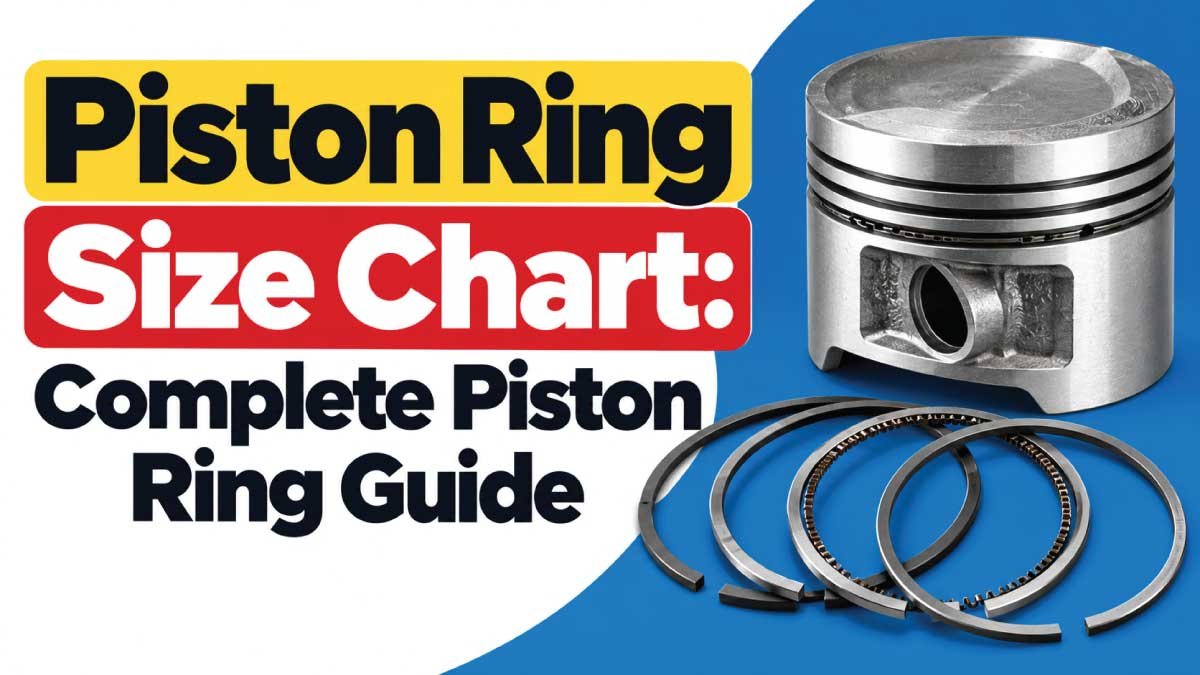
Choosing the correct piston rings is essential for maintaining compression, controlling oil consumption, and allowing an engine to operate properly. However, piston rings are not selected by outside diameter alone. The cylinder bore diameter, ring radial thickness, axial width, groove dimensions, ring type, and piston design all affect compatibility.
This piston ring size chart guide explains the measurements used to identify piston rings, common ring configurations, how piston ring sizes relate to engine bore sizes, and how to measure an existing ring or piston groove. It also covers compression rings, oil-control rings, ring gaps, oversize and undersize considerations, and common installation mistakes.
Because piston ring dimensions are highly dependent on the engine and piston design, the values shown as common configurations should be treated as reference information rather than universal fitment specifications. For an exact replacement, always match the ring dimensions and application requirements specified for the particular piston and engine.
What Is a Piston Ring?
A piston ring is a circular split ring installed in a groove around a piston. It forms a controlled seal between the piston and cylinder wall while allowing the piston to move up and down.
Most four-stroke engines use multiple rings with different jobs. A typical piston may have:
- Top compression ring
- Second compression or scraper ring
- Oil-control ring assembly
The exact number and arrangement depend on the engine design.
Piston rings are manufactured with a carefully controlled diameter, thickness, width, coating, tension, and end gap. Even when two rings appear similar, their groove dimensions or operating characteristics may be different.
Why Piston Ring Size Matters
A properly sized ring must fit the piston groove correctly and conform to the cylinder bore. If the ring is too large, too thick, too narrow, or incorrectly gapped, it may not seal correctly.
Correct sizing affects:
- Cylinder compression
- Blow-by control
- Oil consumption
- Heat transfer
- Ring movement within the groove
- Cylinder-wall sealing
- Engine durability
For this reason, piston ring selection should be based on measured dimensions and the correct engine application rather than appearance alone.
Piston Ring Size Chart
Piston rings are commonly identified according to the nominal cylinder bore, followed by the ring’s radial thickness and axial thickness or groove width. The following chart illustrates common configurations encountered in automotive and small-engine applications. It is a sizing reference, not a universal replacement chart.
| Nominal Bore Diameter | Common Ring Groove Widths | Typical Ring Radial Thickness Range | Typical Applications |
|---|---|---|---|
| 60–75 mm | 1.0–2.5 mm | 1.5–3.0 mm | Small engines, compact applications |
| 75–90 mm | 1.0–3.0 mm | 1.5–3.5 mm | Motorcycles, compact engines |
| 90–105 mm | 1.2–3.0 mm | 1.5–4.0 mm | Passenger vehicles, motorcycles |
| 105–120 mm | 1.2–3.5 mm | 2.0–4.0 mm | Larger automotive engines |
| 120–140 mm | 1.5–4.0 mm | 2.0–5.0 mm | Heavy-duty and larger engines |
| 140 mm+ | 2.0–5.0+ mm | 2.5–6.0+ mm | Large industrial and specialty engines |
These ranges demonstrate the relationship between bore size and ring dimensions, but they should not be used to order replacement rings without confirming the manufacturer’s specifications.
A replacement ring normally needs to match the piston groove dimensions and the finished cylinder bore. A ring marketed simply for a particular bore diameter may still be unsuitable if its groove width, radial thickness, profile, material, coating, or end gap differs.
Common Piston Ring Dimensions
Several measurements are important when identifying a piston ring. Understanding each one makes a piston ring size chart much easier to use.
Bore Diameter
The bore diameter is the internal diameter of the engine cylinder. Piston rings are designed to seal against this cylinder surface.
For example, an engine may have a nominal bore of 80 mm, 90 mm, or 100 mm. The actual finished cylinder dimension can differ slightly because of manufacturing tolerances, honing, wear, or machining.
The ring’s free diameter is not normally the same as the cylinder bore diameter because the ring is manufactured as a split spring-like component. When installed, it contracts to fit the cylinder.
Radial Thickness
Radial thickness is the distance from the inner surface of the ring to its outer sealing surface.
It determines how deeply the ring occupies the piston groove and contributes to the ring’s contact characteristics.
A ring with the wrong radial thickness may sit incorrectly in the groove even if its nominal bore diameter is correct.
Axial Thickness
Axial thickness describes the thickness of the ring along the piston groove’s vertical direction.
This dimension must correspond closely to the piston groove width. A ring that is too thick may bind in the groove, while excessive clearance from a thin ring can allow unwanted movement.
Ring Groove Width
The piston groove is the machined channel in which the ring sits. Groove width must accommodate the ring’s axial thickness while providing the specified side clearance.
Common ring thicknesses can include configurations around 1.0 mm, 1.2 mm, 1.5 mm, 2.0 mm, 2.5 mm, 3.0 mm, and larger sizes, but the correct value depends on the engine.
Ring End Gap
The ring end gap is the opening between the two ends of a piston ring when it is positioned inside the cylinder.
This gap is intentional. The ring expands as temperature increases, so it needs sufficient clearance to prevent the ends from contacting each other.
Types of Piston Rings and Their Sizes
Piston rings are not interchangeable simply because they have the same diameter. Their function and cross-sectional profile also matter.
Top Compression Ring
The top ring is primarily responsible for sealing combustion pressure between the piston and cylinder wall.
It may have a specialized profile or surface coating designed for its operating environment. The top ring can therefore look different from the second ring even when both have the same nominal bore application.
Second Compression Ring
The second ring assists with gas sealing and also helps control oil remaining on the cylinder wall.
Its cross-sectional design can differ from the top ring. Some second rings are designed with scraping characteristics that help manage oil movement.
Oil Control Ring
The oil-control ring regulates the amount of lubricating oil left on the cylinder wall.
Many modern designs use a multi-piece oil ring consisting of:
- Upper rail
- Lower rail
- Spacer or expander
The oil ring therefore needs to be identified according to the complete piston-ring set rather than treated as a simple single-piece ring.
Metric Piston Ring Sizes
Metric piston rings are generally specified using millimeters. A ring set may be described using dimensions related to the bore and groove configuration.
For example, a piston-ring specification might involve:
90 mm bore × 1.2 mm / 1.2 mm / 2.5 mm ring configuration
The three thickness values can represent the top, second, and oil-ring assembly dimensions depending on the manufacturer’s notation.
However, the notation is not universal. Some manufacturers provide complete dimensional drawings, while others identify rings primarily by engine application or part number.
Common Metric Ring Thicknesses
Common modern engine ring configurations may use relatively thin rings such as:
| Ring Dimension | Common Examples | Typical Use |
|---|---|---|
| 1.0 mm | Top or second ring | Modern compact engines |
| 1.2 mm | Top or second ring | Automotive applications |
| 1.5 mm | Top or second ring | Automotive and general applications |
| 2.0 mm | Compression or oil ring | Various engine designs |
| 2.5 mm | Oil-control ring | Automotive and larger applications |
| 3.0 mm+ | Oil or compression ring | Older, heavy-duty, or specialty designs |
These are examples of commonly encountered dimensions, not a universal compatibility standard.
How to Measure Piston Ring Size
Measuring an existing piston ring can help identify its dimensions, but several measurements should be taken rather than relying on one value.
Step 1: Measure the Cylinder Bore
The most reliable bore measurement is taken from the cylinder itself using suitable precision measuring equipment.
Measure at multiple positions because cylinders can develop wear patterns. A worn cylinder may not remain perfectly circular or uniformly sized.
Check for:
- Bore diameter
- Taper
- Out-of-round condition
- Wear near the top of the cylinder
- Honing condition
For an engine rebuild, the finished bore specification is more useful than an approximate measurement from a worn surface.
Step 2: Measure Ring Thickness
Use a suitable micrometer or precision measuring tool to determine the ring’s radial and axial dimensions.
Do not rely on visual comparison with another ring.
Step 3: Measure the Piston Groove
Measure the groove width and depth. Also inspect the groove for wear or carbon buildup.
A replacement ring should correspond to the actual piston groove specification.
Step 4: Check Side Clearance
Place the ring in the piston groove and verify the specified side clearance using the appropriate measurement method.
Excessive clearance can allow the ring to move within the groove. Insufficient clearance can cause binding as temperatures rise.
Step 5: Check the Ring End Gap
Insert the ring squarely into the cylinder and measure the opening between the ring ends with a feeler gauge.
The cylinder location used for checking the gap matters because bore wear can vary from top to bottom.
Piston Ring End Gap Size
End gap is one of the most important piston ring dimensions during engine assembly.
A ring that has too little end gap can experience contact between its ends as temperature rises. This can cause the ring ends to butt together and may create excessive pressure against the cylinder wall.
A gap that is excessively large can reduce sealing effectiveness and contribute to combustion-gas leakage.
Factors Affecting Ring Gap
The appropriate end gap depends on factors such as:
- Cylinder bore
- Engine type
- Ring material
- Ring design
- Operating temperature
- Intended engine use
- Manufacturer’s specification
- Forced-induction application where applicable
For this reason, there is no single end-gap measurement that is correct for every piston ring.
Always use the ring manufacturer’s or engine manufacturer’s specified calculation or measurement procedure.
Standard vs Oversize Piston Rings
One of the most common sources of confusion is the difference between standard and oversize piston rings.
Standard Rings
Standard rings are intended for the manufacturer’s standard finished bore specification.
If the cylinder has been restored to its original bore dimension, a standard ring set may be appropriate, provided all other dimensions match.
Oversize Rings
Oversize rings are generally associated with an engine whose cylinder has been machined to a larger finished bore.
For example, an engine may be rebuilt using a piston and ring set designed for a larger bore than the original specification.
Oversize rings must be matched with the corresponding piston and finished cylinder dimensions. They are not simply a way to compensate for an old or worn cylinder.
Why Ring and Piston Size Must Match
A piston designed for one bore size and a ring set designed for another should not be combined based only on nominal diameter.
The complete system must match:
- Piston diameter
- Cylinder bore
- Ring diameter
- Ring thickness
- Groove width
- Groove depth
- Ring profile
- End gap
- Side clearance
Also Read:
How to Choose the Correct Piston Ring Size
Selecting piston rings becomes easier when the identification process follows a fixed sequence.
Use the Engine or Piston Application
Start with the exact engine information whenever available.
Useful identification information can include:
- Engine manufacturer
- Engine family
- Model
- Displacement
- Production year
- Cylinder bore
- Piston manufacturer
- Piston part number
- Existing ring part number
Application information is often more reliable than estimating a ring size from appearance.
Match the Bore
Confirm the actual finished bore or specified nominal bore.
Do not assume that an engine’s advertised displacement tells you the exact ring size. Different engines can have different bore and stroke combinations while producing similar displacement.
Match Groove Dimensions
Measure or verify every ring groove.
A ring with the correct bore diameter can still be wrong if its thickness does not match the piston groove.
Confirm Ring Position
Compression rings and oil-control rings have different functions and profiles. Some rings are position-specific and must be installed in a particular groove.
Always follow the markings and installation instructions supplied with the ring set.
Also Read:
Piston Ring Size Chart by Measurement
For identification purposes, the following checklist can be used when recording ring dimensions.
| Measurement | What to Record | Why It Matters |
|---|---|---|
| Bore diameter | mm or in | Determines cylinder fit |
| Ring radial thickness | mm or in | Determines radial fit |
| Ring axial thickness | mm or in | Must match groove width |
| Groove width | mm or in | Controls ring side clearance |
| Groove depth | mm or in | Determines ring seating |
| End gap | mm or in | Controls expansion clearance |
| Ring position | Top/second/oil | Determines intended function |
| Ring profile | Manufacturer specification | Ensures correct sealing behavior |
Recording these measurements before purchasing a replacement set can prevent many fitment errors.
Common Piston Ring Problems
Incorrect ring dimensions or installation can produce several symptoms.
Excessive Oil Consumption
Worn, damaged, incorrectly installed, or improperly sized oil-control rings may fail to regulate oil effectively.
Possible contributing conditions include:
- Worn cylinder walls
- Worn piston grooves
- Incorrect oil-ring installation
- Damaged ring lands
- Incorrect ring tension
- Excessive ring clearance
The ring itself should not automatically be assumed to be the only cause.
Low Compression
Poor compression can result from inadequate cylinder sealing. Potential causes include worn rings, incorrect end gaps, damaged cylinders, piston damage, or valve-related problems.
Excessive Blow-By
Combustion gases can pass into the crankcase when cylinder sealing is inadequate. Ring condition and ring fit are among the areas that may require inspection.
Ring Sticking
Carbon deposits can restrict ring movement inside the piston groove. A ring that cannot move as intended may lose its ability to maintain proper cylinder contact.
Also Read:
Common Piston Ring Sizing Mistakes
Several mistakes repeatedly cause problems during piston-ring replacement.
Choosing Rings Only by Bore Diameter
Two ring sets can fit the same nominal bore while having different groove dimensions or profiles.
Better approach: verify the complete dimensional specification and application.
Ignoring Cylinder Wear
An old cylinder may have taper or out-of-round wear.
Better approach: measure the finished cylinder condition before ordering rings for an engine rebuild.
Mixing Ring Types
Top and second rings can have different profiles and functions.
Better approach: identify each ring position and follow the manufacturer’s installation markings.
Skipping End-Gap Measurement
Even a correctly sized ring should have its end gap checked according to the applicable instructions.
Better approach: measure the gap in the cylinder and compare it with the specified range.
Installing Rings Upside Down
Some piston rings have markings indicating their correct orientation.
Better approach: inspect ring markings and installation instructions before fitting them.
Piston Ring Installation Tips
Correct dimensions are only part of the installation process. Handling and orientation also matter.
Keep these points in mind:
- Clean the piston grooves thoroughly before installation.
- Inspect the piston for worn or damaged ring lands.
- Verify each ring’s position.
- Check markings for orientation.
- Measure end gaps as specified.
- Avoid forcing rings into grooves.
- Use an appropriate ring-expander tool when required.
- Keep the cylinder and piston surfaces clean.
- Lubricate components according to the engine assembly procedure.
- Confirm that oil-ring rails and expanders are correctly positioned.
- Rotate ring gaps according to the manufacturer’s instructions where a specific arrangement is required.
Do not assume every engine uses the same ring-gap orientation or installation procedure.
Piston Ring Dimensions: Metric vs Imperial
Piston-ring dimensions may be described in either metric or inch-based measurements depending on the engine and manufacturer.
For example:
| Measurement | Metric Example | Imperial Example |
|---|---|---|
| Bore | 90 mm | 3.543 in |
| Ring thickness | 1.5 mm | 0.059 in |
| Groove width | 1.5 mm | 0.059 in |
| End gap | Manufacturer specified | Manufacturer specified |
Conversions should be performed carefully because rounded conversions can introduce errors when working with precision engine components.
For actual fitment, use the dimensional system and tolerances specified for the piston and ring set rather than converting values unnecessarily.
Frequently Asked Questions About Piston Ring Sizes
How do I know what size piston rings I need?
Start with the exact engine or piston application, then confirm the cylinder bore, piston groove dimensions, ring thickness, ring position, and required end gap. The piston manufacturer’s specification is the most reliable reference for an exact replacement.
Are piston rings the same size as the piston?
Not exactly. Ring selection is related to the cylinder bore and piston groove dimensions. The ring’s free diameter, installed diameter, radial thickness, and axial thickness all have specific relationships to the piston and cylinder.
Can I use a larger piston ring on a standard piston?
Not simply because it appears close in size. Oversize rings are normally associated with a corresponding piston and finished cylinder specification. The complete piston-ring system must be compatible.
What are the most common piston ring thicknesses?
Modern engines can use relatively thin rings such as 1.0, 1.2, and 1.5 mm configurations, while 2.0, 2.5, 3.0 mm, and larger dimensions are also found. Exact dimensions vary by engine and piston design.
How is piston ring end gap measured?
The ring is placed inside the cylinder and positioned squarely in the bore. A feeler gauge is then used to measure the opening between the ring ends. The measured value should be compared with the applicable specification.
Do all three piston rings have the same thickness?
No. The top compression ring, second ring, and oil-control assembly can have different dimensions and profiles. The oil-control assembly may also consist of multiple components.
Can I determine piston ring size from engine displacement?
Displacement alone is not enough. Bore and stroke determine displacement, so two engines with similar displacement can use different bore diameters and piston-ring dimensions.
Final Piston Ring Size Selection Checklist
Before purchasing or installing piston rings, verify the following:
- Exact engine or piston application
- Finished cylinder bore
- Piston diameter
- Ring radial thickness
- Ring axial thickness
- Piston groove width
- Piston groove depth
- Ring position
- Ring profile
- Required end gap
- Required side clearance
- Standard or oversize specification
- Manufacturer’s installation instructions
This approach is much safer than selecting a ring solely from a nominal bore measurement.
Conclusion
A piston ring size chart is useful for understanding the dimensions involved in ring selection, but bore diameter alone does not determine a correct piston ring. Ring thickness, groove dimensions, profile, end gap, piston design, and cylinder condition all need to agree.
For the most accurate replacement, identify the exact engine or piston application and verify the finished bore and piston-groove measurements. When rebuilding an engine, inspect cylinder wear and measure ring end gap rather than relying on visual fit.
The most important rule is simple: match the complete piston-ring specification to the piston and cylinder, not just the advertised diameter. That ensures the compression, oil-control, and sealing functions of the ring set work as intended.

Engineer Hassan is a Mechanical Engineer with 16+ years of hands-on experience in mechanical hardware, fasteners, and workshop tools. He focuses on size selection, thread identification, and measurement, helping users choose the correct components with accuracy and safety.